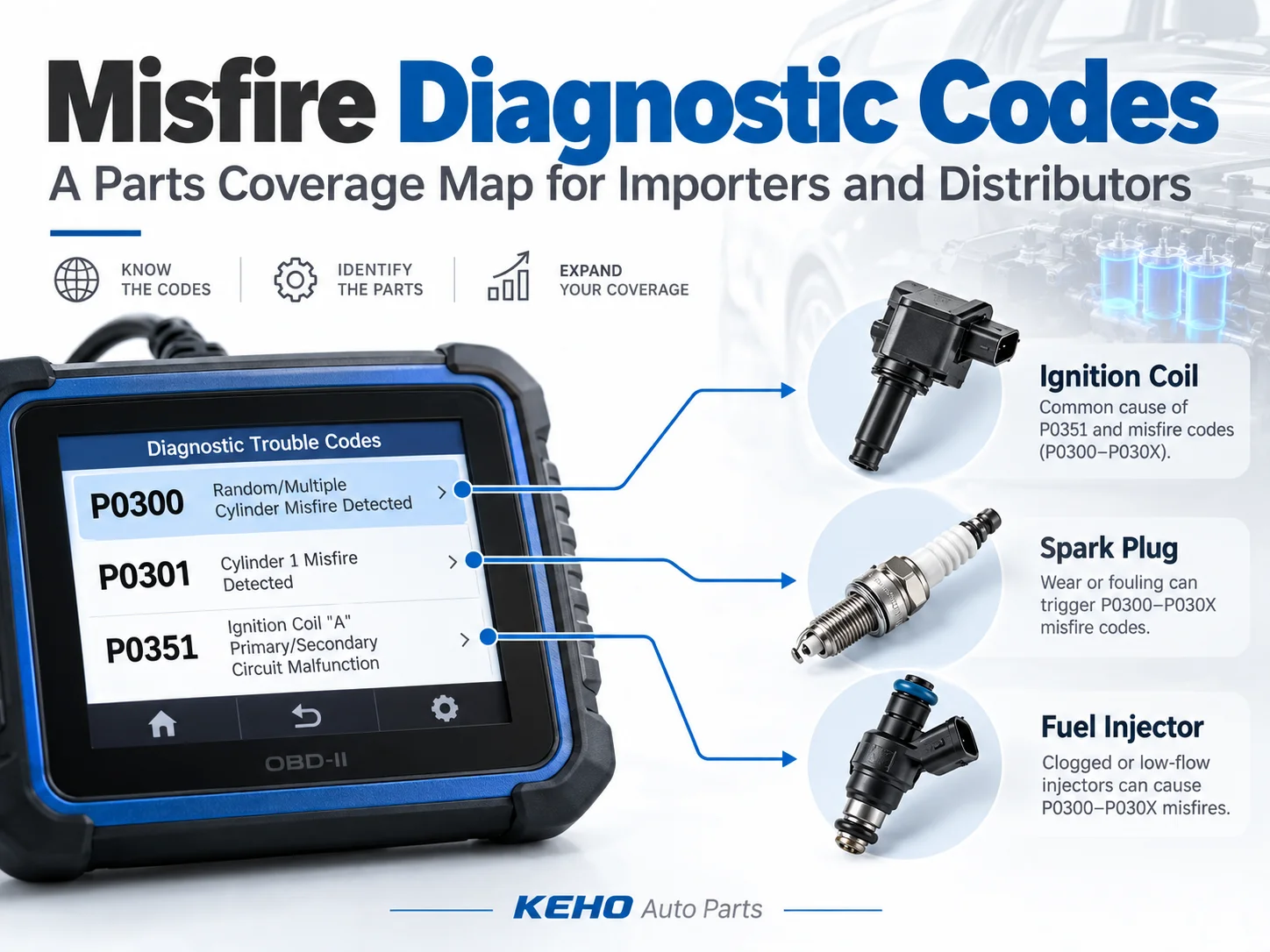
Misfire Diagnostic Codes: A Parts Coverage Map for Importers and Distributors
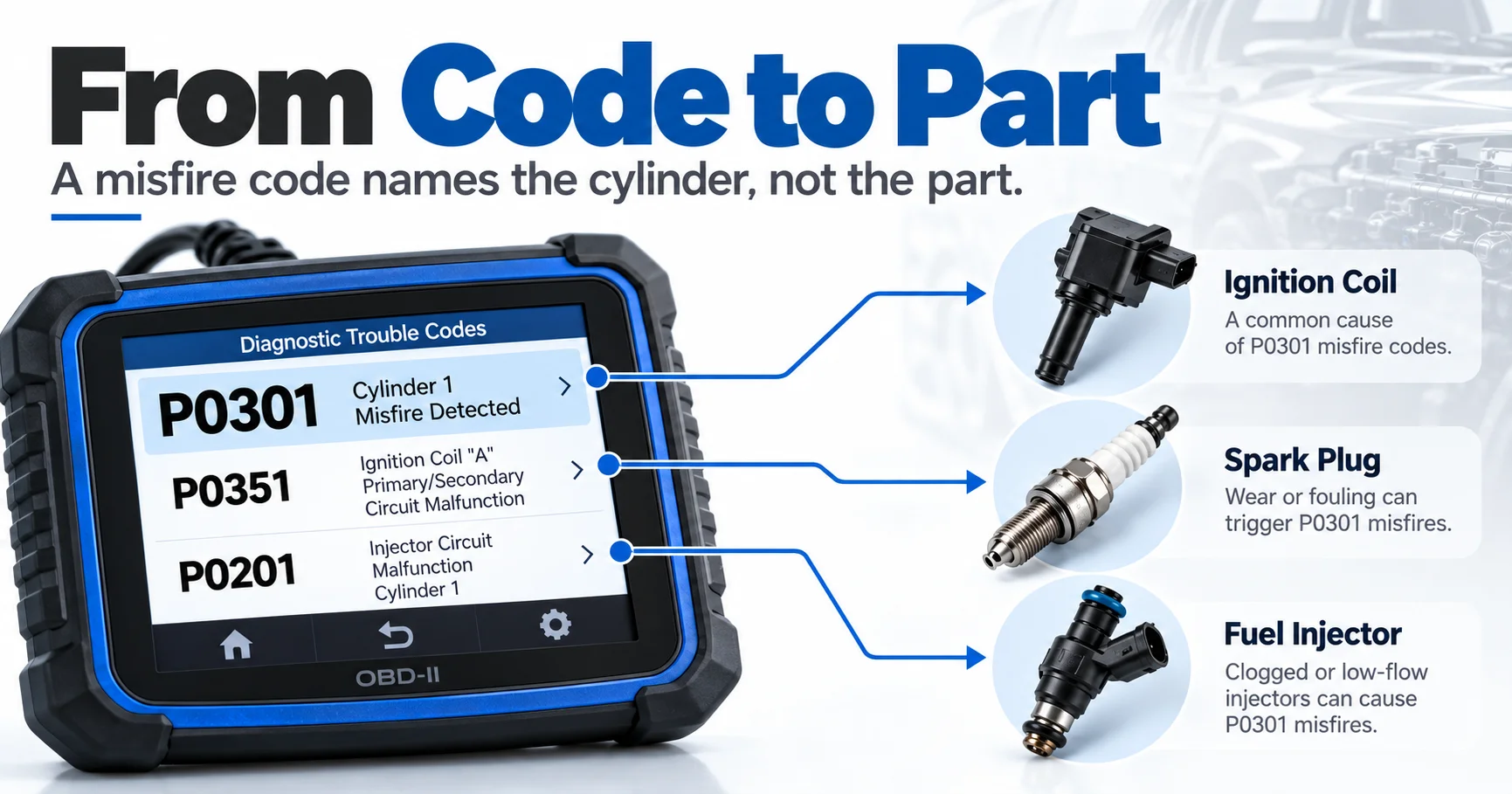 A misfire code names the cylinder that failed. It does not name the part. The gap between those two facts is where a distributor either wins the account or generates a return.
1. Why Misfire Codes Land on a Distributor's Desk
A driver feels the car shaking at idle, the check engine light comes on, and a scan tool returns a code in the P03xx range within seconds. That moment creates two different jobs. The workshop has a diagnostic to run. You have a parts decision to make, and you are usually asked to make it before the diagnostic is finished.
The message that reaches you sounds like this: "P0301, cylinder 1, what do I need?"
Answer "a coil" and you sell one coil, if the shop trusts the guess. Answer with the order the technician should test in, the two parts that cover most of these cases, and the fitment information you need before you ship, and you sell a coil, a plug set for the same cylinder, and the shop's next order as well, because you were the supplier who answered like an engineer.
Fact: KEHO has supplied ignition coils, spark plugs, and fuel injectors to importers in 80+ countries since 1995, holding ISO/TS 16949 certification since 2012 along with CE marking and SGS third-party verification (per company data).
Nearly every page that ranks for misfire codes is written for the car owner. It explains what the code means and stops there. This guide starts where those pages stop: which parts the code pulls, the order a workshop tests them in, and how much of each belongs on your shelf.
One thing to settle before the codes. Misfire diagnosis is a different discipline from code reading. A code names a cylinder. It does not name a part, and the guilty part is often outside the ignition system altogether: a leaking intake gasket, a weak injector, a valve that does not seal. That gap is where distributors build trust, or lose it.
2. How the Control Module Decides That a Cylinder Misfired
2.1 It watches crank speed, not spark quality
The powertrain control module does not measure the spark. It measures the crankshaft.
Every cylinder that burns its charge properly adds a small push to crank rotation when its turn comes. When a cylinder fails to burn, that push is missing, so crank speed dips slightly at that point in the firing order. The controller compares each cylinder's contribution against the others and flags whatever keeps coming up short.
Two commercial consequences follow from that method.
First, the monitor detects a missing burn, not a missing spark. An injector that delivers no fuel produces the same crank speed dip as a coil that delivers no spark, and the scan tool prints the same code for both. A supplier who answers a misfire code with a coil number and nothing else is guessing on the customer's labour time.
Second, a weak burn trips the same monitor as a missing burn. A partly clogged injector, a plug with an eroded electrode, and a valve that does not seat fully all produce a partial misfire that reads as a clean P0301 on the tool.
2.2 The monitor exists to protect the catalytic converter
Misfire monitoring exists for emissions hardware, and that is why the software is fitted to every petrol vehicle rather than only to premium models. The requirement comes from regulation.
Unburned fuel and air leave a misfiring cylinder and arrive at the catalytic converter, which then has to burn them. That extra load overheats the substrate, and sustained misfire can melt it or strip the washcoat, turning a minor ignition repair into a major exhaust repair.
The federal rule states the requirement plainly. On-board diagnostics must detect "engine misfire resulting in exhaust emissions exceeding 1.5 times the applicable standard" and "any misfire capable of damaging the catalytic converter" [1]. The United States required OBD-II on passenger cars and light trucks under 8,500 lb from model year 1996, and the European Union required EOBD on petrol vehicles from 2001 and diesel from 2004 [2].
The practical reading for a distributor is short. Every petrol vehicle sold in your market since the mid 1990s carries a misfire monitor, and every one of them will set a P03xx code at some point. The demand is built into the fleet you serve.
2.3 Pending, confirmed, permanent: three states, three conversations
The same physical fault produces different paperwork depending on how many drive cycles it survives.
- A pending code is set after a single detection cycle and the lamp stays off. Most shops clear these and re-test before quoting anything.
- A confirmed code has been detected on two consecutive drive cycles and the lamp comes on. This is the state that produces a repair order, and therefore your parts order.
- A permanent code sits in a separate memory block that a scan tool cannot clear, and it clears only once the fault stops recurring across a long run of drive cycles.
Add one triage question to your intake script: was the lamp flashing? A flashing lamp means the controller is seeing misfire at a rate it treats as converter-damaging, and the workshop is under pressure to stop the customer driving the car. Orders with that flag move the same day.
The hardware behind those codes is standardized as well. The OBD-II socket is a 16-pin J1962 connector that must sit within roughly 60 cm of the steering wheel, and trouble codes follow a four-character format lettered P for powertrain, B for body, C for chassis, or U for network [2]. The definitions themselves come from SAE J2012 and its ISO equivalent ISO 15031-6, which the federal rule names as the required basis for powertrain codes [1][3].
3. The Code Map: What Each P03xx Number Tells You
Misfire codes are not one code. They are families, and each family points at a different part of the repair.
| Code | Standard meaning | What it narrows down | First part to check |
|---|---|---|---|
| P0300 | Random or multiple cylinder misfire detected | No cylinder is named, so a shared cause is more likely than one failed part | Ignition components feeding several cylinders, fuel pressure, large vacuum leak |
| P0301 to P0312 | Misfire detected on cylinders 1 through 12 | The fault is following a single cylinder | Coil and plug on that cylinder, then that injector |
| P0351 to P0360 | Ignition coil A through J, primary or secondary circuit fault | The fault is electrical, inside the coil circuit itself | Coil, connector, harness |
| P0201 to P0212 | Injector circuit malfunction, cylinders 1 through 12 | Electrical fault in an injector circuit | Injector, connector |
| P0171 / P0174 | System too lean, bank 1 or bank 2 | Unmetered air or a fuel shortfall, and often sets alongside P0300 | Intake gasket, vacuum hose, injector, fuel pressure |
| P0016 | Crankshaft and camshaft position correlation | The two signals disagree, which is a timing question before it is a sensor question | Position sensors, timing components |
| P0335 / P0340 | Crankshaft or camshaft position sensor circuit fault | The sensor signal itself is faulty | Position sensor, wiring |
| P0420 | Catalyst system efficiency below threshold | The converter has already taken damage, often after a long-running misfire | A different product line entirely |
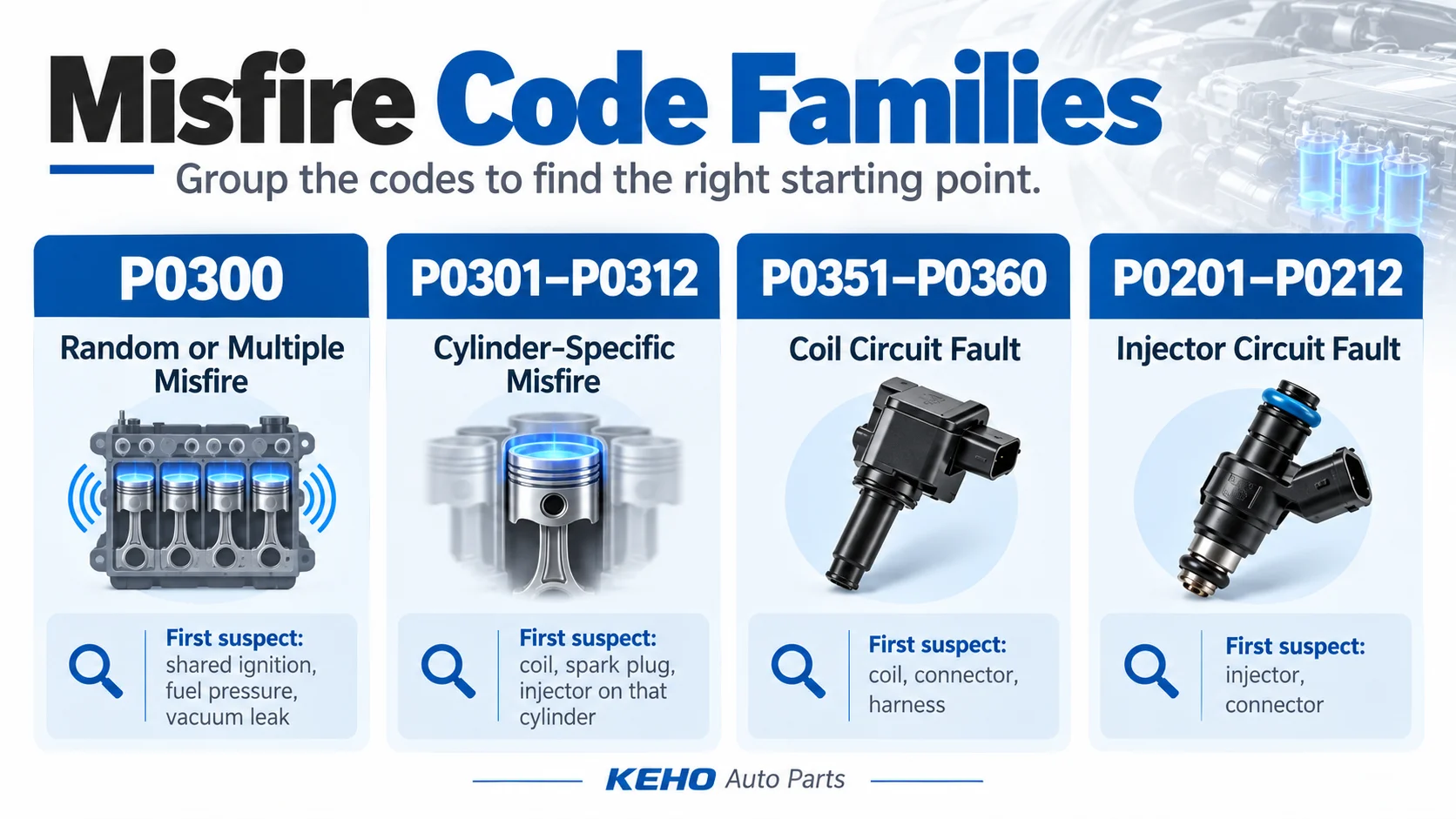 Code families, not individual codes, are what drive a stocking decision. A cylinder-specific code points at parts dedicated to one cylinder. A random code points at something shared.
3.1 A single-cylinder code is a coin flip between three parts
A P0301 on a coil-on-plug engine gives the technician three candidates: the coil, the plug, and the injector on cylinder 1. All three are dedicated to that one cylinder, so the code stays put no matter which of them is guilty.
What makes this manageable is that the test is cheap. A known-good coil moves to cylinder 1, the code clears, and the car is driven. If the misfire travels with the coil, the coil is the fault. If it stays on cylinder 1, the coil is exonerated and the plug comes out next.
That diagnostic order is also a stocking order. Coils are condemned first because a swap test exists and takes minutes. Plugs come out in the same repair, because the labour to reach the coil is already paid, and no competent shop reinstalls a used plug in a cylinder it has just opened. Sell one coil and you should be selling the plug set with it.
3.2 Random codes point at something shared
P0300 with no cylinder number is the code shops complain about most, because it hands them nothing to aim at. Random misfire usually comes from a cause that reaches every cylinder: fuel pressure below specification, a large vacuum leak downstream of the throttle body, contaminated fuel, worn timing, or one ignition component that feeds more than one cylinder.
Wasted spark ignition raises the odds of this pattern. In a wasted spark layout each coil drives two plugs, firing one on the compression stroke and the other on the exhaust stroke [4]. When that coil degrades, two cylinders go quiet together, and the controller may report it as a random code, as one cylinder, or as two specific cylinders.
Wasted spark also wears plugs faster. The coil fires its pair with opposite polarity on alternate cycles, so electrons cross the gap in both directions, and plugs for these systems need erosion-resistant material on both electrodes rather than just the centre one [5].
3.3 Adjacent cylinder numbers are a pattern, not a coincidence
When a scan tool reports P0301 and P0304 together on a four-cylinder, or P0303 and P0306 on a V6, check the firing order before you quote parts.
Two cylinders adjacent in the firing order that share a coil or a coil pack usually mean one failed coil and two dead cylinders. Two cylinders physically side by side, particularly on an inline engine, can mean a head gasket that has failed between the bores, which is a compression problem no ignition part will fix.
The same logic applies when a misfire moves between cylinders over time. A fault that relocates is not attached to one cylinder, so the ignition approach should stop and the fuel and air approach should start.
3.4 The codes that arrive alongside a misfire code
Read a fault list in order, not one line at a time.
When P0171 appears with P0300, the lean condition is usually the root cause and the misfire is the symptom. Unmetered air or low fuel pressure makes cylinders run lean, and a lean mixture burns badly. Replacing ignition parts on that engine fixes nothing, and the code returns inside a week.
When P0420 appears after months of an ignored misfire, the converter has absorbed the damage the monitor was designed to prevent. That is a different product line and a much larger invoice, and it is worth telling a customer before it happens rather than after.
4. Five Failure Clusters Behind One Fault Code
The scan tool names a cylinder. It never names a part. Five families of failure produce the same symptom, and a distributor who can walk a workshop through them in order becomes the supplier that shop calls first.
| Failure cluster | Typical code pattern | Confirmation test | Parts involved |
|---|---|---|---|
| Ignition | P0301 to P0312 on one cylinder, or P0351 to P0360 | Swap a known-good coil, re-test, watch whether the code moves | Ignition coil, spark plug, coil boot, connector |
| Fuel delivery | P0301 or P0300, frequently with P0171 | Rail pressure, injector resistance, bench flow and spray comparison | Fuel injector, filter, pump |
| Unmetered air | P0300 alongside P0171 | Smoke test the intake tract, inspect gasket faces | Intake manifold gasket, vacuum hose, PCV valve |
| Mechanical and compression | One cylinder that keeps misfiring after ignition parts are replaced | Compression and cylinder leak-down | Valves, lash adjuster, head gasket |
| Signal and electrical | P0335, P0340, P0016 | Oscilloscope on crank and cam signals | Crankshaft sensor, camshaft sensor, wiring |
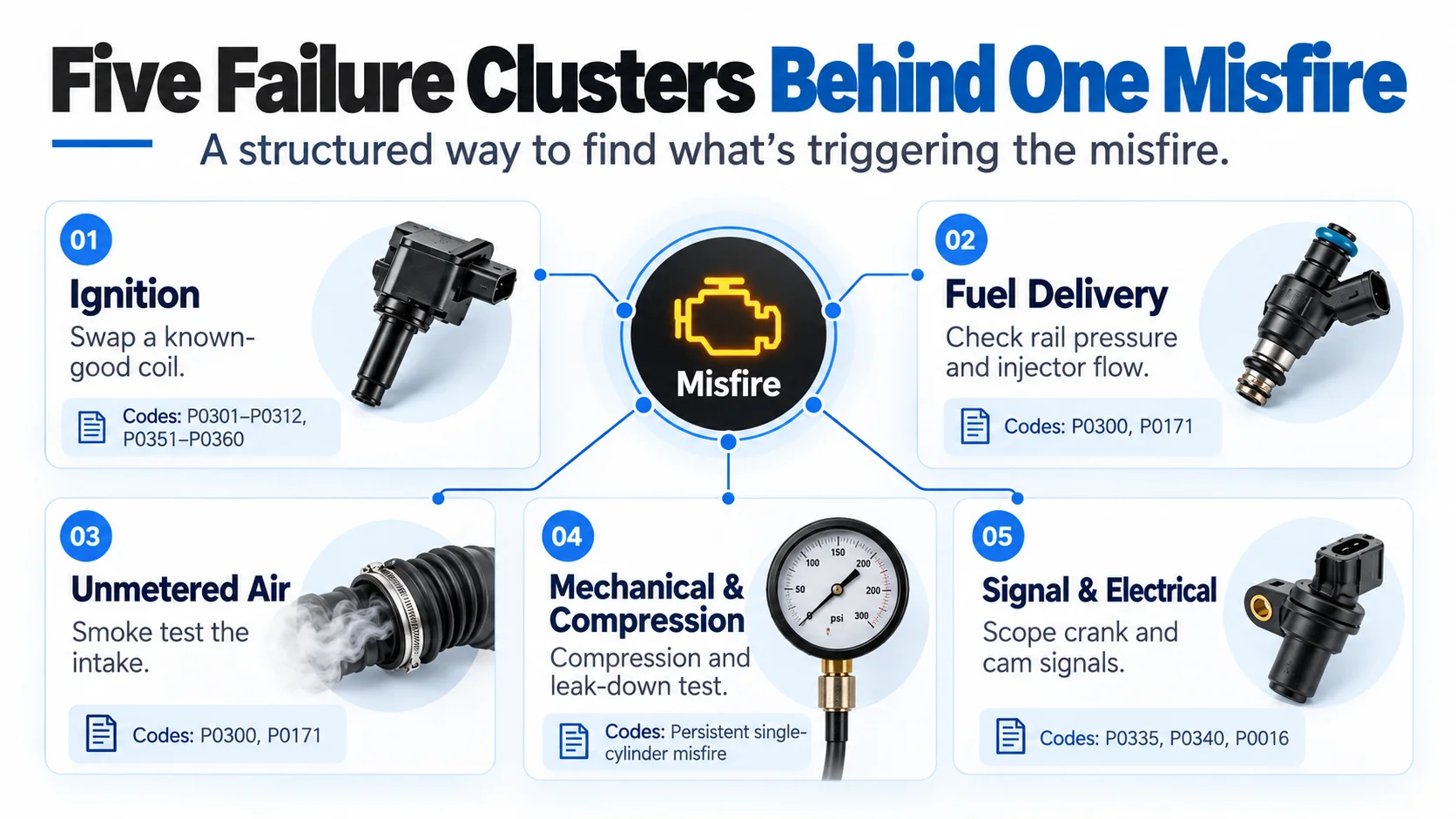
4.1 Ignition leads the diagnostic order, and the order book
Ignition sits first because it is the cheapest cluster to rule out. Nothing has to come apart to test it.
A modern coil-on-plug unit is a transformer built around an iron core: a primary winding of relatively few turns of heavy wire and a secondary winding of thousands of turns of fine wire, insulated from the high voltage by enamel and layers of oiled paper [4]. Output runs from roughly 15 kV on small engines to 40 kV on larger ones [4]. Heat, vibration, and voltage stress degrade that insulation over time, and the first symptom is usually intermittent: the coil fires when cold and breaks down once the engine bay soaks in heat.
A bench resistance check can pass on a coil that still fails on the car. That is why a swap test beats a meter, and why the same coil part number moves faster in a hot climate than in a temperate one. Ambient heat plus stop-start traffic is the hardest working life a coil can have.
Spark plugs fail on a slower curve and create a different kind of order. The electrode erodes, the gap opens, and the ignition system needs more voltage to jump it. A plug running too cold fouls with conductive deposits that bleed off spark energy, and one running too hot can ignite the mixture before the spark arrives. The working window at the tip is roughly 500°C to 800°C [5].
Heat range numbering is the trap at the parts counter. NGK and Denso numbers rise as the plug gets colder, while Bosch, Champion, ACDelco, BRISK, and Beru use numbers that rise as the plug gets hotter [5]. Heat range values are not interchangeable between brands, so a cross-reference that matches thread and reach while ignoring heat range produces a misfire, and the customer blames the part. The spark plug buying guide covers how to keep heat range consistent across a catalog.
4.2 Fuel delivery mimics ignition perfectly
A clogged injector delivers less fuel than the controller commands, the cylinder runs lean, and the misfire looks identical to an ignition failure on a scan tool. The workshop replaces a coil, clears the code, and the misfire returns in a week. That sequence is how a wrong-part return gets created: the shop sends back a coil that was never at fault, and you absorb the freight and the argument.
Injectors are harder to prove than coils. Confirming one needs rail pressure, injector resistance, and ideally a bench that measures flow and spray pattern per unit. That friction is exactly why flow-matched sets sell. A shop replacing one injector on a four-cylinder engine wants the other three to behave identically so it does not end up chasing a cylinder balance code afterwards. The fuel injector buying guide breaks down how flow matching changes a return rate.
Fact: KEHO supplies the ignition, fuel, and sensor lines that misfire diagnosis pulls from a single catalog of 50,000+ SKUs, with OEM number, vehicle model, year, and engine code cross-checked before shipment (per company data).
4.3 Unmetered air
A vacuum leak admits air the controller never measured. The affected cylinders run lean, and once the leak is large enough several cylinders misfire together and P0300 appears next to P0171. Nothing is wrong with the ignition parts in that engine bay, which is why a smoke test belongs before a coil order.
4.4 Compression and mechanical faults
When ignition and fuel have both been ruled out and the misfire stays on one cylinder, the next step is a compression and leak-down test. A burned valve, a collapsed lash adjuster, worn rings, or a head gasket leaking between two bores will all hold a misfire steady, and none of them are parts you sell. Saying so early costs one order and prevents one return.
4.5 Sensor signal faults
The misfire monitor depends on clean crank speed data. Degrade that signal and the controller misreads crank rotation, which produces misfire codes that have nothing to do with combustion.
P0335 and P0340 point at the sensor circuits. P0016 flags a disagreement between crank and cam signals, which is often a stretched chain rather than a failed sensor. Sensors are cheap next to timing work, so they get replaced first, and a distributor who explains the difference stops a workshop from ordering parts that will not fix the car. The crankshaft and camshaft sensor guide covers both sensor families side by side.
5. The Parts Coverage Map: What to Stock, in What Order
Everything above converts into one table. Read it by code family, because that is how workshops report failures to you, not by individual code number.
| Code pattern | First-pull part | Second-pull part | How to weight the stock |
|---|---|---|---|
| P0301 to P0312 on a coil-on-plug engine | Ignition coil for that cylinder position | Spark plug set for the engine | Coils in depth across the engine codes your market runs, plugs by engine family |
| P0301 to P0312 on a coil pack or distributor engine | Spark plug set | Plug wires, then coil pack | Plugs at volume, wires and packs by application |
| P0351 to P0360 | Coil and its connector | Harness pigtail | Coil first, connectors as a low-cost attachment |
| P0300 arriving with P0171 | Fuel injector | Intake gasket, vacuum hose | Injectors by OEM number depth, gaskets by engine code |
| P0201 to P0212 | Fuel injector | Connector pigtail | Injector by OEM number |
| P0335, P0340, P0016 | Crankshaft or camshaft sensor | Connector, wiring | Sensors across platforms you already cover |
5.1 Cover both parts of the pair
The most common stocking error in this category is depth without the matching adjacent part. A distributor carries six coil numbers for a popular engine family and no plug coverage for the same engines, so every coil sale turns into two shipments and half a repair order. The coil and the plug on the same cylinder are replaced in the same visit because the labour is already paid.
The same pairing logic applies one level up. A fuel injector order rarely arrives alone once a workshop has the rail open, and a cylinder-specific misfire that survives a plug and coil replacement usually ends at a position sensor or a compression fault you cannot sell into. Coverage at the pair level is what keeps the average order value of a misfire job intact.
5.2 Weight by conversion, not by code frequency
Do not stock by how often a code appears. Stock by how often a code ends in a part replacement.
P0300 appears often in repair traffic, and plenty of those jobs end at a smoke test or a compression reading rather than a part. P0301 on a coil-on-plug engine is the narrower code and the more dependable parts order, because three specific parts own that cylinder and one of them is usually guilty.
Building a stock plan on code frequency alone over-weights the codes that generate diagnostics and under-weights the codes that generate invoices.
5.3 Let the fleet in your market set the weighting
The same catalog gets weighted differently depending on where your customers are.
- Hot climates with dense traffic punish coil insulation early, so coils sit higher in the mix than the global average.
- Older, high-mileage naturally aspirated fleets move plugs, wires, and coil packs, because those engines still use them.
- Markets with inconsistent fuel quality move injectors and fuel system components, and see more low fuel pressure misfires.
- Fleets running modern turbocharged engines push plugs and coils harder and rarely see the mechanical misfires that older engines produce.
- Markets with high average vehicle age generate more compression-related misfires, which convert to fewer parts orders.
The last two lines matter more than they look. A misfire that a workshop cannot fix with a part is a diagnostic sale for them and nothing for you. Weighting toward the code patterns that convert is how a 50,000 SKU catalog earns its keep.
6. Answering a Workshop's Code Question in One Message
The technical support you provide decides who wins the order, and that support is mostly templates.
6.1 Build the asset once
A code-to-part reference sheet keyed by code family, not by vehicle model, is the single most useful document a distributor can hold. One page per family: what the code means, the test order, the first two parts to quote, and the fitment fields you need back from the shop.
Vehicle-first lookups are the slower path. A workshop that says "2014 Corolla misfire" gives you an engine family to guess at. A workshop that says "P0301, and here is the number on the old coil" gives you a part number to verify.
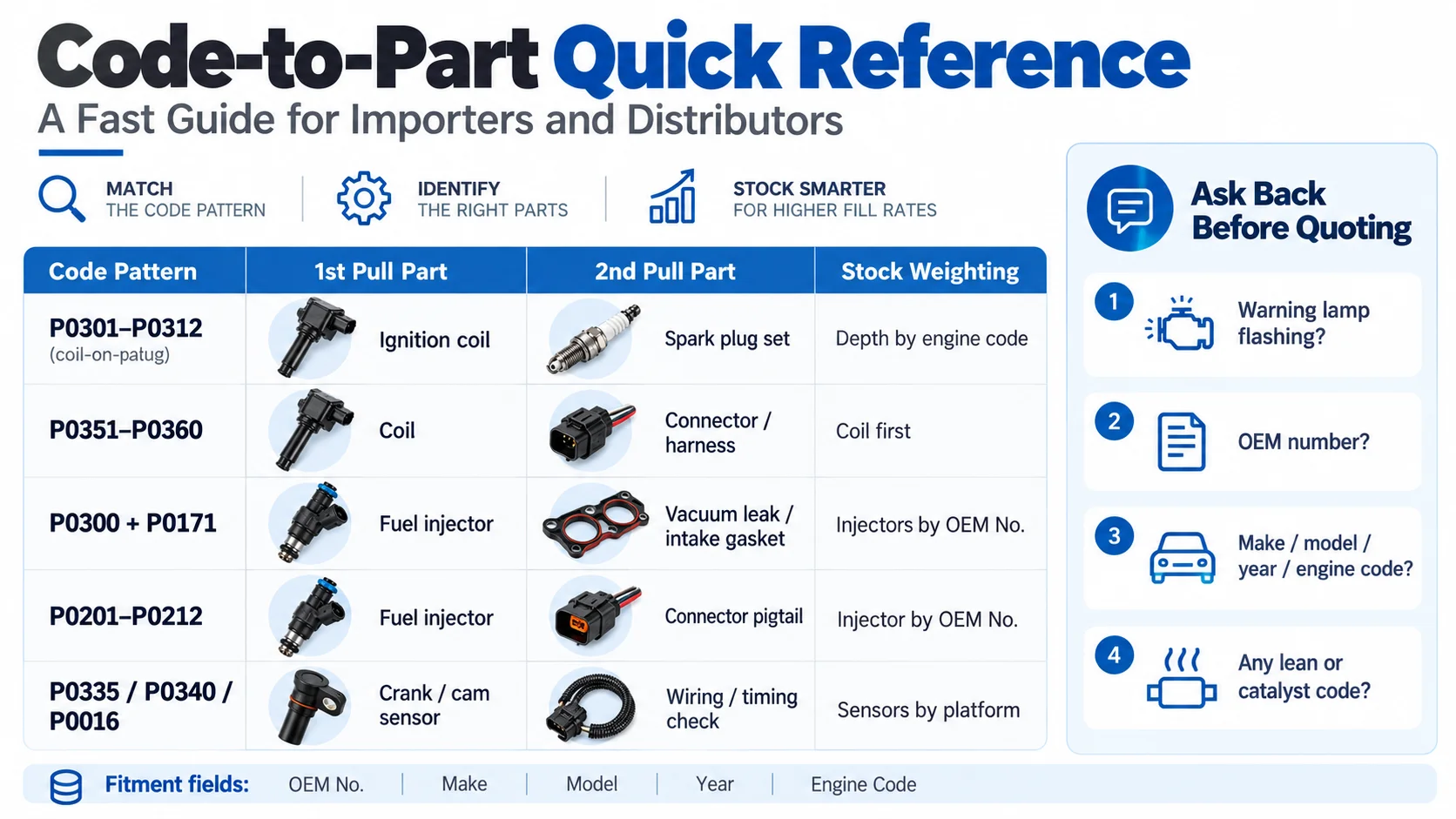
6.2 Ask four questions back
- Was the warning lamp flashing?
- What is the OEM number stamped on the part being replaced?
- Which make, model, year, and engine code?
- Is there a lean code or a catalyst code on the same list?
Question one sets urgency. Question two is the only reliable fitment key. Question three confirms the engine, and the fourth tells you whether the coil in their hand is the actual problem. A distributor who asks all four before quoting looks like a technical partner, and a distributor who skips them looks like a warehouse.
6.3 Fitment verification is the last mile
The engine code question matters for a practical reason. The same vehicle model routinely shipped with different engines in different markets, and different engines use different coils, plugs, and injectors. Vehicle model alone is not a reliable fitment key.
The verification habit is the same one that applies to any OEM-numbered part, and it is set out in the OEM number matching guide: collect the number, verify against make, model, year, and engine, then cross-check the batch before it ships. For a misfire order the stakes are slightly higher than average, because an under-performing part does not fail loudly. It sets the same code again thirty days later.
Fact: KEHO ships in-stock items within 48 hours and standard orders in 15-25 days, with parts backed by a 12-24 month warranty (per company data).
7. Supplier Checks Before You Stock a Misfire Line
Misfire parts are unforgiving on quality. A coil with the wrong winding specification or a plug with drifted heat range holds together in the warehouse and fails inside the customer's diagnostic bay, and the labour cost of that failure lands on your account relationship.
| Check | What to ask | Red flag |
|---|---|---|
| Coil winding specification | "What are the primary and secondary resistance ranges, and what tolerance do you hold?" | No published specification, or a range so wide it fits any coil |
| Coil construction | "How is the coil potted, and what temperature is it rated to?" | Cannot describe the encapsulation process |
| Connector and keying | "Are the housing and pin keying identical to the original?" | "It fits most applications" |
| Plug heat range control | "How do you verify heat range and gap consistency between batches?" | Heat range only checked on a sample per order |
| Plug electrode material | "Are both electrodes erosion resistant on wasted spark applications?" | Precious metal on the centre electrode only |
| Injector flow matching | "Do you flow test each injector and match sets, with a report?" | Batch sample testing, no per-unit data |
| Sensor data completeness | "Do you supply connector and pin information with the specification sheet?" | Specification sheet lists only an OEM number |
| Fitment verification | "Will you verify 50 OEM numbers against vehicle specifications before shipping?" | "We ship what you order" |
| Warranty terms | "What does the warranty cover, and for how long?" | Terms described verbally, never in writing |
The pattern behind those rows is that most misfire quality problems are process problems, not material problems. A supplier who can describe incoming inspection, in-process checks, packaging verification, and a final shipment review has a system that catches drifted heat range and mis-keyed connectors before they reach you.
KEHO runs that four-stage sequence, and the general version of this checklist is set out in the Chinese auto parts supplier vetting guide. For a misfire line, add one test to the standard audit: ask for the coil resistance specification in writing, and compare it against the original equipment figure before you place a stock order.
8. FAQ: Misfire Code Questions Distributors Get Asked
What does P0300 mean?
P0300 is the generic code for a random or multiple cylinder misfire. The control module detected a missing burn but could not assign it to one cylinder, which usually points at a cause that reaches every cylinder: fuel pressure below specification, a large vacuum leak, contaminated fuel, or an ignition component that feeds more than one cylinder. It is the code that most often ends in a fuel or air repair rather than an ignition part.
What is the difference between P0300 and P0301?
P0301 names cylinder 1, while P0300 names no cylinder at all. That single difference changes the whole diagnostic path. A cylinder-specific code tells a workshop to test the coil, plug, and injector on that one cylinder, because the parts dedicated to it are the prime suspects. A random code tells them to test for something shared across all cylinders first.
What does P0351 mean?
P0351 is an ignition coil primary or secondary circuit fault on coil A. Unlike a misfire code, which reports a combustion result, P0351 reports an electrical fault inside the coil circuit, so the coil, its connector, or the harness is the fault. It frequently sets together with a cylinder misfire code, and when it does, the coil circuit is the place to start rather than the fuel or air side.
What are the most common causes of an engine misfire?
Five clusters produce almost every misfire: ignition components, fuel delivery, unmetered air, mechanical compression faults, and sensor signal faults. Ignition is tested first because it is the cheapest cluster to rule out, not because it is always guilty. Fuel and air causes look identical to ignition faults on a scan tool, which is why a workshop that replaces a coil without testing fuel pressure often sees the misfire return.
Which parts should a distributor stock to cover misfire repairs?
Cover the code patterns your market actually sees: ignition coils and spark plugs for cylinder-specific codes, fuel injectors for random codes that arrive with lean codes, and crankshaft and camshaft position sensors for signal codes. The pair matters more than the single part, because a coil replacement usually pulls a plug set on the same cylinder, and stocking one without the other forces a second shipment on the same repair.
How do I verify a replacement part fits the vehicle before ordering?
Start with the OEM number stamped on the original part, then confirm it against the vehicle make, model, year, and engine code. Vehicle model alone is not enough, because the same model often shipped with different engines in different markets, and each engine can use a different coil, plug, or injector. A supplier who verifies all four fields before shipment removes the fitment risk from your side of the order.
9. Turning Codes Into Orders
A misfire code is the most common technical question a workshop will ever put to a parts supplier. That makes it the cheapest place to earn a reputation, because the answer is knowable in advance and most competitors do not prepare it. "It is probably the coil" is not an answer. The test order, the part pair, and the four fitment fields are an answer.
Build the code-to-part sheet once, train your counter staff on the four intake questions, and weight your stock toward the code families that end in a part replacement. The parts are already in the catalog: ignition coils, spark plugs, fuel injectors, and position sensors covering crankshaft and camshaft applications.
For the buying side of the same decision, the ignition coil buying guide covers coil construction and failure patterns in more depth, and the oxygen sensor guide is the starting point when a misfire has already damaged a converter.
If you want the coverage map built against the engine codes your market runs, send us the top fault codes your workshops report and we will come back with a stocking plan and the OEM numbers behind it. Request a quote through the KEHO product catalog.
Sources
- U.S. Code of Federal Regulations. "40 CFR § 86.1806-05, Onboard diagnostics requirements, emission standards for 2005 and later model year vehicles." U.S. Government Publishing Office. PDF (2013 edition) - Federal requirement that OBD systems detect misfire causing emissions above 1.5 times the applicable standard and any misfire capable of damaging the catalytic converter, with trouble codes consistent with SAE J2012.
- Wikipedia contributors. "On-board diagnostics." Wikipedia. https://en.wikipedia.org/wiki/On-board_diagnostics - OBD-II mandate dates in the United States (1996) and the European Union (EOBD 2001 petrol, 2004 diesel), the 150% emission detection threshold, four-character P/B/C/U code format, and the J1962 16-pin connector location requirement.
- SAE International. "SAE J2012, Diagnostic Trouble Code Definitions." SAE Standards. https://www.intertekinform.com/en-us/standards/sae-j2012-202509-1020881_saig_sae_sae_3732294/ (2025) - Standard definition set for powertrain diagnostic trouble codes, adopted as equivalent to ISO 15031-6; basis for the P0300, P0301-P0312, P0351-P0360, and P0201-P0212 definitions in this guide.
- Wikipedia contributors. "Ignition coil." Wikipedia. https://en.wikipedia.org/wiki/Ignition_coil - Coil construction (iron core, primary and secondary windings, epoxy potting), coil-on-plug and wasted spark layouts, and typical output voltages of 15 kV to 40 kV.
- Wikipedia contributors. "Spark plug." Wikipedia. https://en.wikipedia.org/wiki/Spark_plug - Spark plug operating temperature range of 500°C to 800°C at the tip, fouling and pre-ignition failure modes, manufacturer heat range numbering conventions, and the greater electrode load imposed by wasted spark systems.