Fuel Trim Codes P0171, P0172 and P0174: A Parts Coverage Map for Importers
P0171 gets quoted at a parts counter the way a headache gets quoted at a pharmacy. The customer names the symptom, and someone hands over the most familiar box. That habit costs money in both directions. The workshop fits an oxygen sensor that was telling the truth, the importer absorbs the return, and the real fault, often a cracked breather hose or a hardened intake gasket, is still bolted to the engine.
Fuel trim codes behave differently from most of the OBD family. A misfire code points at a combustion event, a circuit code at a wire. P0171, P0172, P0174 and P0175 describe how far the engine control unit had to bend fuel delivery away from its base map to keep the exhaust at stoichiometry. That is a control loop reporting its own correction, not a component confessing a failure. Read the direction and the size of the correction, and the part family narrows.
This map is for importers whose workshops already own scan tools: turn four codes into a short list of part families, ordered by how often they fix the car, then hold stock against that order.
Why Fuel Trim Codes Get Punted Between Departments
Most catalog trees split engine management from emissions hardware, and fuel trim lives in the seam. The engine buyer owns injectors. The emissions buyer owns oxygen sensors and purge valves. Intake gaskets and breather hoses fall under engine overhaul, which nobody in parts distribution owns with any enthusiasm. When a P0171 lands, three desks can each defend their own scope, and the workshop receives three partial answers instead of one order.
There is a second reason. Trim is the only common diagnostic family that reports a correction rather than an event. A technician reading P0301 knows which cylinder to look at. A technician reading P0171 knows only that the loop ran out of adjustment room in one direction, and that several unrelated components can produce that result. The code is accurate and unhelpful at once, which is exactly the kind of code that gets forwarded to whoever answers the phone fastest.
Companion codes make it worse. Lean conditions appear in misfire charts because a lean cylinder misfires, and our own misfire diagnostic codes guide lists P0171 and P0174 in that context. The listing is technically correct and commercially misleading, because it teaches a counter that a lean code belongs to the ignition range. Coils and plugs then sell twice before anyone smoke-tests the intake tract.
The working rule for an importer is simpler. Treat a trim code as a request for a family of parts plus a test sequence, and quote the family rather than the guess. They need the range of parts a confirmed cause will require, in the OEM numbers their market actually carries. Whoever can ship the intake seal, the purge valve and the bank-correct injector in one carton keeps the account when the next code arrives.
Short Trim and Long Trim, in Plain Terms
Two numbers, one direction. Short term fuel trim is the correction applied right now, recalculated several times per second as the upstream sensor switches. Long term fuel trim is the learned version, stored in cells by airflow and engine speed so the next start begins close to the right fueling. Short trim moves; long trim accumulates. Both are broadcast over the diagnostic link that the same federal rule made mandatory.
The sign convention is what gets misread at the counter. Positive trim means fuel is being added because the engine is lean; negative trim means fuel is being removed because it is rich. Both are percentages of base injection time, so plus 8 percent long trim is not a fault by itself.
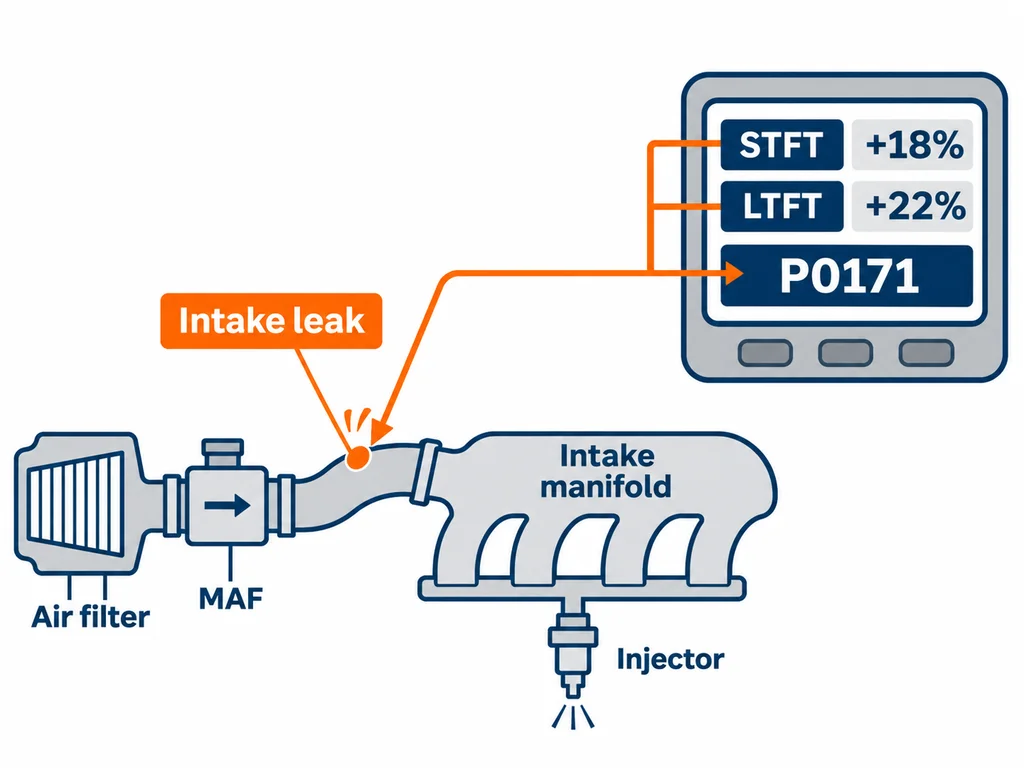
Practical thresholds matter more than textbook ones. A healthy engine swings short trim within a few percent of zero at steady cruise. Sustained short trim beyond plus or minus 10 percent deserves a look. Most calibrations latch P0171 near 25 percent long trim, so a vehicle can run at plus 18 percent for weeks with no lamp. That delay is why trim codes arrive as real repairs, not nuisance visits.
The split between idle and load does most of the diagnostic work before any part is ordered. A leak admits air in proportion to manifold vacuum, so it hurts most at idle. A supply shortfall grows with demand, so it hurts under load. Comparing the two readings separates them.
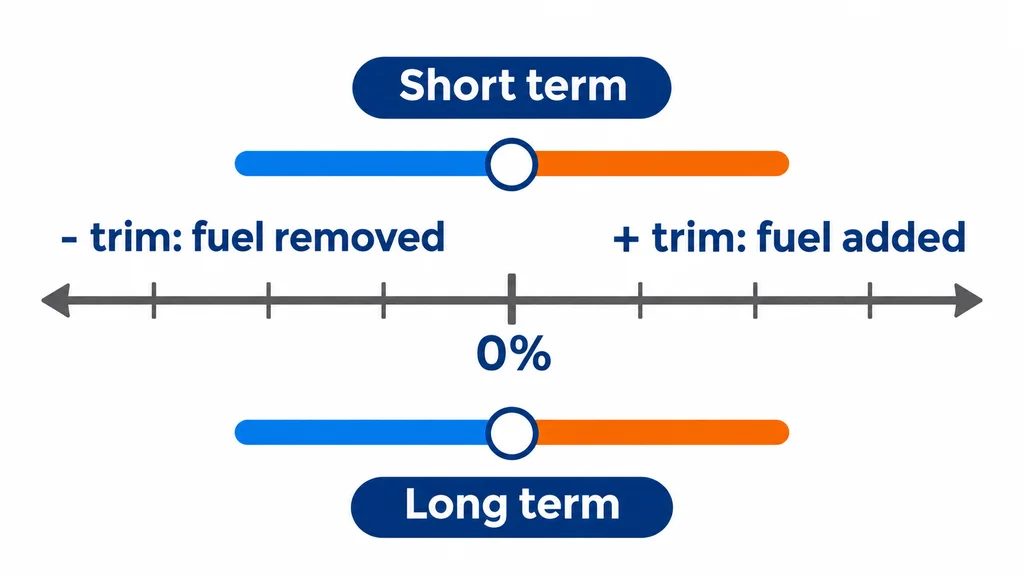 Positive trim adds fuel and points to a lean condition; negative trim removes fuel and points to a rich one.
| Reading | What the control unit is doing | What it usually means |
|---|---|---|
| Short trim plus 10 to 25 | Adding fuel now | Unmetered air, weak supply, low air reading |
| Short trim minus 10 to 25 | Removing fuel now | Injector drip, high pressure, high air reading |
| Long trim plus at idle only | Learned lean at low load | Intake gasket, PCV hose, booster valve |
| Long trim plus across range | Learned lean that follows airflow | Air flow under-reading, low fuel pressure, blocked filter |
| Long trim minus, steady | Learned rich offset | Leaking injector, regulator high, biased sensor |
The Code Map: P0171, P0172, P0174, P0175 and the Lean/Rich Split
Four codes, two directions, two banks, all defined in SAE J1979 and carried in the federal OBD rule at 40 CFR 86.1806-05 [1][2]. P0171 is bank 1 lean. P0172 is bank 1 rich. P0174 is bank 2 lean. P0175 is bank 2 rich. On an inline engine only bank 1 exists, so P0174 and P0175 never appear. On a V engine both banks report separately, and that separation is the most useful thing about the family.
The rule that earns its keep at the counter: one lean bank means a cause that belongs to that bank, two lean banks mean a cause upstream of the split. A single bank points at that side's runner gasket, injectors, upstream sensor or wiring. Both banks point at shared metering and supply: mass air flow sensor, throttle body boot, PCV system, purge valve, pump and filter.
Companion codes narrow it. P0171 with a misfire usually means the lean condition is causing the misfire, so ignition parts are the wrong first order. P0171 with P0101 points at airflow measurement. P0171 with P0442 or P0455 points at the evaporative system, where a purge valve stuck open admits fuel vapor as unmetered air.
The rich side follows in reverse: P0172 on one bank is usually a dripping injector or a sensor drifted rich, and P0172 with P0175 suggests a regulator holding pressure too high. P0175 alone is rare, because bank 2 hardware fails for the same reasons as bank 1, only later.
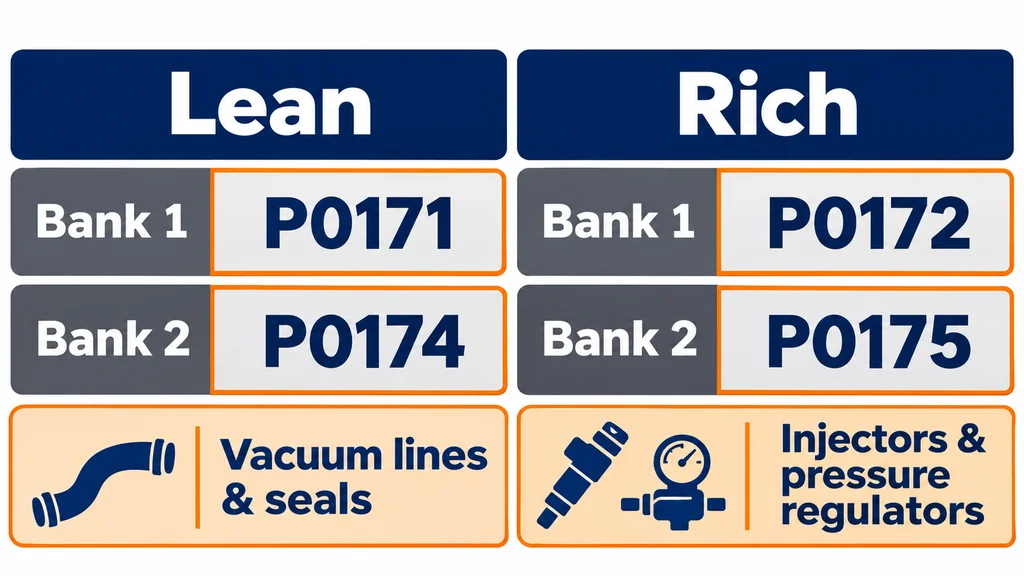 The code family sorted by direction and bank. Each row maps what the driver reports to what the order should contain.
| Code | Bank | Direction | First part families to check |
|---|---|---|---|
| P0171 | Bank 1 | Lean | Intake and vacuum seals, PCV, purge valve, filter and pump, bank 1 injectors, air flow |
| P0172 | Bank 1 | Rich | Bank 1 injectors with seals, regulator, upstream oxygen sensor |
| P0174 | Bank 2 | Lean | Bank 2 runner gasket, bank 2 injectors, shared air and fuel supply |
| P0175 | Bank 2 | Rich | Bank 2 injectors, regulator, bank 2 upstream oxygen sensor |
| P0171 with P0174 | Both | Lean | Shared metering and supply only, not bank hardware |
The Four Causes Behind a Lean Code, Ranked by Parts Impact
Rank the causes by how often they fix the car, not by how interesting they are.
Unmetered air comes first, and it is not one part. Cracked intake boots, hardened manifold gaskets, split PCV hoses, a leaking booster check valve, a missing dipstick O-ring, a porous valve cover and a purge valve held open all admit air the control unit never measured. These are the cheapest parts in the catalog and the highest hit rate in the bay, which is why they get skipped in favour of a sensor with a recognisable name.
Fuel delivery comes second. A weak pump, a restricted filter, a corroded line or a regulator that cannot hold pressure all show one signature: trim climbs with load and rpm while idle stays close to normal. The failure is progressive, so the driver notices lost power on a hill long before the lamp comes on.
Injectors come third. Restricted or unevenly flowing injectors lean out one cylinder first, then the whole bank as the control unit compensates. The pattern to look for is a one-bank lean code with a rough idle and a cylinder-specific misfire that moves when injectors are swapped.
Measurement comes fourth, and it is where the money is wasted. A mass air flow sensor with a contaminated hot film under-reports airflow and drives a lean command. A slow or poisoned upstream sensor can bias the loop. In both cases the sensor reports what it sees, and a replacement changes nothing because the physical lean condition is still there.
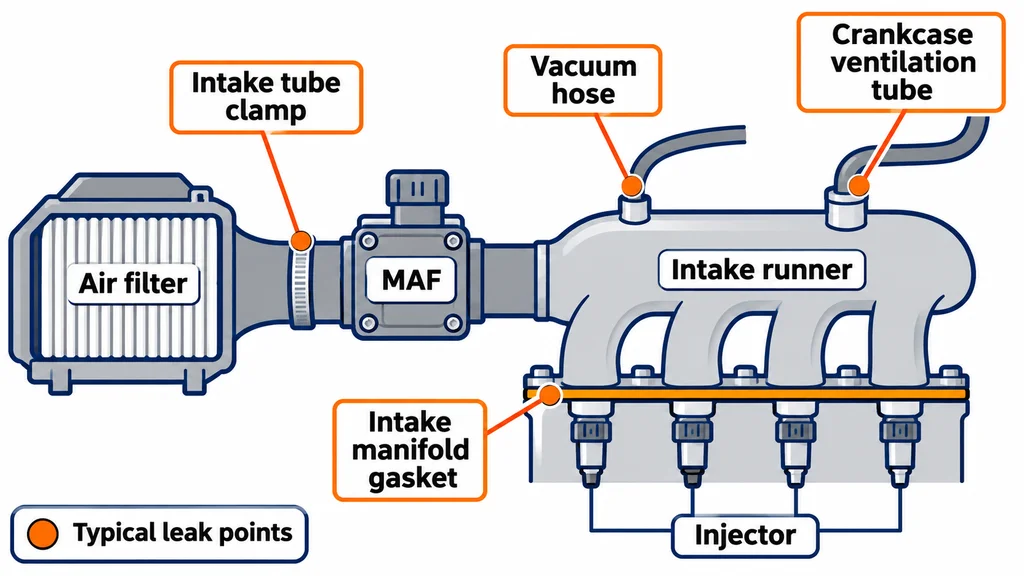 Typical leak points upstream of the injectors. Air admitted after the mass air flow sensor is unmetered and shows up as positive trim.
Two related families belong in the same order: the canister purge valve buying guide covers the valve that turns an evaporative fault into a lean code, and the EVAP leak diagnosis walkthrough covers the test that separates a vapor leak from an intake leak.
Fact: KEHO runs six production lines across a 35,000 m² plant plus a 20,000 m² industrial park, with 40+ R&D engineers and ISO/TS 16949 certification obtained in 2012 (per company data).
Why a Rich Code Is a Different Parts List
P0172 and P0175 report negative trim, which means the control unit is taking fuel out. The fault list barely overlaps with the lean side, and a distributor who stocks trim parts as one bundle ends up holding the wrong half.
The first suspect on a rich code is a leaking injector. A nozzle that drips instead of atomising floods one cylinder at rest and runs that bank rich once the engine starts. The tell is a rich code on one bank, a fuel smell at idle, black exhaust and a plug that fouls faster on that side. A matched set with new seals is the ordinary repair, and matched matters: fitting one new injector beside three worn ones moves the imbalance rather than removing it.
Fuel pressure comes second. A regulator stuck at high pressure, or one whose vacuum reference diaphragm has failed and is passing fuel into the manifold, runs the whole engine rich and can hydraulically lock a cylinder on a hot restart. On direct injection engines, an internal leak at the high pressure pump can put fuel into the camshaft housing, which shows up as a rising oil level before it shows up as a code. Ask about oil level whenever a rich code arrives with a fuel smell.
Airflow and sensing come third. A restricted intake or a collapsed hose runs rich by reducing measured air. An upstream sensor contaminated by coolant, silicone sealant or a history of leaded fuel reads lean when the mixture is correct, so the loop adds fuel and the code follows. Mass air flow over-reporting from an oiled filter or a damaged element does the same from the other direction.
The stock consequence is concrete. Rich code demand pulls injector sets and seal kits, pressure regulators where they are serviceable, upstream oxygen sensors and air filters. It rarely pulls intake gaskets or purge valves.
Fact: Injector and oxygen sensor lines carry a 12-24 month warranty, and fitment is confirmed by OEM number, model, year and displacement before dispatch (per company data).
What Not to Replace First
Four first moves produce most of the returns in this code family.
Replacing the upstream oxygen sensor on a lean code is the classic. The sensor is doing its job: it reports low oxygen, the loop adds fuel, and trim goes positive. A new sensor reads the same lean exhaust and the code returns within a drive cycle. Fit one when the signal is slow, stuck or poisoned.
Replacing a whole bank of injectors for a one-bank lean code is the second. Shared causes sit upstream of the rail, and bank-specific causes are usually a single seal or a single injector. Pressure test and flow test first.
Replacing the catalytic converter is the third. Converter efficiency codes follow prolonged rich or lean running, so the converter is a casualty. Fixing trim after the converter has been cooked means buying the part twice.
Selling an additive as a trim fix is the fourth. A solvent cannot close a mechanical air leak, and it cannot restore a pump that no longer holds pressure.
| Common first move | Why it usually fails | Better first move |
|---|---|---|
| Fit a new upstream oxygen sensor | The sensor is reporting a real lean condition | Smoke test the intake, then read long trim at idle and under load |
| Fit a full injector set on a one-bank code | Shared causes sit upstream of the rail | Compare both banks and check fuel pressure first |
| Fit a catalytic converter | Converter damage is a result, not a cause | Repair trim first, then assess efficiency |
| Sell a fuel system additive | It cannot seal a mechanical air leak | Pressure test the intake path |
One related signal matters. If the downstream sensor also reports lean, the lean condition is real, the converter is being damaged as the car is driven, and the full seal and hose set is justified in one go.
What the Freeze Frame Should Tell You Before Anything Ships
A workshop that sends only the code gets a guessed carton. A workshop that sends freeze frame data gets one shipment. The difference is worth building into an order form; it converts a coin-flip into a parts list.
Ask for six values: engine speed, calculated load, coolant temperature, mass air flow in grams per second, short and long trim at the moment the code set, and whether the lamp came on at idle, at steady cruise or under acceleration. Add long trim recorded separately at idle and at 2,500 rpm with the engine warm. Those numbers describe the shape of the fault, and shape selects a part family.
The idle versus load comparison does most of the work. High positive trim at idle that falls toward normal at 2,500 rpm is a vacuum leak: the leak is a fixed orifice and its effect shrinks as airflow rises. High positive trim that grows with load and rpm is a supply problem: the pump or filter cannot keep up with demand. High trim at both ends, with a rough idle and a lean misfire on one cylinder, is an injector.
Two practical caveats. Generic OBD mode on some scan tools reports only bank 1 trim, so a both-bank lean can look like a single-bank fault until the tool is switched to the manufacturer protocol. Learned cells also reset on a battery disconnect, so a car that arrived on a tow truck with a fresh battery shows clean trims for a few drive cycles and then drifts back into the fault.
An importer can turn this into a one-page intake sheet for every workshop on the account: it filters out orders that were never going to work and makes the rest larger and more accurate.
Holding Stock Against a Trim Code, Not Against a Guess
Trim code demand is a bundle, and the bundle is predictable. For any given platform, the same six or seven families absorb most of the traffic: intake and manifold seals, PCV hoses and valves, purge valves, injectors with seal kits, upstream oxygen sensors, and the mass air flow sensor where that platform is known for it. Build the bundle once per platform and the stock decision stops being a guess.
Depth should follow fleet age, not catalog size. Markets running cars between eight and fifteen years old spend most of their trim budget on seals, hoses and purge valves, because rubber has failed and electronics have not. Markets dominated by newer direct injection engines spend it on injectors and sensors, because carbon and pressure control dominate there. The same code, two different shelves.
Cross-referencing is the other half of the job. Injectors and sensors are bought by OEM number far more often than by description, and a catalog that cannot resolve a number to a platform loses the order to whoever can. Our cross reference guide covers the matching logic, and the fuel injector buying guide covers the flow and seal details worth confirming before a bulk order. For the sensor side, the oxygen sensor fault codes guide explains which sensor positions matter on a given platform.
A practical target for a mid-sized distributor is twelve to fifteen platforms covered deeply rather than sixty covered thinly. Trim codes concentrate on the models actually in the bay, and a deep bundle turns a diagnostic question into a same-day shipment.
Fact: In-stock items dispatch in 48 hours, standard orders ship in 15-25 days, and on-time delivery runs at 99.2% across 80+ export markets (per company data).
Buyers who want the bundle reviewed platform by platform can send a vehicle list through the KEHO contact page, and the fuel injector and oxygen sensor ranges show the current OEM index.
Frequently Asked Questions About Fuel Trim Codes
What do fuel trim codes actually measure?
They measure correction, not failure. The control unit compares the upstream oxygen sensor signal with its target and adjusts injection time to hold stoichiometry. P0171 and P0174 mean fuel has been added past the limit on one or both banks, so the engine is lean. P0172 and P0175 mean fuel is being removed, so it is rich.
How much long trim is too much before quoting parts?
Sustained long trim beyond plus or minus 10 percent is a reason to test. Beyond 20 percent is a reason to quote a repair. Most calibrations latch a lean code near 25 percent, so a vehicle can run at plus 15 to 18 percent for weeks without a lamp.
Can P0171 and P0174 appear together on a V6 or V8?
Yes, and the combination is the most useful diagnostic signal in the family. Two lean banks mean the cause sits upstream of the bank split: mass air flow sensor, throttle body boot, PCV system, purge valve or fuel supply. One lean bank means hardware on that side: a runner gasket, an injector or an upstream sensor.
Is P0171 always a vacuum leak?
No. A leak is the most common cause and the cheapest to repair, but a weak pump, a restricted filter, a clogged injector or an under-reporting air flow sensor produces the same code. The idle versus load split separates them.
Do rich codes use the same parts list as lean codes?
Only partly. P0172 and P0175 usually mean a leaking injector, a regulator holding pressure too high, a restricted intake or a poisoned upstream sensor. Injector sets, seal kits, regulators and air filters move. Intake gaskets, PCV hoses and purge valves mostly do not.
Which part should a distributor stock first for trim code demand?
Start with the cheapest high-hit-rate family on platforms already carried: intake and vacuum seals, PCV hoses and purge valves. Add bank-correct injectors with seals and upstream sensors for the same platforms. Widen to new models only after the bundle turns.
Sources
- U.S. Code of Federal Regulations, 40 CFR § 86.1806-05, On-board diagnostic requirements for light-duty vehicles and trucks. https://www.ecfr.gov/on/2024-06-16/title-40/chapter-I/subchapter-C/part-86/subpart-S/section-86.1806-05
- SAE International, J1979: E/E Diagnostic Test Modes. https://www.sae.org/standards/content/j1979_201202/
- California Air Resources Board, On-Board Diagnostic (OBD) Program. https://ww2.arb.ca.gov/our-work/programs/obd
- U.S. Environmental Protection Agency, Vehicle and Fuel Emissions Testing. https://www.epa.gov/vehicle-and-fuel-emissions-testing
- Wikipedia, Oxygen sensor. https://en.wikipedia.org/wiki/Oxygen_sensor
- Wikipedia, On-board diagnostics. https://en.wikipedia.org/wiki/On-board_diagnostics