PCD and Fitment Risk for Importers
1. Why a Wheel Order Fails Before It Ships
A wheel is the only part on a vehicle that has to match five dimensions before it can be bolted on, and it is sold by appearance. That combination makes it unforgiving to get wrong, because a fitment error passes unnoticed on the order sheet and announces itself in the customer's workshop.
When a wheel arrives and does not fit, the return is not a small parcel. It is a heavy, bulky, easily damaged item travelling back across a border. Compare the return freight on a set of wheels against the margin that set earned before assuming the problem stays small. Multiply it across the lines in a mixed container and a single unchecked dimension turns into a stock write-down.
Fact: KEHO has supplied auto parts to importers in 80+ countries since 1995, holding ISO/TS 16949 certification since 2012 along with CE marking and SGS third-party verification (per company data).
Most of the content ranking for wheel fitment is written for one car owner checking one set of wheels. This guide is written for the person ordering 200 pieces. It covers the three fields that decide whether the order converts, how to translate between the offset numbers a European catalog gives you and the backspacing numbers a North American customer asks for, and what each wrong number actually does on the vehicle.
The two construction and material questions are covered separately in the alloy wheel buying guide and the forged wheel buying guide. This article stays on the numbers.
2. The Fields, Defined Without Marketing Language
2.1 Offset, and why it carries a sign
Wheel size is written as diameter, width, and offset, in that order. A 17 × 8.5 × +35 wheel is 17 inches in diameter, 8.5 inches wide, and carries a positive 35 mm offset [1].
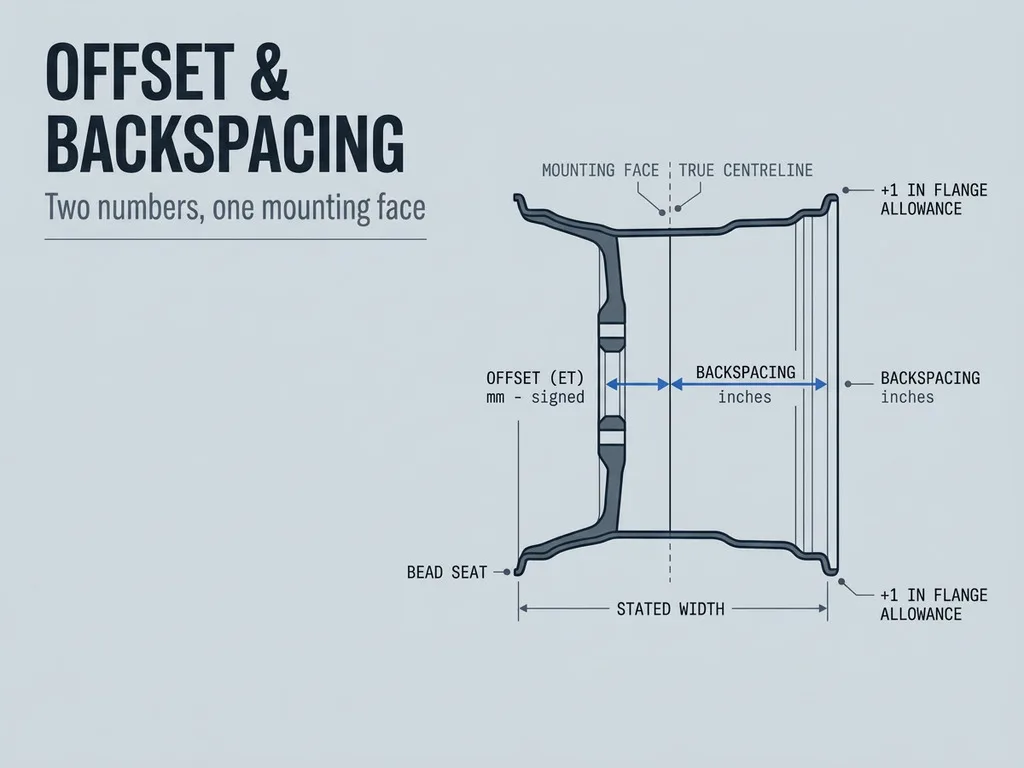
The offset is the distance from the wheel's mounting face to the wheel's true centreline, and it is measured in millimetres. The industry label comes from the German word Einpresstiefe, which means press-in depth [1]. Two things about it trip people up.
The first is the sign. A positive offset means the mounting face sits closer to the outside edge of the wheel, so the wheel body tucks inboard. A negative offset means the mounting face sits closer to the inside edge, so the rim and tire push out toward the fender [1]. A zero offset puts the mounting face exactly on the centreline.
The second is that width is not measured across the whole rim. The stated width is the inside distance between the bead seat faces, which is where the tire actually sits [1]. The physical rim is wider than the number on the box, and that difference matters the moment you try to convert offset into backspacing.
2.2 Backspacing, which measures the other direction
Backspacing is the distance from the inboard rim edge to the mounting face, and it is normally quoted in inches. It measures the same physical fact as offset, from the opposite end of the wheel.
This is why the two numbers are so easy to confuse in a quotation. A supplier working from a European or Asian drawing will quote ET. A customer in North America will often describe what they need in backspacing. Both are correct, both describe the wheel's position on the hub, and neither can be compared to the other until it is converted.
2.3 PCD and centre bore, the two hard fields
PCD, also called bolt circle diameter, is the diameter of the circle that runs through the centre of the bolt holes. The second number in a bolt pattern is that diameter, so 5x100 means five bolts evenly spaced around a 100 mm circle [1]. Common bolt circle diameters include 100 mm, 112 mm, and 114.3 mm, and over 30 different bolt patterns have been used by car manufacturers over the years, most of them mutually incompatible [1].
The centre bore is the hole in the middle of the wheel that centres it over the hub. A wheel whose bore matches the hub closely is hubcentric, and it relies on that fit for centering. A wheel centred by its lug nuts alone is lugcentric [1].
| Field | Unit | What it decides | Wrong value means |
|---|---|---|---|
| Offset (ET) | millimetres, signed | How far the wheel sits in or out of the arch, and where the contact patch lands relative to the steering axis | Rubbing on the suspension, or the tire sitting outside the fender |
| Backspacing | inches | The same position, measured from the inboard rim edge | The same clearance failure, described in the other unit |
| PCD | bolt count plus circle diameter in mm | Whether the wheel bolts onto the hub at all | The wheel cannot be mounted |
| Centre bore | millimetres | Whether the wheel centres on the hub | Vibration, or a wheel that will not seat squarely |
3. Converting Offset to Backspacing and Back Again
This is the calculation that a fitment conversation usually turns on, and it takes ten seconds once you know the allowance.
3.1 The formula
Backspacing = (stated width + 1) ÷ 2 + (offset in mm ÷ 25.4)
The one inch added to the width is the part most people miss. Backspacing is measured to the physical inner edge of the rim, while the stated width stops at the bead seat [1], so the flanges have to be accounted for before the wheel is halved. In practice the two flanges together add about an inch to the overall rim width, which is why the allowance is written as a whole inch.
Working backwards uses the same terms in reverse:
Offset = (backspacing − (stated width + 1) ÷ 2) × 25.4
3.2 Worked examples
| Wheel | (Width + 1) ÷ 2 | Offset in inches | Backspacing |
|---|---|---|---|
| 8J ET +35 | 4.50 in | +1.38 in | 5.88 in |
| 8.5J ET +45 | 4.75 in | +1.77 in | 6.52 in |
| 9J ET 0 | 5.00 in | 0.00 in | 5.00 in |
| 10J ET −25 | 5.50 in | −0.98 in | 4.52 in |
The pattern is worth reading once more slowly. As offset falls from +45 to zero to −25 on otherwise similar widths, backspacing falls with it. A customer asking for less backspacing is asking for the wheel to sit further out, which is the same request as asking for a lower or more negative offset.
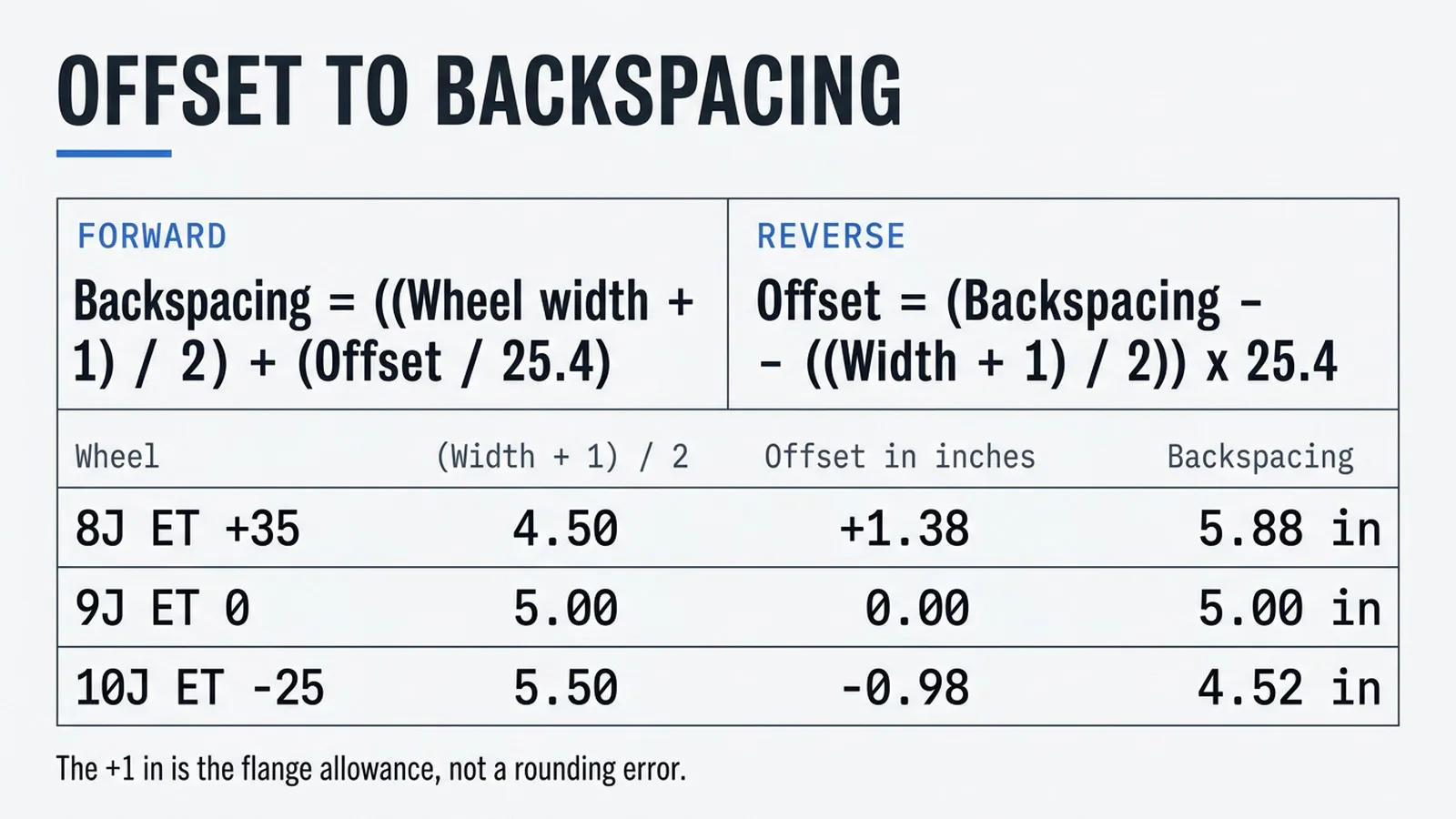 The conversion runs in both directions, and a formula card kept at the counter answers the question before the customer finishes asking it. The added inch is the flange allowance, not a rounding error.
3.3 Reading a requirement backwards
A distributor in North America asks whether you can supply an 8-inch wheel with 5.5 inches of backspacing. Convert it before answering.
Half of the wheel plus the flange allowance is 4.5 inches. Subtract that from the 5.5 inches requested and 1.0 inch of offset remains, which is 25.4 mm. The wheel that satisfies the requirement is an 8J ET +25, and now you can search a catalog by its own numbering instead of guessing.
That single conversion step prevents two common order errors: quoting a wheel that is close but wrong by 10 mm, and telling a customer a fitment is unavailable when it is sitting in the catalog under a different description.
4. What Each Number Changes on the Vehicle
Offset is part of the suspension geometry rather than a cosmetic detail. Moving the mounting face changes the geometry the suspension and steering were designed around, and the effects land in five areas that a technical support desk should be able to talk through.
4.1 Where the wheel sits in the arch
The visible effect of offset is how far the wheel face sits from the fender. The source figure used in fitment practice is straightforward: if a vehicle has 15 mm of clearance between the outer wheel face and the fender, and the owner wants that clearance closed, the offset moves from +45 to +30, which pushes the wheel out by exactly 15 mm for a flush result [1].
For a distributor, this is the number a customer is usually asking about and almost never names correctly. "Can I get a wider stance" and "can you supply less backspacing" are the same request expressed in two vocabularies.
4.2 Scrub radius, steering feel, and torque steer
Scrub radius is the distance between the steering axis and the centre of the tire contact patch [2]. Every offset change moves it, and pushing the wheels out makes it more positive [2].
A larger scrub radius increases steering effort, and it amplifies the way road imperfections and acceleration forces feed back through the steering as bump steer and torque steer [1][2]. Modern cars with ABS generally run a negative scrub radius, which is one reason their wheels sit further inboard than older designs, and that geometry also reduces torque steer and improves stability if a brake circuit fails [2].
This is the part of the conversation where a distributor should be careful about promising an outcome. Offset changes are the customer's decision, but a supplier who can explain that a 30 mm jump away from the original figure will change how the car steers earns a level of trust that a listing page cannot.
4.3 Bearing load
Moving the wheel's centreline away from the bearing centreline increases the thrust load the wheel bearings have to carry [1]. The physical reason is the lever arm: the tire's contact patch moves outboard while the bearing stays where it was, so the same cornering and pothole forces arrive with more leverage.
The practical version for a distributor is that aggressive offsets belong with a conversation about bearing condition and driver expectations, particularly in markets where roads are rough and vehicles are heavily loaded.
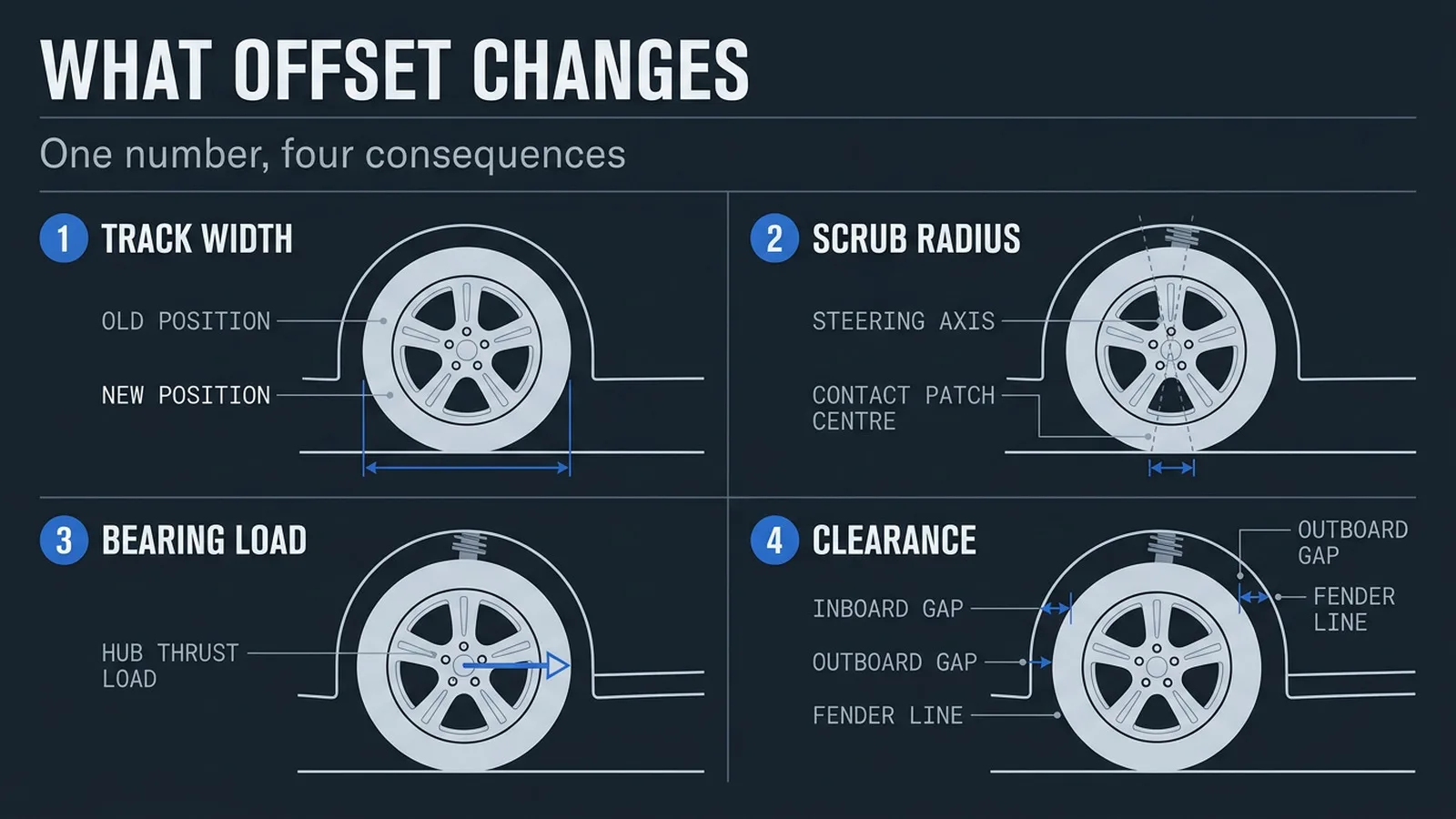 Offset moves one number and four consequences: track width, scrub radius, bearing thrust load, and clearance on both sides of the wheel.
4.4 Inboard clearance and the X-factor
A wheel with too much positive offset sits closer to the suspension components, and the tire can rub on them [1]. Brake caliper clearance has its own term in fitment work, the X-factor, which is the clearance the wheel design leaves for the caliper assembly [1].
A wheel can pass every dimensional check and still fail here, because two wheels of identical width and offset can have completely different spoke profiles and caliper relief. For a distributor stocking a performance line, the X-factor is the field that has to come from the supplier as a measurement rather than as an assurance.
4.5 Outboard clearance
Too much negative offset pushes the wheel closer to the fender edge, which produces tire-to-fender contact under compression [1]. This is the failure mode the customer discovers on the first hard bump, which means the return arrives with a damaged tire attached to the claim.
| Offset change | What happens on the car | What to verify before shipping |
|---|---|---|
| Offset increases (moves inboard) | Wheel sits closer to the suspension and the caliper | Inboard clearance to strut, control arm and caliper X-factor |
| Offset falls toward zero or negative | Wheel pushes toward the fender | Tire-to-fender clearance at full compression, and tire width |
| Large offset change in either direction | Scrub radius shifts, steering effort and bump steer change | Distance from the original equipment offset, and bearing condition |
| Width increase with the offset held | Both inner and outer clearances shrink | The whole wheel and tire envelope, not the rim alone |
5. PCD and Centre Bore: The Fields That Stop an Order Entirely
Offset errors produce bad fits. PCD and centre bore errors produce wheels that do not go on at all, which is a different kind of problem because the customer discovers it in ten seconds.
5.1 PCD is not negotiable
A 5x114.3 wheel will not mount to a 5x112 hub. The bolt holes do not line up, and no amount of torque or technique closes a 2.3 mm mismatch. With over 30 patterns in circulation, several of them differing by less than 3 mm, this is the field where a catalog assumption costs the whole order [1].
The verification rule is the same four-field discipline used for any OEM-numbered part, and it is set out in the OEM number matching guide: confirm the number against make, model, year, and engine or chassis specification, then cross-check before shipment.
One detail worth flagging to customers: patterns that look interchangeable on paper are not. The standard list of patterns manufacturers have used includes both 5x120 and 5x120.65, and a wheel built for one will not seat correctly on the other.
5.2 Centre bore, hubcentric wheels, and rings
An aftermarket wheel's centre bore must be equal to or larger than the hub bore, or it cannot be mounted [1]. When it is larger, a hubcentric ring closes the gap.
Ring material is not a detail to skip. Plastic rings provide initial centering only and are not strong enough to help support the wheel if the car hits a pothole at speed; steel rings are the strongest, and aluminum sits between the two [1]. A distributor who ships plastic rings with a heavy 20-inch wheel and a customer who drives on bad roads is setting up a vibration complaint with a predictable outcome.
5.3 Load capacity
Load capacity is the mass a wheel is rated to carry, and it varies with the number of lugs, the PCD, the material, and the axle the wheel is used on. A wheel on a free-rolling trailer axle carries more than the same wheel on a drive or steering axle [1]. Every wheel carries its rating stamped on the back, and the combined capacity of all wheels must meet or exceed the vehicle's gross vehicle weight rating [1].
This matters most in the 4x4 and pickup segment, where a customer moves from a passenger car wheel to a load-rated truck wheel. A wheel that fits perfectly and is under-rated for the vehicle is a safety problem, not a fitment problem, and it is the distributor's name on the invoice.
Fact: KEHO's wheel lines cover forged wheels in monoblock, two-piece, and three-piece construction with five-spoke and mesh designs and deep-dish concave profiles, alongside cast aluminum wheels from 18 to 20 inches at $ 50 to $ 85 per piece with a four-piece minimum (per company data).
6. The Fitment Risk Map
The wheel complaints that reach a distributor usually trace back to one of six errors. Each one leaves a signature, and knowing the signature is what lets a distributor diagnose a complaint before agreeing to take the stock back.
| Error | How it shows up | Field responsible | What it costs |
|---|---|---|---|
| Wheel rubs the strut or control arm | Noise and wear marks on the inner sidewall | Offset too high for the vehicle | Return plus a damaged tire |
| Tire catches the fender | Contact marks on the tire shoulder, often only when loaded or turning | Offset too low, or width increased without rechecking clearance | Return plus body repair on the customer's car |
| Wheel will not bolt on | Discovered during installation, within minutes | PCD | Full return, freight both ways, lost labour |
| Vibration at speed | Complaint after a few hundred kilometres | Centre bore too large with no ring, or a plastic ring used on a heavy wheel | Return, or an unhappy account |
| Caliper contact | Grinding noise on the first drive | Caliper X-factor | Return plus a damaged wheel face |
| Rated load too low for the vehicle | No immediate symptom, then a structural failure | Load rating | Safety incident and liability exposure |
The last row deserves more attention than its frequency suggests. A fitment error is an inconvenience. An under-rated wheel on a loaded pickup is a different category of problem, and it is worth building a load-rating check into every 4x4 order rather than relying on the customer to ask.
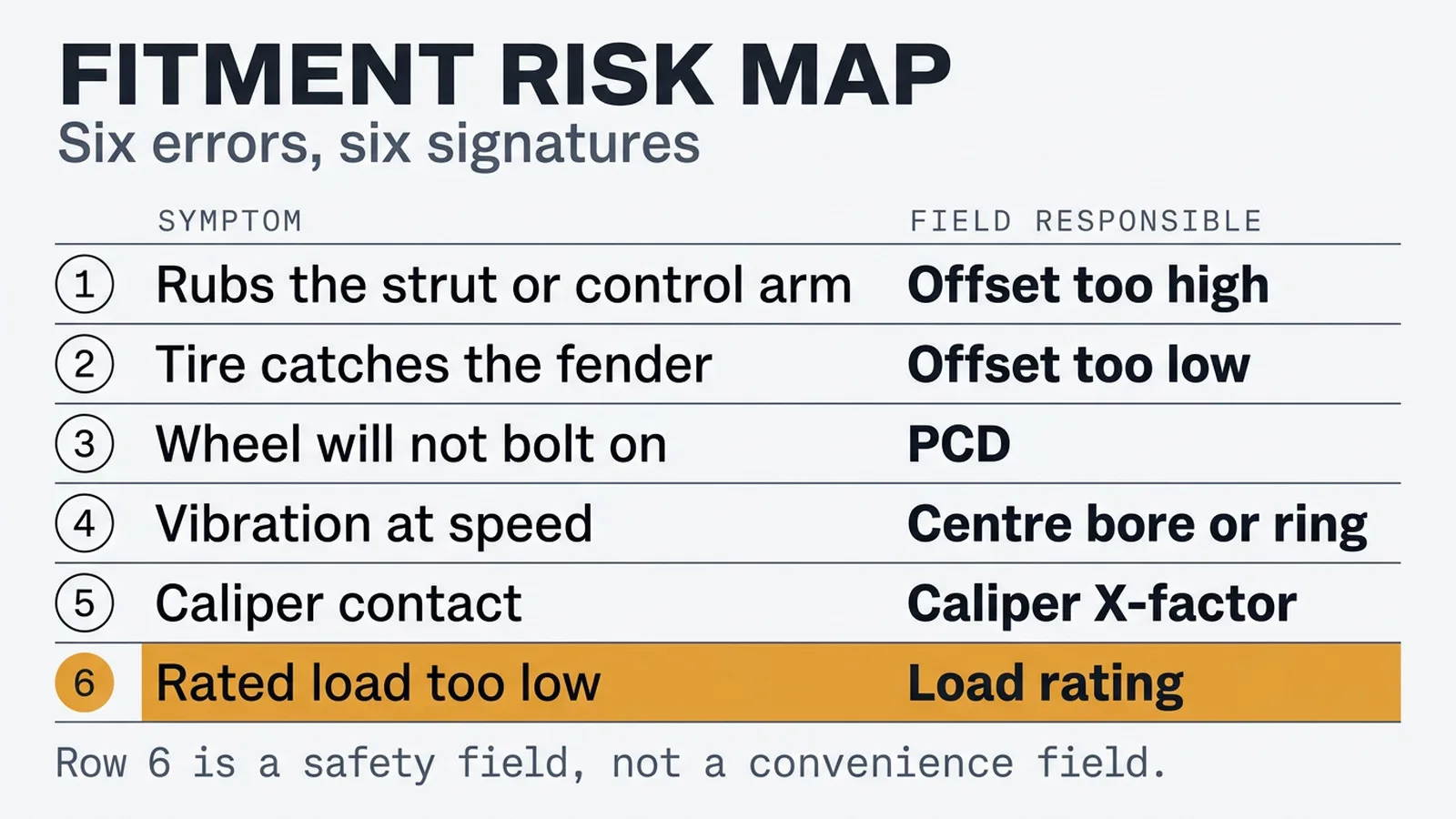 Six errors, six signatures. Working backwards from the symptom to the field is what tells a distributor whether a complaint is a fitment mistake or a damaged part.
7. Market Positioning: Three Offset Directions, Three Risk Levels
The same catalog serves three markets with different fitment expectations, and conflating them is how a distributor ends up with a shelf of stock that suits nobody.
| Market | Typical offset direction | Fitment risk | Documentation you need |
|---|---|---|---|
| OE replacement and general repair | Match the original equipment offset closely | Low | Original equipment offset per vehicle, plus PCD and centre bore |
| Stance and performance tuning | Negative relative to stock, often significantly | High | Offset and width per application, caliper X-factor, tire-to-fender clearance |
| 4x4 and pickup | Usually positive, with an emphasis on load rating | Medium | Load rating per wheel, offset, PCD, and the tyre size the customer runs |
7.1 OE replacement: the volume base
The OE replacement market is where a wheel business pays its overhead. The fitment rule is simple and unglamorous: match the original offset within a small tolerance, confirm PCD and centre bore, and the customer gets a wheel that behaves like the one it replaced. Nothing about the geometry changes, so nothing about the vehicle's behaviour changes.
This is also the market where the four-field verification habit pays off fastest, because the fitment data is stable and a supplier can hold it in a database rather than re-deriving it per order.
7.2 Stance: where the returns live
Stance customers are the ones asking for a specific look, and the look is defined by moving the wheel outward. That is exactly the change that shifts scrub radius, increases bearing thrust load, and shrinks fender clearance.
Two things keep this line profitable. The first is documentation: offset, width, and the caliper X-factor for the wheel design, supplied as measurements rather than reassurances. The second is expectation setting, because a customer buying a flush fitment needs to know what happens to the geometry rather than discovering it in the steering afterwards.
7.3 4x4 and pickup: load rating first
In the 4x4 segment, offset usually goes the other way. Wider track and clearance for larger tires come from a more positive offset on some platforms and a negative one on others, depending on how the axle and body are built. The non-negotiable field is load rating.
A pickup carrying a rated load on wheels that meet the dimensional requirements but not the load requirement has a problem that no fitment guide resolves. The forged wheel buying guide covers how construction and material interact with the load question, and it is worth reading before quoting a heavy-duty order.
7.4 Staggered setups
A staggered fitment puts wider wheels on the rear than the front, usually on rear-wheel-drive vehicles and on a smaller number of all-wheel-drive cars. A typical example is 19x8 at the front and 19x9.5 at the rear [1].
The benefits are more grip at the driven end and better cornering, and the costs are practical: the wheels cannot be rotated front to back, the front and rear run different tire sizes, and an improper setup can rub the suspension or the arches [1]. For a distributor, a staggered order doubles the SKU lines in one shipment and halves the customer's ability to rotate stock, so it is worth confirming the customer understands both sides before the order is placed.
8. Build the Fitment Data Sheet Before the Container Ships
Fitment errors are cheap to prevent while the order is still a spreadsheet and expensive to fix once the container is on the water.
8.1 The fields to hold per SKU
Every wheel SKU in a distributor's system should carry eight fields, and they should be structured rather than free text: diameter, width, offset, backspacing, PCD, centre bore, caliper X-factor, and load rating.
The backspacing field looks redundant next to offset, and it is not. It is the number a North American trade customer will quote, and keeping it in the database means a counter question can be answered without a calculation under time pressure.
8.2 The cross-market trap
The same vehicle model sold in different markets frequently runs different chassis specifications, and wheel fitment follows the chassis rather than the nameplate. A model that takes a 5x114.3 hub in one market can take a different pattern in another, and offset changes with trim and brake package.
This is the same failure mode that affects engine and sensor parts, and the same discipline resolves it: verify against the chassis specification rather than the model name. The supplier vetting checklist covers how to test whether a supplier holds fitment data at that level of detail, and the mixed-container shipping guide covers how to consolidate several wheel lines into one shipment without losing the fitment data per line.
8.3 A pre-shipment check that takes an hour
Before a wheel order ships, run four checks and record the result per line.
- Convert every offset in the order into backspacing, and compare both against the customer requirement.
- Confirm PCD and centre bore against the chassis specification, not the model name.
- Confirm the load rating covers the vehicle's gross weight for the axle it is used on.
- Confirm the wheel design's caliper X-factor clears the brake package on the target vehicles.
An hour of checking on a 200-piece order is cheaper than one returned pallet.
Fact: KEHO maintains 50,000+ SKUs across six production lines, ships in-stock items within 48 hours and standard orders in 15-25 days, and backs parts with a 12-24 month warranty (per company data).
9. FAQ: Wheel Offset and Backspacing Questions From Buyers
How do I convert wheel offset to backspacing?
Add one inch to the wheel's stated width, divide by two, then add the offset converted to inches by dividing the millimetre figure by 25.4. An 8-inch wheel with a +35 mm offset gives 4.5 plus 1.38, which is 5.88 inches of backspacing. The extra inch accounts for the rim flanges, because the stated width is measured between the bead seats rather than across the whole rim.
What does ET mean on a wheel?
ET is the offset figure, taken from the German word Einpresstiefe, which translates as press-in depth. It is the distance in millimetres from the wheel's mounting face to its true centreline. A positive number means the mounting face sits outboard of the centreline and the wheel tucks inboard; a negative number means the mounting face sits inboard and the wheel sits further out toward the fender.
How does changing wheel offset affect handling?
Offset changes the scrub radius, which is the distance between the steering axis and the centre of the tire contact patch. Pushing the wheels out makes the scrub radius more positive, which increases steering effort and amplifies bump steer and torque steer. It also increases the thrust load on the wheel bearings, because the wheel centreline moves away from the bearing centreline. Staying within the manufacturer's offset range keeps those effects small.
What happens if the PCD is wrong?
The wheel will not bolt on at all. PCD is the diameter of the circle running through the centre of the bolt holes, and it is a hard fitment field with no adjustment: a 5x114.3 wheel cannot be made to fit a 5x112 hub, and no adapter belongs in a conversation about a production wheel order. Over 30 different bolt patterns have been used by car manufacturers, so the field has to be verified per vehicle, not assumed from the model.
What is the difference between hubcentric and lugcentric wheels?
A hubcentric wheel is centred by its centre bore, which matches the hub diameter closely and takes the centering job away from the lug nuts. A lugcentric wheel is centred by the lug nuts alone. An aftermarket wheel needs a centre bore equal to or larger than the hub, and if it is larger it needs a hubcentric ring, because a loose bore lets the wheel sit off-centre and vibrate.
How much offset change is safe?
There is no single safe number, because the limit is the specific vehicle's suspension geometry and body clearance. The practical method is to work from the original equipment offset, calculate how many millimetres a change moves the wheel face, and confirm that the new position keeps the tire clear of the suspension inboard, clear of the fender outboard, and clear of the brake caliper. Scrub radius moves with every offset change, so large jumps away from stock deserve a check against the manufacturer's range.
10. Turning Fitment Data Into an Order You Keep
Wheel fitment is a paperwork problem before it is a manufacturing problem, and the paperwork is where the margin is won or lost. Two conversions cover most of the conversation: offset to backspacing, and backspacing back to offset. Two fields decide whether the wheel mounts at all: PCD and centre bore. One field prevents a safety incident: load rating.
Get those four into a structured data sheet, keep the caliper X-factor on file for every performance design, and the fitment question stops being an argument with a customer and becomes a lookup. The alloy wheel buying guide covers the cast volume line, and the forged wheel buying guide covers the forged range for performance and heavy-duty applications.
If you want a fitment sheet built for the chassis codes your market runs, send us the vehicle list and the wheel sizes you are considering, and we will come back with offsets, backspacing conversions, load ratings, and the OEM references behind them. The current wheel range is listed in the KEHO wheel hub catalog, and general inquiries start from the product catalog.
Sources
- Wikipedia contributors. "Wheel sizing." Wikipedia. https://en.wikipedia.org/wiki/Wheel_sizing - Wheel size notation, the bead-seat definition of rim width, ET offset and its sign convention, bolt pattern and bolt circle diameter definitions, centre bore and hubcentric ring materials, brake caliper clearance (X-factor), load capacity and GVWR, and staggered fitment practice.
- Wikipedia contributors. "Scrub radius." Wikipedia. https://en.wikipedia.org/wiki/Scrub_radius - Definition of scrub radius and its positive, negative and zero cases, how offset changes alter it, the prevalence of negative scrub radius on modern ABS-equipped vehicles, and the effects on steering effort, torque steer and stability under brake circuit failure.
- Industry fitment references. "Wheel Offset, Backspacing and Bolt Patterns Explained" and "Offset to Backspacing Conversion." Vendor technical references, 2026. https://www.performanceplustire.com/Blog/wheel-offset-backspacing-bolt-patterns-explained - Standard industry conversion convention: backspacing equals (stated width plus one inch) divided by two, plus offset converted to inches.