Every importer who has sourced from China for more than a year has either been burned or watched someone else get burned. The pattern is almost always the same. A supplier with a polished catalog takes a deposit, sends pictures of the wrong parts, and then goes quiet. Or the parts arrive and do not match the sample that was approved. By then the money has moved, the container has shipped, and the options are expensive.
The fix is a discipline you apply before the first payment: vet the supplier in layers, starting with paperwork and ending with a sample test. This guide gives you that framework. It is written for auto parts importers and distributors who buy in bulk, where a bad supplier is not an inconvenience: it is a write-off.
1. Start With the Paperwork: Verify the Business License
The first check costs nothing and eliminates the laziest scammers. Ask for the supplier's business license and the Unified Social Credit Code printed on it [2]. Then verify the number against China's official government business registry. A legitimate company has nothing to hide here; a fake one stalls or sends a blurred scan.
Three things to confirm on the license:
- The company name matches the name on the invoice, the contract, and the Alibaba storefront.
- The registration date matches the claimed company history. A supplier claiming 30 years of experience but registered two years ago is a trading company rebranded as a factory.
- The registered address matches the actual factory and shipping address. A mismatch does not always mean fraud, but it is a question you must get answered.
Fact: KEHO has been a verified auto parts supplier since 1995, holding ISO/TS 16949 certification (since 2012), CE marking, and SGS third-party verification (per company data).
2. Certifications That Matter for Auto Parts
Not all certificates carry equal weight. For auto parts, one standard matters more than the rest.
ISO/TS 16949, now IATF 16949 [1], is the automotive-specific quality management standard. It is the successor to the ISO/TS 16949 system that the industry used for years, and it is what Tier-1 and Tier-2 suppliers hold. It is not a generic ISO 9001 badge: it covers the entire supply chain, from supplier management to traceability to defect prevention. When a parts supplier holds it, they have built their quality system to the standard the automakers themselves require.
CE marking matters for parts entering the European market. SGS or equivalent third-party verification adds independent assurance on top of a self-declared certificate. The point of all three is the same: they are checkable. Ask for the certificate number and verify it against the issuing body's database. A PDF that cannot be verified is worth less than the paper it is not printed on.
3. Factory or Trading Company: How to Tell
This is the question behind most of the "how do I know if a Chinese supplier is legit" posts online. A trading company is not automatically bad. Some of them add real value through consolidated shipping and multilingual support. But you should know which one you are buying from, because it changes your leverage, your pricing, and your recourse when something goes wrong.
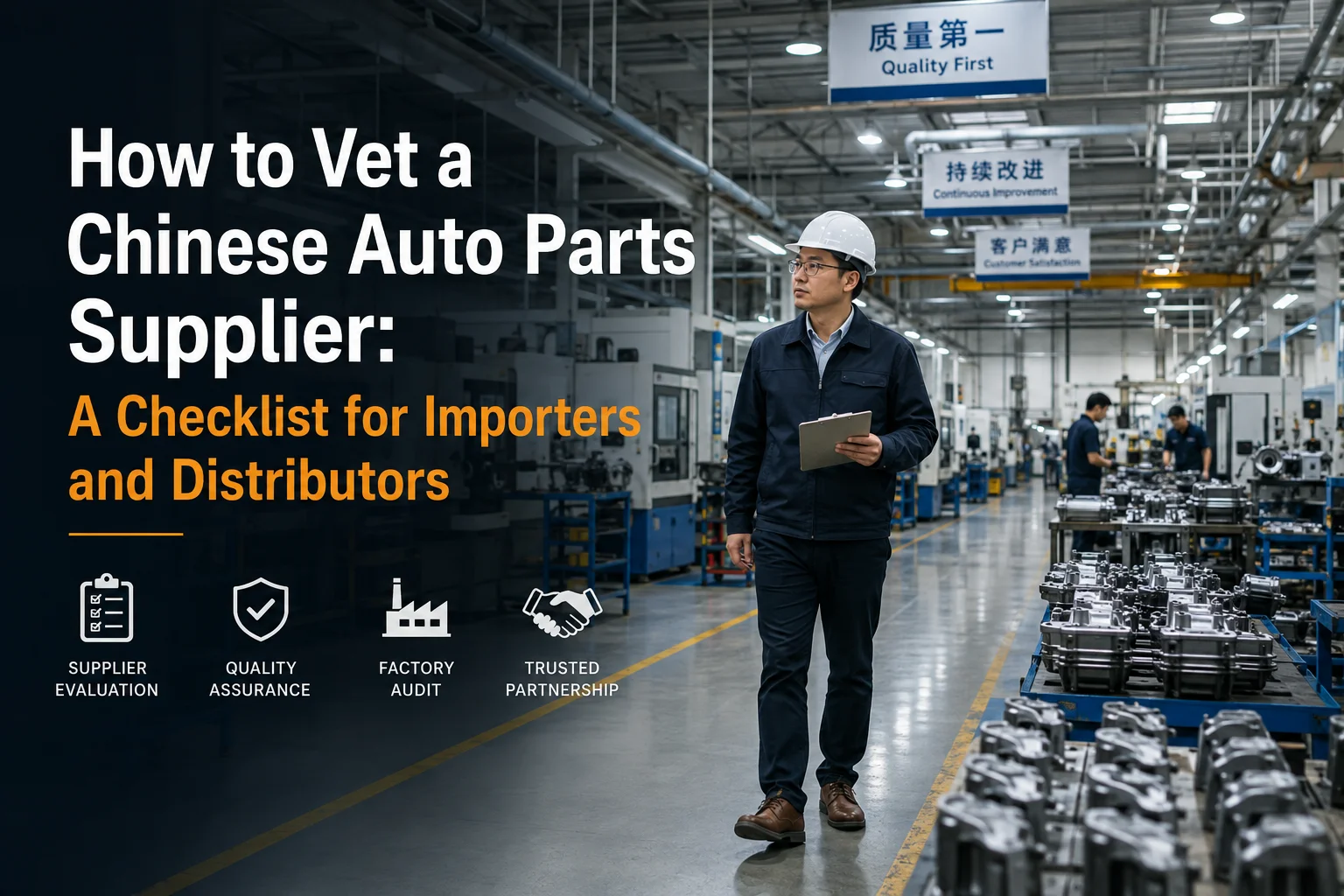
The fastest way to tell is a live video walkthrough. Ask the supplier to walk the production floor on a video call, showing machines running and lines operating, not a pre-recorded tour. A real factory can do this in five minutes. A trading company that represents a factory has to coordinate, delay, or refuse.
Then cross-check the physical address against the business license and any assessment report. On Alibaba, look for the Manufacturer tag and a completed onsite check, which means a third party physically visited the operation.
4. The Sample Test Before You Commit
Paperwork and video tell you the supplier is real. A sample tells you the product is right. This is where the discipline connects to the part number.
Before a bulk order, request samples and verify them the same way you would verify fitment: by OEM number, vehicle make and model, production year, and engine displacement. If you have not already read our guide on matching auto parts by OEM number, that method is the backbone of this step. A sample that matches the OEM number on paper and fits a test vehicle is the strongest signal you will get short of a full production run.
Then run a small trial order before the full container. Most legitimate suppliers will support a low minimum on a new SKU specifically so you can test it. A supplier that refuses samples or demands a full container on a first order is telling you something about how much they trust their own product.
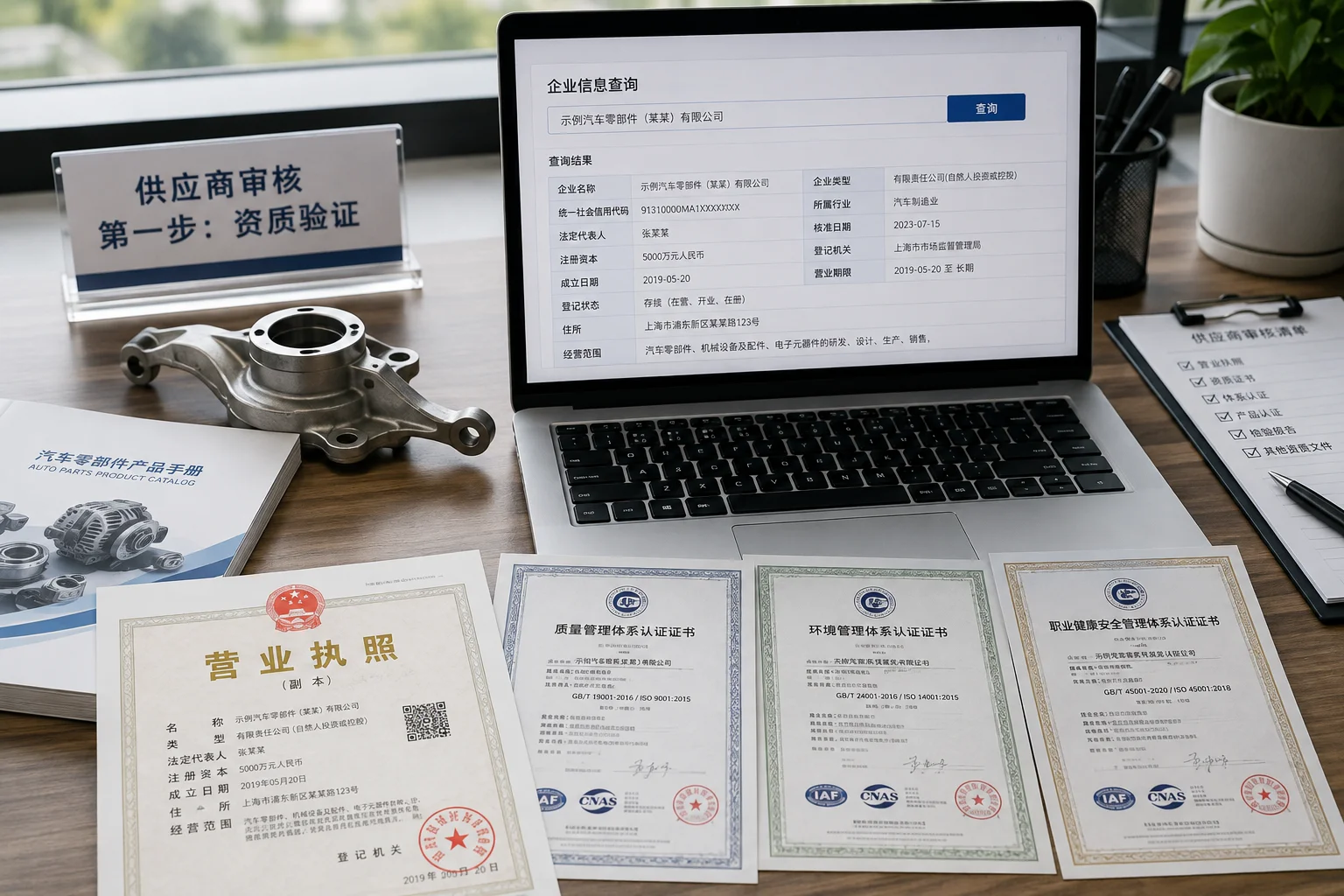 Start with documents you can verify against official registries, then confirm with a live factory tour and a sample test. Each layer catches what the previous one cannot.
5. Trading Company vs Real Factory: A Direct Comparison
| Factor | Trading company | Real factory |
|---|---|---|
| Live video tour | Coordinates, delays, or refuses | Walks the floor in five minutes |
| Pricing | Adds a margin on top of the factory price | Sells direct at factory cost |
| MOQ flexibility | Often higher, less control | Can adjust to test new SKUs |
| Quality control | Depends on the underlying factory | Owns the process end to end |
| Recourse on defects | Acts as intermediary | Direct accountability |
| Best use case | Consolidated multi-category sourcing | Single-category deep sourcing |
Neither is universally better. The failure mode is not buying from a trading company: it is buying from a trading company while believing it is a factory, and paying a factory price for a middleman's risk.
6. Payment Terms That Protect You
How you pay determines what happens when the order goes wrong. The rule is simple: payment follows documented milestones, it does not precede verification.
Safe structures:
- A deposit (typically 30%) with the balance against the bill of lading, so you pay the remainder only after the goods are loaded and documented.
- A letter of credit for larger orders, where the bank releases payment against shipping documents.
- A platform escrow service that holds funds until you confirm receipt.
What to refuse:
- Full payment up front into a personal account.
- Pressure to pay outside the documented channel.
- A supplier that will not put terms in writing.
The cheapest insurance against a disappearing supplier is refusing to send money into an account that cannot be traced to the company you vetted.
Fact: KEHO is an Alibaba Gold Supplier with a completed onsite check, and its four-stage quality control covers incoming inspection, in-process checks, packaging verification, and final shipment review (per company data).
7. Red Flags That Should Stop an Order
Some signals are worth a question. Others are worth walking away. Here is the short list of walk-away signs:
- Refusal to provide a business license or Unified Social Credit Code.
- A registration date that contradicts the claimed company history.
- Refusal to do a live video tour of the production floor.
- Prices far below the market average for the same part.
- Requests to pay into a personal account or an unrelated company account.
- A shipping address that does not match the registered address.
- Certificates that cannot be verified against the issuing body.
One of these warrants caution. Two or more should end the conversation, regardless of how good the catalog looks.
Fact: KEHO backs its parts with a 12-24 month warranty and ships in-stock items within 48 hours, holding a 99.2% on-time delivery rate across 50,000+ SKUs (per company data).
8. FAQ: Supplier Vetting Questions From Real Buyers
How do I verify a Chinese auto parts supplier is legitimate?
Start with the business license. Ask for the Unified Social Credit Code and cross-check it against China's official government business registry. Then confirm the registration date matches the claimed history and the registered address matches the factory and shipping address. A supplier that cannot provide a verifiable license number is a red flag, not a negotiating point.
What certifications should a Chinese auto parts supplier hold?
For auto parts, ISO/TS 16949 (now IATF 16949) is the automotive-specific quality standard and the most meaningful certificate to request. CE marking matters for parts entering Europe. SGS or similar third-party verification adds independent assurance. Ask for the certificate number and verify it against the issuing body's database rather than accepting a PDF at face value.
How do I check if a supplier is a real factory or a trading company?
Ask for a live video walkthrough of the production floor, not a pre-recorded tour. A real factory can show machines running and lines operating. Cross-check the factory address against the business license and the assessment report. On Alibaba, look for the Manufacturer tag and a completed onsite check. Trading companies can be legitimate partners, but know which one you are buying from before you pay.
What red flags should I watch for when vetting a Chinese supplier?
The consistent red flags: refusal to provide a business license or Unified Social Credit Code, a registration date that does not match the claimed history, refusal to do a live video tour, prices far below market, requests to pay into a personal account, and a shipping address that does not match the registered address. One warrants caution; two or more should stop the order.
Should I use a third-party inspection before a bulk order?
For a first bulk order, yes. A third-party inspection (SGS, TUV, Bureau Veritas, or a China-based QC firm) verifies quantity, appearance, packaging, and key specs before the container ships. It costs a small fraction of the order value and catches problems while they are still cheap to fix. For repeat orders with an established supplier, you may move to spot checks.
What payment terms are safe when ordering from a Chinese supplier?
Avoid paying the full amount into a personal account. Safe terms include a deposit with the balance against the bill of lading, a letter of credit for larger orders, or a platform escrow service. A 30% deposit with 70% before shipment is common. The rule is that payment follows documented milestones, not before any verification.
9. Conclusion: Vet in Layers, Then Pay
Vetting a Chinese auto parts supplier is not a single check. It is a sequence: verify the license, confirm the certifications, tour the factory live, test the sample against the OEM number, and structure the payment so it follows milestones instead of hope.
Apply the sequence in order and most bad suppliers remove themselves before you send a dollar. The ones that pass all five layers are the ones worth building a program around.
KEHO has been through this filter from the buyer's side of the table for 30 years (per company data). Whether you are vetting a supplier for fuel injectors, ignition coils, or spark plugs, the same checklist applies. And if you want to start with a supplier that already passes, send your OEM number list for a fitment and pricing review.
Sources
- Total gaps: 2 | Resolved: 2 | Unresolved: 0
- Authority breakdown: Standards Body 2 | Reference 1 | Company data 1
- [International Automotive Task Force (IATF)]. "About IATF 16949:2016." iatfglobaloversight.org: The automotive quality management system standard that replaced ISO/TS 16949, developed by the International Automotive Task Force.
- [FDI China]. "Unified Social Credit Code: 5 Essential Facts and How to Check." fdichina.com (Dec 2025): Explanation of China's Unified Social Credit Code as the primary company identification number and how to look it up.
- [AIAG]. "IATF 16949:2016." aiag.org: Automotive quality management system requirements for organizations across the global automotive industry.
- [KEHO]. Company data: certifications, onsite check, quality control process, warranty, delivery rate. kehoauto.com: Company-reported figures marked "(per company data)" in the article body.