The oxygen sensor is one of the few auto parts that a distributor can count on selling steadily for years. It is a wear item with a finite lifespan, it fails on cars regardless of how they are driven, and nearly every modern vehicle carries more than one. That is the opportunity. The risk is that the category has a hidden trap: two sensors that look identical can be completely different parts, and the wrong one generates returns, not revenue.
This guide explains the oxygen sensor category from an importer's perspective. It covers the upstream-downstream split that defines the catalog, the three sensor technologies, how to index by OEM number, and the quality checks that separate a real sensor from a reboxed one.
1. Upstream vs Downstream: The Split That Defines Your Catalog
An oxygen sensor measures the oxygen left in the exhaust gas, but where it sits changes what it does.
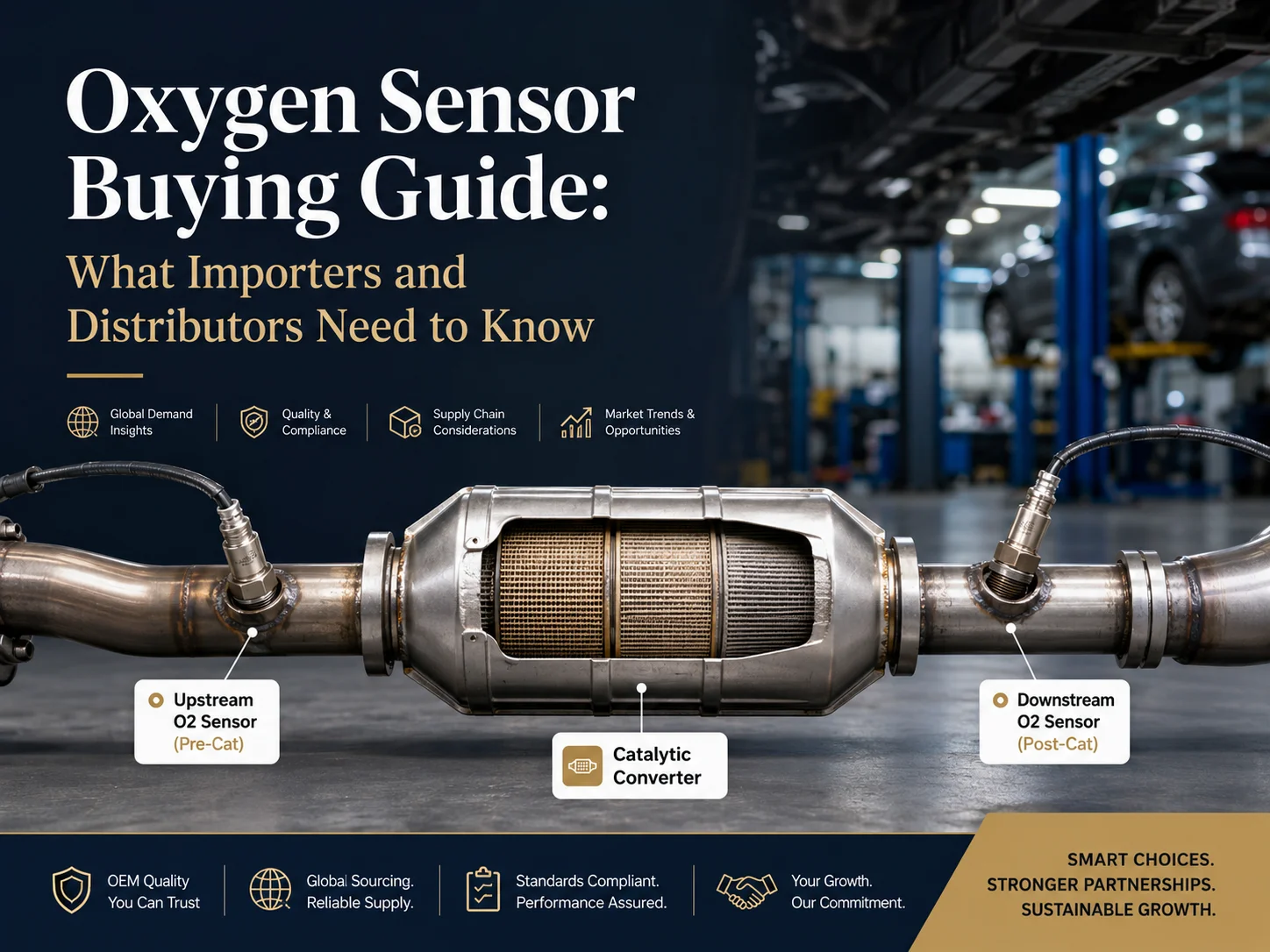
The upstream sensor (also called the front sensor or air-fuel ratio sensor) sits before the catalytic converter [2]. It reads the exhaust in real time and feeds the engine computer, which trims the fuel mixture to keep combustion efficient. This is the working sensor: it directly affects fuel economy, idle quality, and emissions. It has to respond fast, which is why many modern upstream sensors are wideband units rather than simple O2 sensors.
The downstream sensor (rear sensor) sits after the converter. Its job is simpler: it watches the oxygen level behind the catalyst and tells the computer whether the converter is still doing its job. It does not tune the mixture, so it does not need the same response speed.
For an importer, the practical point is that these are two separate SKUs on most vehicles, and they are not interchangeable. A buyer asking for "an oxygen sensor for a 2014 Corolla" could mean any of up to four distinct part numbers depending on position and engine. If your catalog does not split upstream from downstream, you will ship the wrong one about half the time.
Fact: KEHO supplies upstream and downstream oxygen sensors (Lambda/O2 sensors) with OEM number matching, holding ISO/TS 16949 certification (since 2012), CE marking, and SGS third-party verification (per company data).
2. The Three Oxygen Sensor Technologies
Oxygen sensors come in three technologies, and they map to different market segments.
Zirconia sensors are the workhorse [1]. They generate a small voltage that swings between roughly 0.1V and 0.9V as the exhaust crosses the ideal air-fuel ratio. They are cheap, durable, and cover the vast majority of the replacement market. If your buyers serve general repair shops and older fleets, zirconia is the bulk of your catalog.
Titania sensors change resistance rather than voltage and appear mainly on older vehicles, particularly some European and Japanese platforms from the 1980s and 1990s. They are a niche: low volume but steady demand from specialists.
Wideband sensors (air-fuel ratio sensors) measure a broad range of mixtures precisely and are standard on modern and performance engines. They carry higher unit prices and tighter quality requirements, which makes them the higher-margin but higher-risk end of the category. A reboxed or counterfeit wideband sensor fails in ways a workshop will notice immediately.
The catalog decision is not "pick one technology." It is to weight zirconia for volume and wideband for margin, with titania as a small legacy tail for the shops that still ask for it.
3. How to Index Your Catalog by OEM Number
A sensor catalog falls apart when it is organized by vehicle name. A "Toyota Camry oxygen sensor" is not one part: it is a family of parts that varies by engine, year, market, and sensor position. The only structure that holds up at volume is indexing by OEM number.
The OEM number is stamped on the sensor body or printed on its connector, and it points to one exact spec. When a buyer sends an OEM number, a competent supplier cross-references it against vehicle make, model, year, and engine displacement, then confirms the position: upstream or downstream. This is the same four-dimension method we describe in our guide on matching auto parts by OEM number, applied to the sensor category.
The workflow that scales:
- Collect OEM numbers in batches from your buyers.
- Send the batch for cross-referencing against make, model, year, engine, and position.
- Spot-verify a sample against a public catalog before approving the order.
- Test new part numbers with a small sample order before committing to volume.
Fact: KEHO's oxygen sensor range covers both upstream and downstream positions across BMW, VW, Audi, Toyota, and Honda applications, with four-dimension fitment verification (OEM number, vehicle, year, engine) as standard (per company data).
4. Quality Checks That Catch Counterfeit and Reboxed Sensors
Oxygen sensors are prime targets for counterfeit and reboxed parts because the good ones and the bad ones look nearly identical on the outside. The difference only shows up on a test bench or, worse, on a customer's car.
Three checks separate a real sensor from a reboxed one:
- Response time. A working sensor switches between lean and rich quickly when you introduce a propane or vacuum signal on a test bench. A sluggish sensor is either old or counterfeit.
- Heater circuit resistance. Most sensors have an internal heater with a specified resistance. If the measured resistance does not match the spec sheet, the part is suspect.
- Wiring and connector. The pinout and connector should match the OEM reference exactly. A sensor with a generic or adapted connector is a red flag, because it was probably built to look right rather than to function right.
None of this requires exotic equipment. A supplier that can produce per-batch test data and a four-dimension fitment confirmation is already ahead of most of the market. This is the same discipline we cover in our guide on vetting a Chinese auto parts supplier, applied to one specific component.
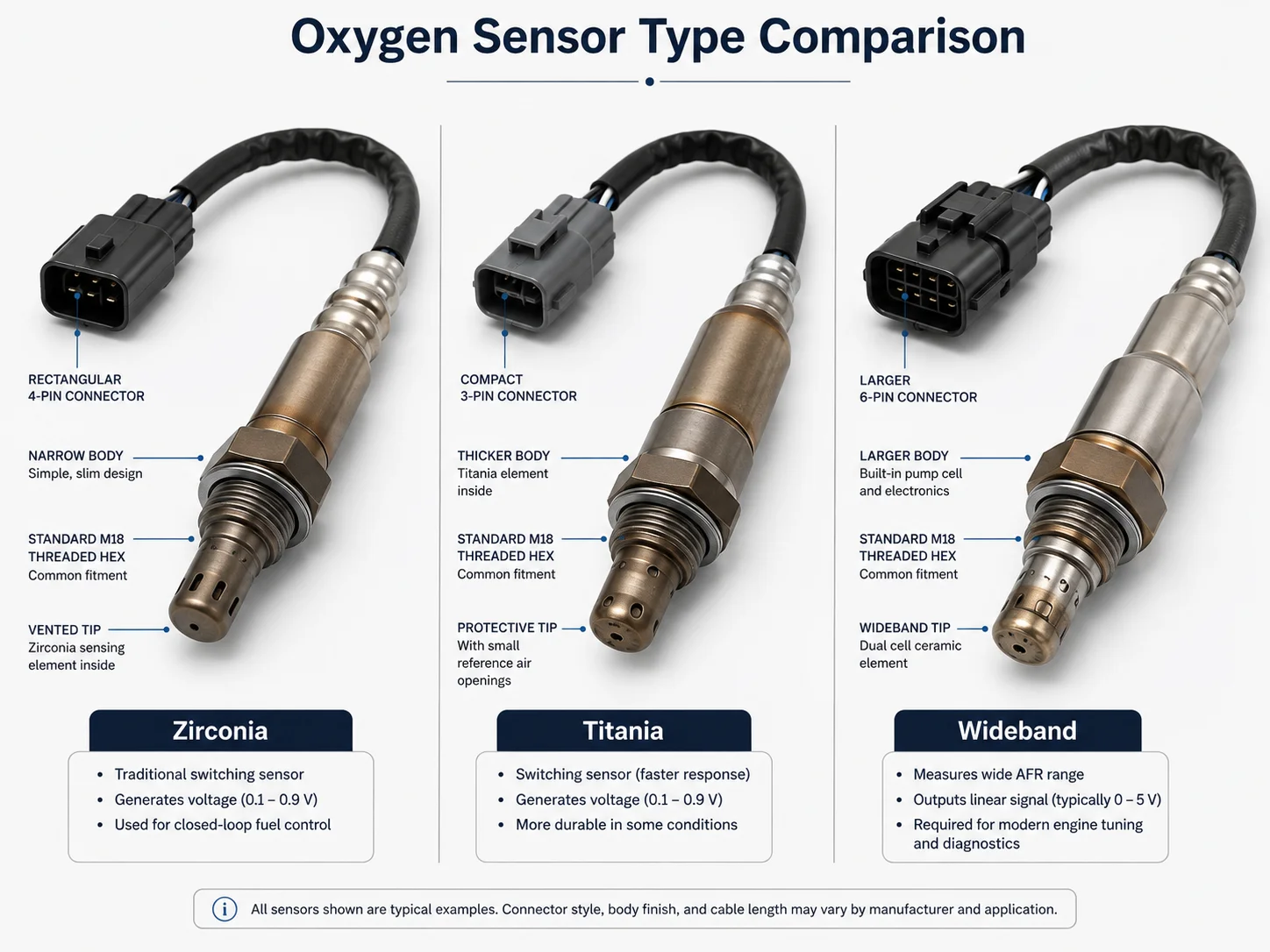 Three sensor technologies, three market tiers. Zirconia carries the replacement volume, wideband carries the margin, and titania is a small legacy tail.
5. Upstream vs Downstream: A Direct Comparison
| Factor | Upstream sensor | Downstream sensor |
|---|---|---|
| Position | Before the catalytic converter | After the catalytic converter |
| Primary job | Tunes the air-fuel mixture | Monitors catalyst efficiency |
| Response speed | Fast (often wideband) | Slower (standard O2) |
| Typical unit price | Higher | Lower |
| Failure consequence | Poor economy, rough idle, check-engine light | Catalyst fault codes, failed emissions test |
| Replacement logic | Replaced proactively at service intervals | Often replaced reactively with the catalyst |
The split matters because it changes how your customers buy. Upstream sensors are a scheduled replacement item, which makes them steady, predictable volume. Downstream sensors are often replaced reactively, which makes them sporadic but tied to a larger repair job. Stocking both, in the right ratio, is how a distributor covers the full demand instead of half of it.
6. Building a Sensor Catalog That Covers Your Market
A working oxygen sensor catalog is built around three questions about your buyers.
What vehicle fleet do they serve? If your buyers handle Asian commuter cars, weight the catalog toward zirconia upstream and downstream units for Toyota, Honda, and Hyundai. If they serve European specialists, wideband upstream sensors become the priority.
Do they buy for scheduled maintenance or reactive repair? Maintenance-heavy workshops order upstream sensors on a schedule. Repair-heavy shops order downstream sensors when a catalyst job comes in. The mix tells you which SKUs to keep in stock depth.
How many positions does the average vehicle in their fleet have? A four-cylinder car runs two sensors; a V6 or V8 runs three or four. The fleet mix multiplies the number of part numbers you need to carry, which is exactly why OEM-number indexing and a supplier with broad coverage matter more than a low unit price.
Fact: KEHO supports oxygen sensor sample orders from 10 pieces, with typical wholesale pricing of $ 5.98-15.80 per piece (per company data).
7. FAQ: Oxygen Sensor Questions From Real Buyers
What is the difference between upstream and downstream oxygen sensors?
An upstream sensor sits before the catalytic converter and measures exhaust oxygen in real time, feeding the ECU to tune the air-fuel mixture. A downstream sensor sits after the converter and monitors how efficiently the catalyst works. They are not interchangeable: the upstream sensor is usually an air-fuel ratio sensor with faster response, while the downstream sensor is a standard O2 sensor. For importers, this split defines two distinct SKUs on most vehicles.
How do I know which oxygen sensor I need?
Match by OEM number and by position, not by vehicle model alone. The OEM number identifies the exact sensor spec, and the position (upstream or downstream) tells you which slot it fits. A single vehicle often uses different part numbers for the front and rear sensors. A supplier that cross-references the OEM number against make, model, year, and engine before dispatch removes most of the guesswork.
How many oxygen sensors does a car have?
Most modern vehicles have two to four oxygen sensors. A four-cylinder car typically has one upstream and one downstream sensor. V6 and V8 engines often run two upstream sensors plus one or two downstream sensors. This matters for importers because it multiplies the catalog: one engine family can need four distinct part numbers, and stocking only the front or only the rear leaves half the demand uncovered.
What is the difference between zirconia, titania, and wideband oxygen sensors?
Zirconia sensors are the most common type and produce a voltage signal based on oxygen concentration. Titania sensors change resistance instead of voltage and appear mainly on older vehicles. Wideband sensors (air-fuel ratio sensors) measure a broad range precisely and are standard on modern and performance engines. For importers, zirconia dominates the replacement volume, while wideband units carry higher prices and tighter quality requirements.
How long do oxygen sensors last?
Oxygen sensors typically last 100,000 to 150,000 kilometers (roughly 60,000 to 100,000 miles), but contaminated fuel, oil burning, and coolant leaks shorten that lifespan. As a distributor, the practical point is that O2 sensors are a scheduled wear item, not a repair-only part, which means steady repeat demand.
How do I verify oxygen sensor quality before a bulk order?
Request samples and check three things: response time (a good sensor switches from lean to rich quickly on a test bench), heater circuit resistance (which should match the spec sheet), and wiring and connector (which should match the OEM pinout). A supplier that provides per-batch test data plus a four-dimension fitment confirmation is far less likely to ship reboxed or counterfeit sensors.
8. Conclusion: Split the Category, Then Scale It
Oxygen sensors reward importers who respect the structure of the category: upstream versus downstream, zirconia versus wideband, indexed by OEM number and verified before shipment. Treat it as one generic part and the returns will find you. Treat it as a structured catalog and it becomes one of the steadier lines in your engine parts program.
KEHO supplies the full oxygen sensor range with the same discipline we apply to the rest of the engine systems catalog: OEM number matching, four-dimension fitment verification, and quality control that catches reboxed parts before they ship. Browse the oxygen sensor product page to see the range, and if you are building a broader engine parts program, our guides on fuel injectors, ignition coils, and spark plugs cover the rest of the category.
Sources
- Total gaps: 2 | Resolved: 2 | Unresolved: 0
- Authority breakdown: Reference 2 | Manufacturer 1 | Company data 1
- [Wikipedia]. "Oxygen sensor." en.wikipedia.org: Technical reference covering oxygen sensor operation and the zirconia, titania, and wideband sensor types.
- [DENSO Products]. "Oxygen Sensor Position Guide." densoproducts.com: Manufacturer guide to upstream and downstream oxygen sensor positions relative to the catalytic converter.
- [GGS Ceramic]. "Lambda Sensor Definition, Working Principle, and Types." ggsceramic.com: Reference covering zirconia, titania, and wideband lambda sensor technologies.
- [KEHO]. Company data: certifications, sensor coverage, pricing, MOQ. kehoauto.com: Company-reported figures marked "(per company data)" in the article body.