Crankshaft and camshaft position sensors are the two components that importers most often mix up, and the mix-up is expensive. They share a name, they live near each other in a catalog, and a buyer who asks for "a position sensor for a 2009 Mazda" could mean either one. Ship the wrong one and the car still will not start, which is how a $ 4 sensor turns into a return that costs more than the part.
This guide clears up the split, explains how the two sensors work together, and shows how to build a catalog around them by OEM number. It is written for importers and distributors, for whom the crankshaft position sensor is a high-turnover core SKU and the camshaft sensor is the coverage that multiplies with engine complexity.
1. Crankshaft vs Camshaft: The Split That Defines Your Stock
The two sensors sit at opposite ends of the engine, and their jobs are opposite in the same way.
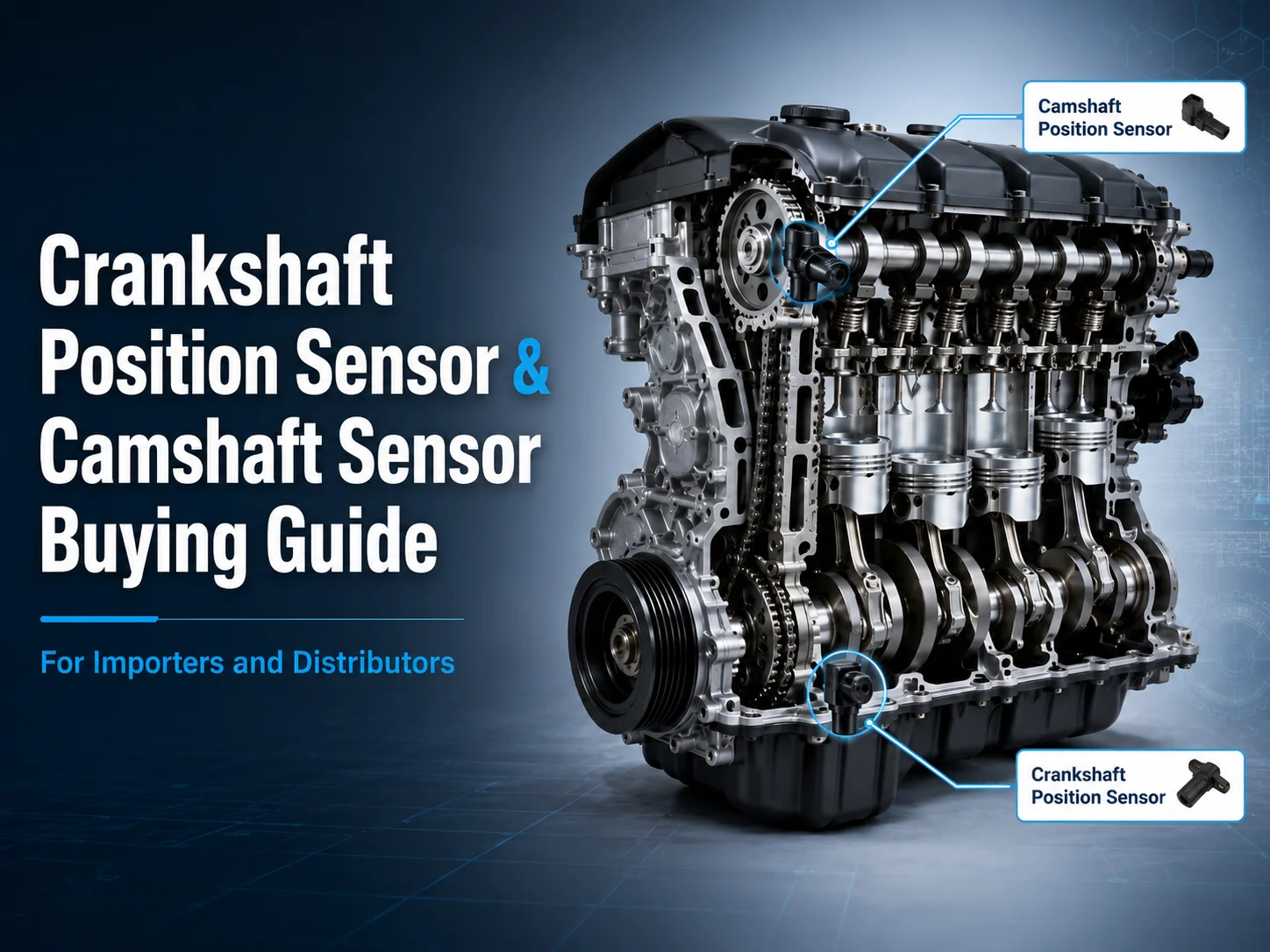
The crankshaft position sensor (CKP) sits near the bottom of the engine and reads the crankshaft's rotation [2]. It tells the ECU the engine's speed and exactly where the pistons are, down to top dead center. That signal is what the computer uses to time every ignition spark and every fuel injection. No CKP signal, no combustion.
The camshaft position sensor (CMP) sits near the top and reads the camshaft, which opens and closes the valves. It tells the ECU which cylinder is on the intake stroke and which is on the compression stroke, so the computer can sequence injection for each cylinder in the right order.
For an importer, the practical difference is in demand. The crankshaft sensor lives in a hotter, harsher spot and fails more often, so it is the high-volume, high-turnover SKU. The camshaft sensor is more stable, but its coverage is wider: a V6 or V8 engine carries more than one, so the number of camshaft part numbers you need grows with engine complexity.
Fact: KEHO supplies crankshaft position sensors (CKP) with OEM number matching, covering applications like the Mazda 323 and Haima Family, with a typical reference number of 5293161AA (per company data).
2. Why These Sensors Are Replaced in Pairs
A workshop will often replace the crankshaft and camshaft sensors together, and the reason is diagnostic rather than mechanical.
The two sensors share a failure symptom: an engine that will not start or stalls intermittently. When a car comes in with that complaint, the technician reads the codes, but the codes do not always point cleanly at one sensor. The crankshaft sensor is more likely to have failed, because it sits in the hotter location, but the camshaft sensor is cheap insurance while the job is already open.
That behavior shapes your catalog. Stock the crankshaft sensor in depth, because it is the part that sells on its own. Stock the camshaft sensor in breadth, because it sells as a companion part across many engine platforms. A distributor that only carries the crankshaft sensor walks away from every paired replacement that follows it.
Fact: KEHO's crankshaft position sensors start at a 1-piece MOQ with typical wholesale pricing of $ 3.80-5.20 per piece, so importers can test the SKU before committing to volume (per company data).
3. How to Index Your Catalog by OEM Number
These sensors are a textbook case for why vehicle-name cataloging fails. A "Mazda 3 crankshaft position sensor" is not one part: it varies by engine, year, market, and whether it is the crank or the cam sensor. The only structure that holds up is OEM number indexing.
The workflow is the same one we use across the engine systems catalog. Collect OEM numbers in batches, cross-reference each against vehicle make, model, year, and engine, and confirm the position: CKP or CMP. If you have not already read it, our guide on matching auto parts by OEM number is the method behind this step.
The position flag matters more here than almost anywhere else, because the two sensors share a vehicle platform but not a part number. A batch that does not separate CKP from CMP will come back wrong about half the time.
4. Symptoms That Map to SKUs
The fastest way to explain a position sensor catalog to your sales team is through symptoms, because that is how the customer describes the problem.
- Crank, no start. The engine turns over but never fires. This points at the crankshaft sensor first, since the ECU has no engine-position reference to time the spark.
- Stalls while driving. The engine dies at random, usually when warm. Both sensors can cause this, which is why the pair is often replaced together.
- Erratic or dead tachometer. The tach reads from the crankshaft signal, so a dead tach points directly at the CKP sensor.
- Rough idle. The ECU is working with a degraded position signal, so the mixture and timing drift.
Mapping these symptoms to SKUs does two things. It helps your team recommend the right part over the phone, and it tells you which SKUs to keep in depth: the crankshaft sensor carries most of the symptom volume.
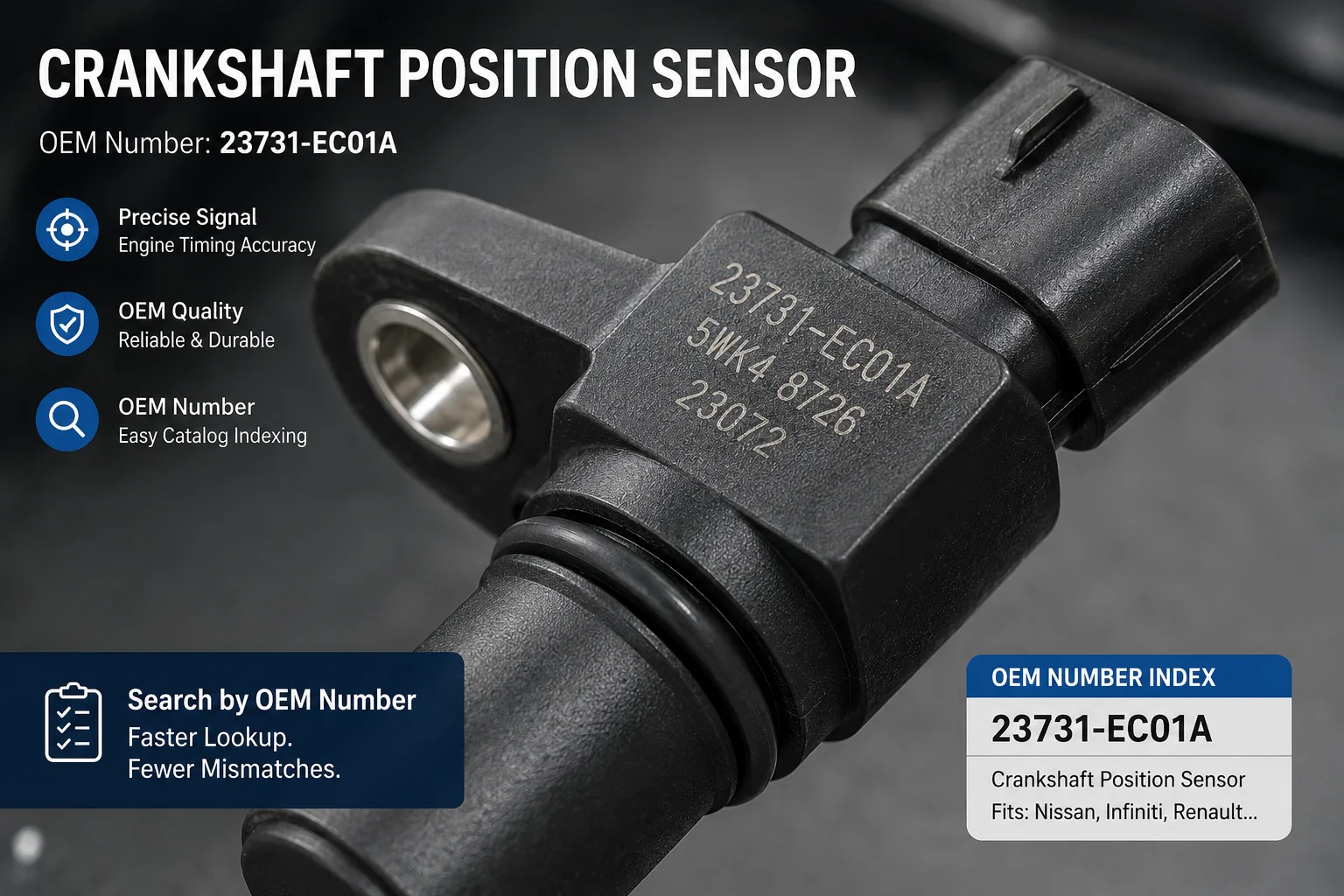 Index the catalog by the OEM number stamped on the sensor body, and flag every line CKP or CMP. That flag is the difference between a match and a return.
5. Crankshaft vs Camshaft Sensor: A Direct Comparison
| Factor | Crankshaft position sensor (CKP) | Camshaft position sensor (CMP) |
|---|---|---|
| Position | Bottom of engine, near the crank | Top of engine, near the camshaft |
| What it reads | Crank rotation, speed, top dead center | Camshaft position, valve timing |
| Signal used for | Ignition and fuel timing | Injection sequencing per cylinder |
| Failure rate | Higher (hotter location) | Lower |
| Typical unit price | Lower | Comparable or slightly higher |
| Coverage pattern | One per engine | Multiplies with cylinders and cams |
The comparison drives the stocking decision. The crankshaft sensor is the volume play: one per engine, fails often, sells on its own. The camshaft sensor is the coverage play: more part numbers per engine, steadier demand, sells as a companion. A balanced program carries depth on CKP and breadth on CMP.
6. Quality Checks for Position Sensors
Position sensors are small, cheap, and easy to counterfeit, which makes the quality check a real part of sourcing them.
Two technologies dominate: magnetic reluctance sensors, which generate their own signal from the rotating reluctor wheel, and Hall effect sensors, which need a power feed and switch in response to the reluctor [1]. The technology affects the connector and the signal shape, so a reboxed or substitute sensor usually fails either on the connector or on the signal.
The checks that catch this are simple. Confirm the connector matches the OEM reference exactly. On a bench, confirm the sensor produces a clean signal across the full rev range, not just at idle. And confirm the supplier can show a four-dimension fitment check before shipment. This is the same discipline we describe in our guide on vetting a Chinese auto parts supplier, applied to a part that is easy to get wrong.
Fact: KEHO's four-stage quality control and four-dimension fitment verification (OEM number, vehicle, year, engine) back a 99.2% on-time delivery rate across 50,000+ SKUs (per company data).
7. FAQ: Position Sensor Questions From Real Buyers
What is the difference between crankshaft and camshaft position sensors?
A crankshaft position sensor (CKP) tracks the crankshaft's rotation speed and position, telling the ECU when a piston is at top dead center so it can time ignition and fuel injection. A camshaft position sensor (CMP) tracks the camshaft to determine valve timing, so the ECU knows which cylinder is on the intake or compression stroke. They work together but are not interchangeable: CKP measures engine rotation, CMP measures valve position. For importers, they are two distinct SKUs on most vehicles.
What are the symptoms of a bad crankshaft position sensor?
The classic symptoms are a crank-but-no-start condition, the engine stalling while driving, an erratic or dead tachometer, rough idling, and diagnostic codes in the P0335-P0339 range. Because the crankshaft sensor sits in a hot area of the engine, it tends to fail more often than the camshaft sensor, which is why many workshops replace it first when both symptoms are present.
How do I find the right crankshaft position sensor by OEM number?
Match by OEM number, not by vehicle model alone. The OEM number identifies the exact sensor spec, including the connector style, mounting, and signal type. A supplier that cross-references the OEM number against vehicle make, model, year, and engine before dispatch removes most fitment risk. This is the same four-dimension method covered in our OEM number matching guide.
Are crank and cam position sensors the same part?
No. On most vehicles they are different parts with different functions, different connectors, and often different mounting points. Some older engines used a single combined sensor, but that is rare. Stocking one SKU and selling it for both positions is a common source of returns, so the catalog must keep CKP and CMP separate.
How many crankshaft position sensors does a car have?
Most vehicles have one crankshaft position sensor. The camshaft side is where the count varies: single-overhead-cam engines have one cam sensor, while V6, V8, and dual-overhead-cam engines have two or more. For importers, the practical point is that the crankshaft sensor is the high-turnover core SKU, while camshaft sensor coverage multiplies with engine complexity.
What happens when a crankshaft position sensor fails?
The ECU loses its reference for engine position, so it cannot time ignition or injection. In most cases the engine will not start at all, or it will start and then stall unpredictably. The failure is usually progressive: intermittent stalling first, then a hard no-start. Because the part is small and inexpensive relative to the diagnosis time, workshops often replace it preemptively at the first intermittent symptom.
8. Conclusion: Depth on CKP, Breadth on CMP
The position sensor category rewards a simple structure: keep depth on the crankshaft position sensor, which is the high-turnover core, and keep breadth on the camshaft sensor, which multiplies with engine complexity. Index both by OEM number, flag every line CKP or CMP, and verify the signal before it ships.
KEHO supplies both sensors with the same discipline we apply to the rest of the engine sensors line, including the oxygen sensors that sit alongside them in the engine management system. If you are building a position sensor program, start from the crankshaft position sensor product page and send your OEM number list for a fitment and pricing review.
Sources
- Total gaps: 2 | Resolved: 2 | Unresolved: 0
- Authority breakdown: Manufacturer 1 | Industry Media 1 | Company data 1
- [Haltech]. "Hall Effect or Reluctor?" haltech.com: Technical reference on Hall effect and magnetic reluctance sensor signal types used in position sensing.
- [Brake & Front End]. "Understanding the Differences and Challenges Between Crankshaft Position Sensors." brakeandfrontend.com: Industry technical reference on crankshaft position sensor operation and failure characteristics.
- [KEHO]. Company data: sensor coverage, reference numbers, pricing, MOQ, quality control, delivery rate. kehoauto.com: Company-reported figures marked "(per company data)" in the article body.