ABS Wheel Speed Sensor Codes (C0035-C0050): A Parts Coverage Map for Importers
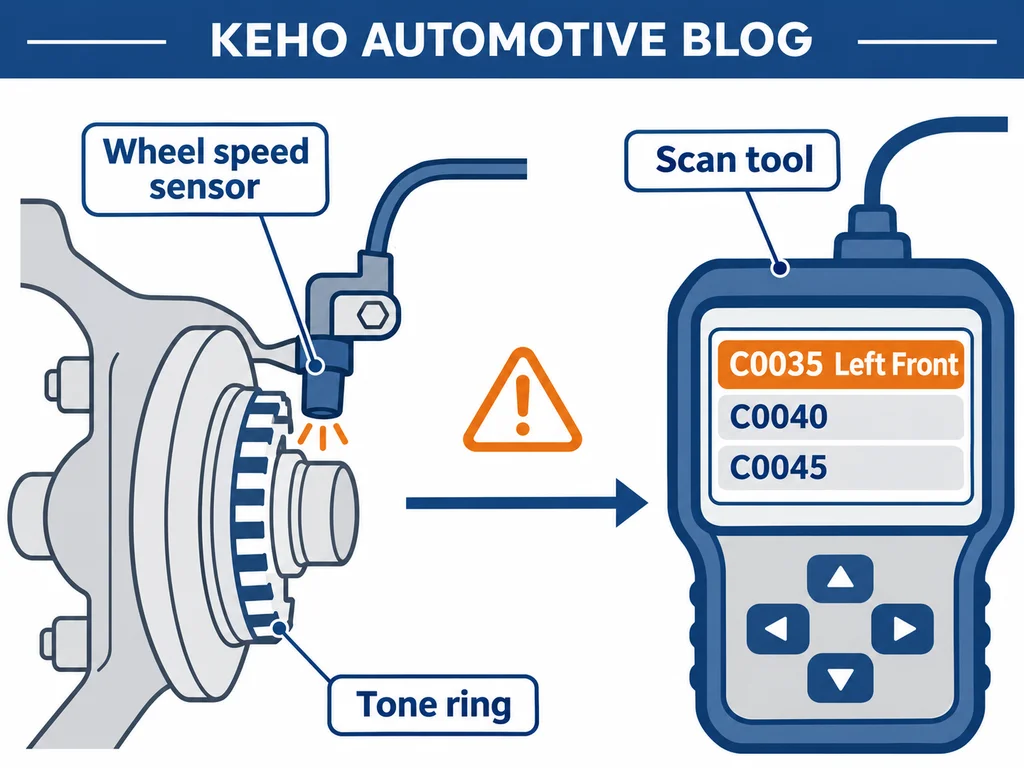
A distributor in Sharjah sent me a photo of a scan tool last month. Three lines on the screen: C0036, C0042, C0048. Three corners of one car, one order request. He did not ask what was wrong with the car. He asked which part numbers to put on the pallet and which ones to keep on the shelf.
That is how ABS work reaches a parts counter. The workshop reads a code, the counter converts it into a sensor, and the importer absorbs every mismatch as a return or a slow-moving SKU. The codes are not the problem. The gap between what a code says and what a part number covers is the problem. This map closes it for the C0035 to C0050 block.
Why ABS Codes Arrive as a Parts Order, Not a Repair Order
An ABS module cannot see a sensor. It sees voltage, current, and timing on a circuit it controls, and it reports what it does not like. That is why the wording sounds like a wiring problem and not like a failed component. Circuit low, circuit high, signal erratic are descriptions of an electrical condition on a wire pair, not a death certificate for a part.
The workshop knows this and still orders a sensor, because a sensor is the only field-replaceable item in that chain cheap enough to swap on spec. One part, one hour, one road test, and either the light goes out or the car goes to the auto electrician.
Your job is to make that first swap land correctly. The code gives you three things, and you should use all three before you open a catalogue.
First, a corner. C0035 to C0039 are left front, C0040 to C0044 right front, C0045 to C0049 left rear, and C0050 opens the right rear block. One number narrows a four-corner search to one corner, which is the difference between quoting one SKU and quoting four.
Second, a fault class. Open, short, high, low, range, performance, erratic. Each class has a different primary suspect, and section 3 lays them out.
Third, a repeat pattern. When the same corner comes back inside the warranty window, the sensor was never the fault. That is a fitment or installation problem, and it belongs in your QC conversation with the supplier, not in your returns ledger.
Fact: KEHO has built ABS and wheel-end parts on 6 production lines in Zhengzhou since 1995, 30 years of continuous production (per company data).
What the code never gives you is the part number. That comes from OEM matching: the code tells you where, the OEM number tells you which. If that distinction is new to your team, the OEM number matching method is worth reading before you build a list per code.
What the ABS Module Actually Watches
Four things sit between the road and the module: tone ring, air gap, sensor head, harness. Nearly every ABS code is the module complaining about one of those, or about the connector that ties them together.
The tone ring is a toothed wheel or a magnetized encoder turning at wheel speed. On older cars it is pressed onto the outer CV joint or the knuckle. On many modern vehicles it is molded into the bearing seal, so it is not a serviceable part. When that ring cracks or picks up a rust shadow, no sensor reads it cleanly.
The air gap is the distance from tip to ring. A sensor pushed into a rusty bore sits too far out; one hammered in grinds the ring. Both give the driver the same complaint: a light at low speed or after a bump.
The head is where the two families split. A passive inductive sensor makes its own AC voltage, rising with speed and fading toward zero as the wheel slows, which is why passive systems lose a wheel below walking pace. An active sensor takes a supply, typically around 12 V, and returns a square wave by switching current between two levels. It reads down to zero speed, which is what stability control needs.
The harness is the part everyone forgets. It runs from the knuckle to the body through a flex zone that twists with every steering input and every bump. Most intermittent ABS codes I have seen in fifteen years were born in that zone, not in the sensor head.
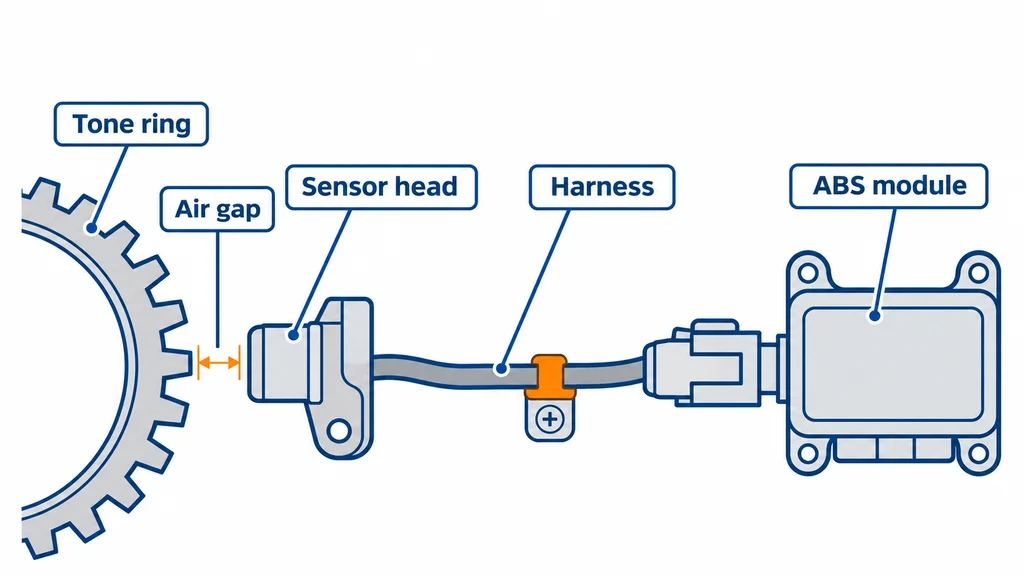 The signal chain behind every C0035 to C0050 code: ring, gap, head, harness, connector, module.
The Code Map: C0035 to C0050 by Function
Here is the block, corner by corner. The third column is the part I would quote first; the last is what to check before it ships.
| Code | What the module reports | First suspect part | Check before shipping |
|---|---|---|---|
| C0035 | Left front sensor circuit, general fault | Left front ABS wheel speed sensor | Keyway and pin count |
| C0036 | Left front circuit, range or performance | Left front sensor, then tone ring | Ring condition, rust shadow, debris |
| C0037 | Left front circuit, low input | Sensor or harness short to ground | Harness rub points at the strut |
| C0038 | Left front circuit, high input | Left front sensor, open circuit | Continuity through the flex zone |
| C0039 | Left front circuit, erratic signal | Left front sensor or air gap | Gap depth, bent mounting flange |
| C0040 | Right front sensor circuit, general fault | Right front ABS wheel speed sensor | Keyway and pin count |
| C0041 | Right front circuit, range or performance | Right front sensor, then tone ring | Ring condition, rust shadow, debris |
| C0042 | Right front circuit, low input | Right front sensor or harness short | Routing near the brake hose |
| C0043 | Right front circuit, high input | Right front sensor, open circuit | Pin tension at the body connector |
| C0044 | Right front circuit, erratic signal | Right front sensor or air gap | Gap depth, wheel bearing play |
| C0045 | Left rear sensor circuit, general fault | Left rear ABS wheel speed sensor | Harness length against the trailing arm |
| C0046 | Left rear circuit, range or performance | Left rear sensor, then encoder ring | Ring in the hub seal |
| C0047 | Left rear circuit, low input | Left rear sensor or harness short | Water ingress at the grommet |
| C0048 | Left rear circuit, high input | Left rear sensor, open circuit | Continuity at the axle flex point |
| C0049 | Left rear circuit, erratic signal | Left rear sensor or air gap | Debris on the ring, seal weep |
| C0050 | Right rear sensor circuit, general fault | Right rear ABS wheel speed sensor | Connector orientation, clip presence |
Two habits make it usable. Read the fault class before the corner: low and high are wiring words, so a sensor swap on a C0038 often leaves the real fault untouched. And never take a general circuit code as a sensor sale without the freeze frame, because speed at fault separates a gap problem at walking pace from a head or harness problem at road speed.
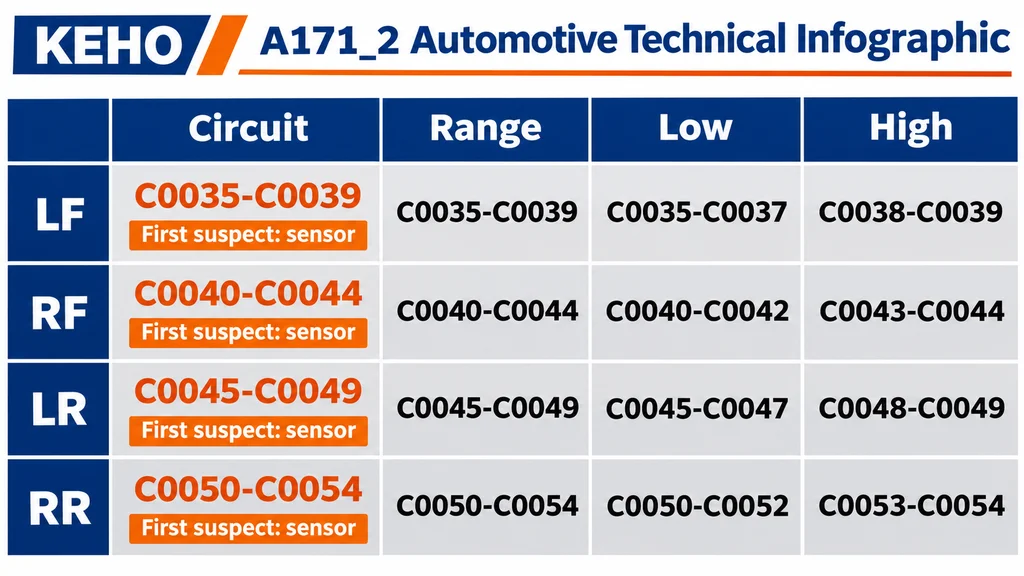 Code block to corner to first suspect: a mapping you can paste into a quotation template.
The family behind this table sits on our ABS wheel speed sensor range, indexed by OEM number, because a code is a location and a number is a part.
Three Failure Patterns That Decide the SKU
Most ABS returns I see fall into three patterns. The pattern, not the code, decides whether you ship a sensor, a hub, or a repair item.
Hard electrical failure. Open circuit, short to ground, short to power. The light stays on and the code is present at key-on before the car moves. The sensor or its harness is genuinely broken. Ship the sensor, but ask the workshop to flex the harness by hand while watching live data. If the reading jumps, the fault is upstream and your sensor will be the second one they fit.
Signal quality failure. Range, performance, erratic. The light comes and goes, often at low speed, over bumps, or in rain. The circuit is intact and the information is bad. Suspects are air gap, ring condition, and bearing play. This is the pattern that turns into a hub sale, because a cracked or corroded encoder ring inside a bearing seal cannot be repaired separately. My rule of thumb: erratic code plus more than roughly 150,000 km plus a salt-belt history means quote the hub and the sensor together.
Contamination and thermal failure. Grease, brake dust, water through a torn boot, heat soak near the caliper. The sensor works cold and drops out hot: a clean waveform at room temperature, a ragged one after twenty minutes at 120 C. Hot, dusty markets see this more often than European service data suggests.
The commercial point is simple. A sensor-only catalogue turns pattern two into a lost sale or a return. Add hubs matched to the same fitment and the fault becomes a two-line order, which is why we quote wheel hub assemblies next to the sensor range for bearing-integrated rings.
Front vs Rear, Left vs Right: Why Position Multiplies SKUs
Sixteen codes, four corners, one number each. That is the arithmetic nobody warns a new importer about: one platform can carry four sensor numbers, a full range forty.
Position multiplies SKUs for four reasons. Harness length grows front to rear as the body connector moves away. Routing differs left to right, one side passing the brake hose, the other the strut. Keying stops a left harness plugging into a right socket. Mounting geometry follows knuckle casting, flange depth, and bolt angle.
| Corner | Harness reality | Connector reality | Typical ordering mistake |
|---|---|---|---|
| Front left | Short run, high steering flex | Keyed body, clip on the strut | Right front sensor sent as a substitute |
| Front right | Mirror routing past the hose | Same housing, opposite keyway | Clip missing, harness chafes in service |
| Rear left | Long run along the trailing arm | Grommet through the body panel | Front sensor quoted for a rear code |
| Rear right | Long run, tight bend at the arm | Same family, different index | Wrong length, cable tie fix, repeat code |
| Rear, AWD | Extra length for diff travel | Sealed pass-through | Two-wheel-drive part sent for an AWD car |
The AWD row is where most of my customer conversations end up. A rear sensor that fits a front-drive car can match at the head and still be wrong for an AWD car, because suspension travel and the diff housing change the routing. The code does not name the drivetrain. The VIN does.
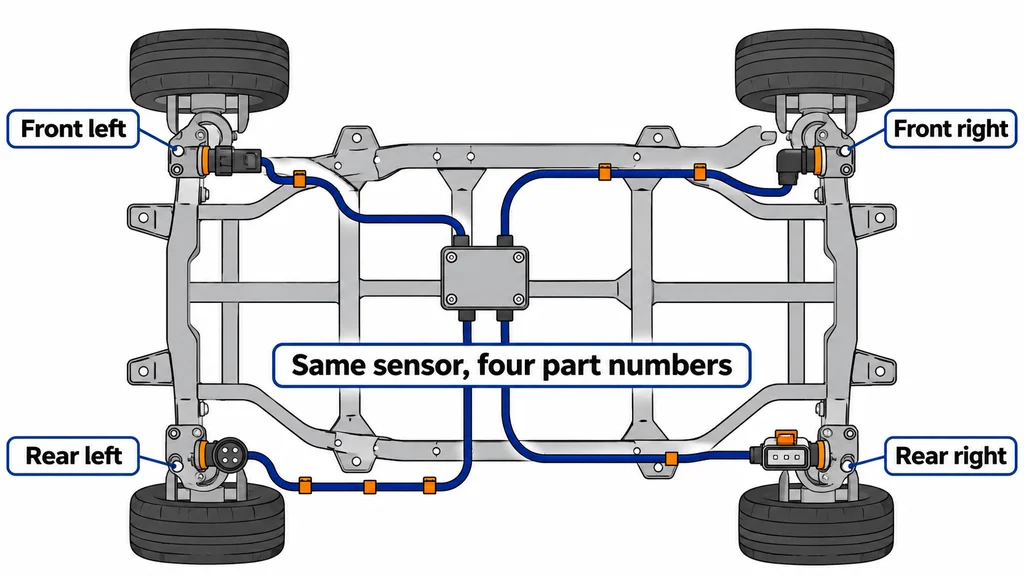 One code family, four positions, four part numbers, before drivetrain variants are counted.
Build coverage as a matrix: corner on one axis, platform on the other, cells filled from OEM data. A flat list of sensors hides the holes. When a workshop sends C0049 and you answer with a front sensor, that is not a stock problem, it is a matrix problem.
What a Distributor Should Hold per Code Family
Stocking by code family beats stocking by brand, because the code family is what the counter sees first. The order in which you build depth matters more than the depth itself.
Start with the front corners: they fail more often, they are faster to replace, and one number often covers several model years. Then add the rear pair for platforms you already sell, then drivetrain variants, then hubs for bearing-integrated fitments, a different family with a different capital profile.
| Stage | What to add | Why this order |
|---|---|---|
| 1 | Front left and right sensors for your top platforms | Highest turnover, lowest fitment risk |
| 2 | Rear left and right for the same platforms | Completes the four-corner answer for one car |
| 3 | AWD and drivetrain variants | Stops the fits-but-wrong return |
| 4 | Hubs with integrated encoder rings | Converts erratic codes into a two-line order |
| 5 | Connector and harness repair items | Saves the sale when the sensor is not the fault |
Two ratios keep the shelf honest. Hold one part number per active fitment per corner, and let depth follow actual movement rather than a supplier carton size. Review the bottom decile every quarter and cut what has not moved twice. A wide list full of dead cells looks good in a catalogue and costs cash in the warehouse.
Fact: KEHO supports 50,000+ SKUs, ships to 80+ countries, serves 2,000+ active customers, and holds 99.2% on-time delivery, with standard orders shipping in 15-25 days (per company data).
Breadth only helps if the catalogue is indexed the way a counter thinks. Ask for an ABS list sorted by corner and OEM number. If a supplier cannot produce one, you rebuild the matrix every season.
Quality Checks Before You Commit
A wheel speed sensor is a small part with a short failure list, and every item on it is visible before you place an order. Here is what I check on a sample, in order.
Harness jacket. Bend the cable 90 degrees twenty times where it leaves the overmold. A jacket that whitens or cracks there fails in a steering flex zone within a season. Ask for the compound, TPE or PVC, and for an abrasion test result rather than a description.
Overmold bond and seal fit. Try to lift the plastic at the head with a fingernail. Any gap between overmold and metal insert is a water path, and water in the head is the second most common field failure I see after harness damage. The O-ring should sit in its groove without stretching and compress when the sensor seats, so measure groove depth against the OEM drawing.
Terminal plating and latch. Tin is normal, gold shows up on some low-current signal pins. The latch matters more: a connector that clicks once and holds is the difference between a repair and a comeback.
Bench waveform. Spin the sensor against a ring at a known speed and watch the output. A passive unit should build amplitude smoothly with speed. An active unit should switch cleanly between its two current levels with no dropouts. Sweep the air gap and note where the signal degrades.
Fact: Every KEHO order passes four inspection stages: incoming check, in-process patrol, packaging inspection, and pre-shipment review, backed by a 12-24 month warranty (per company data).
Temperature and vibration. Ask for thermal cycling that covers the range your market actually sees, not a lab default. Gulf importers should insist on the hot end; northern European importers on the cold end and salt spray.
If a supplier answers these six questions with documents, you have a partner. If the answers arrive as adjectives, you have a broker. Our ABS sensor buying guide covers the list in more depth, and the contact page is where to send a fitment question with a VIN.
Reading Codes Across Markets: US, EU, and Asian Scan Tools
The same physical fault produces three different strings on three tools, and that is where cross-market orders go wrong.
A US tool on a GM vehicle shows C0035 to C0050 as listed here. The C prefix marks a chassis code, and the numbering block is manufacturer-defined inside the SAE J2012 framework that most scan tool databases are built on. A European tool on the same car often shows a manufacturer code such as 5DF0, or a text line like "wheel speed sensor front left, implausible signal." An Asian tool may show no number at all, only a description and a freeze frame.
Two consequences. Always ask for the code number and the freeze frame, not the description, because descriptions are translated and sometimes wrong. And when a customer sends text only, ask for the corner and the OEM number before quoting. The corner is in the text; the number is not.
One trap is worth knowing. A generic P0500 vehicle speed sensor code is a powertrain code about a signal the engine controller wants, not a C0035 circuit fault. Shops mix these up constantly. If a customer quotes P0500 and expects an ABS sensor, ask which module stored it.
The framework has limits. SAE J2012 defines structure and many generic definitions, ISO 15031-6 covers the same ground internationally, and SAE J1930 governs terminology. None of them say which part fits a 2014 compact SUV. That comes from OEM data, which is why our other maps, the crankshaft and camshaft position code map, the oxygen sensor fault code guide, and the misfire diagnostic code guide, end at the same instruction: code to corner, corner to OEM number, then fitment.
Frequently Asked Questions
What does code C0035 mean on an ABS scan tool?
C0035 reports a fault on the left front wheel speed sensor circuit. Read it as a location plus a fault class, not a diagnosis. Before you quote, confirm three things: whether the code is present at key-on, whether it appears only below walking speed, and whether live data drops out over bumps. Those answers separate a sensor sale from a harness job.
How do I know whether an ABS code needs a sensor or a wheel hub?
Start with the fault class. Open, short, high, and low codes point at the sensor or harness. Range, performance, and erratic codes point at signal quality: air gap, ring condition, bearing play. Past roughly 150,000 km with a bearing-integrated ring, an erratic rear code is often a hub. On a low-mileage car with a clean ring, it is usually the sensor or its connector.
Can I replace a wheel speed sensor without replacing the hub?
On many vehicles, yes. Where the tone ring sits on the outer CV joint or on a separate ring pressed to the knuckle, the sensor is a standalone service part. Where the encoder is molded into the bearing seal, a new sensor can restore the circuit and still leave a bad signal. Quote both lines and let the workshop choose. Showing the option prevents a return.
Is C0035 the same part on every vehicle?
No. The number identifies a corner and a circuit, not a component. Two vehicles can both log C0035 and need sensors with different harness lengths, keyways, flange depths, and output types, one passive and one active. Matching on the code alone is the most common cause of wrong-part shipments here. Match on OEM number, then confirm year, model, and drivetrain.
Do ABS wheel speed sensor codes need to be cleared after replacement?
Usually the module clears them once it sees a plausible signal from all four wheels during a drive cycle. If a stored code survives two ignition cycles and a road test, the fault is still live and the part did not fix it. That matters commercially: a warranty claim without a road test result is hard to defend and hard to reject. Ask customers for the post-repair scan, not just the complaint.
Why does the ABS light come back after a new sensor is fitted?
Four causes cover most cases. The connector was pinned wrong or not latched. The harness was pinched at the strut or trailing arm. The air gap is out of range from rust in the bore or a bent flange. The ring is cracked, corroded, or packed with debris. All four are installation or wear issues, not defects, which is why a supplier should ask for photos before opening a claim.
Sources
- National Highway Traffic Safety Administration, 49 CFR 571.126, Electronic stability control systems for light vehicles. https://www.ecfr.gov/current/title-49/subtitle-B/chapter-V/part-571/subpart-B/section-571.126
- National Highway Traffic Safety Administration, 49 CFR 571.101, Controls and displays, including ABS and ESC malfunction telltale requirements. https://www.ecfr.gov/current/title-49/subtitle-B/chapter-V/part-571/subpart-B/section-571.101
- SAE International, J2012, Diagnostic Trouble Code Definitions. https://www.sae.org/standards/content/j2012_201208/
- SAE International, J1930, Electrical/Electronic Systems Diagnostic Terms, Definitions, Abbreviations, and Acronyms. https://www.sae.org/standards/content/j1930_202005/
- U.S. Environmental Protection Agency, On-Board Diagnostics program overview. https://www.epa.gov/obd
- National Highway Traffic Safety Administration, Driver assistance technologies overview. https://www.nhtsa.gov/equipment/driver-assistance-technologies
- Wikipedia, Anti-lock braking system. https://en.wikipedia.org/wiki/Anti-lock_braking_system
- Wikipedia, On-board diagnostics. https://en.wikipedia.org/wiki/On-board_diagnostics