Auto Parts Payment Terms: T/T, L/C and Deposit Structures
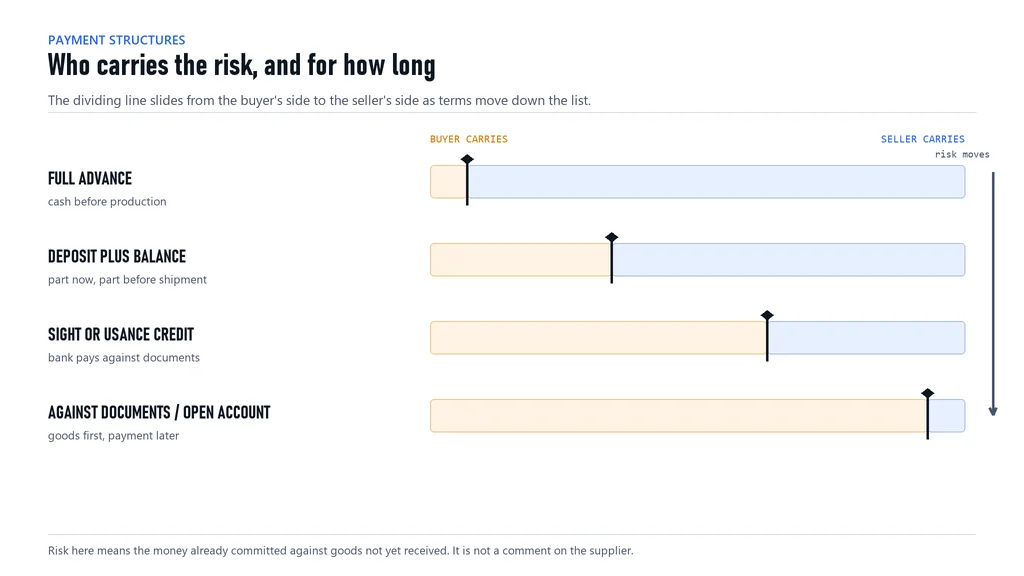 Four structures, one question: when the money leaves, what is still standing between it and the goods?
1. The Cost Line That Never Reaches the Quotation
A quotation for a fuel injector states the unit price, the MOQ ladder and the delivery term. It rarely states what the money costs while you wait, or what it costs if the goods are wrong when they land.
Three costs sit behind every set of auto parts payment terms, and none appears on the invoice. The first is capital time: money paid at order confirmation is unavailable for the length of the production and transit cycle. Multiply the amount by days outstanding and by your own cost of capital, and the result often exceeds the price difference three rounds of email were spent negotiating.
The second is the currency window. A payment made today converts at today's rate; a payment made at shipment converts at whatever the rate is then. Stretching terms lengthens that exposure, a benefit if the rate moves your way, a cost if it does not, and never neutral.
The third is non-performance. A deposit paid to a supplier who stops answering is not a commercial dispute in any practical sense, because cross-border litigation usually exceeds the claim at the order sizes most importers work in.
Payment terms also decide leverage after signing: whoever still holds money holds the conversation. Once the balance is paid, the remaining instrument is the warranty clause, and a claim is slower and weaker than an unpaid invoice. Ranking competing offers is a separate exercise, covered in the quotation comparison guide.
Fact: KEHO has manufactured and exported auto parts since 1995, now serving importers in 80+ countries, with ISO/TS 16949 certification held since 2012 alongside CE marking and SGS third-party verification (per company data).
2. Four Structures and the Four Places Risk Can Sit
The four structures importers meet most often are not rungs on a ladder from reckless to safe. They are four placements of the same risk, and each placement costs something. Which one applies is a matter for the contract and, where a bank is involved, that bank's practice.
Full advance. The whole value is paid before production. The buyer carries performance, quality and timing risk. Sellers ask for it because it finances raw material and removes credit risk, which is why it appears on custom tooling and first orders from a buyer nobody has checked. It fits very small values, where any instrument costs more than the risk.
Deposit plus balance. A split at a defined point, with risk shared but not symmetrically. Before the split the buyer is exposed to the deposit; once goods are finished, the seller is exposed to a buyer who refuses the balance. That exposure is real, which is why sellers accept the structure only where the balance is secured by control of the transport document or by a trading history.
Documentary credit, at sight or at usance. The bank substitutes its undertaking for the buyer's promise, conditional on a complying presentation. Payment risk moves onto the issuing bank's obligation, a genuine improvement over a promise from a company you have not audited. Everything else stays: a credit pays against documents that describe goods, not against goods that work. A sight credit pays on presentation; a usance credit pays at a stated future date, which turns the instrument into financing and moves the cost of waiting onto whoever discounts it.
Against documents, on delivery, and open account. The seller ships first. Cash against documents asks the buyer to pay when the document set is presented, which gives the buyer a look at the shipment but the seller nothing beyond control of the transport document. Open account, and the consignment variant where goods sit with the buyer before invoicing, place almost all risk on the seller, and are extended against a track record, insurance or a group relationship.
| Structure | What triggers payment | Non-payment risk sits with | What the buyer still carries |
|---|---|---|---|
| Full advance | Order confirmation | Buyer, entirely | Performance, quality, timing |
| Deposit plus balance | Deposit at order, balance at an inspection or document event | Split; moves to seller as production completes | Loss of the deposit |
| Sight documentary credit | Complying presentation of documents | The issuing bank's undertaking | Goods that comply on paper but not in the box |
| Usance or deferred credit | Complying presentation, paid later | The issuing bank, plus financing cost | Conformity judged from documents |
| Cash against documents | Presentation of the document set | Seller until payment clears, buyer afterwards | Quality and count at arrival |
| Open account | Agreed credit period after shipment | Seller throughout | Nothing documentary |
3. Where the Deposit Ends and the Balance Begins
Nothing in this section is a recommended percentage. The right split is a function of what each side can afford to lose and what each tranche can prove. It is negotiated order by order, and the only defensible statement about the number is that the parties agree it.
The rule that survives contact with real disputes: every tranche should buy a verifiable event, and the final tranche should buy a document the buyer can check without the seller's cooperation.
Work through the events in sequence. Order confirmation and material release come first, and is costly for the seller because material and production slots are committed. Pre-production sample approval matters when the part number is new, since it turns a drawing into a physical reference. Completion of production is an event only if someone independent confirms it. Handover of the transport document is the first point at which the buyer can verify that goods exist and are moving. Arrival inspection is the last point at which the buyer can still influence payment.
Two failure modes account for most arguments. The first is a tranche that buys nothing verifiable, typically a balance due before shipment, which the seller alone controls. The second is a final tranche so small that it no longer motivates performance.
Sizing follows the same logic rather than an industry norm. Ask what you would lose if the supplier stopped answering the day after the deposit cleared, and whether that is recoverable by a route you would realistically use. If the answer is uncomfortable, the problem is upstream in supplier verification, not in the percentage. For a low-value trial, a fixed sum is often cleaner than a share, because a small percentage costs more to administer than it protects.
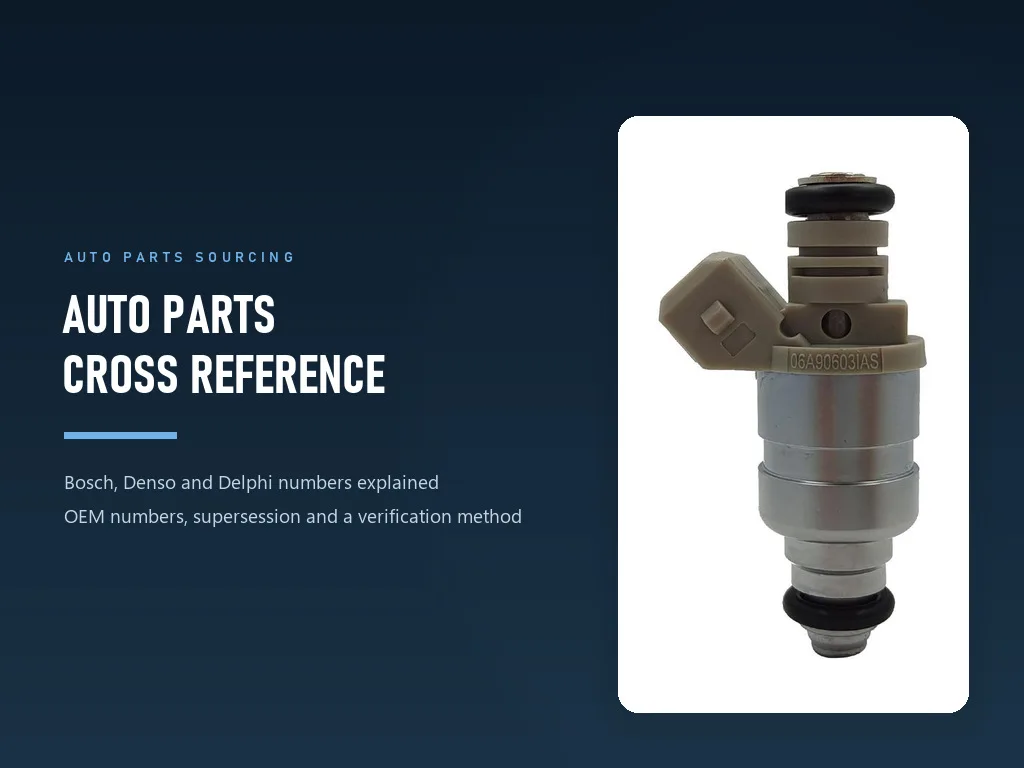
On a made-to-order fuel injector lot, the inspection that makes a balance tranche meaningful has to be specific: a sample drawn from the production lot, a flow and spray pattern check, lot marking on units and cartons, and packaging that matches what was agreed. A report saying the goods look acceptable gives the tranche nothing to hang on. A report from the seller is a photograph.
4. Letters of Credit: The Documents Decide, Not the Goods
A documentary credit is an undertaking to pay against a complying presentation. Banks examine documents, not goods, and are in no position to judge whether an injector flows correctly.
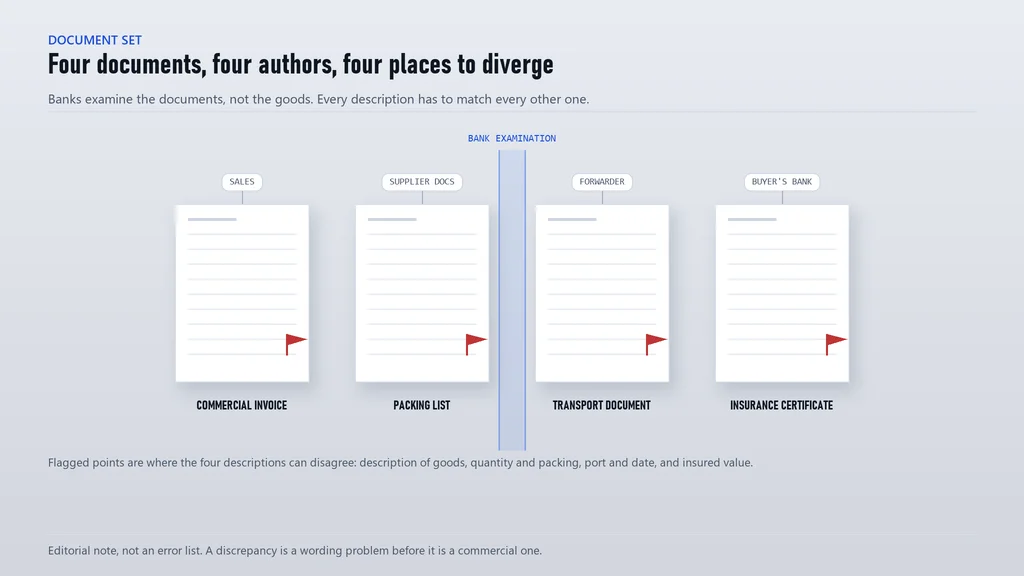 Four documents, four authors, one credit that must agree.
That fact explains most of what goes wrong. In practice discrepancies are the most common reason presentations are refused, and they are usually editorial rather than commercial. The proforma invoice is drafted by a salesperson, the credit application by the buyer's bank, the transport document by a forwarder, the invoice by a supplier's documents clerk. Four authors, four descriptions of one shipment, and a credit that requires them to agree.
The recurring discrepancies are unglamorous: shipment after the latest shipment date; a goods description that does not match the credit wording; a transport document without an on-board notation; insurance in the wrong currency or coverage basis, or dated after shipment; presentation after the presentation period has run; missing endorsements; quantity or amount outside tolerance; port names that differ from the credit; and a certificate the credit requires that no party issued.
A discrepancy costs more than the refusal. Goods sit at the destination while paperwork is corrected, storage accrues, and the buyer is asked to accept the discrepancy and pay outside the credit, which returns the transaction to where it started with demurrage added. A credit can create a failure mode of its own: conforming goods that cannot be paid for on time.
Soft clauses deserve separate attention. A soft clause makes payment depend on an act by the buyer or an event the seller cannot control, dressed as a document requirement. The pattern, described without reproducing wording: payment conditional on an inspection certificate issued by the applicant's representative, where the applicant decides who signs; effectiveness conditional on the buyer obtaining an import permit; a charge clause allowing costs to be deducted from the credit amount. The test is simple: can the seller alone satisfy this condition, using documents it can obtain? If not, the credit is a promise with a switch on the buyer's side of the table.
The practical defence is procedural and cheap: ask for the draft before the credit is issued, and have whoever prepares the documents compare it against the proforma invoice and the forwarder's list. Where a credit is used, the governing rules are the ICC's Uniform Customs and Practice for Documentary Credits, currently UCP 600, but their application is a question of the individual bank's practice, and what binds the parties is what the credit and the contract say.
5. Matching the Structure to the Production Path
Auto parts orders arrive in two shapes with two different clocks, and one structure rarely suits both.
The standard production path runs 15 to 25 days. The window is short enough that a deposit's exposure is bounded by time as well as amount, and a split tied to a pre-shipment inspection fits naturally: the inspection can be scheduled days before shipment, and the seller's exposure to a refused balance is one order of finished goods. A documentary credit is workable when the order value is large relative to the buyer's credit line or when the buyer's bank requires one, and its documentary cost weighs less on a full container than on two cartons.
The 48 hour stock path has no production window at all, so a split buys nothing. Dividing a stock order into deposit and balance adds two transfers and a waiting period to a shipment already on a shelf. Payment at dispatch, against dispatch documents, or on a running account where there is history suits that clock. A stock order commits inventory rather than capacity, so the term turns on how much consignment risk the seller will carry. The stock order versus production order comparison sets out how the two clocks are quoted.
The mixed cart is where structure gets sloppy. If a shipment holds stock and made-to-order lines, one structure across the whole invoice means either prepaying stock to secure production, or financing production because part of the cart was on a shelf. Split the invoice by line type. A container of in-stock ignition coils alongside a made-to-order injector set is the ordinary case.
Fact: KEHO holds 50,000+ SKUs, dispatches in-stock items within 48 hours, ships standard production orders in 15 to 25 days, and backs parts with a 12 to 24 month warranty (per company data).
6. Currency: The Clause Nobody Reads Until the Rate Moves
Every payment term implies a currency, and every currency implies that someone carries the movement between pricing and settlement. Invoice in the seller's currency and the buyer carries the exposure. Invoice in the buyer's currency and the seller carries it, which the seller prices in. Invoice in a third currency and both sides carry it, in opposite directions.
Whichever allocation is chosen, the clause needs five things to be a term rather than a word: the invoicing currency; the reference rate source; the date and time of fixing; who bears conversion charges; and a tolerance band within which neither side reopens the price, with what happens outside it stated. A contract that names a currency and stops there has left the contested part to be argued when payment falls due.
Two ways reduce the exposure, and they are not mutually exclusive. Matching the invoicing currency to your own revenue is the cheapest cover, because the position nets out inside the business. Otherwise the exposure can be priced into the unit price or covered forward with a bank, on terms that bank sets.
For a buyer earning in another currency, a longer term is also a longer currency position. That is the second reason terms are not free.
7. Tools That Change the Risk Without Changing the Price
The instruments below are concepts only: availability, cost and legal effect differ by jurisdiction and counterparty, and each covers a specific risk rather than all of them.
- Third-party inspection before shipment. Covers the risk that goods do not match the approved sample. Does not cover the seller's solvency.
- Pre-shipment inspection with a defined document set. Converts a quality question into a documentary one while you still hold the balance, the only point where that conversion has value.
- Credit insurance. Covers non-payment by the buyer, as commonly structured against insolvency and protracted default. Does not cover quality or delay.
- Staged shipments. Divides one large exposure into several smaller ones, each released against its own payment. Costs freight and administrative time.
- Bank guarantee or performance bond. Puts a bank between the buyer and the seller's non-performance, for a fee and usually against collateral.
- Counterparty checks. Registration data, trade references, a site visit, and a look at who signs the contract. The cheapest tool here, and the only one that works before the deposit leaves.
None of these makes a transaction risk free. Each moves a named risk to a party paid to hold it, and what is worth paying depends on order value, the relationship and the seller's law. Where a claim route matters more than prevention, the warranty claims and returns process describes what happens after the goods are yours.
Fact: KEHO operates at $ 50M+ annual output value with 2,000+ active customers and a 99.2% on-time delivery rate (per company data).
8. The Payment Terms Checklist
| Structure | Buyer risk | Seller risk | Where it fits |
|---|---|---|---|
| Full advance | Total: non-delivery, wrong goods, no recovery route | None on payment | Very small values, tooling, unverified suppliers |
| Deposit plus balance | Loss of deposit if the order fails | Refused balance on finished goods | Production orders with an inspection point |
| Sight documentary credit | Goods conform on paper only; discrepancy delays | Discrepancy risk and document cost | Large orders, new counterparties |
| Usance or deferred credit | As above, judged later | Discount cost if payment is accelerated | Repeat programs wanting a financing window |
| Cash against documents | Quality and count risk at arrival | Non-payment after shipment, limited by document control | Established relationships |
| Open account | Minimal until payment falls due | Full credit risk for the credit period | Long-term programs with insurance behind them |
Questions worth written answers:
- Which tranche buys which event, and what document proves the event happened?
- Can the final tranche be released only against a document I can verify without the seller?
- If the seller stops answering after the deposit clears, what is my recovery route and its cost?
- If I refuse the balance, what is the seller's recourse, and does the contract say so?
- Which currency, fixed at which date and by which rate, and who pays conversion?
If you are structuring terms on a specific order, the fastest route is to put part numbers, quantities and the delivery date in front of the supplier and ask for a structure matched to the production path rather than a template. Start at the contact page, or check availability across the fuel injector and ignition coil ranges, where stock and made-to-order lines run on different clocks.
FAQ
What are the most common auto parts payment terms?
T/T in advance, deposit plus balance by T/T, documentary credit at sight or at usance, and payment against documents or on open account. Which one a supplier offers tracks order value, whether the part is stock or made to order, and how long the two companies have traded. Ask for the structure in writing.
What payment terms should I use for a first order with a new supplier?
One where your exposure at any moment is bounded by something you can verify, which in practice means at least two tranches with a pre-shipment inspection between them, so the larger payment is released against evidence rather than a promise. Confirm the scope, the document set and the currency first.
Who pays the letter of credit fees?
Charges are allocated by the credit itself and by the agreement between buyer and seller, not by a universal rule. Issuing bank charges normally sit with the applicant, the buyer, and advising or negotiating charges with the beneficiary, the seller, but credits often state otherwise, and discrepancy charges usually fall on whichever side caused them. Read the charge clause before issuance.
Can I get open account terms from a Chinese auto parts supplier?
Possible after a track record, and rare before one. Open account means the seller ships before payment and waits, carrying your credit risk with no documentary security. Suppliers extend it after several settled orders, sometimes against credit insurance or a bank guarantee. A first order on open account should prompt you to ask what the seller is relying on.
Should a deposit be a percentage or a fixed amount?
It depends on order value. A percentage scales with the order and is the usual form for production orders. For a low-value trial a fixed amount can be cleaner, because the transfer costs the same either way and a small percentage produces a figure not worth tracking. Tie either form to a stated event, not a calendar date.
Does a letter of credit protect me if the parts are wrong?
No. A credit pays against documents that comply with its terms, and documents describe goods rather than test them. It lowers the risk that you pay and receive nothing that clears customs; it does not lower the risk that the parts fail on the bench, which is handled by inspection and a warranty clause with a defined claim route.
Can payment be tied to an inspection report?
Yes, and it is one of the more useful structures available to an importer. The balance becomes payable on presentation of a report issued by a party the buyer appoints, against a scope agreed before production. It only works if the scope is specific and the inspector's access is written into the contract.
Conclusion
Payment terms do not change what a part costs. They change what the money costs, who holds it while the goods are made, and how much recourse remains when something goes wrong. The four structures are not safe and unsafe options but four placements of the same risk, and the placement should follow the production clock, the value at stake and how much of the counterparty you have verified.
The work that pays is narrow. Fix the cut points to events rather than dates. Make the last tranche buy a document you can check alone. Read the credit before it is issued. Write the currency clause in five parts. Everything else depends on the order, the counterparty and the applicable law, and belongs in the contract.
Sources
- International Chamber of Commerce, "ICC to wrap up new documentary credit rules this year" (background on UCP 600 as the ruleset for documentary credits): https://iccwbo.org/news-publications/news/icc-to-wrap-up-new-documentary-credit-rules-this-year/