Every auto parts importer eventually learns the same lesson the expensive way. A buyer sends a vehicle model name: "injectors for a 2015 BMW 320i," or "coils for a Toyota Corolla." The supplier ships parts that look right. They arrive, get installed, and do not work. The connector is different, the flow rate is off, the bracket does not line up. Now you are paying return freight on a container, holding dead stock, and explaining to a customer why the "correct" part was wrong.
The fix is one discipline: match parts by OEM number, not by vehicle name. This guide explains what an OEM number actually is, how to read and verify it, and how to demand the right fitment data from a supplier before money changes hands. It is written for importers and distributors who buy in bulk, where one wrong reference does not cost a single return: it costs a shipment.
1. What Is an OEM Part Number?
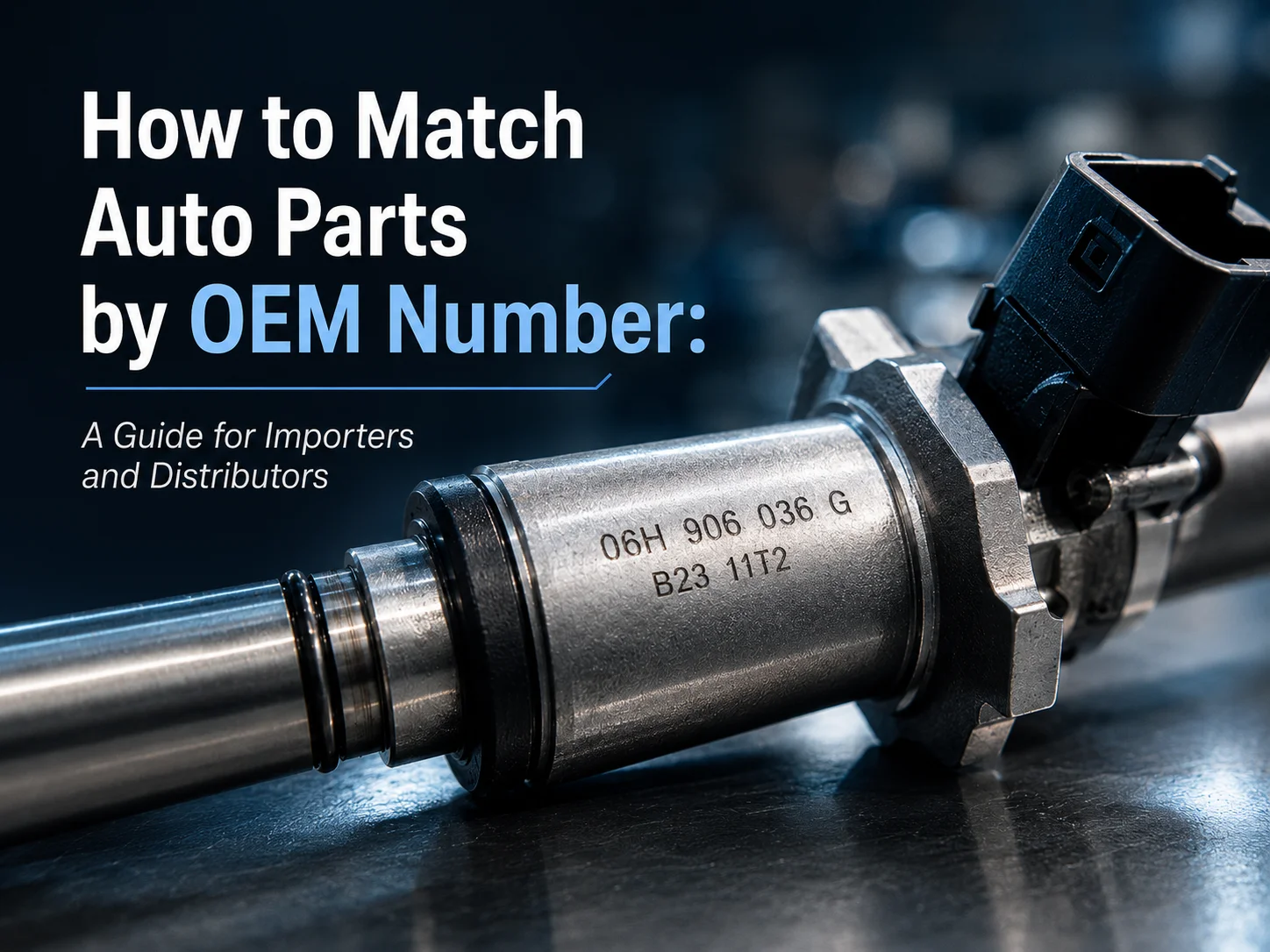
An OEM part number is the reference code the original equipment manufacturer assigns to a specific factory-fitted part [3]. It is stamped on the part body, printed on the original packaging, and listed in the vehicle maker's parts catalog. The code identifies one exact component: its dimensions, connector type, electrical spec, and the production period it was designed for.
The reason this number matters more than a vehicle name is simple. A single model like a BMW 3 Series or a Toyota Corolla can ship with dozens of engine, trim, and market variants over its production life. The same model sold in Germany and Brazil can use different injectors, different sensors, and different coils, because emissions rules, fuel quality, and local content requirements all change the part spec. A vehicle name gets you to the neighborhood. An OEM number gets you to the exact door.
For an importer, this is not a technicality. It is the difference between a catalog that holds up at volume and one that generates returns. When you build your sourcing workflow around OEM numbers, every inquiry starts with a precise, verifiable reference instead of a vague description.
Fact: KEHO has matched auto parts by OEM number for importers across 80+ countries since 1995, holding ISO/TS 16949 certification (since 2012), CE marking, and SGS third-party verification (per company data).
2. OEM vs Aftermarket Part Numbers: What the Distinction Actually Means for Buying
The market uses "OEM number" and "aftermarket number" in ways that confuse importers. Here is the clean distinction.
An OEM number is assigned by the vehicle manufacturer (or its Tier-1 supplier, such as Bosch, Denso, or Delphi) to the factory part. It is the reference that appears in the automaker's own parts system.
An aftermarket number is a replacement brand's own code. The aftermarket maker builds a part to fit the same application, then maps its number back to the OEM reference through an interchange table. The aftermarket part may be functionally identical, or it may be a close approximation: same fitment, slightly different material or electrical tolerance.
For a bulk buyer, the practical question is not "which is better." It is "how is this number verified?" A supplier that can show you the OEM cross-reference behind an aftermarket number is giving you traceability. A supplier that only quotes its own internal part code is asking you to trust the mapping without evidence. Demand the OEM number as the anchor, then treat any aftermarket alternative as a derivative that must trace back to that anchor.
3. How to Find and Read an OEM Number
The OEM number is not always where a beginner looks. Here is where to find it, and what the format tells you.
On the part itself. Most factory parts carry the number stamped, molded, or laser-etched on the body. On a fuel injector, it sits on the metal housing. On a sensor, it is printed on the connector or the barrel. On a coil, it is on the bracket or the boot. This is the most reliable source, because it comes from the part that is actually in the vehicle.
On the original packaging. The factory box and label repeat the number. For importers receiving samples, photograph both the part stamp and the box label: they should match, and a mismatch is an early red flag.
In the service documentation. The vehicle maker's parts catalog, workshop manual, and electronic parts system all list the OEM number against the vehicle VIN. This is how you confirm the part a specific car actually left the factory with.
Through a VIN. Many public parts systems and dealer catalogs accept a 17-character VIN and return the exact factory part numbers for that specific vehicle. This is the highest-confidence lookup for a single car, and a useful independent check when a supplier's catalog disagrees with your own data.
Formats vary by manufacturer. BMW uses 11-digit codes (for example, 12120039664). Volkswagen and Audi use 9-digit codes with a letter suffix. Bosch and Denso use their own 10-digit sequences. The lesson is not to memorize formats: it is to always capture the number exactly, including dashes and letter suffixes, because a single transposed digit can point to a different part entirely.
4. How to Verify Fitment: The Four-Dimension Check
Having the OEM number is necessary but not sufficient. A number alone will not catch a stale catalog, a re-boxed part, or a missed supercession. That is why importers verify fitment across four dimensions, not one.
| Dimension | What It Confirms | Why It Matters |
|---|---|---|
| OEM number | The part matches the exact factory reference | Anchors the whole check; filters out wrong SKUs immediately |
| Vehicle make and model | The part belongs to the buyer's stated platform | Catches number-to-model mismatches in the catalog |
| Production year range | The part covers the right model years | One model name spans multiple generations and facelifts |
| Engine displacement | The part fits the specific engine | The same body can carry 1.6L, 2.0L, and turbo engines with different parts |
A supplier that confirms all four dimensions is verifying that the OEM number, the vehicle, the year, and the engine all agree. A supplier that confirms only the number is leaving the other three to chance.
This is where the discipline pays off in bulk. When you send a supplier a batch of 50 OEM numbers, the useful response is a table that fills in all four columns for every line. Any blank cell is a question you should ask before approving the order, because a blank cell is exactly where fitment errors hide.
Fact: KEHO's fuel injector catalog alone covers 117+ OEM numbers, each cross-verified across four dimensions: OEM number, vehicle make/model, production year, and engine displacement (per company data).
The same four-dimension logic applies beyond injectors. When you are sourcing spark plugs or ignition coils, the check is identical: number, model, year, engine. Standardizing on this single method across every category is what lets a distributor scale without multiplying error.
5. OEM Number Matching vs Vehicle-Only Matching: A Direct Comparison
Importers sometimes resist building their workflow around OEM numbers because it feels like more work up front. The comparison below shows why the upfront effort is the cheaper path.
| Factor | Vehicle-only matching | OEM number matching |
|---|---|---|
| Inquiry starts with | "Parts for a 2015 Corolla" | "Parts for OEM number 90919-XXXXX" |
| Fitment accuracy | Approximate: covers the whole model range | Exact: points to one part spec |
| Return rate | Higher: model name hides variants | Lower: number filters to the precise part |
| Catalog management | Hard to scale: names are fuzzy | Easy to scale: numbers are indexed |
| Supplier verification | Hard to confirm | Four-dimension cross-check possible |
| Cost of a mistake | A container of returns | A single SKU catch before shipment |
The vehicle name is still useful: it tells you the application. But it should never be the final word. The OEM number is what you index, verify, and put on the purchase order.
6. How to Cross-Reference OEM Numbers
A cross reference, also called an interchange, links one OEM number to equivalent parts from other manufacturers. One injector OEM number may map to a Bosch number, a Delphi number, and a Denso number. One coil OEM number may map to several aftermarket brands. Cross references are how buyers compare prices and source alternatives when the original part is out of stock.
The workflow for a bulk buyer looks like this:
- Start from the OEM number the buyer provides, not from a brand name.
- Ask the supplier for the cross-reference table, listing every equivalent manufacturer number for that OEM reference.
- Confirm the four dimensions still hold for every equivalent line: number, model, year, engine.
- Spot-check a sample of the cross-references against an independent public catalog before committing a full order.
The caution is that cross-reference data ages. Manufacturers issue supercessions: a part number is retired and replaced by a new one, sometimes with a spec change. A cross-reference that was correct three years ago may be wrong today. The supplier that maintains current supercession and interchange data is the one that saves you from re-boxed errors. Ask how the interchange data is updated, not just whether a table exists.
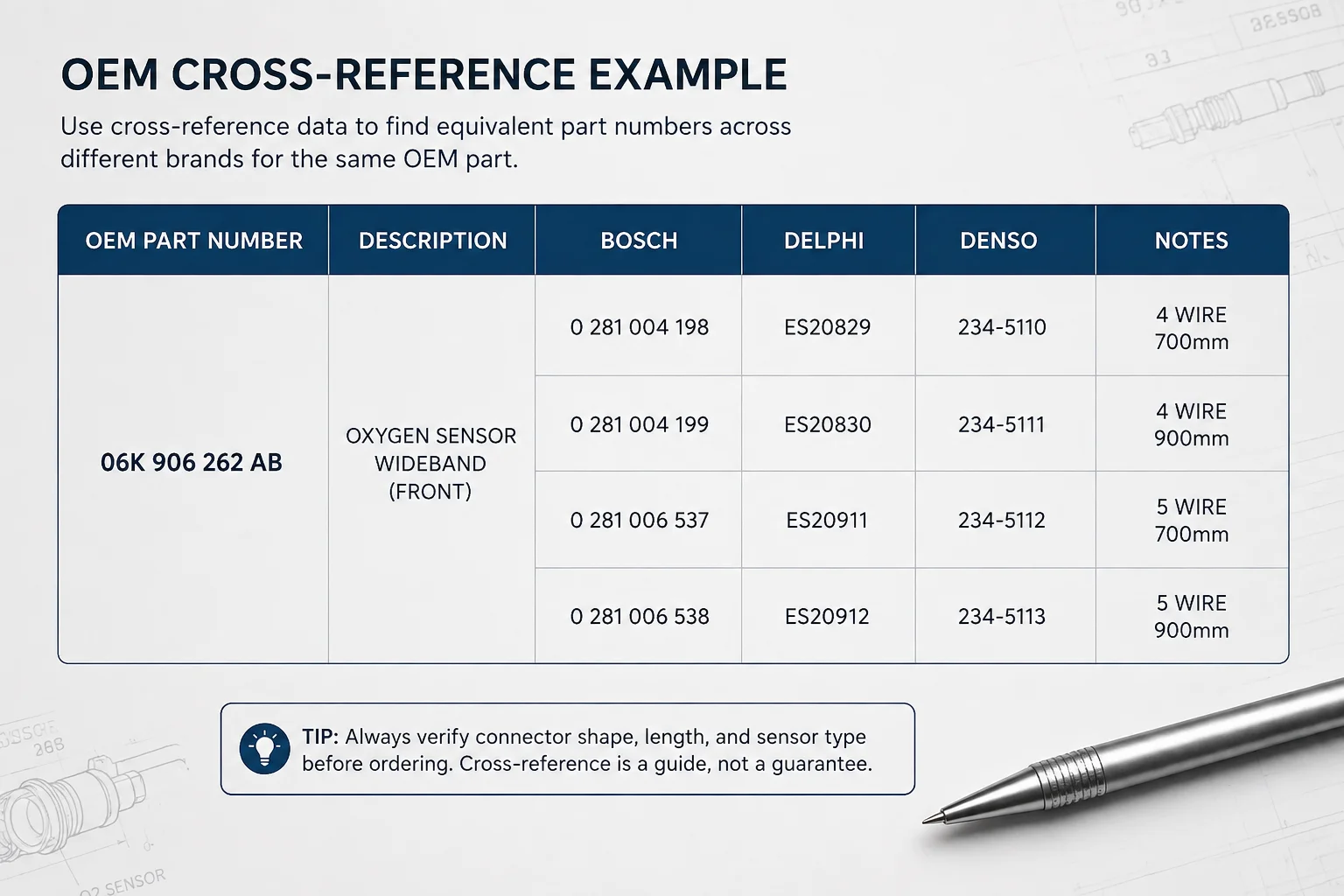 A maintained cross-reference maps one OEM number to equivalent parts across brands. The value is in how current and verified that mapping is, not that it exists.
7. What Fitment Data to Demand from a Supplier Before Ordering
The difference between a parts vendor and a sourcing partner is the fitment data each one provides before you commit. Fitment data has a formal industry standard: the Aftermarket Catalog Exchange Standard (ACES), maintained by the Auto Care Association, which defines how vehicle-to-part compatibility is communicated across the supply chain [1]. Here is what to require.
The minimum set, on every order:
- The OEM number, confirmed against your inquiry
- The vehicle make, model, and production year range the part covers
- The engine displacement or engine code where relevant
- A cross-reference table for equivalent manufacturer numbers, if you requested alternatives
- A supercession note if the OEM number has been replaced by a newer reference
Red flags that should stop an order:
- "We ship what you order" with no verification step
- A catalog that lists parts by vehicle name only, with no OEM numbers
- Blank cells in the fitment table with no explanation
- An inability to produce certification or test documentation when asked
- Cross-reference data the supplier cannot explain how it maintains
None of this is about making the supplier jump through hoops. It is about confirming, before a container leaves the port, that the parts inside will fit the vehicles they are destined for. The cheapest fix happens before shipment. Every fix after shipment is freight, duty, restocking, and a damaged account.
Fact: KEHO's four-stage quality control (incoming inspection, in-process checks, packaging verification, final shipment review) backs a 99.2% on-time delivery rate across 50,000+ SKUs (per company data).
8. FAQ: OEM Number Questions From Real Buyers
What is an OEM part number?
An OEM part number is the original equipment manufacturer's unique reference code stamped on a factory-fitted part. It identifies one exact component spec for a specific vehicle platform, engine, and production period. Unlike a vehicle model name, which covers many engine and trim variants, the OEM number points to a single precise part. For importers, it is the only reliable starting point for matching a replacement part to the vehicle it must fit.
How do I verify a part matches the vehicle using the OEM number?
Provide the OEM number to your supplier and ask for a cross-check against four dimensions: OEM number, vehicle make and model, production year range, and engine displacement. A single-dimension check is not enough, because one vehicle model often ships with several part variants across years and markets. A supplier that confirms all four dimensions before dispatch removes most fitment risk. KEHO runs this four-dimension verification as standard on engine parts orders.
What is the difference between OEM and aftermarket part numbers?
An OEM number is assigned by the vehicle manufacturer to the factory part. An aftermarket number is a replacement brand's own code, mapped to the OEM number through an interchange table. The aftermarket part may physically fit and function the same, but it was not built against the automaker's original production spec. For importers, the practical question is traceability: an aftermarket number is only trustworthy if the supplier can show the OEM cross-reference that links it back to the original part.
What is an OEM number cross reference?
A cross reference, or interchange, links an OEM part number to equivalent parts from other manufacturers. One BMW injector OEM number may cross-reference to a Bosch number and a Delphi number. Cross references let buyers source alternatives and compare prices. The risk is that a poorly maintained cross-reference can link two parts that look similar but differ in a critical spec, so always ask how the supplier verifies and updates its interchange data.
Can matching the OEM number guarantee the part will fit?
Matching the OEM number removes most fitment risk, but it is not an absolute guarantee. A part with the right number can still be wrong if the supplier's catalog is outdated, if the part was re-boxed incorrectly, or if a supercession was not tracked. Pair the number check with a physical sample test on new SKUs and a supplier that maintains current cross-reference and supercession data.
How do I avoid fitment mistakes when importing auto parts in bulk?
Four practices cut bulk fitment errors sharply. First, index every inquiry by OEM number, never by vehicle model alone. Second, demand four-dimension fitment confirmation before shipment. Third, order small sample quantities on new OEM numbers and test them on a real vehicle before committing to a full container. Fourth, work with one supplier that keeps a maintained cross-reference database, so supercessions and brand equivalents are handled centrally rather than ad hoc.
9. Conclusion: Index by Number, Verify in Four Dimensions
Matching auto parts by OEM number is not a technical trick. It is a procurement discipline that separates distributors who scale cleanly from those who spend their margin on return freight and dead stock.
The method is short: index every inquiry by OEM number, verify across four dimensions, demand a maintained cross-reference, and test new SKUs with small samples before volume. Apply it consistently, and the container that arrives is full of parts that fit.
KEHO has run this discipline since 1995, across 80+ countries and a catalog of more than 50,000 SKUs (per company data). Whether you are building a program around fuel injectors, ignition coils, or spark plugs, the same OEM-number workflow keeps every shipment tight.
Submit your OEM number list for a fitment, cross-reference, and consolidation review.
Sources
- Total gaps: 2 | Resolved: 2 | Unresolved: 0
- Authority breakdown: Industry Association 2 | Reference 2 | Company data 1
- [Auto Care Association]. "Aftermarket Catalog Exchange Standard (ACES®)." autocare.org: The automotive aftermarket industry data standard for managing and communicating vehicle-to-part fitment data.
- [Auto Care Association]. "Product Information Exchange Standard (PIES®)." autocare.org: The aftermarket industry data standard for managing and communicating product and part-number information.
- [Investopedia]. "Understanding Original Equipment Manufacturer (OEM)." investopedia.com: Definition of OEM parts and the OEM vs aftermarket distinction in the auto repair industry.
- [Edmunds]. "Understanding OEM: What Is an Original Equipment Manufacturer." (July 2024) edmunds.com: OEM definition in the context of automotive parts manufacturing.
- [KEHO]. Company data: years in business, certifications, SKU count, on-time delivery rate. kehoauto.com: Company-reported figures marked "(per company data)" in the article body.