1. The Middle Child of Engine Systems: Why Ignition Coils Deserve Their Own Playbook
Spark plugs are commodity consumables. You stock them by the thousand, replace them by the set, and accept a small percentage of returns as the cost of doing volume business. We covered the full procurement framework in our spark plug buying guide.
Fuel injectors are precision components. Get the OEM number wrong and the engine misfires: no second chances. We covered the stakes in our fuel injector buying guide.
Ignition coils sit between these two extremes, and that middle position creates a specific set of sourcing dynamics that most importers miss:
- Coils are bought less often than spark plugs but more often than injectors. A workshop replaces spark plugs every 60,000-100,000 km. Injectors might last 150,000 km. Coils fail somewhere in between, usually at 100,000-150,000 km, but often get replaced preventively alongside spark plugs: creating a bundled sale that doubles the invoice.
- Coils have higher unit margin than spark plugs but lower return-rate risk than injectors. A $10 COP coil with 1-2% returns is a better margin-to-risk ratio than a $2 spark plug with 0.5% returns or a $25 injector with 3% returns. The middle ground is where steady profit lives.
- Coils are the natural cross-sell to spark plugs. When a workshop installs new spark plugs, the coils are already exposed during the job. Many shops recommend replacing coils at the same time, especially on V-engines where rear-bank labor is expensive. An importer who stocks both from one supplier captures that bundled demand without adding freight or administrative overhead.
Fact: KEHO supplies ignition coils with OEM number-based fitment verification (per company data): matching both physical dimensions and electrical specifications to the original part before shipment.
2. COP, Coil Pack, or Distributor: Three Coil Types, Three Market Tiers
Most ignition coil buying guides on the internet start with "check your owner's manual." That works for a DIY mechanic replacing one coil on a Sunday afternoon. It does not work for an importer building a catalog for an entire market.
2.1 Three Technologies, Three Demand Profiles
| Property | Coil-on-Plug (COP) | Coil Pack (Waste Spark) | Distributor-Based |
|---|---|---|---|
| Configuration | One coil per cylinder, mounted on plug | One pack serves 2 cylinders | Single coil + distributor cap + rotor |
| Spark plug wires | None | Short leads | Full wire set required |
| Typical vehicle era | 2000-present | 1990s-2005 | Pre-2000 |
| Failure rate per 100k km | 3-8% | 5-12% | 2-5% (but declining fleet) |
| Wholesale unit price | $5-15 (std), $20-40 (premium) | $15-40 per pack | $3-8 per coil |
| Replacement pattern | Individual or full set | Full pack | Coil + cap + rotor + wires |
| Market trend | Growing (still dominant) | Stable (declining slowly) | Declining |
| Import priority | High (volume + margin) | Medium (niche but profitable) | Low (add-on only) |
Coil-on-Plug (COP) is the modern standard. Every cylinder gets its own coil, mounted directly on the spark plug. No spark plug wires. Less voltage loss. More precise ignition timing. COP has been the dominant architecture since roughly 2000 across all brands: Toyota, Honda, BMW, Ford, GM, Hyundai. For importers, this is the volume play. COP coils are what your buyers' workshops install five or ten times a day.
Coil Pack (Waste Spark) uses one coil to fire two cylinders simultaneously: one on the compression stroke (producing power) and one on the exhaust stroke (wasted spark). These systems were common in the 1990s and early 2000s, particularly on American and Japanese four-cylinder engines. The market is smaller than COP but still active: millions of these vehicles remain on the road, especially in price-sensitive markets where older cars stay in service longer.
Distributor-Based systems use a single coil, a distributor cap, and a rotor to distribute spark to each cylinder in sequence. This is pre-2000 technology, still found in classic cars, some commercial vehicles, and very old fleets. Volume is low. Margins are thin. But the buyers who need these coils have few supplier options: which means less price competition for the importers who stock them.
2.2 Building Your Ignition Coil Catalog
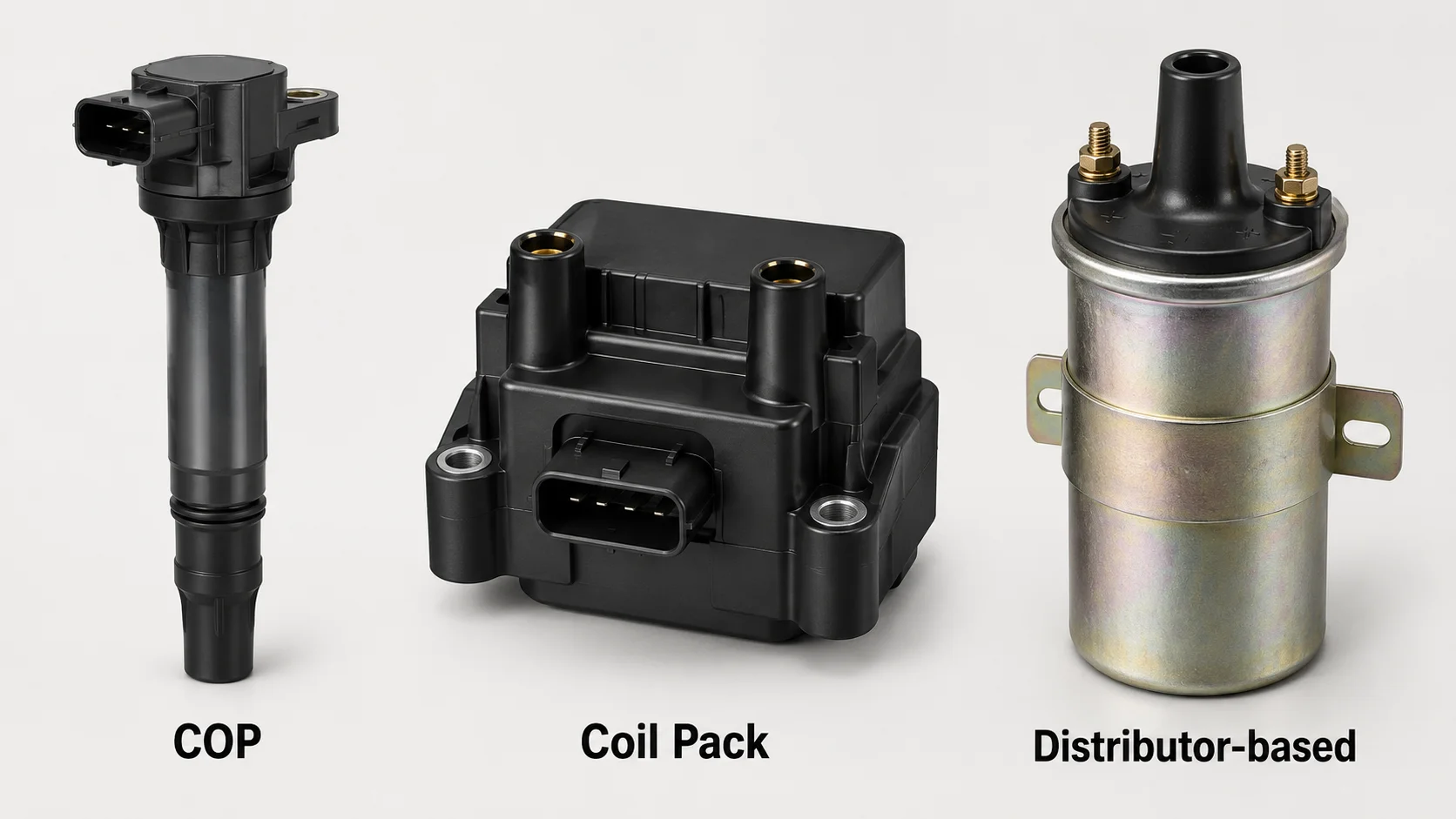 Three ignition technologies, three distinct market segments. COP is the volume driver; coil packs fill the mid-era gap; distributor coils serve a niche with less competition.
- If your buyers serve general repair shops (the majority) → stock COP (80%) + Coil Pack (15%) + Distributor (5%). COP pays the bills. The rest covers the outliers.
- If your buyers serve older-vehicle specialists or export to developing markets → stock Coil Pack (50%) + COP (40%) + Distributor (10%). Older fleets need more coil packs and distributor parts.
- If your buyers serve European specialists → stock premium COP (70%) + standard COP (30%). European COP coils have higher unit prices and tighter specs, but also higher per-unit margin.
The insight is not which type to pick. It is that each coil type has a different demand curve, margin profile, and return-rate expectation. A catalog that treats all coils as one category will overstock slow movers and understock the volume drivers.
3. Why Ignition Coil OEM Matching Is Harder Than Spark Plugs
A spark plug has three physical dimensions that matter: thread diameter, reach, and hex size. If those match, and the heat range is close, the plug will generally work: perhaps not optimally, but the engine will run.
An ignition coil has two sets of requirements, and both must be right:
Physical fitment: mounting bracket geometry, connector type and pin count, boot length and diameter, and overall package dimensions. A coil that does not bolt onto the valve cover is a return, no questions asked.
Electrical parameters: primary coil resistance (typically 0.3-1.0 ohm), secondary coil resistance (typically 5,000-15,000 ohms), inductance, and turns ratio. These values are designed into the ECU's ignition driver circuit. A coil with the wrong primary resistance draws too much current: overheating the ECU driver transistor: or too little: producing a weak spark. Either way, the engine throws a misfire code within minutes of installation.
This is why OEM number matching matters more for ignition coils than for almost any other engine systems component. A coil that fits physically but is electrically wrong will pass a visual inspection and fail on the road. Your customer's customer blames "cheap Chinese coils" when the real problem is that nobody checked the primary resistance against the OEM specification.
Fact: Every KEHO ignition coil order goes through four-stage quality control: incoming inspection, resistance and insulation testing, packaging verification, and final shipment cross-check: before dispatch (per company documentation).
How to Verify Coil Specifications Before Ordering
When sending an OEM number to your supplier for ignition coil matching, ask for three confirmations:
- Physical fitment confirmed: mounting points, connector type, boot length
- Primary resistance within OEM spec: typically ±10% of nominal
- Secondary resistance within OEM spec: typically ±15% of nominal
A supplier who can provide these three data points per SKU has done the engineering work. A supplier who says "it fits" without numbers has not.
4. Ignition Coil Failure Patterns and What They Mean for Your Return Rate
Understanding why coils fail helps you predict which SKUs will have higher return rates: and which suppliers are actually testing for those failure modes.
The Three Failure Modes That Drive Returns
Heat cycling (COP coils, especially rear-bank): COP coils sit directly on the cylinder head, exposed to continuous thermal cycling from ambient to 120°C+. Over years, the epoxy insulation inside the coil body develops micro-cracks. Moisture seeps in. The coil shorts internally, producing an intermittent misfire that gets worse as the engine warms up. This is the most common failure mode in COP coils and the hardest to catch without high-potential (hipot) insulation testing.
Insulation breakdown (coil packs, vibration-prone): Coil packs are typically mounted on the engine block or firewall, exposed to vibration and moisture. The high-voltage secondary winding insulation degrades over time. The failure is often sudden and complete: one cylinder pair stops firing entirely. Return rate on coil packs tends to be higher than COP precisely because failures are more likely to be catastrophic rather than gradual.
Overload from worn spark plugs (all types): When spark plugs are not replaced on schedule, the electrode gap widens. The coil must generate higher voltage to jump the wider gap: up to 40,000 volts instead of the designed 25,000-30,000 volts. This accelerated stress shortens coil life. It is the single most preventable cause of coil returns, and it is why coils and plugs should be sold and replaced together.
What Supplier Testing Actually Prevents
| Test | What It Catches | Without It |
|---|---|---|
| Primary resistance | Wrong winding spec, internal short | ECU driver damage, weak spark |
| Secondary resistance | Open winding, partial short | Misfire at specific RPM ranges |
| Hipot / insulation test | Epoxy cracks, moisture ingress | Intermittent misfire (worst kind: hard to diagnose) |
| Bench spark test | Assembly defect, connector fault | Dead on arrival |
A supplier that does all four on every unit has a documented quality system. A supplier that batch-samples or skips hipot testing is shipping a percentage of coils that will fail within the first 10,000 km: and those failures become your returns.
5. Buying Coils and Plugs From One Supplier: The Case Is Already Made
We made the logistics argument in our fuel injector buying guide: one container, one customs entry, one payment cycle. For ignition coils and spark plugs, the case is even stronger: because the products are mechanically linked.
Here is the reality of automotive repair: when a workshop removes a spark plug, the ignition coil is already in the technician's hand. On a COP engine, the coil sits directly on top of the plug. Removing the coil is step one of a spark plug replacement. The incremental labor to install a new coil instead of reusing the old one is zero seconds.
This creates a natural bundled sale:
- Workshop buys spark plugs + coils together → saves labor on a future coil failure
- Importer sells spark plugs + coils in one shipment → higher average order value, same freight cost
- Supplier verifies both against the same OEM database → one fitment check covers the entire ignition system
For importers building or expanding an engine systems program, the math is straightforward: every spark plug customer is also an ignition coil prospect. Stocking both from the same supplier captures that demand without adding supplier relationships.
KEHO's engine systems catalog covers ignition coils, spark plugs, and fuel injectors under one OEM database, one quality standard, and one MOQ policy. For importers looking to consolidate their engine parts sourcing, the consolidation logic writes itself.
Fact: KEHO supports consolidated Engine Systems sourcing: ignition coils, spark plugs, and fuel injectors shipped together in one container, under one quality standard, with one technical support team.
6. What to Check in an Ignition Coil Supplier: Importer's Checklist
| Criterion | What to Ask | Red Flag |
|---|---|---|
| OEM coverage | "How many OEM numbers do you stock? Can you share a sample list by vehicle brand?" | Cannot produce a catalog or list. |
| Electrical testing | "Do you test primary resistance, secondary resistance, and insulation on every coil? What are your tolerance ranges?" | No documented electrical test procedure. |
| Physical fitment | "How do you verify mounting dimensions and connector type against OEM specs?" | "We match by vehicle model": no dimensional verification. |
| Certifications | "Are you CE and ISO certified? Can I see the certificates?" | Unwilling to share documentation. |
| MOQ flexibility | "What is your minimum order per SKU? Can I order small quantities to test a new OEM number?" | Same high MOQ across all SKUs. |
| Cross-category capability | "Can you supply spark plugs and fuel injectors in the same shipment?" | Single-category only, no consolidation option. |
| Response time | "If I send a fitment question during your working hours, when can I expect an answer?" | No clear commitment. |
| Warranty policy | "What is your warranty period and process for defective coils?" | No written warranty terms. |
7. FAQ: Ignition Coil Questions From Real Buyers
What is the difference between COP and traditional ignition coils?
Coil-on-Plug (COP) places one coil directly on each spark plug, eliminating spark plug wires entirely. Traditional systems use a single coil with a distributor, or a coil pack firing two cylinders (waste spark). COP dominates vehicles from 2000 onward and is the highest-volume segment for importers. Coil packs cover mid-era vehicles (1990s-2005). Distributor-based coils serve legacy fleets. For importers, COP is where both volume and margin concentrate.
OEM vs aftermarket ignition coils: which should I stock?
The real distinction is not the label but the electrical specification. An aftermarket coil with primary resistance, secondary resistance, and turns ratio within OEM tolerance will perform identically to the branded part: because it is electrically identical. The risk is aftermarket coils that approximate the fitment but not the electrical parameters. A supplier that verifies both dimensions before shipment eliminates that risk, regardless of whether the part carries an OEM or aftermarket label.
What are the signs of a bad ignition coil?
Engine misfire (codes P0300-P0308), rough idle, hesitation under acceleration, increased fuel consumption, and in severe cases, a no-start condition. For importers, understanding which failure modes are most common by coil type helps set realistic warranty expectations. COP coils typically fail from heat cycling. Coil packs fail from vibration and moisture. A supplier that tests for each failure mode reduces your exposure.
How much do ignition coils cost at wholesale?
COP coils: $5-15/piece for standard applications, $20-40 for premium European models. Coil packs: $15-40 per pack. Distributor-based single coils: $3-8/piece. Aftermarket pricing is typically 40-60% of OEM list. For importers, the key margin insight is that premium European COP coils have the highest absolute dollar margin: the difference between wholesale cost and selling price is widest in the $20-40 category.
Can I replace just one ignition coil?
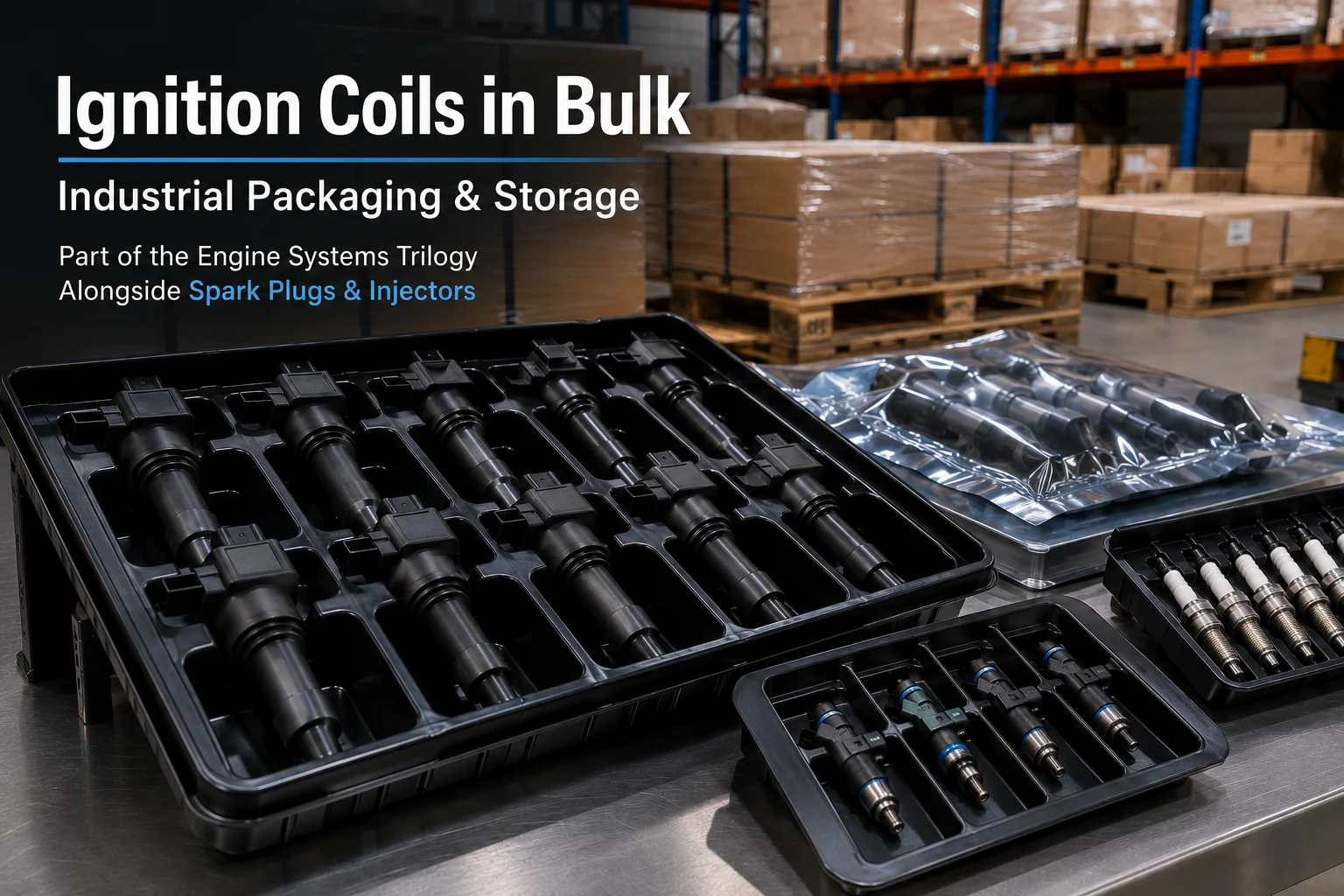
Yes, but many workshops prefer replacing all coils on a bank when one fails: especially on V6 and V8 engines where accessing the rear bank is labor-intensive. For importers, packaging coils in sets of 4, 6, or 8 is often more attractive to workshop buyers than single units. A supplier that offers both single and set packaging gives you the flexibility to serve both buying patterns.
What causes ignition coil failure?
Heat cycling (COP coils on the cylinder head), insulation breakdown from age and vibration (coil packs), and overload from worn spark plugs with excessive gap. This last point is the most actionable for importers: when spark plugs are not replaced on schedule, the widened gap forces the coil to generate higher voltage, accelerating coil wear. Stocking coils and plugs together: and recommending both to your buyers: reduces failure-related returns for both lines.
How often should ignition coils be replaced?
Ignition coils do not have a fixed replacement interval. They typically last 100,000-150,000 km but can fail earlier in high-heat applications. Many workshops recommend replacing coils when doing a major spark plug service, especially on V-engines where labor overlap makes preventive replacement cost-effective. For importers, this creates a natural bundled sale opportunity with every spark plug order.
8. Conclusion: Complete Your Engine Systems Program
Ignition coils complete the Engine Systems triad. Spark plugs are the volume play. Fuel injectors are the precision play. Ignition coils are the margin play: higher unit value than plugs, lower return risk than injectors, and mechanically linked to the spark plug replacement cycle.
The framework in this guide: segmenting by coil technology, verifying both physical and electrical specifications, understanding failure patterns to predict returns, bundling coils with plugs, and evaluating suppliers on documented testing: gives you a repeatable process for adding ignition coils to your engine parts program.
KEHO has built its ignition coil supply line on the same principles as its spark plug and fuel injector programs: OEM number-based verification across physical and electrical specs, four-stage quality control, consolidated Engine Systems shipping, and technical support that responds within hours.
Submit your OEM number list for ignition coil fitment and pricing. For the full Engine Systems program, combine with spark plugs and fuel injectors: one OEM database, one quality standard, one shipment.
Sources
- [MotoRad]. "OEM vs Aftermarket Ignition Coils: What is the difference?" motorad.com: OEM vs aftermarket comparison covering fitment, electrical specifications, and compatibility by vehicle make and model.
- [MotoRad]. "What's the Difference in Coil-on-Plug vs Traditional Ignition Systems?" motorad.com: Technical comparison of COP systems (one coil per cylinder) against traditional single-coil and distributor-based ignition architectures.
- [Underhood Service]. "How Ignition Coils And Plugs Find The Path Of Least Resistance." (September 2020) underhoodservice.com: Technical article covering ignition coil failure diagnostics, the limitation of resistance testing, and current ramp testing for identifying defective coils.
- [COWTOTAL]. "10 Reliable Ignition Coil Manufacturers for Your Automotive Needs." (March 2025) cowtotal.com: B2B supplier reference covering quality factors, certifications, compatibility, and customer feedback criteria for ignition coil manufacturer evaluation.
- [Alibaba SmartBuy]. "How to Choose the Best Ignition Coil for Your Vehicle: A Complete Buying Guide." smartbuy.alibaba.com: B2B wholesale buying guide covering ignition coil selection criteria and purchasing considerations.