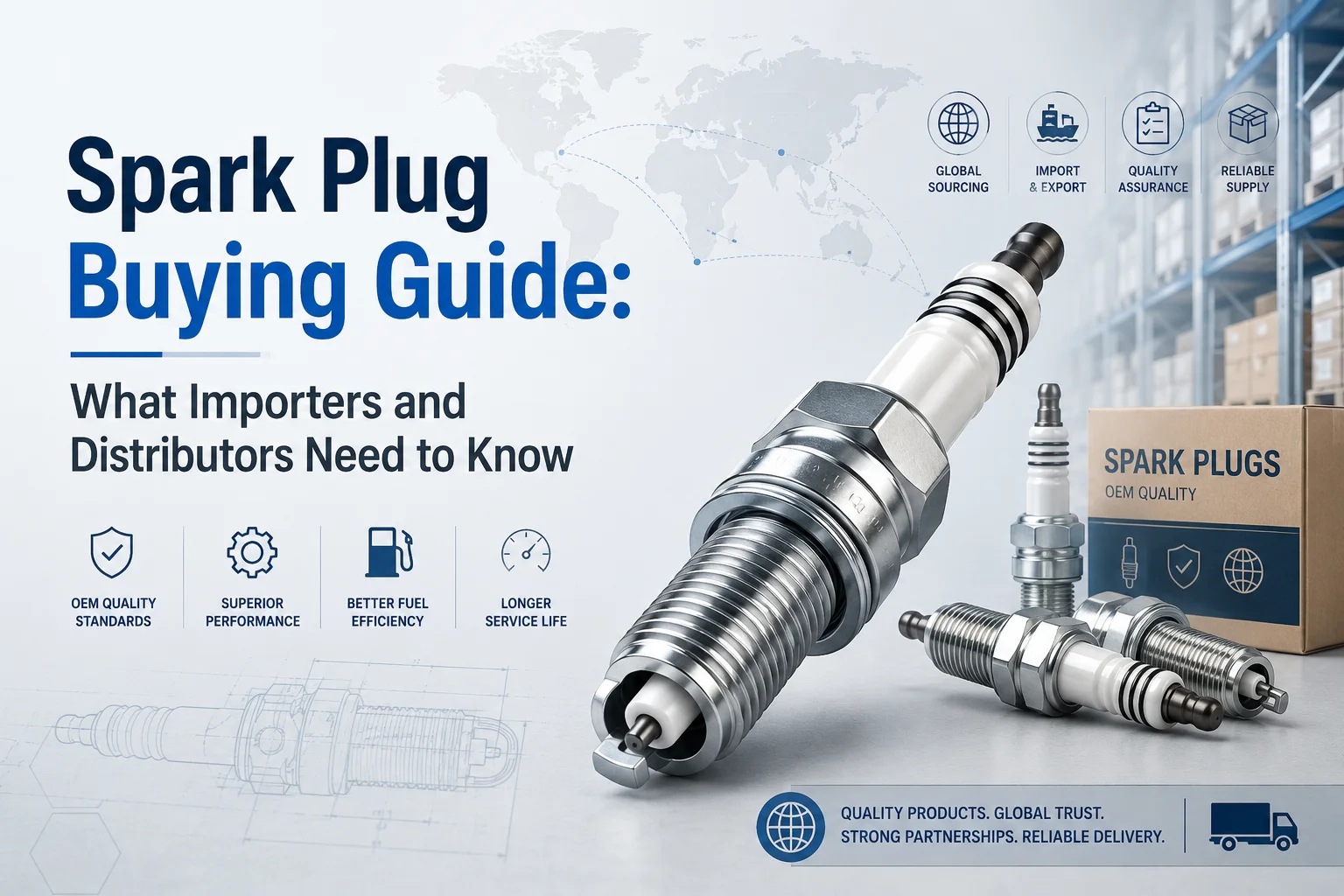
 Bulk spark plug orders require a different decision framework than retail purchases: material, heat range, and supplier reliability matter at scale.
1. Beyond the Retail Shelf: Why B2B Spark Plug Sourcing Is Different
When a workshop owner walks into a parts store on a Saturday morning, they need four spark plugs for one car. When an importer places a spark plug order, they are buying for hundreds of workshops across a country: and the calculus changes completely.
Fact: KEHO supplies CE- and ISO-certified iridium and platinum spark plugs to importers across 100+ countries (per company data), backed by 30 years of auto parts sourcing experience.
Most spark plug buying guides on the internet stop at "check your owner's manual" or "pick iridium if you want the best." That advice works for the DIY mechanic. It does not work for a distributor who needs to stock 5,000 spark plugs covering 40 vehicle models across two market tiers.
Here is what actually matters when you are sourcing spark plugs in bulk:
- Unit price is only the starting line. A $0.88 copper plug and a $2.50 iridium plug have different margin structures, replacement cycles, and customer expectations. The cheaper option can cost more in returns if it does not match what your buyer's end customers expect.
- Fitment errors multiply at scale. Ship 100 pieces of the wrong OEM number to one customer, and you lose that customer. Ship it to ten customers, and you lose a market segment. OEM number verification is not a nice-to-have: it is the difference between a repeat order and a dispute.
- Your supplier's quality process is your quality process. If your supplier ships without inspecting electrode gap, heat range consistency, and packaging accuracy, those problems land on your desk: multiplied by every customer who opens the box.
The sections that follow walk through each decision layer: electrode material, OEM number matching, heat range, and supplier evaluation. By the end, you will have a framework for building a spark plug supply line that holds up at volume.
2. Iridium, Platinum, or Copper: Which Electrode Material Fits Your Market?
Every spark plug buying guide starts with electrode materials. Most stop at "iridium is better." But for an importer, the question is not which material is best: it is which material fits your target market's price expectations, vehicle fleet, and margin structure.
2.1 Material Comparison: Conductivity, Lifespan, and Unit Cost
| Property | Copper (Nickel Alloy) | Platinum | Iridium |
|---|---|---|---|
| Electrode melting point | ~1,080°C | ~1,770°C | ~2,450°C [2] |
| Typical lifespan | 20,000-30,000 km | 60,000-100,000 km | 100,000-120,000 km [5] |
| Electrical conductivity | Highest [1] | Moderate | High (fine-wire tip compensates) |
| Wholesale unit price range | $0.50-$1.20 | $1.00-$2.00 | $1.50-$3.50 |
| Best suited engine type | Naturally aspirated, older models | Modern NA engines, light-duty | Turbocharged, direct-injection, high-compression |
| Replacement frequency | High (repeat business) | Medium | Low |
Copper spark plugs have the best raw electrical conductivity among common electrode materials: better than platinum and iridium [1]: which is why some performance enthusiasts still prefer them. The trade-off is lifespan. The nickel-alloy electrode erodes faster, widening the gap and degrading spark quality within 30,000 km.
Platinum and iridium plugs use precious-metal electrodes precisely because they resist erosion. The electrode stays sharp longer, maintaining a consistent spark without requiring the ignition system to work harder. Iridium, being six times harder than platinum [2], extends this effect further: which is why most OEMs specify iridium for modern turbocharged and direct-injection engines.
2.2 How Material Choice Affects Your Margin Structure
The material you stock has a direct impact on how your customers see you: and how often they reorder.
Copper (high-volume, low-margin per unit): If your market is price-driven: independent workshops in cost-sensitive regions, fleet maintenance contracts for older vehicles: copper plugs make sense. You move more units. Margins per piece are thin, but volume and repeat frequency compensate. Just make sure your supplier's copper plugs hit consistent gap specs; at this price point, manufacturing variance is the biggest quality risk.
Platinum (mid-market, balanced): Platinum plugs cover the broad middle: modern naturally aspirated engines where customers expect longer service intervals than copper delivers, but do not want to pay iridium prices. This is often the largest addressable market for a generalist auto parts distributor.
Iridium (premium, higher margin per unit): Iridium commands the highest unit price and the highest per-unit margin. It is what OEM dealerships and premium independent workshops stock. The catch: iridium buyers expect OEM-spec consistency. A distributor selling iridium plugs that do not match the original heat range and gap exactly will see returns, regardless of the electrode material printed on the box.
Fact: KEHO manufactures iridium and platinum spark plugs with OEM number-based fitment verification (per manufacturer specifications), supporting importers who need to match exact vehicle specifications: not just electrode material.
2.3 Matching Material to Market Reality
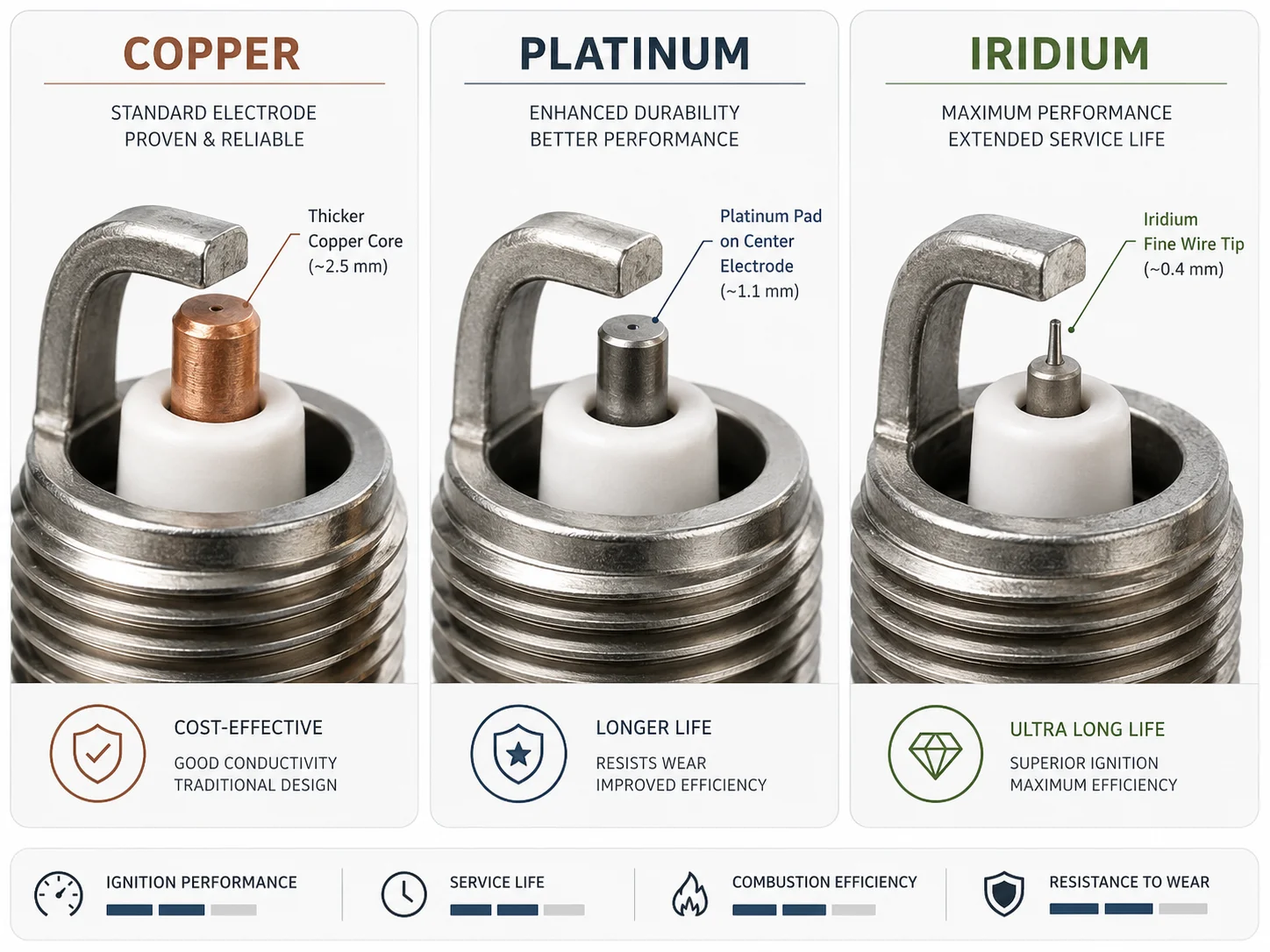 Three electrode materials, three market segments. The right choice depends on what your end customers value: price, lifespan, or OEM-spec consistency.
Here is a practical framework:
- If your buyers serve fleet operators and budget workshops → stock copper (70%) + platinum (30%) for upsell.
- If your buyers serve general repair shops covering 2015+ vehicles → stock platinum (50%) + iridium (50%).
- If your buyers serve dealerships and premium European/Japanese specialists → stock iridium (80%) + platinum (20%) for older model coverage.
The key is not picking one material. It is building a catalog where each SKU has a clear market position: and your supplier can deliver consistent quality at each tier.
3. How OEM Numbers Eliminate Fitment Guesswork
The single largest cause of spark plug returns in B2B trade is fitment error. A distributor orders "spark plugs for BMW 3 Series" and receives parts that fit some 3 Series engines but not others.
3.1 Why OEM Numbers Matter More Than Brand Names in B2B
Spark plugs are not universal. The same vehicle model can ship with different engines in different markets. A BMW 320i sold in Germany and a BMW 320i sold in South Africa may use different spark plugs: same car name, different engine specification, different OEM spark plug number.
The OEM number: stamped on the factory spark plug, printed in the vehicle's service documentation: is the only reliable reference. Everything else (brand name, vehicle model, "compatible with" claims) is an approximation.
When sourcing spark plugs, start with the OEM number. Ask your supplier to confirm compatibility by OEM number first, then cross-verify with vehicle make, model, year, and engine displacement. Any supplier who does the reverse: vehicle model first, OEM number as an afterthought: is guessing.
3.2 How to Verify Spark Plug Compatibility by OEM Reference
Here is a process that works at scale:
- Collect OEM numbers from your buyers. Ask for the number stamped on the original spark plug or listed in the vehicle's service manual: not just "Toyota Corolla 2018."
- Send the OEM numbers to your supplier for batch cross-referencing. A competent supplier maintains a database mapping OEM numbers to their own SKU codes. They should return a clear table: your OEM number → their equivalent part number → verified fitment.
- Spot-check the results. Pick 2-3 OEM numbers from the batch and independently verify on a public cross-reference tool (such as sparkplug-crossreference.com or the NGK/DENSO part finders). If the supplier's matches hold up, the rest of the batch is likely reliable.
- Order samples for physical verification. Before committing to 5,000 pieces, order 50-100 of each SKU. Have your team or a trusted workshop physically install and test a few. Thread pitch, reach, and hex size are easy to confirm; gap and heat range consistency require actual engine testing.
Fact: KEHO supports flexible spark plug orders starting at 100 pieces, with OEM number, vehicle model, year, and displacement cross-verification included as standard before shipment.
3.3 Cross-Referencing Across Manufacturers
Most major spark plug brands: NGK, DENSO, Bosch, Champion: use their own numbering systems. The same physical spark plug might be labeled NGK BKR6EIX, DENSO IK20, and Bosch FR7KPP33+. For a distributor, memorizing these mappings is impractical.
A supplier that handles cross-referencing internally saves you hours of manual lookup. When you provide an OEM number, the supplier should return the equivalent part across your preferred manufacturer: not just their own catalog number. This matters when your customers ask: "Can you get me the DENSO equivalent of this NGK plug?"
4. Heat Range: The Specification Most Buyers Overlook
Of the hundreds of spark plug SKUs a distributor might stock, heat range is the specification that causes the most silent failures. A plug with the wrong heat range will not fail immediately. It will cause gradual problems: pre-ignition, carbon fouling, uneven wear: that your customer's customer blames on "bad quality spark plugs" without ever knowing the actual cause.
4.1 What Heat Range Actually Means for Engine Life
Heat range measures how quickly a spark plug transfers heat from its firing tip to the cylinder head. It is not about how hot the spark is: it is about thermal management inside the combustion chamber.
- A "cold" plug has a short insulator nose. Heat travels a shorter path from the tip to the cylinder head, so the plug runs cooler. Cold plugs belong in engines that generate a lot of heat: turbocharged, supercharged, high-compression, sustained high-RPM.
- A "hot" plug has a longer insulator nose. Heat travels a longer path, so the tip stays hotter. Hot plugs suit engines that run at lower combustion temperatures: city driving, stop-and-go traffic, older naturally aspirated designs.
The optimal tip temperature range for any spark plug is approximately 500°C to 850°C [3]. Below 500°C, carbon deposits accumulate on the insulator (fouling). Above 850°C, the tip becomes a glow plug: igniting the air-fuel mixture before the spark fires (pre-ignition), which can melt pistons.
4.2 Hot vs Cold Plugs: Matching to Your Buyers' Vehicle Fleet
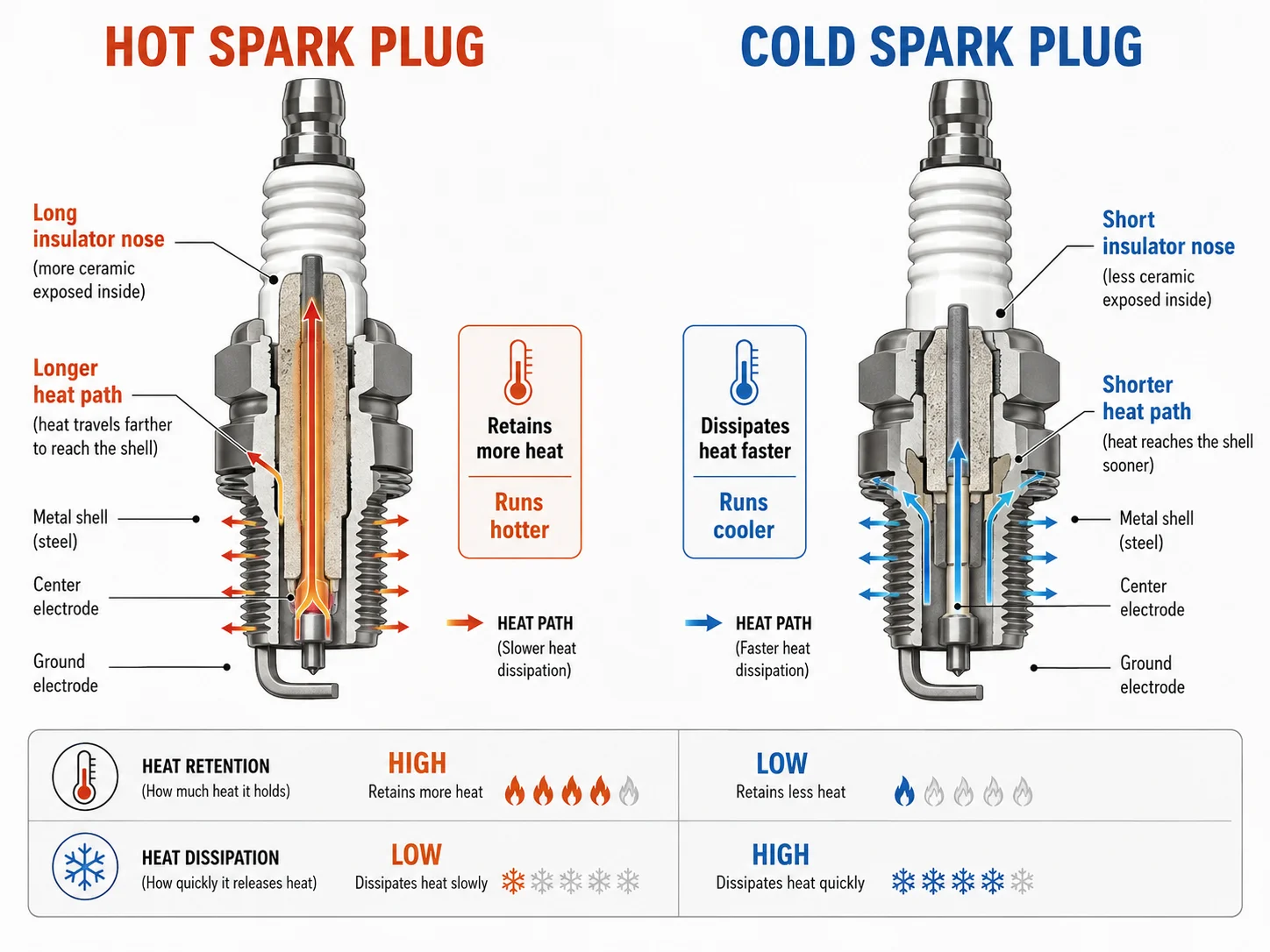 Heat range is not about spark temperature: it is about how efficiently the plug transfers heat from its firing tip into the engine head. Matching this to your buyers' vehicle fleet prevents pre-ignition and fouling.
For an importer stocking spark plugs by vehicle model, here is the practical rule:
- If your buyers serve mostly modern turbocharged European vehicles (BMW, Audi, VW, Mercedes) → stock colder-range plugs. These engines run hotter, especially the direct-injection turbo variants. Stocking the wrong heat range here is the fastest way to generate complaints.
- If your buyers serve older naturally aspirated cars (2000-2010 Toyota, Honda, Mazda fleet) → standard to slightly hotter plugs are fine. These engines run cooler and are more forgiving of heat range variance.
- If your buyers serve mixed fleets → segment your catalog by engine type, not just vehicle brand. A Toyota Supra (turbo) and a Toyota Corolla (NA) use different heat ranges even though both are Toyotas.
4.3 Turbocharged vs Naturally Aspirated Engines
Turbocharged engines compress intake air before it enters the cylinder. Higher air density means higher combustion temperature, which means more heat for the spark plug to dissipate. Turbo engines nearly always call for colder plugs than their naturally aspirated equivalents of the same displacement.
For a distributor, this distinction should be built into your catalog structure. Do not list spark plugs by vehicle model alone. Add engine type (NA / Turbo) as a second filter. This reduces the chance of shipping a standard heat range plug for a turbo application: an error that will not cause an immediate return, but will generate complaints about "bad plugs" 10,000 km later.
5. What to Check in a Spark Plug Supplier: An Importer's Checklist
The spark plug itself is a commodity. The difference between suppliers is how consistently they deliver the right plug, in the right packaging, with the right documentation: at a volume that matches your business.
5.1 Quality Control Process
Ask every potential supplier: "Walk me through your QC process from incoming material to outgoing shipment."
A supplier who pauses before answering, or who says "we check every order before shipping," does not have a process. A supplier who can describe specific inspection stages: what gets checked, at what frequency, by whom: has a system.
KEHO operates a four-stage quality control workflow (per company documentation): incoming inspection verifies raw material and electrode specifications against the order sheet. In-process patrol checks electrode gap, thread integrity, and insulator condition during production. Packaging verification confirms the correct OEM number, branding, and quantity per box before sealing. Final shipment review cross-checks the packing list against the purchase order and inspects outer carton labeling for destination-market compliance.
Fact: Every KEHO spark plug order goes through a four-stage quality control process: incoming inspection, in-process patrol, packaging verification, and final shipment review: before leaving the warehouse (per company documentation).
5.2 Certifications That Matter
For international spark plug trade, two certifications are baseline:
- CE marking: required for entry into the European Economic Area. Confirms the product meets EU safety, health, and environmental standards.
- ISO 9001: confirms the supplier operates a documented quality management system. ISO certification alone does not guarantee good spark plugs, but the absence of ISO certification means you are betting on undocumented processes.
Beyond certifications, look for third-party verification. Alibaba's Onsite Check program sends staff to physically inspect the supplier's operations: an extra layer of confirmation that the address, equipment, and team exist as claimed.
5.3 MOQ Flexibility and Sample Policy
Minimum order quantities in the spark plug industry vary widely. Some factories demand 1,000-5,000 pieces per SKU. Others, like KEHO, support orders starting at 100 pieces.
Why MOQ flexibility matters for importers:
- New SKU testing: Before committing 5,000 pieces to a new OEM number, you want to sell 100-200 and gather customer feedback.
- Slow-moving references: Not every OEM number sells at the same velocity. A supplier that forces the same MOQ across all SKUs forces you to tie up capital in slow movers.
- Market entry: When entering a new country or vehicle segment, flexible MOQs let you test the water without overstocking.
Ask for the MOQ per SKU: not just a blanket number. And ask whether the supplier offers sample orders at reduced quantities (10-50 pieces) with air shipping for fitment verification.
5.4 Technical Response Time and Fitment Support
When your customer in Nairobi asks "do these plugs fit a 2019 Toyota Hilux 2.8 GD-6?", you need an answer within hours: not days. The supplier's technical response speed directly affects your sales cycle.
KEHO maintains a ≤3-hour average response window on Alibaba (per platform data), with technical questions typically answered the same business day. Fitment support covers OEM number, vehicle model, year, and engine displacement: four dimensions of cross-verification before shipment confirmation.
Supplier Evaluation Checklist
| Criterion | What to Ask | Red Flag |
|---|---|---|
| QC process | "Describe your inspection stages from material to shipment." | Cannot name specific stages. |
| Certifications | "Are you CE and ISO certified? Can you share the certificates?" | Unwilling to provide documentation. |
| MOQ flexibility | "What is your minimum order per SKU? Can I order samples at lower volume?" | Same high MOQ for every SKU, no sample policy. |
| Fitment support | "If I send you 50 OEM numbers, will you verify each one against vehicle specs before shipping?" | "We ship what you order": no verification step. |
| Response time | "If I send a technical question during your working hours, when can I expect an answer?" | No clear response time commitment. |
| Onsite verification | "Has a third party physically inspected your facility?" | No, and reluctant to arrange one. |
6. FAQ: Answers for First-Time and Experienced Spark Plug Buyers
What is the difference between copper, platinum, and iridium spark plugs?
Copper spark plugs offer the highest conductivity at the lowest price but have the shortest lifespan at 20,000-30,000 km. Platinum plugs last 60,000-100,000 km with moderate conductivity: a solid mid-market choice. Iridium is the hardest electrode material, with a melting point over 2,400°C, delivering 100,000-120,000 km of consistent spark performance. For importers, the decision is about your market segment: copper for price-sensitive replacement markets, iridium for OEM-tier quality expectations, platinum for the broad middle.
How do I find spark plugs by OEM number?
The OEM number is the original equipment manufacturer's part code: usually stamped on the factory spark plug and printed in the vehicle service manual. Use this number, not the vehicle model alone, when sourcing. A reliable supplier cross-references your OEM number against their inventory and confirms compatibility by vehicle make, model, year, and engine displacement before shipment. At KEHO's spark plug product page, every order includes OEM-based fitment verification across all four dimensions.
What is spark plug heat range and why does it matter for bulk buyers?
Heat range measures how fast a spark plug transfers heat from its firing tip into the cylinder head. A wrong heat range causes pre-ignition (too hot) or carbon fouling (too cold). For bulk buyers, stocking the correct heat range for each engine type in your market prevents returns and warranty claims: issues that multiply when you are shipping to dozens of workshops rather than one.
Can spark plugs affect fuel economy?
Yes. Worn plugs with widened electrode gaps require higher voltage to fire, causing incomplete combustion. Independent testing has documented fuel economy improvements when replacing spark plugs that have exceeded their service interval: particularly in fleet applications where efficiency gains compound across hundreds of vehicles [4]. For your end customers, recommending timely spark plug replacement is an easy upsell with measurable value.
How often should spark plugs be replaced?
Copper plugs: 20,000-30,000 km. Platinum: 60,000-100,000 km. Iridium: 100,000-120,000 km. However, turbocharged and direct-injection engines often shorten these intervals. As a distributor, stocking copper (for high-frequency replacement accounts) and iridium (for premium workshops) covers both ends of the demand curve.
What should I check in a spark plug supplier before placing a bulk order?
Evaluate five areas beyond unit price: (1) documented quality control process with named stages; (2) CE and ISO certifications, verifiable on request; (3) per-SKU MOQ flexibility and sample-order policy; (4) OEM number-to-vehicle fitment verification as a standard pre-shipment step; (5) technical response time commitment: same business day answers to fitment questions signal a supplier who understands importer timelines.
What is the difference between hot and cold spark plugs?
A hot plug retains more heat with a longer insulator nose, keeping the tip clean during low-speed driving. A cold plug sheds heat faster with a shorter insulator nose, preventing overheating under high RPM or heavy load. The choice depends on your buyers' vehicle mix: if they serve turbocharged European models, prioritize colder plugs. If they serve older naturally aspirated fleets, standard-range plugs work fine.
7. Conclusion: Building a Reliable Spark Plug Supply Line
A good spark plug supply line is not about finding the cheapest unit price. It is about predictability: knowing that when you order 5,000 plugs across 80 OEM numbers, every SKU will match its specification, every box will carry the right label, and every customer will get what they expected.
The framework covered in this guide: electrode material by market segment, OEM number as the single source of truth, heat range matched to engine type, and a structured supplier evaluation checklist: gives you a repeatable process for sourcing spark plugs at import scale.
KEHO has spent 30 years (per company data) building exactly that kind of predictability for global auto parts buyers. With CE and ISO certification, a four-stage QC process (per company documentation) verified by Alibaba's onsite inspection, flexible MOQs starting at 100 pieces, and OEM number based fitment support that responds within hours, the company supplies importers who need spark plugs that match: every time.
Explore KEHO's spark plug OEM catalog to submit your OEM number list for a fitment and pricing review. For complementary ignition system components, see our guides on ignition coils and fuel injectors, or browse the ignition coil and fuel injector ranges: all backed by the same four-stage verification process.
Sources
- [Champion Auto Parts]. "Copper & Iridium vs Platinum Spark Plugs." championautoparts.com: Material comparison for copper, platinum, and iridium electrode properties, including the "six times harder than platinum" claim for iridium.
- [NGK Spark Plugs]. "Spark Plug Basics." ngksparkplugs.com: Technical reference for optimal spark plug firing end temperature range (500°C-800°C), carbon fouling threshold, and pre-ignition conditions.
- [NGK.com]. "What is a Spark Plug's Heat Range?" ngk.com: Heat range definition and the 500°C-850°C optimum combustion chamber temperature for gasoline engines. Confirms that forced induction (turbo/supercharger) requires colder plugs.
- [FleetRabbit]. "How Spark Plugs Improve Fuel Efficiency." (August 2025) fleetrabbit.com: Reports that independent testing shows replacing worn spark plugs (80,000+ miles) can restore lost fuel efficiency.
- [NGK Spark Plugs]. "Service Intervals 2020." ngksparkplugs.com: Manufacturer service interval reference for copper, platinum, and iridium spark plugs across domestic and import vehicle applications.