1. Why Fuel Injector Procurement Demands More Than Spark Plugs
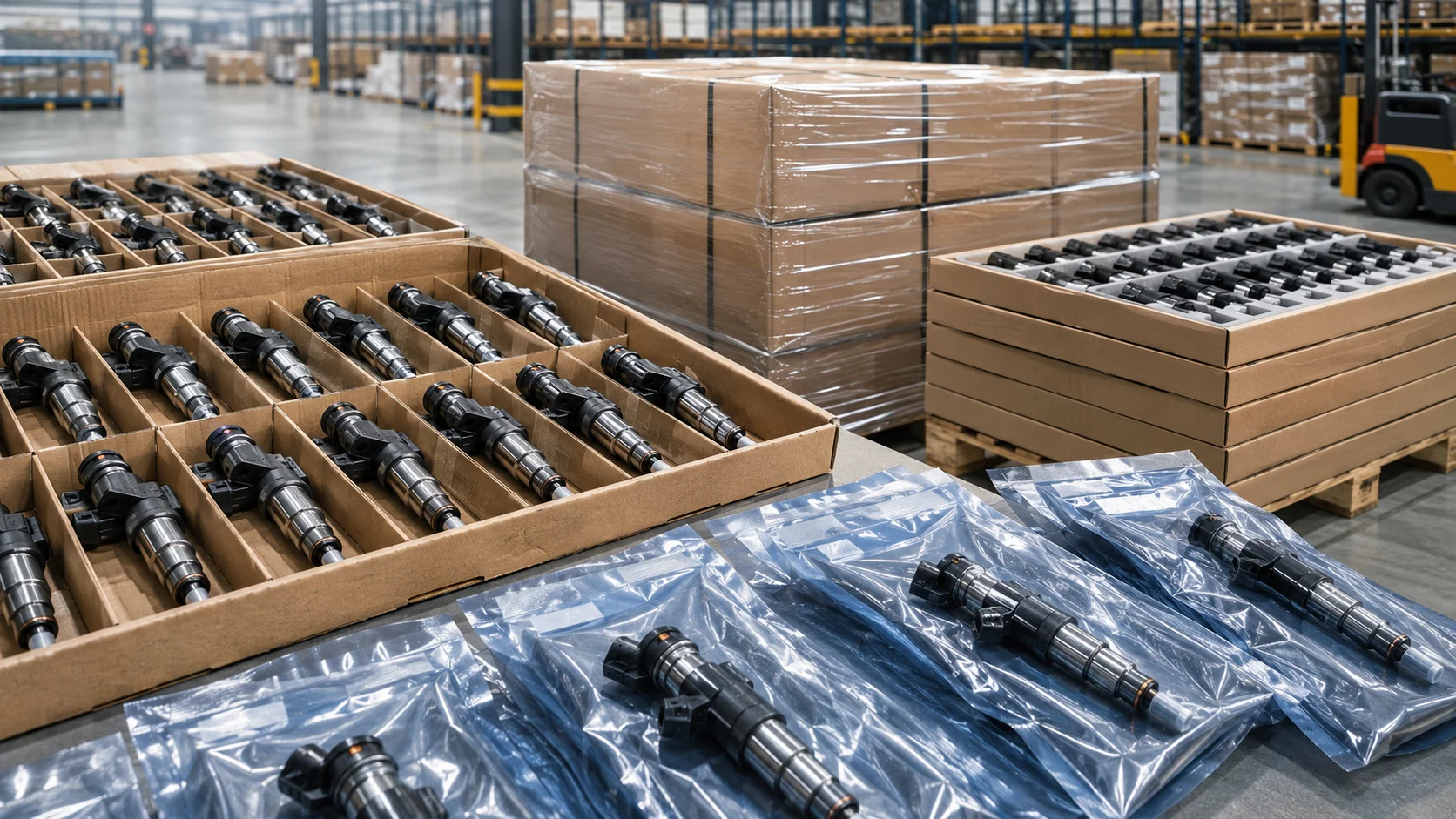
A spark plug costs under a dollar at wholesale. If you ship the wrong heat range to a workshop, the worst case is a rough idle and a replacement under warranty. A fuel injector costs $6 to $25 at wholesale. If you ship the wrong OEM number: wrong connector, wrong flow rate, wrong spray pattern: the engine misfires. Your customer's customer is stranded. That single SKU mistake costs you the order, the return shipping, and probably the account.
Fuel injectors are the most precision-intensive component in the engine systems category. They meter fuel at millisecond intervals under combustion chamber pressure. Manufacturing variance that would be acceptable in a brake pad or an air filter becomes an engine-damaging defect in an injector.
This means three things for importers:
- OEM number verification is non-negotiable. Unlike spark plugs, where a close match sometimes works, an injector with the wrong flow rate or connector type simply will not function. The OEM number is the only reliable starting point.
- Unit price masks the real cost. A $6 injector that causes a return costs far more than a $10 injector that fits first time. The math changes at import scale: 100 returns out of 5,000 units wipes out the margin on the entire shipment.
- Supplier process is everything. An injector supplier without documented flow testing, cleaning procedures, and fitment verification is selling you risk, not parts.
Fact: KEHO supplies CE- and ISO-certified gasoline fuel injectors across 100+ countries (per company data), with a catalog covering 117+ OEM numbers for BMW, VW, Audi, Toyota, Honda, Ford, and Chevrolet applications.
2. Port, Direct, or GDI: Which Injector Types Fit Your Buyers' Market?
Most fuel injector buying guides start with "how to clean your injectors." For an importer, the conversation starts earlier: which injector technology does your buyers' vehicle fleet use, and what does that mean for your catalog?
2.1 Three Injection Technologies, Three Market Segments
| Property | Port Injection (MPI) | Direct Injection (GDI) | Turbo GDI |
|---|---|---|---|
| Fuel delivery point | Intake port (before valve) | Directly into cylinder | Directly into cylinder |
| Operating pressure | 3-5 bar | 100-200 bar | 150-350 bar |
| Typical vehicle age | Pre-2010 (most brands) | 2010-2020 | 2015+ (turbo models) |
| Wholesale unit price | $4-8 | $8-25 | $15-80 |
| Tolerance sensitivity | Moderate | High | Very high |
| Failure consequence | Rough idle, poor economy | Misfire, cylinder wash | Piston damage (pre-ignition) |
| Market position | Price-sensitive replacement | Mainstream modern vehicles | Premium, European, performance |
Port injection (MPI) is the oldest technology: fuel sprays into the intake port, mixes with air, then enters the cylinder. These injectors are simple, robust, and cheap. They dominate the replacement market for pre-2010 Toyota, Honda, and American-brand vehicles. Volume is high, unit margins are thin, but fitment risk is low.
Direct injection (GDI) sprays fuel at high pressure directly into the combustion chamber. GDI systems typically operate at 50-200 bar, substantially higher than port injection's 3-5 bar range [1]. This enables leaner mixtures, better fuel economy, and lower emissions: which is why every major automaker adopted it after 2010. GDI injectors are more expensive, more sensitive to manufacturing variance, and more likely to generate returns if the OEM number is not matched exactly.
Turbo GDI takes direct injection and adds forced induction. Combustion pressures and temperatures are higher, which means the injector must deliver precise fuel volume under extreme conditions. These are the highest-margin injectors in the catalog, but also the highest-risk if quality control is not rigorous.
2.2 Building Your Catalog by Market Profile
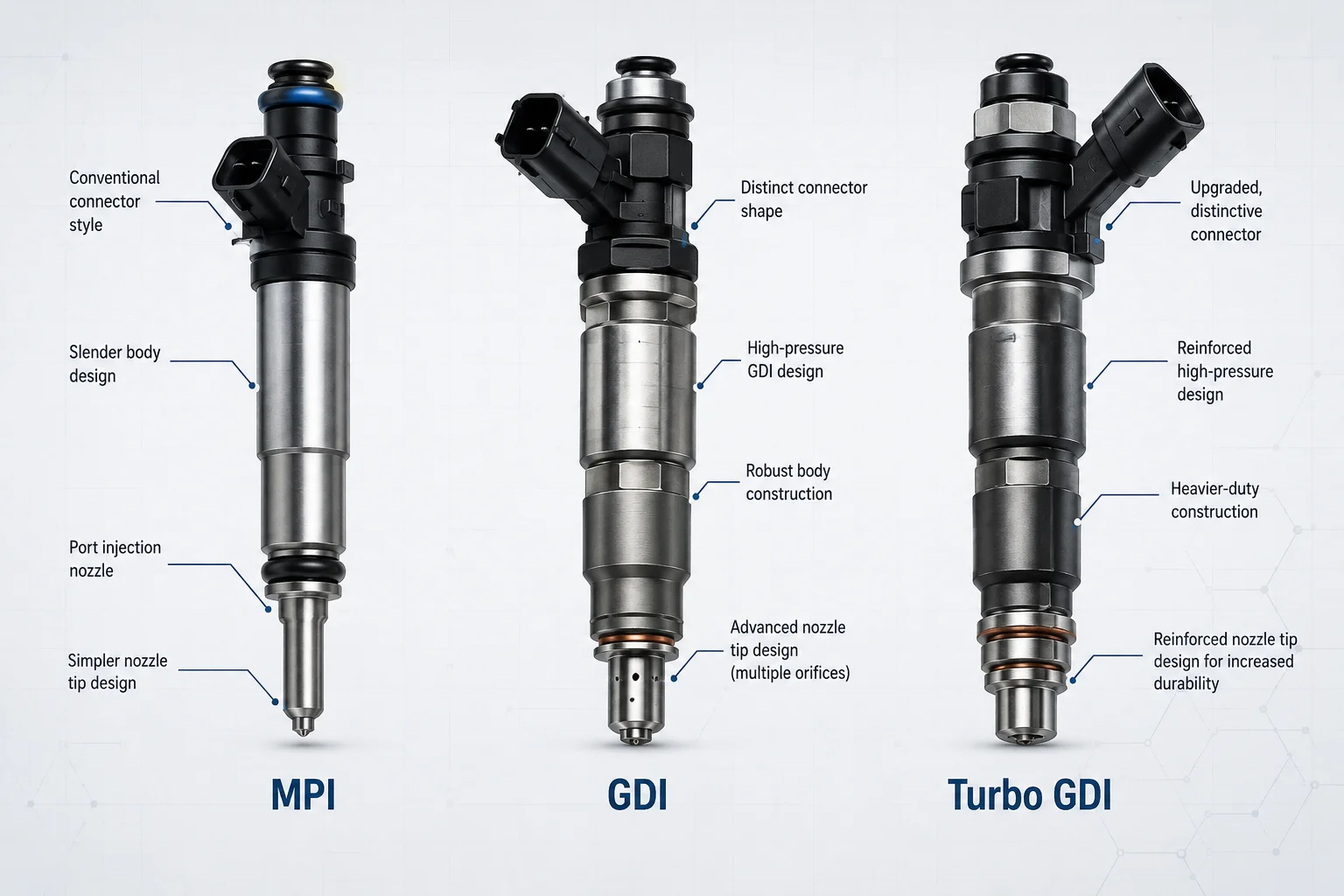 Three injector technologies, three market tiers. The right mix depends on whether your buyers serve budget workshops, mainstream repair shops, or premium European specialists.
- If your buyers serve budget workshops and older-vehicle fleets → stock MPI (60%) + standard GDI (40%). MPI volume pays the bills; GDI covers newer trade-ins.
- If your buyers serve general repair shops covering 2010+ vehicles → stock GDI (70%) + Turbo GDI (20%) + MPI (10%) for legacy coverage.
- If your buyers serve European specialists and performance shops → stock Turbo GDI (60%) + GDI (30%) + MPI (10%). Premium margin justifies the higher quality bar.
The insight is not "pick one type." It is that each injector type has different margin, return-rate, and volume profiles. A catalog that does not segment by injection technology is guessing about which SKUs to prioritize.
3. New vs Remanufactured Fuel Injectors: An Importer's Margin and Risk Calculus
This is the question that almost no consumer-facing buying guide covers, because consumers buy four injectors for one car. Importers buy 5,000 injectors for a market: and the new-vs-reman decision compounds across every unit.
3.1 What Remanufacturing Actually Means
Remanufacturing is not the same as "refurbishing" or "reconditioning." A properly remanufactured injector is:
- Disassembled completely: nozzle, valve body, solenoid, filter basket
- Ultrasonic cleaned to remove carbon and varnish deposits
- Inspected for wear on the pintle, seat, and internal passages
- Rebuilt with new O-rings, seals, filter baskets, and pintle caps
- Flow tested on a calibrated bench to verify spray pattern, volume, and leak-down
The difference between a quality reman injector and a cheap one is entirely in steps 4 and 5. A supplier who skips flow testing and just replaces external O-rings is selling cleaned cores, not remanufactured injectors.
3.2 The Margin Arithmetic
Remanufactured injectors typically cost 30-50% less than new equivalents. On a $10 wholesale injector, that is $3-5 per unit saved. On a 5,000-unit order, that is $15,000-25,000 in lower cost of goods.
Here is where the math gets real:
| Scenario | New Injectors | Reman Injectors |
|---|---|---|
| Unit cost | $10.00 | $6.00 |
| Order size | 5,000 units | 5,000 units |
| COGS | $50,000 | $30,000 |
| Return rate (typical) | 0.5-1% | 2-5% |
| Returns (units) | 25-50 | 100-250 |
| Cost of returns (refund + shipping) | $375-750 | $1,500-3,750 |
| Net COGS after returns | $50,375-50,750 | $31,500-33,750 |
| Net savings vs new | : | $17,000-19,250 |
The spreadsheet says reman wins: by a mile. But the spreadsheet does not capture the customer who switches suppliers after two bad batches, or the workshop owner who tells five colleagues to avoid your brand.
3.3 When Reman Makes Sense and When It Doesn't
Reman works when:
- Your market is price-driven and customers accept slightly higher variance
- The supplier provides individual flow-test reports per injector
- The return rate stays below 3% and you have priced that into your margin
- You are selling to high-volume workshops that install injectors daily and can absorb an odd return
Reman is risky when:
- Your buyers serve premium dealerships or fussy end customers
- The injector type is Turbo GDI (high pressure, low tolerance for variance)
- You are entering a new market and cannot afford reputation damage
- The supplier cannot produce documented test data per batch
Fact: KEHO offers both new and remanufactured gasoline fuel injectors (per company data). Every reman unit ships with a flow-test report, and new units are backed by four-stage quality control: giving importers a clear choice based on market strategy rather than supplier capability gaps.
4. How OEM Numbers Turn 117+ SKUs Into a Manageable Catalog
Managing a fuel injector catalog with 100+ OEM numbers sounds intimidating. It is not, once you treat the OEM number as the database key and build your workflow around batch cross-referencing.
4.1 OEM Number as the Single Source of Truth
A fuel injector's OEM number encodes the manufacturer, vehicle platform, engine family, and specification variant. A Bosch 0280150962 is not interchangeable with a Bosch 0280150963: the flow rate differs by 5-10%, which is enough to trigger a check-engine light.
The rule is simple: every inquiry starts with the OEM number. If a buyer says "I need injectors for a 2015 BMW 320i," your first question is "what is the OEM number stamped on the original injector?" The BMW 320i shipped with at least three different injector part numbers depending on production date and market. The vehicle model gets you close. The OEM number gets you exact.
4.2 Building a Batch Cross-Referencing Workflow
Here is a process that handles 117+ SKUs without drowning in spreadsheets:
- Collect OEM numbers in batches. When a buyer sends 20 OEM numbers, log them in one batch. Do not process one at a time.
- Send the batch to your supplier for cross-referencing. A competent supplier returns a table: Your OEM → Our SKU → Vehicle make → Model → Year range → Engine code. If any field is blank, ask why before proceeding.
- Spot-verify 10% of the batch. Pick 2 OEM numbers from every batch of 20. Independently verify on a public database (Bosch, Denso, or Delphi online catalogs). If those two check out, process the batch. If one fails, flag the entire batch for manual review.
- Order 4-piece samples for new OEM numbers. At KEHO's 4-piece MOQ, you can physically verify fitment on a test vehicle for less than $40 in sample cost. This is insurance against a $5,000 return.
4.3 Multi-Manufacturer Mapping
The same physical injector may carry part numbers from Bosch, Denso, Delphi, Siemens, and the vehicle manufacturer. A BMW injector with OEM number 13647599876 may cross-reference to Bosch 0280158096 and Delphi FJ10565.
Your supplier should handle this mapping. When a buyer asks "can you get me the Denso equivalent of this Bosch injector?" the answer should be a single lookup, not a research project. A supplier that maintains a multi-manufacturer cross-reference database saves you hours per order.
Fact: KEHO supports fuel injector sample orders starting at just 4 pieces (per company policy), with OEM number, vehicle model, year, and engine code cross-verification included as standard.
5. Flow Matching: The Quality Signal Most Importers Miss
In the consumer world, flow matching is a niche topic discussed on performance tuning forums. In the B2B world, it is a direct predictor of return rates.
5.1 What Flow Matching Actually Measures
Flow matching measures how evenly a set of injectors delivers fuel. A testing bench runs each injector at a specified pulse width and pressure, measures the volume of fuel delivered, and records the variance. A set is "flow matched" when every injector in the set delivers within 1-2% of the same volume [2].
Without flow matching, a set of four injectors might deliver 100cc, 97cc, 103cc, and 99cc: a 6% spread. Cylinder 2 runs lean. Cylinder 3 runs rich. The engine idles rough. The customer blames the injectors and returns the set.
5.2 Why It Matters for Your End Customers
A workshop installing flow-matched injectors does not need to adjust fuel trims or chase cylinder-balance codes after installation. The car starts, idles smoothly, and drives off the lift. The customer pays the bill and comes back next time.
A workshop installing unmatched injectors might spend an extra 30 minutes diagnosing a rough idle that is not actually a fault: it is injector variance. That 30 minutes erases the margin on the parts sale. The workshop remembers which supplier's injectors created the headache.
5.3 How to Ask Your Supplier About Flow Tolerance
When evaluating a fuel injector supplier, ask these three questions:
- "Do you flow test every injector before packaging, or batch sample?"
- "What is your acceptable flow variance between injectors in a matched set?"
- "Do you include a flow-test report with each set?"
A supplier who answers all three with specific numbers (not "we test everything") has a documented process. A supplier who hesitates or gives vague answers is batch testing at best.
Fact: Every KEHO fuel injector SKU goes through four-stage quality control: incoming material inspection, in-process flow testing, packaging verification, and final shipment cross-check: before dispatch (per company documentation).
6. Buying Injectors, Plugs, and Coils From One Supplier: The Logistics Math
Importers who buy fuel injectors from Supplier A, spark plugs from Supplier B, and ignition coils from Supplier C are paying three times for freight, three times for customs brokerage, and three times for document handling. They are also managing three payment terms, three quality standards, and three communication channels.
The engine systems category: fuel injectors, spark plugs, ignition coils, oxygen sensors, crankshaft position sensors: naturally belongs under one purchase order. Here is the math:
| Scenario | 3 Suppliers | 1 Supplier (KEHO) |
|---|---|---|
| Minimum container commitment | 3 × partial loads | 1 consolidated load |
| Freight cost | 3 × LCL rate | 1 × FCL rate (lower per unit) |
| Customs entries | 3 | 1 |
| Payment terms to manage | 3 | 1 |
| Quality documentation | 3 sets | 1 unified set |
| Communication touchpoints | 3 | 1 |
The savings are not just financial. When a fitment question comes in: "does this injector match the coils I ordered last month?": one supplier has the answer in one email. Three suppliers means three email chains, three response times, and three chances for the answer to conflict.
KEHO's engine systems catalog covers fuel injectors, spark plugs, and ignition coils under one quality standard, one MOQ policy, and one technical support team. For importers building a multi-SKU engine parts program, the consolidation logic writes itself.
7. What to Check in a Fuel Injector Supplier: An Importer's Checklist
| Criterion | What to Ask | Red Flag |
|---|---|---|
| OEM coverage | "How many OEM numbers do you stock? Can you share a sample list?" | Cannot produce a catalog or list. |
| Flow testing | "Do you flow test every injector? What variance do you accept in a matched set?" | No documented tolerance. |
| Reman process | "Walk me through your remanufacturing steps. Do you replace all seals and test each unit?" | Cannot describe specific steps. |
| Certifications | "Are you CE and ISO certified? Can I see the certificates?" | Unwilling to share documentation. |
| MOQ flexibility | "What is your minimum order per SKU? Can I order 4 pieces to test a new OEM number?" | Same high MOQ across all SKUs. |
| Fitment support | "If I send 50 OEM numbers, will you verify each against vehicle specs before shipping?" | "We ship what you order": no verification. |
| Cross-category capability | "Can you supply spark plugs and ignition coils in the same shipment?" | Single-category only, no consolidation option. |
| Response time | "How quickly do you answer technical fitment questions?" | No clear commitment. |
8. FAQ: Fuel Injector Questions From Real Buyers
What is the difference between OEM and aftermarket fuel injectors?
OEM injectors are produced to the vehicle manufacturer's specifications, often by the same Tier-1 suppliers (Bosch, Denso, Delphi) that supply the automaker. Aftermarket injectors may match the physical dimensions and connector type but are not verified against the original production batch specifications. For importers, the practical distinction is fitment risk. A supplier that cross-references OEM numbers before shipment: as KEHO does across all 117+ SKUs: eliminates that gap regardless of whether the injector carries an OEM or aftermarket label.
New vs remanufactured fuel injectors: which should I stock?
Remanufactured injectors cost 30-50% less but have higher return-rate potential (2-5% vs 0.5-1% for new). The decision depends on your market: price-sensitive replacement markets absorb occasional returns; premium markets do not. A supplier that offers both with transparent flow-test data per unit gives you the flexibility to serve both tiers. KEHO supplies new and reman gasoline injectors, with every reman unit shipped with an individual test report.
What is fuel injector flow matching?
Flow matching tests each injector in a set and groups them so every unit delivers within 1-2% of the same fuel volume. Without it, cylinder-to-cylinder variance causes rough idle, uneven power, and higher emissions. For importers, flow-matched sets reduce returns because professional workshops can install them without additional calibration. Ask your supplier for their flow variance tolerance before placing a bulk order.
How do I find fuel injectors by OEM number?
The OEM number is stamped on the injector body and listed in the vehicle service documentation. Provide this number to your supplier: not just the vehicle model. A reliable supplier cross-references it against make, model, year, and engine code before confirming. At KEHO's fuel injector product page, every order includes multi-dimensional fitment verification.
What are the types of fuel injectors?
Port injection (MPI) sprays fuel into the intake port and is common on pre-2010 vehicles. Direct injection (GDI) sprays directly into the cylinder at high pressure and dominates 2010+ engines. Turbo GDI operates at even higher pressures with tighter tolerances. Each type requires different flow rates, seals, and connectors. Knowing which type your buyers' fleet uses determines which SKUs to stock first.
How much do fuel injectors cost at wholesale?
Port injection units: $4-8/piece. GDI injectors: $8-25/piece. Turbo GDI or premium-brand units: $15-80/piece. Remanufactured versions are 30-50% lower across all categories. KEHO's gasoline injector catalog ranges from $6-10/piece for standard applications, with sample orders starting at 4 pieces.
Can I buy fuel injectors and spark plugs from the same supplier?
Yes, and there is a strong logistics case. Fuel injectors, spark plugs, and ignition coils are all engine systems components. One supplier means one consolidated container, one set of customs documents, one payment cycle, and one technical contact. For importers building a multi-category engine parts program, consolidation is where the real margin improvement lives. Browse KEHO's spark plug and ignition coil ranges to see the full engine systems catalog.
9. Conclusion: A Fuel Injector Supply Line That Holds Up at Volume
Fuel injectors punish guesswork. They are the engine systems component where the gap between "close enough" and "exact match" is measured in customer complaints, not spec sheets.
The framework in this guide: segmenting by injection technology, choosing new vs reman by market profile, using OEM numbers as database keys, verifying flow tolerance, evaluating supplier process, and consolidating engine systems sourcing: is designed to eliminate that gap before it reaches your customers.
KEHO has spent 30 years (per company data) building a fuel injector supply line that importers can rely on. 117+ OEM numbers covering BMW to Chevrolet. Four-stage quality control verified by CE, ISO, and Alibaba onsite inspection. Sample orders at 4 pieces. A full engine systems catalog that lets you consolidate injectors, spark plugs, and ignition coils into one shipment.
Submit your OEM number list for a fitment, pricing, and consolidation review. One batch. One supplier. One standard.
Sources
- [PatSnap / Eureka]. "GDI Engine Fuel Pressure Regulation for Consistency." (August 2025) eureka.patsnap.com: Technical overview of GDI system operating pressures (50-200 bar) compared to traditional port injection systems.
- [Redline Injectors]. "What is Injector Flow Matching." redlineinjectors.com: Technical definition of injector flow matching, acceptable variance ranges, and the process of grouping injectors by flow characteristics.
- [Goldfarb Inc]. "OEM vs. Aftermarket Fuel Injectors: 2026 Guide." goldfarbinc.com: Distinction between new, OEM, aftermarket, and remanufactured injectors with compatibility guidance.
- [EnginesWorld]. "Remanufactured Diesel Fuel Injectors: B2B Buyer Checklist." enginesworld.com: B2B remanufacturing process reference covering fitment verification, test reports, warranty, core policy, and supplier traceability.
- [Credit-Parts]. "Fuel Injector Kit Wholesale Guide: EV1/EV6/EV14, FKM/PTFE." credit-parts.com: B2B wholesale reference covering injector connector types, seal materials, and OEM brand cross-referencing.