Private Label Auto Parts: An OEM Branding Program for Distributors
Most distributors arrive at private label auto parts from the same place. They have been buying a competitor's box for years, the margin is thin, and they have finally decided the name on the carton should be their own. The next question is almost always about logo printing, and that question is the smallest part of the decision.
A private label program is not a printing service. It is a transfer of commercial identity. When your name goes on the box, your customer stops asking who made the part and starts asking you. Your number goes on the label, your warranty terms apply, your reputation absorbs the failure.
This guide is for distributors and importers who are already buying, who have a price list in hand, and who need to know what a program covers before they sign. It works through the four deliverable layers, the trademark work that must happen before artwork, the clauses that decide who owns what when the relationship ends, and the failures that appear in year two rather than month one.
What a Private Label Program Actually Transfers
Contract language usually says private label service. What you are buying is a set of transfers, each moving a specific risk from the factory's side of the table to yours.
The part comes first. In a plain branded purchase the supplier carries the specification and you carry the selection. Under your own name you still choose the range, but you also carry the claim that the part suits the application, because that claim now appears on your label. When a workshop fits your box to the wrong engine, the call comes to you.
Packaging next. A factory can print a carton, but it cannot decide what your market expects that carton to say. Language, warnings, origin marking and barcode format sit on your side of the line.
Then identity. Your mark, your registration, your right to sell under that name in that territory. A supplier offering to handle the brand for you is describing a risk, not a service.
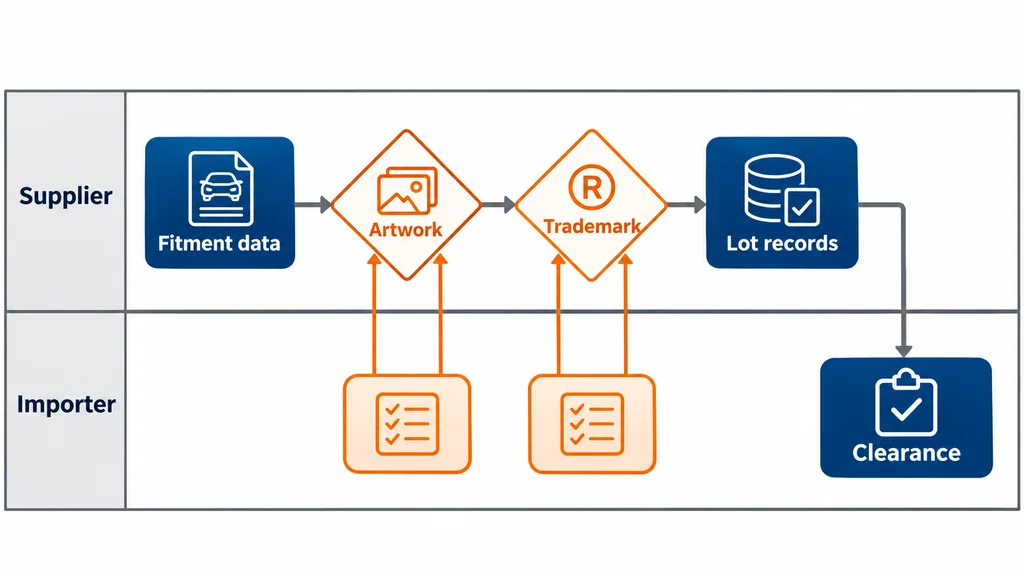
The split below is the one I use when scoping, and it is blunt on purpose: most year two disputes trace to a line nobody wrote down in year one.
| Activity | Supplier side | Importer side |
|---|---|---|
| Fitment data | Holds reference data, confirms fitment | Chooses the range, carries the risk |
| Artwork | Applies approved artwork to a dieline | Supplies files, approves the proof |
| Trademark | Discloses conflicting marks it knows of | Owns and registers the mark in market |
| Lot records | Prints the code, keeps inspection records | Links lot code to customer invoices |
| Clearance | Provides invoice, origin, test documents | Handles duty, surveillance, labelling |
Two rows cause most of the trouble. Lot coding looks like a factory task until a return arrives and nobody can name the run behind it. Clearance looks like your forwarder's job until an officer asks for a document only the factory holds.
 The supplier executes, the importer owns.
Branding Is Not the Hard Part; Traceability Is
Printing a logo on a part or a box is a solved problem. Any factory with a pad printer and a carton supplier can do it this week. What separates a program that survives a warranty cycle from one that collapses at the first claim is the paper trail behind the carton.
A branded part has somewhere to hide. The customer blames the OEM, the OEM's warranty process takes over, and the distributor is just a channel. A private label part has no such backstop. When a claim arrives you have to reconstruct which lot the part came from, which material batch fed that lot, which line ran it, which inspection signed it off and which cartons went where.
That chain breaks easily. The lot code has to exist where returns happen, usually the part or its primary pack, not the master carton. It has to be recorded against the inspection result, not the shipping date. The record has to outlive the warranty you published. And someone has to be named as the person who answers a traceability query.
This is where quality management systems earn their keep. A system audited to IATF 16949 requires documented production control and traceability discipline, which is a different thing from a certificate on a website. The certificate says a system exists. The lot records say it is being used.
Fact: KEHO runs a four stage control sequence (incoming inspection, in-process patrol, packaging inspection and final shipment review), reports 99.2% on-time delivery, and backs its lines with a 12 to 24 month warranty, ISO/TS 16949 certification since 2012, CE marking and SGS third party verification (per company data).
Two tests before you sign. Ask for a lot record from a part the supplier already makes, and check whether the code on the carton traces back to an inspection result. Then ask what happens to that record if a claim lands long after the invoice.
The Four Layers You Are Buying
A private label program is quoted as one thing and delivered as four. Suppliers who blur them quote low and deliver the first layer only.
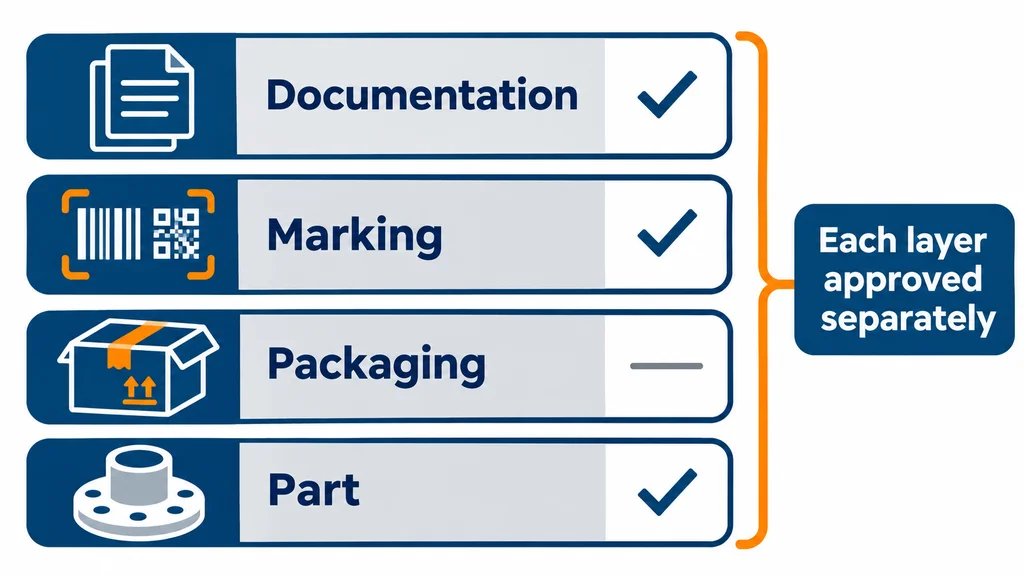
Layer one is the part. The question is not whether the supplier can make it, but whether the specification you approve can be repeated on a second run. Material grade, tolerance, electrical values, surface finish and pack quantity all belong in that document. If the specification lives in an email thread, you do not have one.
Layer two is packaging: structure, board grade, print method, colour reference, dieline and pallet pattern. This is where the visible difference between a professional brand and a hobby brand sits, and where the cost of a program actually moves.
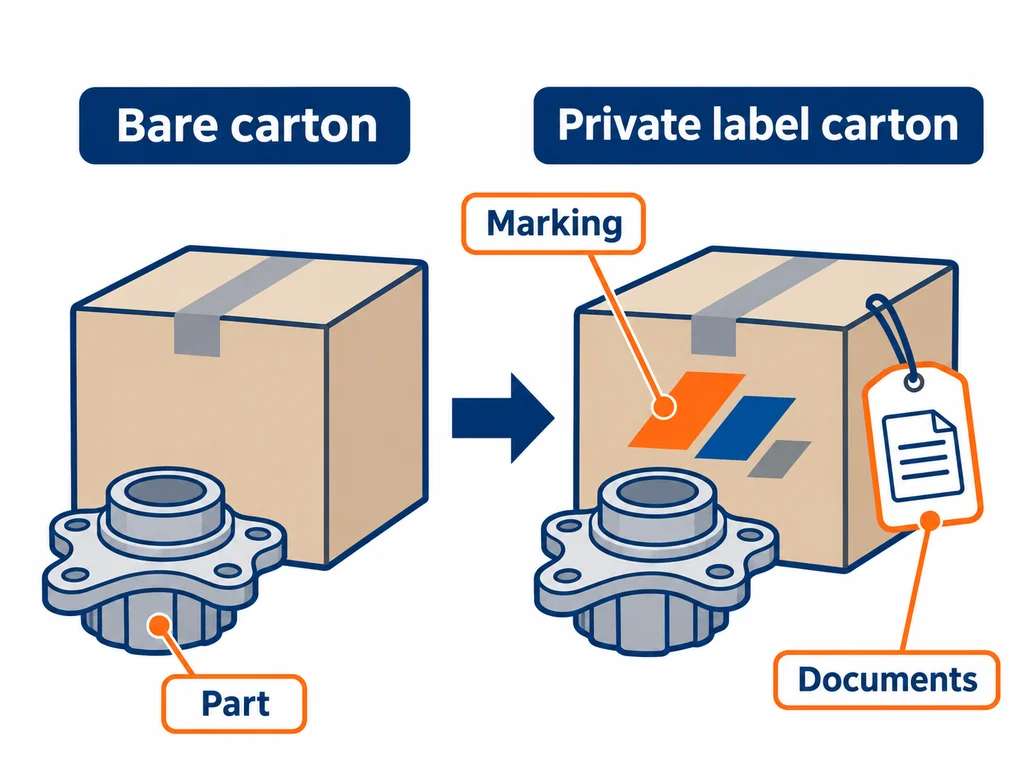
Layer three is marking. What is printed on the part, the inner pack and the carton, and in what format. Marking is not decoration. The part mark makes a return traceable, and the carton mark makes a shipment clearable.
Layer four is documentation: declaration of conformity, test reports, material certificates, origin documents and the artwork files themselves. It is the layer buyers forget to scope, and the layer that decides whether your customer's compliance team accepts the goods.
Treat the four layers as four approvals. One sign-off covering the sample is how a program ends up with a correct part in an unsellable carton, or a beautiful carton around a part with no traceable mark.
 Four layers, four specifications, four approvals.
Fact: The production base behind those layers includes six production lines, a workforce of 500+, a 35,000 m² plant area and a 20,000 m² industrial park, with 40+ R&D engineers and 30+ patents (per company data).
Capability of that kind matters for layers two and three more than for layer one. Printing, packing and coding are the steps smaller suppliers subcontract first, and subcontracted steps are where consistency goes.
Trademark and Market Access Before Any Artwork
The order of operations matters more than the content of the artwork. Register first, then design.
Sending artwork to a factory before you own the mark creates a record that somebody else is producing your identity. It is rarely malicious. Factories talk to each other, accounts get passed around, and an unregistered mark is not something you can enforce.
Ownership has to sit with you, in your name, in the markets where you sell. The Madrid System lets a holder file one international application and seek protection across the member territories instead of filing country by country, which is why it is the usual route for a distributor planning more than one market. The system extends a national or regional application you already hold; it does not replace it.
Class choice is a detail people get wrong. Vehicle parts are generally filed in Class 12. Electronic components such as sensors and ignition coils are often filed in Class 9 as well, and some engine components sit more naturally in Class 7. A filing covering only Class 12 can leave the electrical half of your catalogue unprotected.
One more check before you commit: whether the supplier already holds, or has applied for, a conflicting mark in its own jurisdiction. Uncomfortable to unwind later, cheap to check now.
Market access is a separate track and it gets confused with branding. CE marking is a declaration of conformity made by the party placing the product on the market, resting on a technical file, not a certificate a factory issues to you. IATF 16949 certifies a quality management system for automotive supply, not an individual product. Neither guarantees your goods will clear, and a supplier framing them that way is overselling.
What you can require is concrete: the applicable test reports, a declaration you can put your name to, and the technical file behind it. Our guide to auto parts compliance requirements sets out what each market asks for.
What to Write Into the Agreement
Private label disputes are rarely about quality. They are about a document that said nothing. A purchase order with a logo file attached is not an agreement, and the clauses that decide the outcome are the unglamorous ones.
| Clause | What it must state | Why it matters |
|---|---|---|
| Artwork ownership | Who owns files, proofs and separations | Stops your packaging being reused for another buyer |
| Tooling and plates | Owner, storage, transfer terms at exit | Paid-for assets should not become the supplier's |
| Brand licence | Which marks, products, territories, period | Limits use of your name outside the agreed range |
| Change notification | Named contact, notice before shipment | Catches material and print changes before customers do |
| Sub-supplier disclosure | Which processes are outsourced, and to whom | You cannot audit a process you do not know exists |
| Lot records | Code format, level applied, retention period | Makes a claim answerable instead of negotiable |
| End of program | Disposal or transfer of branded stock | Stops your brand circulating without your control |
Change notification is the clause I would fight hardest for. Sub-suppliers change: a print house moves to a different press, a plating line changes chemistry, a carton supplier switches board grade. None of that is a scandal, and all of it shows up in your product. You need notice before the shipment, not an explanation after the claim. Name a contact and a window, and make silence a breach.
Tooling and plate ownership deserves the same treatment. If you pay for a cylinder, a mould or a dieline, the contract should say who owns it and where it is stored.
Then the end of the program: what happens to branded stock if you stop ordering, and what the supplier may do with it.
If the supplier decision is still open, how to vet a Chinese auto parts supplier covers the checks that come first.
Cost and Volume Logic Without Published Prices
A private label quotation usually arrives as one number per part, and that number is the least useful figure in the document. What moves the total is not the part.
Open the conversation by asking for the program split into three lists. That gives you something comparable across suppliers without pretending a single figure means anything at the enquiry stage.
| Included | Not included | To be confirmed |
|---|---|---|
| Approved artwork on an approved dieline | Trademark search and registration | Which SKU range enters the first run |
| Logo on part, inner pack and carton | Market specific regulatory registration | Whether the existing tool can carry the mark |
| A proof cycle before the print run | Certification body fees and testing | How setup is treated across repeat runs |
| Lot coding to an agreed format | Freight, duty and destination handling | Retention period for lot records |
| Standard export cartons and pallets | Retail or shelf ready display formats | Who administers warranty claims in market |
| Export documents for clearance | Local language importer labelling | Sub-supplier list for print and packing |
Read the third column first. An empty to-be-confirmed column means the project was never scoped, or the quote came from a template. Both beat finding the gap after the deposit.
Setup is a one-time cost carried by a short run. Plates, cylinders, dielines and proof cycles are consumed once and absorbed over whatever quantity follows, which is why a second run of the same artwork is commercially different. Fix how setup is treated before the second run.
Volume is limited by packaging, not production. A factory runs more parts than it can print and pack, so when timing becomes a problem, ask about the print and packing line.
For the comparison mechanics, how to compare auto parts quotations is the companion piece. Bring a normalised structure to the table and the conversation turns from haggling into scoping.
Common Failure Modes
Programs rarely fail in the first shipment. The first shipment gets attention. They fail in the fourth, when everyone has stopped looking.
Same batch, different shade. Print runs get split across two presses or two carton suppliers and nobody compares the outputs side by side. The fix is a reference sample retained from the approved run, held by both parties, plus a written rule that any print source change needs a new proof.
Logo drift. Without a controlled dieline, artwork gets redrawn per run and the mark creeps a few millimetres each time. By the third run the pack looks like a copy of your own brand. Lock the dieline, fix position and size, and reference it in the purchase order.
Traceability break. The lot code is printed on the master carton only, then the goods are repacked at destination and the link is gone. Code at the level where returns happen, and write the requirement into the packing specification instead of leaving it to habit.
Barcode and label errors. A private label part carrying the OEM barcode instead of your own GTIN will scan into someone else's inventory record. Origin marking that disagrees with the invoice creates a clearance problem that is expensive to fix at the border.
Mixed references in one carton. Consolidated shipments make it tempting to combine part numbers to fill a carton. It saves space and creates picking errors in the distributor's warehouse for years.
Warranty without an owner. The promise is printed on the box, but nobody inside the importer's team owns the claim process. That fix is administrative, not technical.
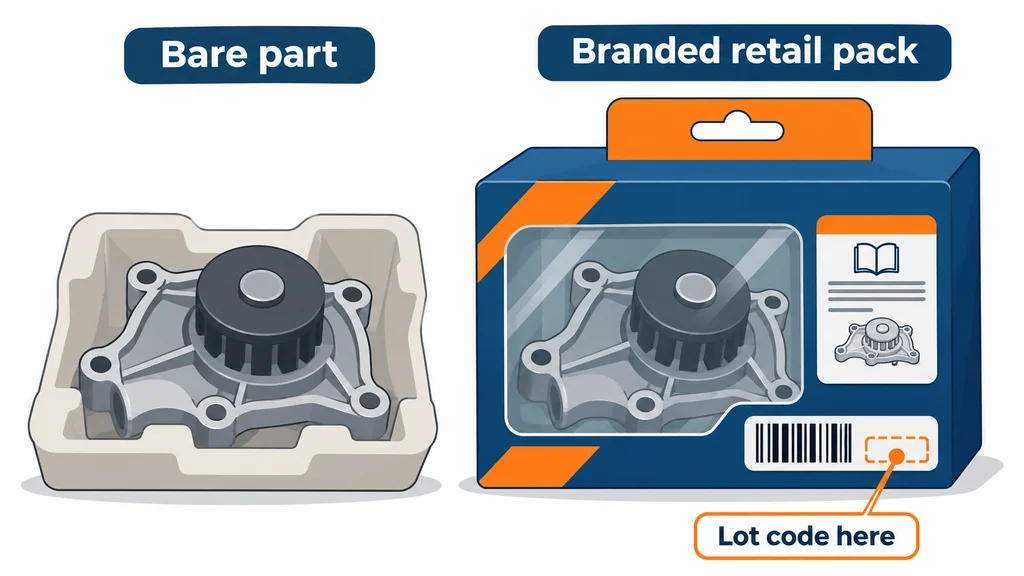 Bare part and branded pack: the same goods, two different businesses.
Most of these are cheap to prevent and expensive to correct. The export packaging and labeling guide and the warranty claims and returns guide go deeper on the operational side.
How to Sequence a First Program
Sequence beats scope. A distributor who runs a narrow pilot properly learns more in one cycle than one who launches a full catalogue and spends a year repairing it.
Fix the trademark position first. Confirm ownership and filing status in your selling markets before artwork leaves your office.
Write the four layer specification. One document covering part, packaging, marking and documentation, with an approval line for each layer.
Approve samples in writing. A sample approved verbally is a sample nobody can be held to. Photograph it, sign it, keep one copy at each end. The process in sample approval before bulk order is the one worth copying.
Run a pilot on a narrow range. Few SKUs, full packaging, full documentation. The point is to test the paperwork, not the parts.
Verify documents before dispatch, not after arrival. Certificates, test reports and origin documents are cheap to correct at the factory and expensive at the port.
Test the record chain. Take one carton from the pilot and ask the supplier to trace it back to an inspection record. If they cannot, you found the problem while it was still small.
Then scale, and consolidate. Once the process holds, widening the range inside the same program is where the economics improve, because setup and administration are already paid for. Multi category parts program covers how to widen without loosening control.
Fact: KEHO has operated since 1995, works with 2,000+ active clients across 80+ countries, carries 50,000+ SKU and reports annual output of $ 50M+ (per company data).
A supplier with that history has run this sequence in many regulatory environments. Ask yours to show you the sequence rather than describe it. The product range shows what a program can be built around, and the contact page is where a scoping conversation starts.
FAQ
What does a private label auto parts program include?
Four layers: the part made to an approved specification, packaging built to your dieline and artwork, marking on the part and pack in a format that supports traceability, and documentation including test reports and a declaration of conformity. A program covering only the first two is a printing job with a part attached.
Can I put my own brand on parts that carry an OEM reference number?
Yes, provided you do not use the vehicle maker's marks, logos or trade dress. Referencing a part number for fitment is a different act from presenting yourself as the OEM. Keep the reference in technical data, keep the branding yours, and check the labelling rules in the destination market.
Is CE marking required for private label auto parts sold in the EU?
It depends on the product. CE marking applies where a product falls under a directive that requires it, and many aftermarket mechanical parts do not. Where it does apply, the declaration is issued by the party placing the goods on the market, which under your brand is you, and it must rest on a technical file.
Do I need my own GTIN barcode for private label auto parts?
Yes, if the part is sold through retail or scanned into a distributor system. A GTIN is licensed to the brand owner, so a barcode borrowed from the factory or from the OEM does not belong to you and will resolve to someone else's product record. Treat it as part of the packaging layer.
Why do private label parts from the same supplier vary between shipments?
Almost always a change upstream of final assembly: a different print source, a board grade substitution, a plating line change, or a dieline redrawn by a new designer. The variation is rarely a supplier deciding to make a worse product. It is an unmanaged change, which is why change notification and a retained reference sample matter more than another inspection.
Which certifications should I ask for in a private label program?
Ask for the quality management system certificate and its scope, the product test reports relevant to the destination market, and the declaration of conformity where one applies. Then ask for a lot record, because a certificate describes a system and a lot record shows the system being used. No certificate guarantees that a given shipment will pass.
Sources
- WIPO, Madrid System for the International Registration of Marks. https://www.wipo.int/madrid/en/
- WIPO, Trademarks. https://www.wipo.int/en/web/trademarks
- IATF Global Oversight, International Automotive Task Force. https://www.iatfglobaloversight.org/
- USPTO, What Is a Trademark? https://www.uspto.gov/trademarks/basics/what-trademark
- EUIPO, Trade Marks. https://euipo.europa.eu/en/trade-marks
- Wikipedia, Private label. https://en.wikipedia.org/wiki/Private_label
- Wikipedia, Trademark. https://en.wikipedia.org/wiki/Trademark