Auto Parts Stocking for Repair Shops: A Coverage Plan for Distributors
A workshop owner asks the question in the first five minutes of a first meeting. "What do you stock?" He is not asking for a warehouse tour. He is asking whether the car on his lift at nine in the morning will be back on the road by lunch, or whether the bay stays blocked for two days while a part travels.
Most distributors answer with a catalog. They hand over a PDF, list the categories, and mention how many part numbers they carry. The workshop cannot convert any of that into an answer about his own bays. A SKU count says nothing about the 2013 Corolla, the 2016 Transit or the 2011 Hilux parked outside.
Three different things get folded into that one question, and they deserve separate answers:
- Category breadth. How many part families you can supply at all.
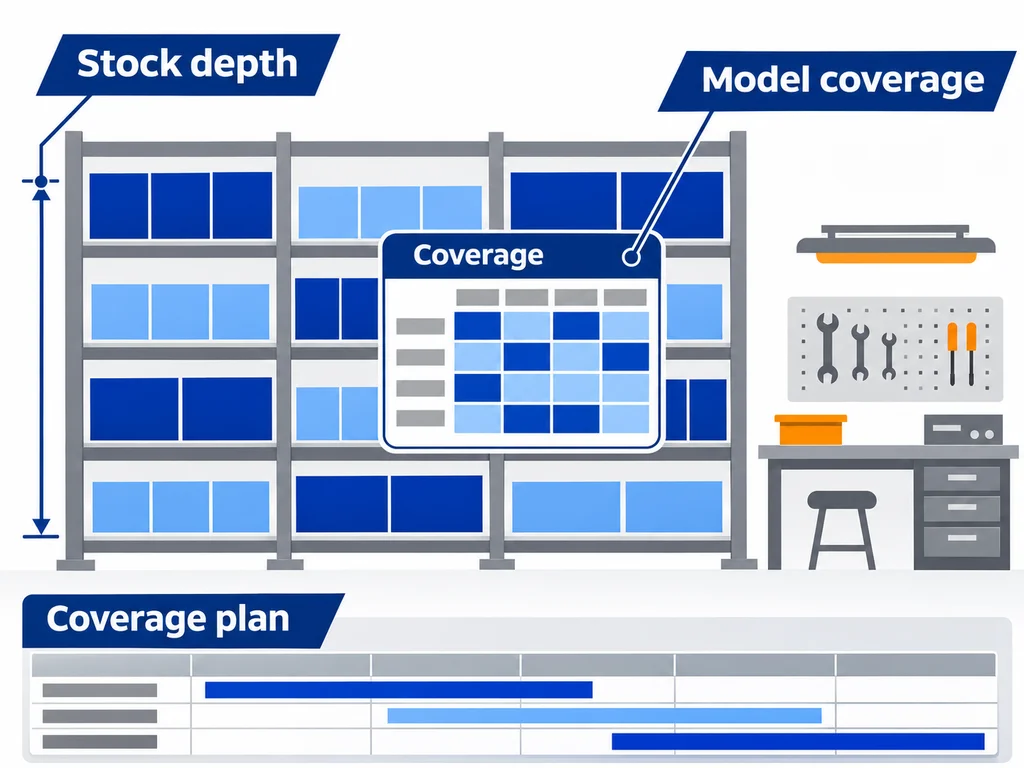
- Model coverage. How much of the vehicle mix in his area those families actually reach.
- Stock depth. How many units of one part number you can put on the counter today.
A distributor can be strong on the first and weak on the other two. That is the normal case, and it is why a workshop keeps three suppliers instead of one.
Fact: KEHO carries 50,000+ SKU across engine, electrical, braking, suspension and steering families, and exports to 80+ countries (per company data).
The reframe worth keeping: a distributor does not sell parts, it sells the answer to "can I finish this job today". Every choice below follows from that. A stocking plan is a promise about response time, written in inventory.
The Question Behind "What Do You Stock?"
Read the question again as an operations question. A shop with six bays and two technicians has a fixed cost per bay per day. When a part is missing, that cost does not pause. It converts into an apology, a delayed handover and sometimes a lost customer who needed the car for work on Monday.
So the workshop is not shopping for the cheapest coil. It is shopping for certainty about time. Two distributors can quote the same part number and the same delivery window, and the workshop will still prefer the one whose shelf it has already tested.
That is why "we have a big catalog" fails as an answer. Breadth does not reduce the wait on a specific job. Depth does, but only on the part families where depth exists.
There is a second layer, and it is the one distributors underestimate. Workshops talk to each other. A shop that gets a same-day coil from you will ask for the sensor next month, then the hub, then the brake line. Depth on one family earns the right to be asked about the next one, which is how a multi-category parts program starts in practice rather than on a slide.
Judgment from the stocking side: for a distributor inside a few hours of its workshops, one deep engine-electrical family will out-earn five thin ones. The thin ones look better on a website. They do not fill a bay.
Breadth or Depth: The Trade Nobody Prices
Every stocking plan lands somewhere between two extremes, and almost nobody puts a price on the choice. The cost is real. It shows up as capital tied in shelf stock, as shelf space, and as the write-down on part numbers that stopped moving while you were buying more of them.
| Decision | Wide and shallow | Narrow and deep |
|---|---|---|
| Part numbers carried | Many, one or two SKUs each | Fewer, full service line each |
| Capital per model covered | Low | High |
| Fill rate on a specific job | Low, the shop waits | High, counter sale |
| Catalog conversation | Strong | Weak on paper |
| Obsolescence risk | Spread thin, easy to ignore | Concentrated, visible |
| Best fit | Backstop supplier for odd jobs | Primary supplier inside a delivery radius |
Neither column is wrong. They answer different customer questions.
Wide and shallow wins the first meeting. Narrow and deep wins the second phone call, the one at 9 a.m. when a car is already on the lift. If your workshops have no other local source, depth is what they are paying you for. If they already buy from a fast warehouse down the road, breadth is your only angle, and you should price it as a convenience line rather than a service promise. Either way, the part numbers have to be looked up the way the shop looks them up, by OEM reference rather than by your internal code, as covered in the auto parts cross reference guide.
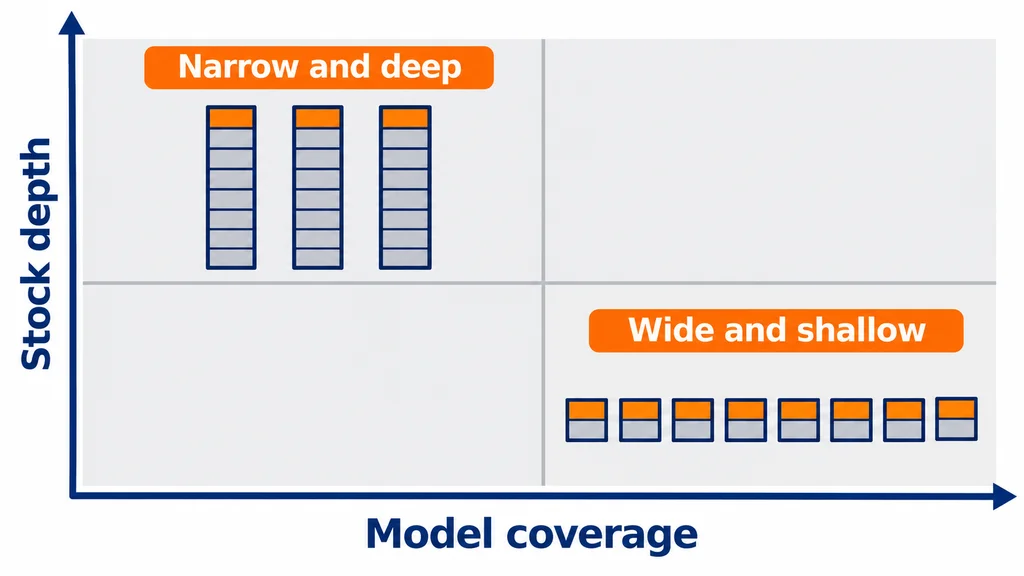 Wide and shallow covers more models on paper. Narrow and deep covers fewer models completely, which is what a bay needs.
The trap is trying to do both with the same money. A distributor that buys one of everything ends up with a shelf full of part numbers that each answer a question no workshop asked twice. Pick the axis per part family, not per company. Engine electrical can be deep while body trim stays wide and thin, and that mix is usually correct.
Four Inputs for a Coverage Plan
A coverage plan needs four inputs. Not five, not a software platform. Four, and most distributors have three of them in their own systems already.
One: the registered vehicle list. Which models, which year ranges, which engine variants actually get serviced in your delivery area. Your own invoice history is the cheapest source and the most honest one. It reflects what you sold, not what you wish you sold. Pull twelve months of lines and group them by model and year band.
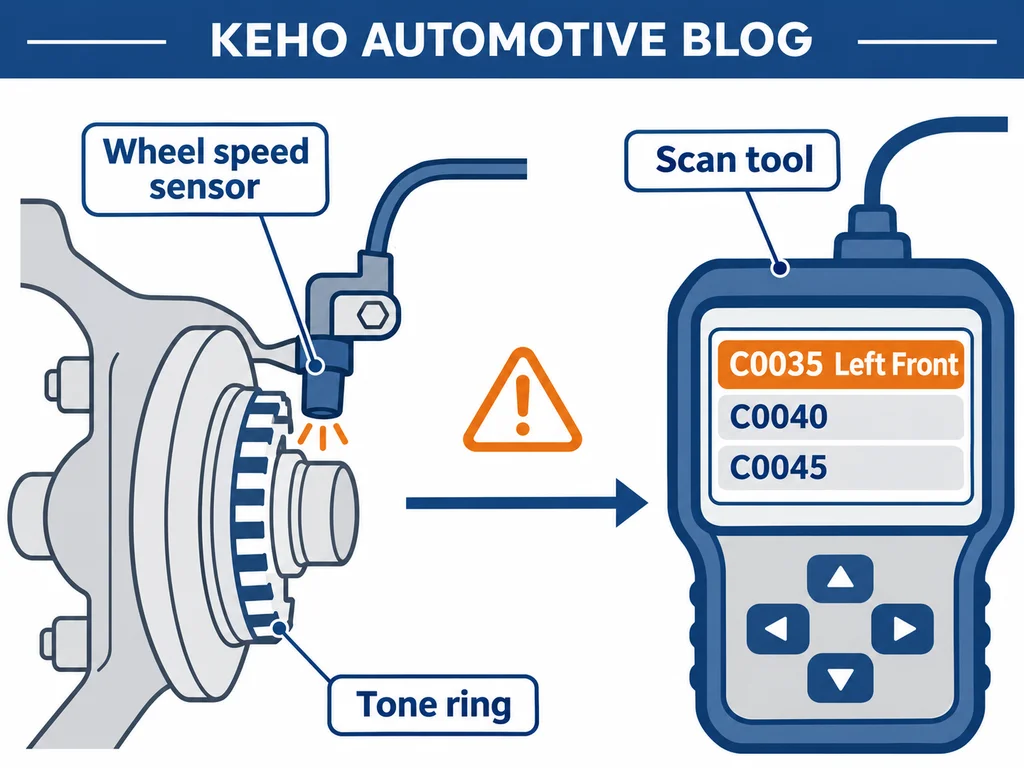
Two: failure frequency per part family. How often a given family fails on those models, and at what mileage. Ignition coils and spark plugs sit on scheduled and unscheduled work. ABS wheel speed sensors fail on age and road condition. A part that fails once in a vehicle's life does not deserve shelf depth no matter how many vehicles are registered.
Three: the wait a workshop will tolerate. This is not your transit time. It is the number of hours before the shop starts calling your competitor. For most independent workshops, a part needed today has a window measured in hours, and a part needed for a booked job has a window measured in days.
Four: unit cost per SKU. Inventory value at risk. A cheap part number can be stocked deep for the price of one expensive sensor, and that asymmetry should drive the whole plan.
Rank by demand multiplied by margin per shelf slot, not by margin alone. The highest-margin part in your catalog is worthless if it moves four times a year. Before any of this goes into a buying list, confirm that each candidate part number resolves cleanly to a model and year band, which is the same discipline described in how to match auto parts by OEM number.
Building a Coverage Rate You Can Quote
Distributors get burned here, so be precise. There are at least three different numbers people call "coverage", and they are not interchangeable.
| Basis | Numerator | Denominator | What it flatters |
|---|---|---|---|
| Part number coverage | Part numbers you stock | Part numbers in a full service line | Ignores how often each number is needed |
| Model coverage | Models with at least one stocked SKU | Models in the target mix | One cheap SKU can mark a whole model as covered |
| Demand-weighted coverage | Demand lines you can ship today, weighted by how often each occurs | All demand lines from the target mix | Nothing, if the demand data is real |
Quote the demand-weighted version. It is the only one a workshop can test against its own week.
The algorithm is short. Build a demand line list from twelve months of workshop orders or job cards, one line per part requested. Tag each line with the model and year band, the quantity, and whether your current stock could ship it the same day. Weight each line by how many times it appears in the period. Divide the weight you can fill by the total weight. That is your coverage rate on that basis, for that vehicle mix, at that moment.
Two rules keep the number honest. First, state the basis in the same sentence as the number: which part families, which model mix, which dispatch window. Second, publish the exclusions list next to it, because the exclusions are where overstatement lives.
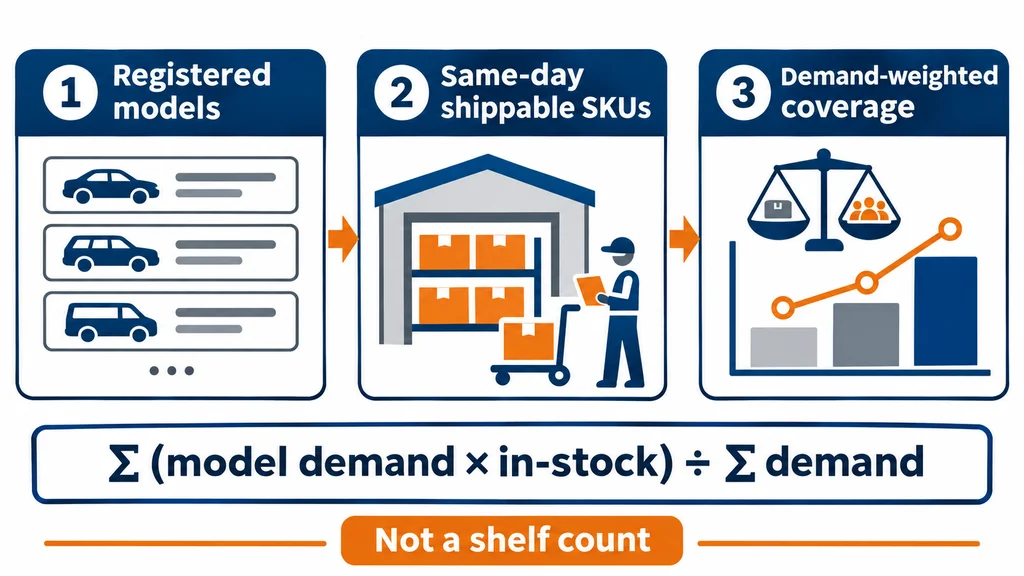 Coverage is demand weighted, not a shelf count. The same stock produces different rates against different vehicle mixes.
Recalculate quarterly. A coverage rate that is not dated should not be quoted, and a rate carried over from last year is a guess wearing a percentage sign. The same caution applies to the cost side of the plan: a comparison built on unit price alone will always favour the thinner shelf, which is why the quotation comparison framework belongs next to the coverage model rather than in a separate folder.
Fast Movers, Slow Movers and the Dead SKU
Once a part number is on the shelf, it enters a lifecycle. The mistake is treating all of them the same way on the same review cycle.
| Tier | Behaviour | Stock decision | Review cadence |
|---|---|---|---|
| Fast mover | Ships weekly, demand is steady | Hold depth, guard against stockout | Weekly |
| Slow mover | Ships monthly or seasonally | Hold a thin buffer, or none if the supplier ships fast | Monthly |
| Dead SKU | No movement in a full cycle | Remove, credit, or bundle | Once, then act |
The cutoff between tiers is yours to set, but it has to be set in advance. A distributor who reviews slow movers whenever the warehouse gets crowded is really deciding by shelf space, and shelf space is the wrong signal.
Dead SKU removal is the part of auto parts stocking nobody enjoys. It also frees more capital than most buying negotiations ever will. A part number that has not moved in a full demand cycle is not waiting for its moment. It is occupying a slot that a fast mover could use, and it is quietly making your coverage rate look better than your fill rate.
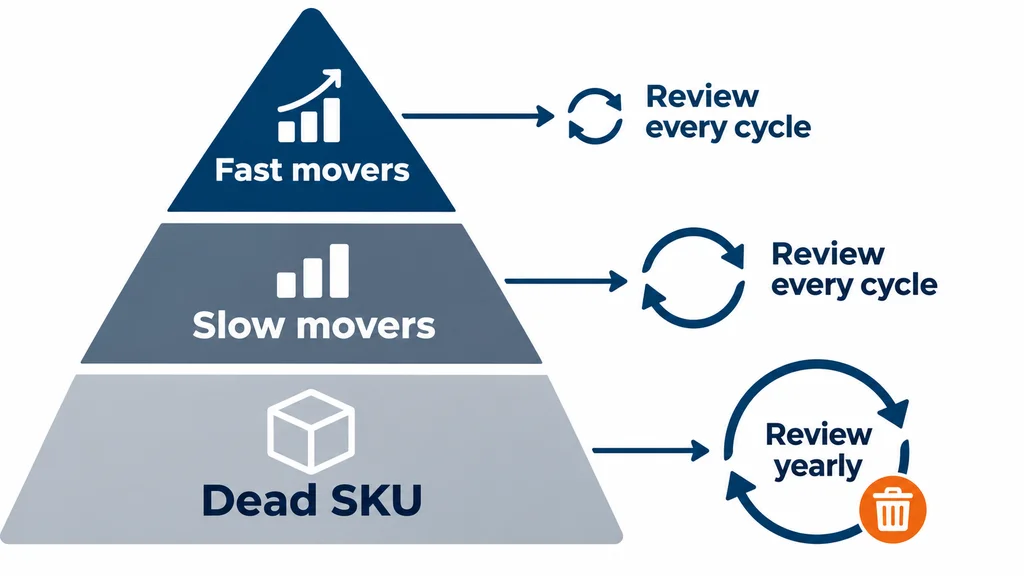 Three tiers, three review cycles. One cadence for every SKU hides both stockouts and dead stock.
Two practical notes from the stocking side. First, slow movers in an expensive family deserve a thin buffer, because the cost of a stockout on a high-ticket part is a lost job and not a delayed one. Second, dead stock in a cheap family is cheaper to keep than to argue about, so put your attention where the capital is.
Judge your own tier counts annually. If fast movers are the majority of your part numbers, your definition of fast is too loose. If dead SKUs are more than a rounding error, your buying is driven by a catalog instead of a demand list. Spark plugs, ignition coils and ABS wheel speed sensors fail on different clocks, so their tiers should not be reviewed together.
Proving Coverage to a Workshop Without Overstating It
A workshop will test you within a month. Whatever you claimed in the meeting gets checked against a real job, so claim less than you can do and let the shelf do the talking.
The evidence that survives contact with a workshop is specific and dull:
- A cross-reference file keyed to OEM numbers. The shop searches the number on the old part, not your internal code.
- The vehicle list behind your coverage claim. Which models, which year bands.
- A dispatch statement. What ships today, what ships in two days, what has to be produced.
- An exclusions list. The families or variants you do not hold, stated up front.
- A named contact for fitment questions. Sensors and ignition parts fail on connector and pin differences, not on brand.
The most common overstatement is the word "stock". A distributor that holds one unit of a part number and sells it twice in a week is not stocking it, it is sampling it. Say "we hold this" only when the quantity on hand covers the shop's normal ask, and say "we can get it in two days" when it does not.
Fact: KEHO dispatches in-stock items in 48 hours and runs a 99.2% on-time delivery rate (per company data).
That distinction does commercial work for you. A workshop that hears an honest two-day answer plans the job and calls back. A workshop that hears "in stock" and then waits five days starts looking for a second supplier, and the second supplier gets the whole account, not just that part.
There is a version of this that costs nothing: publish your coverage basis and let the shop compute against its own job cards. Distributors rarely do it because it invites comparison. The ones who do it tend to keep accounts longer, because the comparison usually goes their way on the families where they chose depth. What the shop is really checking is whether your source can repeat the result shipment after shipment, which is the same question asked in how to vet a Chinese auto parts supplier.
Replenishing Without Cash Lock-Up
Stock is a loan you give your own warehouse. The question is the interest rate, and the interest is everything you cannot buy while the money sits on a shelf.
The mechanics are standard. A reorder point equals average daily demand multiplied by supplier lead time, plus a safety buffer for variability in either one. The buffer is not a fixed percentage. It is insurance priced against two uncertainties: how much demand moves, and how reliably the supplier ships.
Three habits keep replenishment from turning into a cash problem.
Separate stock orders from production orders. A part number that sells steadily should be replenished from a stock program with a short dispatch window. A part number that only moves when a specific job appears should ride a production order and never touch your shelf. Mixing the two is how distributors end up holding inventory for jobs that were cancelled, a split explained in stock orders vs production orders.
Set the order cycle by family, not by convenience. Weekly for fast movers, monthly for slow movers. A fixed cycle makes the reorder point meaningful. Random ordering makes every reorder point a guess.
Fact: KEHO ships standard orders in 15-25 days and holds stock for 48-hour dispatch (per company data).
Fund the buffer before you fund the breadth. Every new part family you add takes capital that a proven family could have used. Add a family when a real workshop has asked for it twice, not when a catalog makes it look complete. If the first order has to stay small, treat freight and consolidation as part of the plan rather than an afterthought, since they change the true cost of the buffer, as set out in the low MOQ shipping guide.
The failure mode is predictable. A distributor grows the part number count every quarter, keeps the same working capital, and slowly converts depth into breadth without deciding to. Fill rate falls first on the fast movers, because that is where the money was taken from.
A 90-Day Sequence for a New Part Family
Adding a family is a project, not a purchase order. Ninety days is enough to do it with evidence instead of instinct.
Days 1 to 15: collect demand. Pull twelve months of workshop orders and job cards for the candidate family. Count how many lines you turned away or sourced elsewhere. If you cannot name the workshops that asked, you do not have demand, you have a hunch.
Days 16 to 30: build the model list. Reduce the family to the models and year bands that appear in that demand. Use OEM numbers as the key, since that is how the workshop looks up the part, and confirm fitment before the list becomes a buying list.
Days 31 to 45: price the shelf. Cost the candidate part numbers and rank them by demand multiplied by margin per slot. Take the top of that list and stop where the capital budget ends. Do not round up to make the family look complete.
Days 46 to 60: place the first order. Mix a stock portion for the fast movers with a production portion for the long tail. Agree the dispatch window in writing, because that number becomes your coverage claim.
Days 61 to 75: publish the claim. Tell the workshops what you now hold, on which models, with what dispatch time, and what you do not hold. Understate it.
Days 76 to 90: measure and cut. Recalculate coverage on real demand, look at what did not move, and remove one part number for every two you added. That last step is the one that keeps the plan alive in year two.
If the family is engine electrical, this sequence is mostly about fitment detail rather than price. If it is braking or suspension, weight and freight change the economics of depth, and the capital budget has to include the container math. When the list is built, the range behind it matters as much as the price, so check the product catalog against your model list before you commit, and send the model and year bands to KEHO for a fitment check if any line is ambiguous.
Frequently Asked Questions
What is auto parts stocking for a repair shop?
It is the decision about which part numbers a distributor holds locally, in what quantity, so that a workshop can finish a job the same day instead of waiting on an order. It is a service commitment expressed as inventory, and it is measured by fill rate on real demand, not by the size of the catalog.
How do distributors decide which part numbers to stock?
Start from the vehicle mix in the delivery area. Rank part families by failure frequency on those models, rank the part numbers inside each family by demand multiplied by margin per shelf slot, then cut the list where unit cost is high and demand is thin. The order matters: model mix first, part numbers last.
Can a distributor quote a coverage rate without overstating it?
Yes, if three things are stated in the same sentence as the number: the part families included, the vehicle mix used as the denominator, and the dispatch window that counts as covered. Add the exclusions list. A rate without a dated basis is marketing, and a workshop will find out within a month.
Is it better to stock wide or deep?
Deep on failure-prone families for workshops inside a few hours of delivery, because depth is what removes the wait from a bay. Wide only when the workshops already have a fast local source and use you as a backstop for unusual jobs. Trying to be both with one capital budget produces neither.
Do workshops care how many SKUs a distributor carries?
Rarely. A SKU count answers a question the workshop did not ask. What it asks is whether the specific part on its lift this morning is on your shelf, and whether the counter can confirm fitment by OEM number without a phone call to the supplier.
Why does lead time matter more than unit price in stocking decisions?
A workshop bills by the bay, and a blocked bay still costs money. Two lost days on one repair usually costs more than the price difference between two suppliers on the same part. That is why a distributor with a 48-hour dispatch window can hold a workshop account against a cheaper supplier who ships in three weeks.
Sources
- U.S. Bureau of Labor Statistics. Occupational Outlook Handbook: Automotive Service Technicians and Mechanics. https://www.bls.gov/ooh/installation-maintenance-and-repair/automotive-service-technicians-and-mechanics.htm
- U.S. Census Bureau. North American Industry Classification System, NAICS 811111, General Automotive Repair. https://www.census.gov/naics/?input=8111&year=2022&details=811111
- International Automotive Task Force. IATF 16949 quality management standard for automotive production and relevant service parts organizations. https://www.iatfglobaloversight.org/
- Auto Care Association. Industry resources for manufacturers, distributors, and repair businesses. https://www.autocare.org/
- Wikipedia. Inventory turnover. https://en.wikipedia.org/wiki/Inventory_turnover
- Wikipedia. Safety stock. https://en.wikipedia.org/wiki/Safety_stock