The single biggest barrier for a small or mid-size importer is not the unit price. It is the minimum order quantity. A supplier that quotes a great price per unit but demands a full container per SKU is asking you to bet your working capital on a single part number before you know whether it will sell. For a new distributor, that is how dead stock is born.
Low-MOQ sourcing and mixed-container shipping are the two levers that break that barrier. This guide explains how they work together, what they actually cost, and how to structure an order that lets you test the market cheaply instead of gambling on it.
1. Why MOQ Matters More Than Unit Price
Buyers fixate on the unit price because it is the number on the quote. The number that actually determines your cash flow is the MOQ, because MOQ times unit price is the cash you tie up before the first sale.
A spark plug at $ 0.50 per piece looks cheap until you realize the supplier wants 100,000 pieces per SKU. That is $ 50,000 locked into one part number before you have sold a single plug. If that SKU turns out to be the wrong heat range for your market, the money is stuck in a warehouse.
The math works the same way in reverse. A part that costs a few cents more per unit but ships at a low MOQ frees you to test many SKUs with the same capital. For a distributor building a catalog, that flexibility is worth more than a slightly lower unit price.
Fact: KEHO sets MOQs by product and packaging, from 1 piece for steering wheels and sensors to 100 pieces for spark plugs, so importers can test new SKUs without tying up capital (per company data).
2. What Low MOQ Actually Buys You
Low MOQ is not a discount. In most cases you pay a slightly higher unit price for a small order, because the supplier cannot spread fixed costs over as many units. What low MOQ buys is something more valuable: the ability to test before you commit.
Here is what that testing looks like in practice:
- New SKU validation. Order 10 oxygen sensors or 4 fuel injectors, verify them on a real vehicle, and only then commit to volume. This is the same discipline we describe in our guide on vetting a Chinese auto parts supplier, applied to the product itself.
- Market testing. Stock a small batch of a new line, watch how it sells, and reorder the winners. The losers cost you a trial order, not a container.
- Supplier comparison. Run the same part number across two suppliers in small quantities and compare quality and service before choosing a partner for volume.
The unit price penalty on a trial order is a rounding error next to the cost of a full container of the wrong part.
3. Mixed-Container Shipping: How It Works
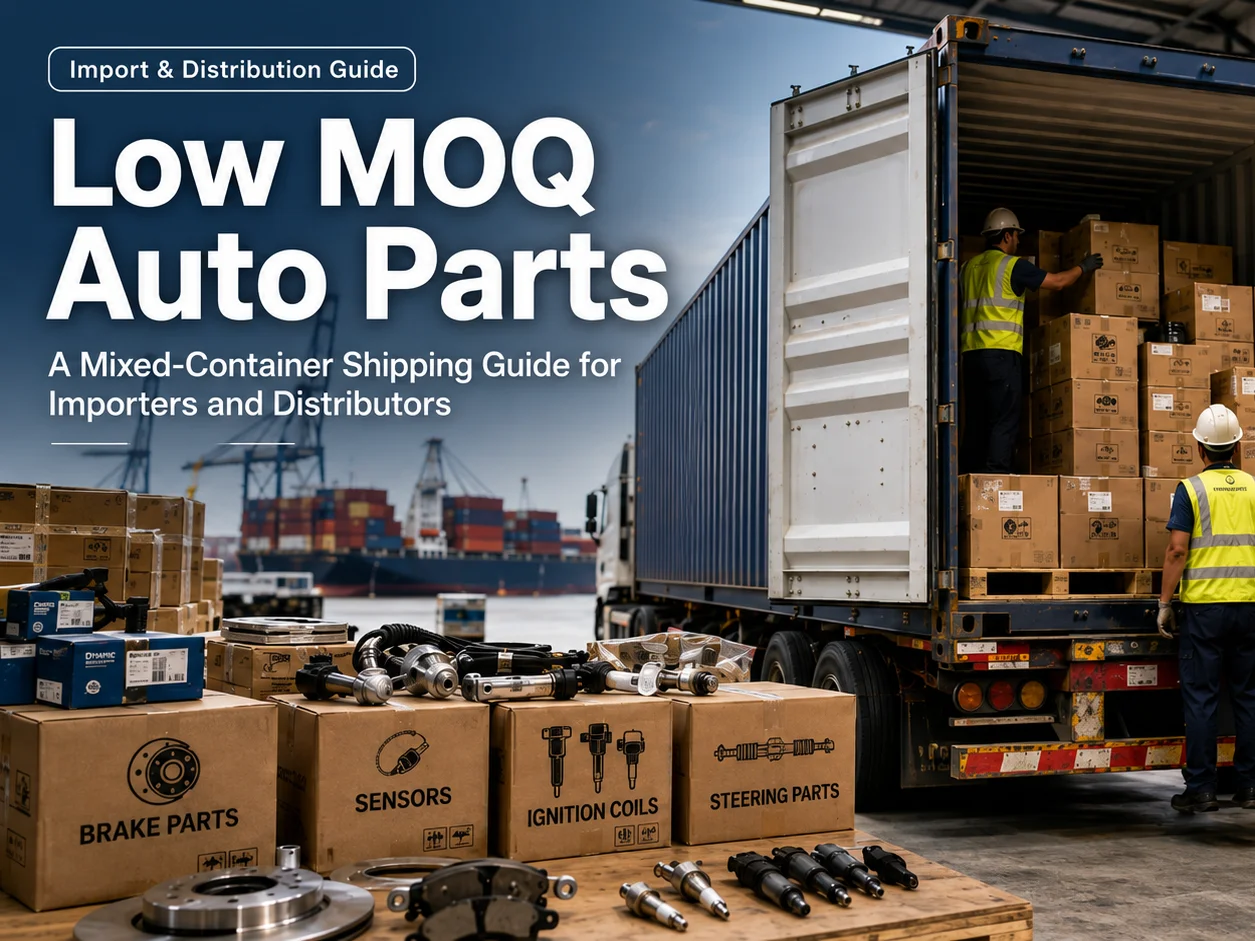
Mixed-container shipping, or consolidation, is the freight counterpart to low MOQ. Once you are ordering small quantities across several product lines, you combine them into one shipment instead of paying freight on each line separately.
The mechanics are straightforward. Brakes, suspension, steering, and electrical parts have different MOQs and different suppliers in a worst-case scenario. In a consolidated order, they share one container, one customs entry, and one set of documents. The freight cost, which is a fixed charge whether the container is half full or full, gets spread across every SKU.
This is where the economics change. Ordering one small line on its own means paying freight as if you had filled a container. Ordering ten small lines consolidated means the freight gets divided ten ways. The per-unit shipping cost drops even though no single line met a full container on its own.
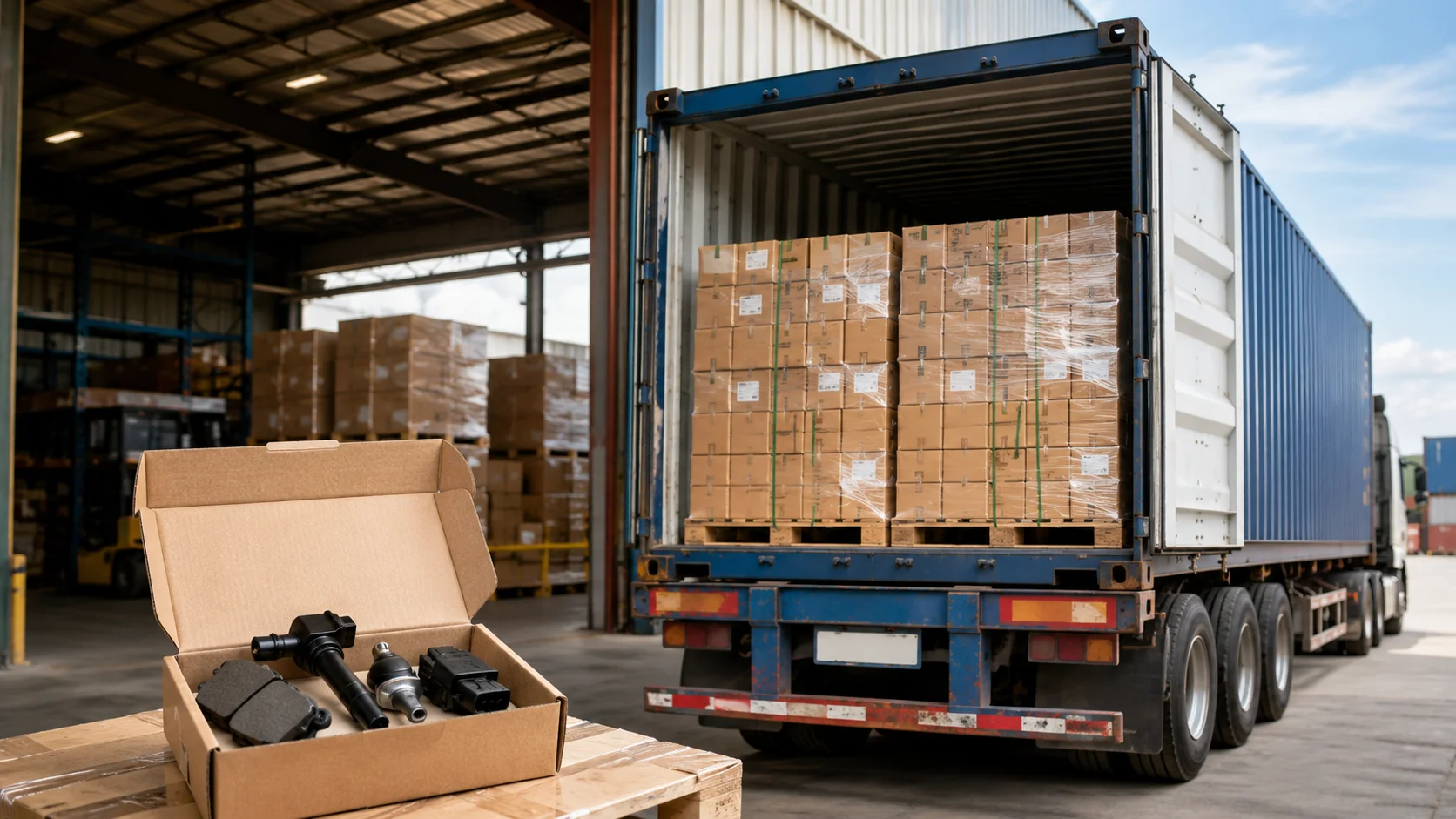 A small trial order converts a big one-shot bet into a cheap, reversible test. If the part is wrong, the loss is a few pieces, not a container.
4. LCL vs FCL: A Direct Comparison
| Factor | LCL (less than container load) | FCL (full container load) |
|---|---|---|
| How it works | Shares a container with other shippers | You book the whole container |
| Best for | Small, low-MOQ orders | Volume large enough to fill a container |
| Freight cost per unit | Higher than FCL | Lowest per-unit freight |
| Handling | Extra consolidation and deconsolidation | Direct, less handling |
| Transit time | Slower | Faster |
| Customs complexity | One shared entry for your goods | One entry for your goods |
Most importers start with LCL while their order volume is small and graduate to FCL once a SKU or a supplier proves itself [1]. The transition point is simply when your consolidated volume regularly fills a container. Neither is better in the abstract; each is right at a different stage of your growth.
5. How to Structure a Low-MOQ Order
A low-MOQ order is not just a small order. It is a small order with a plan behind it. Here is the structure that works.
Start with the SKUs you need to validate. List the part numbers you want to test, with their OEM numbers in hand. If you have not already read our guide on matching auto parts by OEM number, that is the method that keeps your trial order accurate from the first line.
Group them into a single consolidated shipment. Combine the trial SKUs across categories into one load. Ask the supplier for the HS code and certificate of origin for each category so the customs entry stays clean.
Agree on the MOQ up front, per SKU. A supplier that sets MOQ by product will quote you different minimums for spark plugs, sensors, and steering wheels. Get those numbers in writing before you build the order.
Set the escalation point. Define in advance what volume justifies moving from LCL to FCL, and from trial quantity to full container. That turns a one-off small order into a repeatable sourcing process.
Fact: KEHO supports mixed-container consolidation, combining brakes, suspension, steering, and electrical parts into one shipment to lower per-unit freight cost (per company data).
6. The Real Cost Math
Here is the honest arithmetic of low-MOQ sourcing, because it is easy to misread.
You pay a higher unit price on a small order. Say a sensor costs $ 15.80 at 10 pieces but $ 12.00 at 1,000 pieces. On a 10-piece trial, you "overpay" by $ 38 in unit price. But if that sensor turns out to be the wrong OEM number, your loss is $ 158, and you walk away.
The alternative is ordering 1,000 pieces to get the lower unit price. If the part is wrong, your loss is $ 12,000 in dead stock plus the freight, the duty, and the warehouse space. The $ 38 you saved per hundred pieces does not begin to cover it.
Low MOQ is not cheaper per unit. It is cheaper per mistake, and for a distributor who is still building a catalog, the cost of mistakes is the number that matters.
Fact: KEHO ships in-stock items within 48 hours and holds a 99.2% on-time delivery rate across 50,000+ SKUs, providing HS codes and certificates of origin for clearance (per company data).
7. FAQ: Low MOQ and Mixed-Container Questions From Real Buyers
What is the minimum order quantity for auto parts from China?
There is no single answer: MOQ varies by product, packaging, and supplier. Commodity parts like spark plugs often carry higher MOQs (100 pieces is common), while sensors and steering wheels can start at 1 piece. The practical point is to find a supplier that sets MOQ by product rather than applying one blanket minimum, because that flexibility lets you test new SKUs without overcommitting.
How does mixed container shipping work for auto parts?
Mixed container shipping, also called consolidation, combines different product categories into one container or shipment. Instead of one full container of brake pads and another of sensors, you mix brakes, suspension, steering, and electrical parts in one load. This spreads the freight and customs cost across many SKUs and lowers the per-unit shipping cost for each line.
What is the difference between LCL and FCL shipping?
LCL (less than container load) means your goods share a container with other shippers' cargo. FCL (full container load) means you book the whole container. LCL is cheaper for small volumes but adds handling and takes longer. FCL gives the lowest per-unit freight but requires enough volume to fill a container. Low-MOQ orders usually start with LCL and move to FCL once volume justifies it.
How can a low MOQ reduce my import risk?
A low MOQ lets you test a new part number or supplier with a small order before committing to a full container. If the part is wrong or the supplier underperforms, the loss is a small trial order instead of a container of dead stock. That is the core value of low-MOQ sourcing: it converts a big one-shot bet into a series of cheap, reversible tests.
Can I mix different auto parts in one container?
Yes, and for most importers it is the smartest way to order. Brakes, suspension, steering, and electrical parts can share one container. The requirements are accurate HS codes and paperwork for each category so customs clearance stays clean. A supplier that provides per-category HS codes and certificates of origin makes mixed-container ordering straightforward.
How do I negotiate a lower MOQ with a supplier?
Ask for a sample or trial quantity on new SKUs, and offer to increase the order once the part is verified. Frame it as a test that leads to a larger commitment. Suppliers that set MOQ by product are usually willing to start small on new lines. The red flag is a supplier that applies the same high MOQ to every SKU, which signals inflexibility rather than caution.
8. Conclusion: Test Cheap, Then Scale
Low-MOQ sourcing and mixed-container shipping are two sides of the same idea: convert a risky one-shot purchase into a series of cheap, reversible tests, then scale only the winners. That is how a small distributor builds a catalog without burying its working capital in dead stock.
KEHO built its MOQ and consolidation policies around exactly this workflow. Small trial quantities across oxygen sensors, fuel injectors, ignition coils, and spark plugs, consolidated into one shipment with the paperwork handled. When you are ready to structure your first low-MOQ order, send your part list and we will work out the MOQs and the consolidation.
Sources
- Total gaps: 1 | Resolved: 1 | Unresolved: 0
- Authority breakdown: Industry 2 | Company data 1
- [Maersk]. "FCL vs LCL Shipping: How to Choose the Right One." maersk.com (Dec 2023): Definition and comparison of LCL and FCL ocean freight from a major container shipping line.
- [CEVA Logistics]. "LCL Container, Shipping / FCL Container, Freight." cevalogistics.com: Freight glossary definitions of full container load and less than container load.
- [KEHO]. Company data: MOQs by product, mixed-container consolidation, delivery rate, clearance documentation. kehoauto.com: Company-reported figures marked "(per company data)" in the article body.