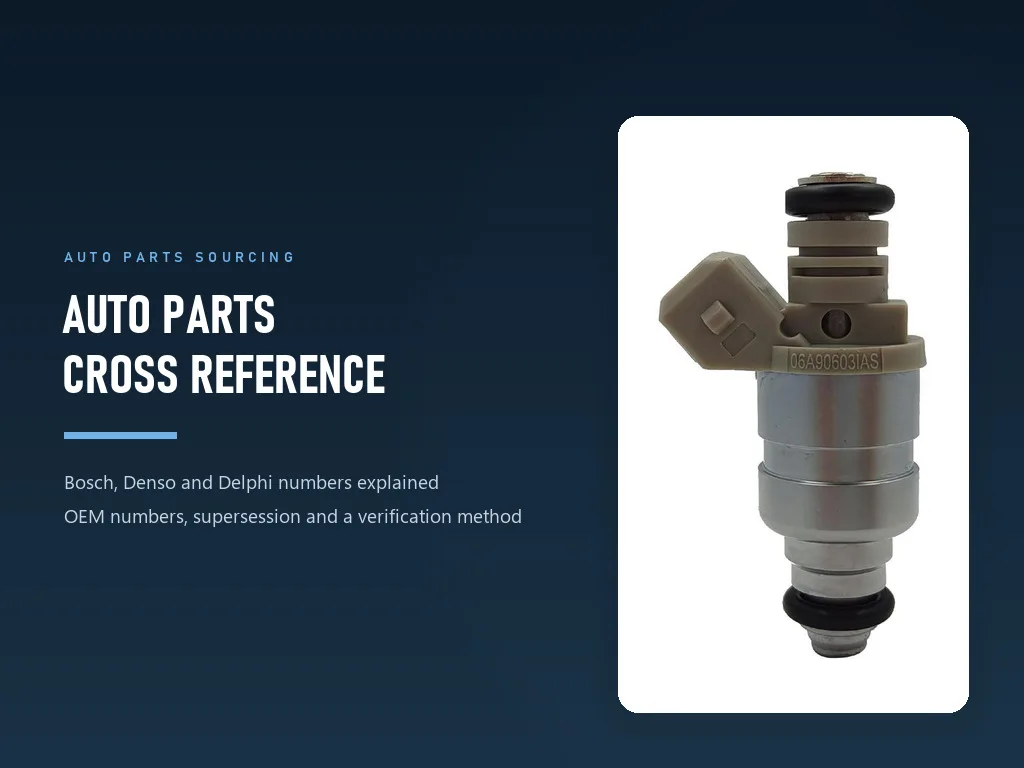
Bosch, Denso and Delphi Numbers Explained
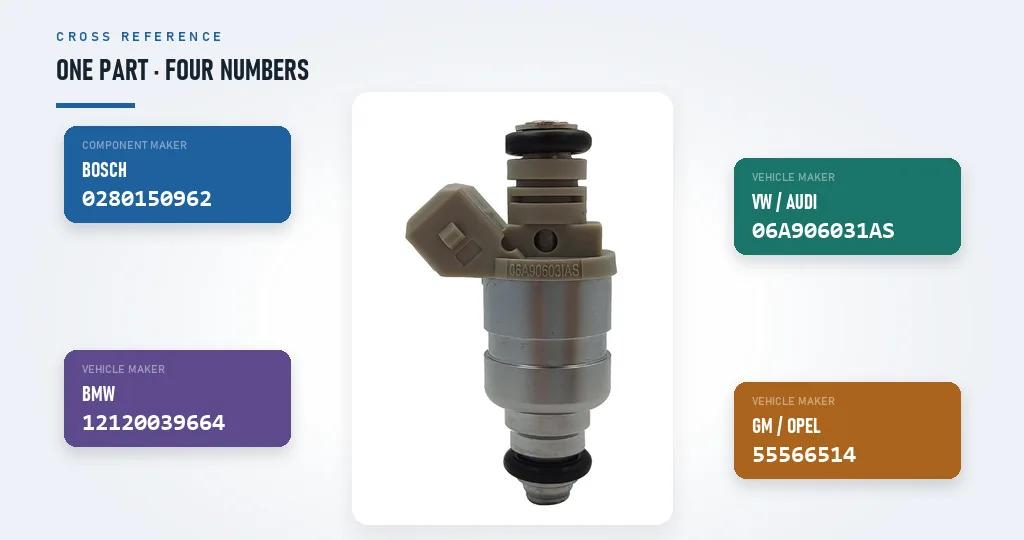 One physical part, four numbers, and none of them designed to be read by the other three companies. Cross referencing is the work of establishing which numbers point at the same object.
1. Why One Part Carries Five Numbers
Take a single fuel injector off a 2015 sedan and you can find five different numbers attached to it. There is the number the vehicle maker stamped on it, the number the company that built it uses in its own catalogue, the number an aftermarket brand sells it under, one or two competitor equivalents, and your own internal SKU.
None of those numbers is wrong. They are issued by different organisations for different purposes, and the part they describe is the same object.
That is what makes cross referencing a distinct skill rather than a lookup task. When a customer sends an OEM number and asks what it converts to, they are asking you to establish identity across systems that were never designed to talk to each other. Get it right and you ship the part that fits. Get it wrong and the wrong part arrives in a market where returns are slow and expensive.
Fact: KEHO has supplied auto parts to importers in 80+ countries since 1995, holding ISO/TS 16949 certification since 2012 along with CE marking and SGS third-party verification (per company data).
Most guidance on this topic stops at "use the OEM number". That advice is correct and incomplete, because the OEM number is only one of four layers, and the failure modes live in the gaps between them. This guide covers the four layers, what a number can and cannot tell you, why supersession breaks lookups, where cross reference data comes from in the first place, and a verification method that holds up on a 500-line purchase order.
The mechanical side of matching a part to a vehicle is covered separately in the OEM number matching guide. This article is about the numbering systems themselves.
2. The Four Numbering Layers
2.1 Original equipment numbers
An OEM number is assigned by the vehicle manufacturer for a part as it is used in production. It identifies the part inside that maker's own catalogue, and it is the number the workshop will read off the original part and quote to you.
The important property of an OEM number is that it is scoped to the vehicle maker, not to the part. Two vehicle makers can specify the same Bosch injector for their own engines and give it two different OEM numbers, and both are correct. The number also changes when the maker revises the part, which is where supersession enters the picture.
2.2 Component manufacturer numbers
The company that builds the part numbers it separately. Bosch, Denso and Delphi each maintain their own catalogues and their own numbering conventions, because those numbers have to serve every vehicle maker they supply.
A component manufacturer's number is tied to the component specification rather than to the application. That makes it stable in a useful way: the same Bosch number can serve several vehicle applications, and it will not change because one car maker revised its own catalogue.
The reverse is also true, and it is the detail that causes disputes. Where a vehicle maker qualified two component suppliers for the same application, one OEM number sits over parts built by two different companies under two different component numbers. Whether those parts are interchangeable depends on the specification, and the specification is not written into either number.
2.3 Aftermarket catalogue numbers
Aftermarket brands and catalogue houses assign their own numbers to the versions they sell. These numbers describe a sellable item, which means they can change for commercial reasons rather than technical ones: a new supplier, a revised packaging configuration, a range consolidation.
This layer is where most cross reference traffic actually happens, because it is the layer your customers order from. It is also the layer with the most variability between brands.
2.4 Your own SKU
The last layer is yours. Your SKU identifies the stock item you hold, with your packaging, your warranty terms and your warehouse location. It is the only number in the entire chain that you fully control.
A distributor's real asset is the mapping between that SKU and the three layers above it.
| Layer | Who assigns it | What it identifies | Who can change it | Where you can verify it |
|---|---|---|---|---|
| OEM number | Vehicle manufacturer | The part as used in production, within the maker's catalogue | The vehicle manufacturer, when the part is revised | The maker's parts catalogue |
| Component manufacturer number | Bosch, Denso, Delphi and equivalents | The component by its own specification | The component maker, when the product is replaced | The maker's own catalogue |
| Aftermarket catalogue number | Catalogue house or aftermarket brand | A sellable aftermarket item | The brand, for commercial or technical reasons | The catalogue, where you have access |
| Distributor SKU | You | Your stock item, packaging and warranty | You | Your own system |
The reason this table matters is the fourth column. Three of the four layers can change without any change to the part, and only one of them is under your control. A cross reference process that treats all four as equally stable will generate errors that nobody can trace back to a cause.
3. What a Part Number Cannot Tell You
Number formats differ between manufacturers, and the differences tempt buyers into a decoding habit that does not hold up.
| Brand or system | Example | Observable pattern |
|---|---|---|
| Bosch | 0280150962 | Ten digits, frequently written with a leading zero, with a shared prefix across a product family |
| Volkswagen / Audi group | 06A906031AS | Alphanumeric, encoding subsystem and fitment generation inside the maker's own scheme |
| BMW | 12120039664 and the shorter 97506 service reference | Numeric, with a condensed form used in service literature |
| Opel / Vauxhall and related GM European applications | 55566514 | Eight digits, scoped to the maker's catalogue |
| Denso, Delphi and other component makers | Brand-specific convention | Each maintains an internal scheme for its own products |
All examples above are taken from KEHO's own catalogue entries (per company data), and they make the point better than any rule could. The formats share nothing. Some are numeric, some alphanumeric, some shorter than others, and the digits do not line up with any shared meaning.
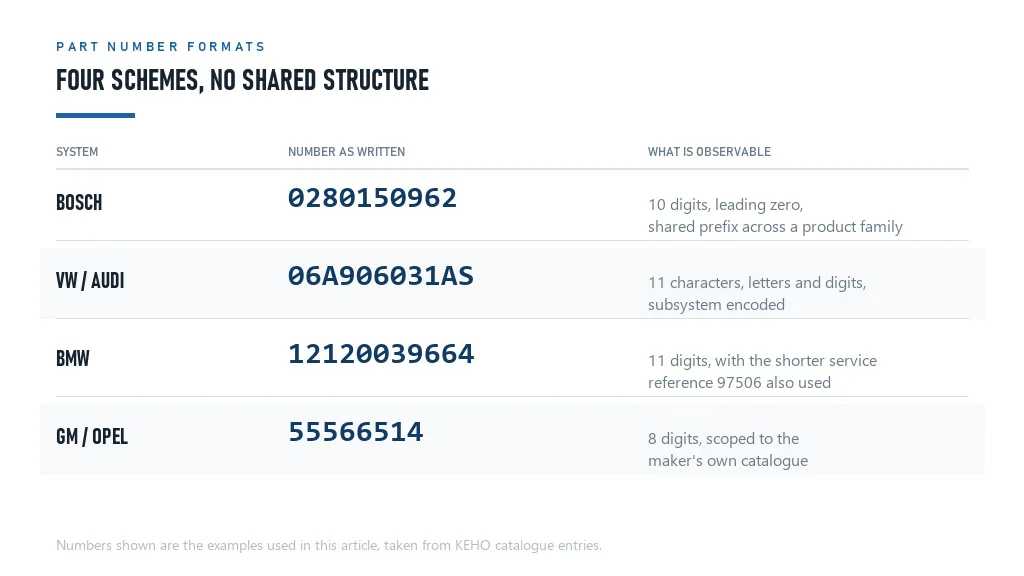 Four numbering schemes, no shared structure. Reading a part number like a specification is a common wrong assumption in cross reference work.
3.1 A number is an identifier, not a specification
Part numbers are internal identifiers. They are built to be unique inside one company's system, to sort sensibly in that company's warehouse, and to be quoted without ambiguity by that company's staff. They are not built to be read by anyone outside.
This is why "decoding" a number rarely produces anything useful, and why cross reference work has to be based on documented mappings rather than on pattern recognition.
3.2 The one thing a number does guarantee
A number guarantees that two people are talking about the same catalogue entry. That is a real and valuable guarantee, and it is the reason the OEM number remains the correct starting point for any fitment question.
What it does not guarantee is that the entry describes a part that fits the vehicle in front of you. That has to be established separately, against the vehicle.
4. Supersession: The Gap That Breaks Lookups
Supersession is a frequent reason a cross reference search returns nothing for a part that is still in production.
4.1 What supersession is
A manufacturer supersedes a number when the part changes or when the range is consolidated. The old number is retired from the active catalogue and a new number takes its place. Depending on the case, the replacement may be identical in form and function, may carry a revised specification, or may not exist at all because the part has been discontinued.
Three outcomes, and they require three different responses from a distributor:
- Direct replacement. Same part, new number. The mapping is safe to make automatically.
- Revised replacement. New number with a specification change. Related parts may also need to change, and an automatic mapping here is how a "compatible" part ends up not working.
- Discontinued. No replacement. The customer needs a used part, a repair service, or a different solution entirely.
4.2 Why this breaks tools
A cross reference tool that holds a flat table of number pairs handles direct replacements and fails on the other two cases.
It also fails for a structural reason. The mapping between aftermarket numbers and OEM numbers is not one to one. An aftermarket maker will often consolidate several original numbers under one replacement part, because the differences between them were immaterial for the aftermarket application. That means one OEM number maps to one aftermarket number, but one aftermarket number maps to several OEM numbers.
A tool that answers "what does this OEM number convert to" is answering a different question from "which OEM numbers does this aftermarket part cover". A distributor who understands the asymmetry can ask the second question, and that is the question that resolves a no-match result.
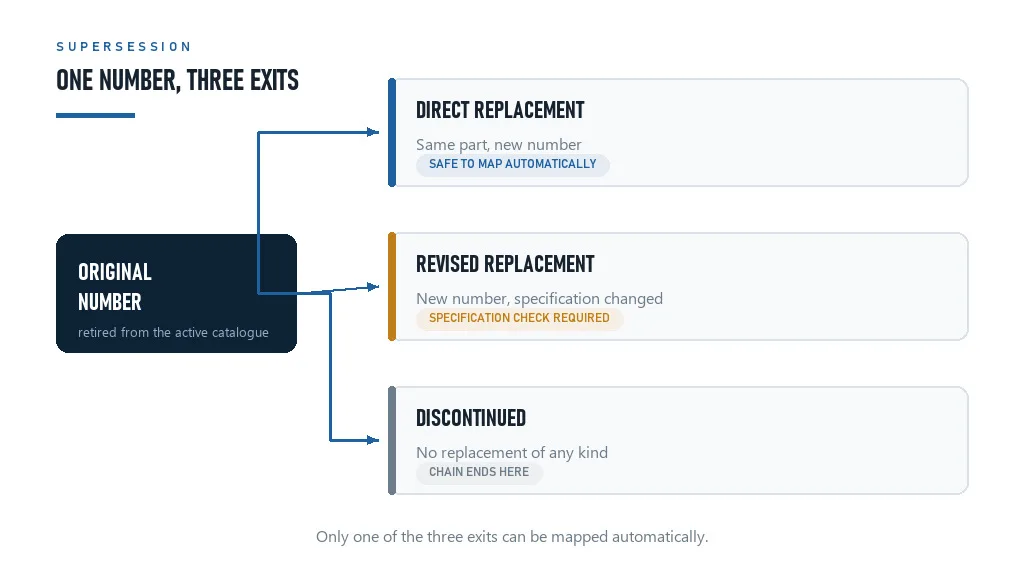 A supersession chain has three exits, and only one of them can be mapped automatically. The other two need a specification check or an honest answer to the customer.
4.3 The rule that follows
Never treat "no match" as "not available". Treat it as an incomplete query, and go back with the supersession chain in hand.
That single habit converts a dead end into an order, and it is the behaviour that separates a supplier holding a database from a supplier holding a catalogue.
5. Where Cross Reference Data Comes From, and Why It Exists
5.1 The regulatory reason independent catalogues exist
The independent aftermarket's access to fitment information is not an accident of commerce. It is a policy position, and in Europe it is written into the reasoning of the block exemption regulation that governs motor vehicle distribution.
Recital 13 of Commission Regulation (EU) No 461/2010 sets out the logic: effective competition in the markets for spare parts and repair services depends on competitive interaction between authorised and independent operators, including independent spare parts suppliers, and "the latters' ability to compete depends on unrestricted access to essential inputs such as spare parts and technical information" [1].
Read that against the four-layer table. The regulation is the reason a distributor outside the franchised network can obtain the fitment data needed to sell a part under a number that is not the vehicle maker's own. It is also why the numbering layers can coexist rather than collapsing into a single proprietary system.
5.2 Aggregated catalogue data
On top of that policy foundation sits the commercial layer: catalogue databases that aggregate OEM numbers, component maker numbers and aftermarket numbers into searchable mappings. Access is licensed, coverage varies by region and by vehicle age, and the depth of supersession history differs from one database to the next.
That variance explains why two tools give two answers for the same query, and why a tool's answer carries the weight of a hypothesis rather than a conclusion.
5.3 The mapping a supplier holds
The third source is the one that decides whether a supplier is useful. A manufacturer that sells across many vehicle brands has to maintain its own internal mapping between the OEM numbers its parts serve and its own catalogue numbers, because that mapping is what turns an incoming enquiry into a shippable part.
Fact: KEHO's fuel injector catalogue carries 117+ OEM numbers covering BMW, VW, Audi, Toyota, Honda, Ford and Chevrolet applications, indexed by OEM number rather than by vehicle name (per company data).
That index is a commercial asset. It is also the thing to interrogate during supplier evaluation, because a supplier who cannot produce a mapping table between your OEM numbers and their SKUs is asking you to take the fitment risk on their behalf. The Chinese auto parts supplier vetting guide covers how to test that capability, and the fuel injector buying guide works through the same question from the product side.
6. A Method That Survives a 500-Line Order
Four steps, in this order. Skipping the first one is the most common cause of a wrong shipment.
6.1 Start from the number on the part, not the number in the message
A customer's message contains a number, and that number came from somewhere. It may have come from the part in their hand, or from a listing, or from a service invoice, or from a search result they did not read carefully.
The only version that carries full weight is the number physically stamped or printed on the part being replaced. Everything else is a lead.
The distinction carries commercial weight. A listing number can belong to a different specification of the same component, and an invoice number can be a superseded one. The stamp on the part is the closest thing to ground truth that a distributor will ever get.
6.2 Use the vehicle as the second key
The second key does not come from the part at all. It comes from the vehicle, and the most compact way to describe a vehicle is its identification number.
A VIN is defined by ISO 3779 for content and structure and ISO 4030 for location and attachment [2]. The current 17-character format traces to 1981, when the National Highway Traffic Safety Administration standardised it for on-road vehicles in the United States, excluding the letters I, O, U and Q so they cannot be confused with digits [2].
The structure divides into three parts: the world manufacturer identifier in positions one to three, the vehicle descriptor section in positions four to nine, and the vehicle identifier section in positions ten to seventeen [2]. The manufacturer identifier is assigned by SAE, which allocates world manufacturer identifiers to countries and manufacturers [2][3].
Four positions carry most of the value for parts work.
- Position 8 identifies the engine on most vehicles built since the 1980s, wherever more than one engine was offered for the model. On a 2007 Corvette, for example, U denotes the 6.0-litre V8 and E denotes the 7.0-litre V8 [2].
- Position 10 encodes the model year in the North American implementation, while outside North America it is usually 0 [2].
- Position 7 disambiguates the year range. Where it is numeric, the position 10 year falls between 1980 and 2009; where it is alphabetic, the year falls between 2010 and 2039 [2].
- Position 9 is a check digit, compulsory for vehicles in North America and China but not in Europe [2], which is useful for catching transcription errors before they become order errors.
Two cautions matter here. The first is that implementations differ: the European and North American schemes are compatible but not identical, so the same position does not always carry the same information [2]. The second is that a VIN identifies a vehicle, not a part. Two vehicles with the same engine can still carry components from different qualified suppliers, and the VIN will not tell you which one was fitted. NHTSA publishes a public decoder for the vehicle side of that check, which is a reasonable first step and not a substitute for the part number.
6.3 Run the four-field check
Once you have the part number and the vehicle, confirm the combination against four fields together: OEM number, vehicle model, year and engine code. The OEM number matching guide sets out the workflow in detail, and the logic is the same for every OEM-numbered component, whether the item is a fuel injector, an oxygen sensor or a spark plug.
The fields are not redundant. The model narrows the platform, the year narrows the production range, the engine code separates the variants sold under one model name, and the OEM number identifies the part. Any single field can agree while the others disagree, and it is the disagreement that tells you a supersession or a variant split is in play.
6.4 Verify in batches, not one line at a time
At order scale, verification is a sampling discipline. Process the whole list as a batch, ask for a mapping table that shows every line, and spot-check a sample against an independent catalogue before the shipment is confirmed.
The sample is what protects you. If the spot-checks hold, the batch is likely sound. If one fails, the whole batch goes back for manual review rather than shipping with a known unknown in it.
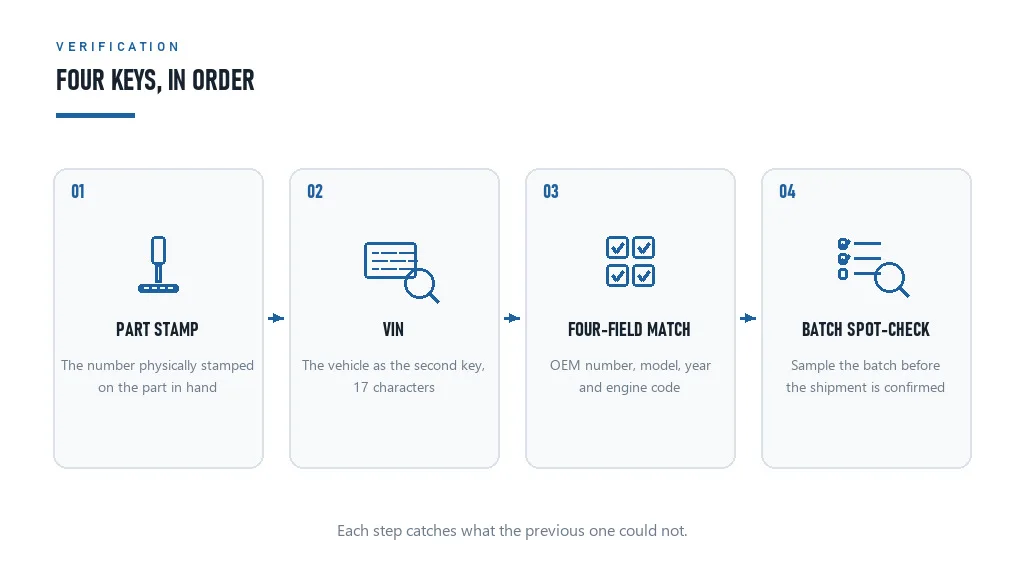 Four keys, in order: the stamp on the part, the vehicle identification number, the four-field match, and a batch spot-check. Each one catches what the previous step could not.
Fact: KEHO verifies OEM number, vehicle model, year and engine code as standard before shipment, across a catalog of 50,000+ SKUs, with in-stock items dispatched within 48 hours and standard orders in 15-25 days (per company data).
7. The Cross Reference Error Map
| Error | How it appears | What it costs |
|---|---|---|
| Reading a no-match result as discontinued | The customer is told a part is unavailable | The order goes to a competitor who asked one more question |
| Assuming a one-to-one mapping | A consolidated aftermarket part is sold against an OEM number that had a specification change | Return, plus a dissatisfied workshop |
| Decoding a number as if the digits mean something | A part is chosen because the number "looks right" for the application | Wrong part shipped and installed |
| Using the model without the engine code | A variant-specific part ships to the wrong variant | Return with installation labour already spent |
| Trusting a number from a listing or invoice | The number belongs to a different specification or an outdated revision | Return, and a customer who stops quoting numbers altogether |
| Mapping a revised supersession automatically | The replacement goes in without the related parts that also changed | Field failure and a warranty claim |
| Skipping the spot-check on a large batch | One bad line ships inside a 500-line order | Freight and rework across the whole consignment |
Two rows deserve emphasis. The first is the no-match habit, because it converts a catalogue gap into a lost order, and it is entirely fixable by asking for the supersession chain. The second is the automatic mapping of a revised replacement, because it is the only row on the list that produces a failure in the field rather than at the loading dock.
8. What to Require From a Supplier's Cross Reference Data
Cross reference capability is testable before you place an order, and the test is a set of questions rather than a set of promises.
| Check | What to ask | Red flag |
|---|---|---|
| Mapping table granularity | "Send the mapping for these 20 OEM numbers: your SKU, vehicle model, year range, engine code" | A list of SKUs with no vehicle data attached |
| Supersession handling | "What do you do when an OEM number has no match in your system?" | The answer is "no match means unavailable" |
| Multi-supplier coverage | "This number was qualified with two component makers. Can you supply either, and do the specifications match?" | Unaware that the situation exists |
| Reverse lookup | "Which OEM numbers does this one SKU cover?" | Cannot answer, which means the mapping only works in one direction |
| Specification data | "Do I get connector, pin and flow data with the part number?" | Only a number and a photo |
| Pre-shipment cross-check | "Will you verify the batch against vehicle specifications before dispatch?" | "We ship what you order" |
| Revision tracking | "How do I know when a mapping in your catalogue changes?" | No notification process |
| Warranty on cross-referenced parts | "Is a part sold under a cross reference covered on the same terms as an OEM-numbered one?" | Different, unwritten terms for cross-referenced items |
The last row is worth pressing on. A supplier who is confident in a mapping will warrant it on the same terms as anything else. A supplier who hedges on the warranty is telling you how much confidence to place in the mapping itself.
9. FAQ: Cross Reference Questions From Buyers
How do I cross reference auto parts numbers?
Start with the physical number stamped on the part being replaced, then map it across three layers: the vehicle maker's original equipment number, the component manufacturer's own number, and the aftermarket catalogue number your supplier sells under. Verify the result against vehicle make, model, year and engine code before ordering. A match on the number alone is not enough, because several numbers can describe the same physical part and only the four combined fields tell you it fits the vehicle in front of you.
What is the difference between an OEM number and a manufacturer part number?
An OEM number is assigned by the vehicle manufacturer for a part as it is used on the assembly line, so it identifies the part within that maker's own catalogue. A manufacturer part number is assigned by the component maker that builds the part, such as Bosch, Denso or Delphi, and it identifies the component by its own specification. The same physical part can carry both, which is why one number does not replace the other. Cross referencing means knowing which of them your supplier is quoting.
What does a superseded part number mean?
A superseded number is one the manufacturer has replaced with a newer number, usually because the part was revised, the supplier changed, or the range was consolidated. The old number often still circulates in the market even though it no longer appears in active catalogues, so a lookup can return nothing for a part that is still made. When a search says no match, ask for the supersession chain rather than accepting that the part is unavailable.
Can I use a VIN to find the right part?
A VIN narrows the vehicle, not the part. The first three characters are the world manufacturer identifier, positions four to nine describe the vehicle, and the last section identifies the individual unit. On most vehicles since the 1980s the eighth character identifies the engine where more than one engine was offered, which is the most useful digit for parts work. The VIN tells you which vehicle specification you are dealing with; the part number then has to be confirmed against that specification.
Why do different brands use different numbers for the same part?
Each numbering system belongs to whoever created it. A vehicle maker numbers parts for its own production and service catalogue, while a component maker numbers the parts it builds for its own catalogue, and an aftermarket brand numbers the version it sells. None of those systems is designed to be read by another company, and none of them encodes fitment in a way a buyer can decode. That is why cross referencing is a matching exercise rather than a translation.
How reliable are online cross reference tools?
They are useful as a starting point and risky as a final answer. A tool can only return what its database holds, and databases differ in how much supersession history and how many aftermarket mappings they carry, so a no-match result does not prove a part is unavailable. Treat any lookup as a hypothesis, then confirm it against the four fields on the actual vehicle and against the number stamped on the part in hand before committing to an order.
10. Turning Four Numbers Into One Shippable Part
Cross referencing is a data discipline rather than a search skill, and it rests on four ideas that fit on one page.
A number is an identifier, not a specification. The layers belong to different owners, so three of the four can change without the part changing. Supersession means a no-match result is a question rather than an answer. And verification is a four-field exercise that ends in a documented spot-check, not a conclusion reached from one number.
Build the mapping table once, hold it in your own system, and the number that arrives in a customer's message stops being a guess and becomes a line item. The component-level detail behind that mapping sits in the spark plug buying guide and the ignition coil buying guide for those product lines, while the misfire diagnostic codes guide shows what happens downstream when the wrong part reaches a workshop.
If you want a mapping table built against your own catalogue, send us the numbers you buy most and we will return the mapping with vehicle model, year range and engine code attached to each line. The relevant product ranges are listed under fuel injectors and oxygen sensors, and general enquiries start from the KEHO product catalogue.
Sources
- European Commission. "Commission Regulation (EU) No 461/2010 of 27 May 2010 on the application of Article 101(3) of the Treaty on the Functioning of the European Union to categories of vertical agreements and concerted practices in the motor vehicle sector." Official Journal of the European Union, L 129, 28.5.2010, pp. 52-57. https://eur-lex.europa.eu/legal-content/EN/TXT/?uri=CELEX:32010R0461 - Recital 13 sets out the competitive reasoning behind access to spare parts and technical information for independent operators, including independent spare parts suppliers.
- Wikipedia contributors. "Vehicle identification number." Wikipedia. https://en.wikipedia.org/wiki/Vehicle_identification_number - ISO 3779 and ISO 4030 as the defining standards, the 1981 NHTSA 17-character standardisation and excluded letters, the WMI, VDS and VIS structure, position 8 engine coding, position 9 check digit applicability, position 10 model year encoding and the position 7 year-range rule, and the public NHTSA VIN decoder.
- SAE International. "SAE J1044, World Manufacturer Identifier." SAE Standards. https://www.sae.org/standards/content/j1044_202403/ (2024) - Standard governing the assignment of world manufacturer identifiers to countries and manufacturers.
- Wikipedia contributors. "Original equipment manufacturer." Wikipedia. https://en.wikipedia.org/wiki/Original_equipment_manufacturer - Definition and usage of the original equipment manufacturer term in supply chains.