Spark Plug Heat Range Cross Reference: NGK, DENSO, Bosch and Champion
A purchase order arrives with one line of description: a 1.8 turbo, and the workshop has written the NGK number because that is what it stocks. Your warehouse holds Bosch and Champion. Someone has to decide what goes in the box, and no chart will make that decision.
This article gives importers and distributors a method they can defend in front of a customer: what the number measures, which direction each brand counts, the four fields that must match before heat range is discussed, the three checks that stop a wrong cross, and the evidence that tells you whether the plug you shipped is behaving.
Why Heat Range Cannot Be Copied From a Number
Every aftermarket catalogue prints a cross reference column, and almost every one of them is a fitment table wearing a thermal costume. It says which plug fits the same hole and does the same job in the same application. It does not say the two plugs are thermally identical, because in most cases nobody measured that claim.
The reason is structural. A heat range number is an index into a scale that one manufacturer defined, using its own test conditions, its own reference bench and its own family of insulator profiles. Two makers can both print 6 on a box and mean two different firing end temperatures. Treated as a physical quantity, the digit is like a shoe size read across countries: the number looks transferable and is not.
The standards do not close that gap, and were never written to. ISO 28741 sets out the main properties and dimensions of spark plugs and their cylinder head housings: threads, seats, reaches, terminals. It is the reference behind the dimensional checks below. It does not assign heat ratings and does not publish equivalence between makers. Dimension is something a caliper settles. Heat range is something an engine settles.
That leaves two kinds of documents. The dimensional standard is authoritative and narrow. The heat range conversion chart is broad and unaudited, usually assembled from field observation and one distributor's experience with one engine family. Those charts are not worthless, but they are not a specification, and the moment one is quoted as if it were, the error becomes yours.
For a distributor the cost shows up in returns. A plug crossed on heat range alone can install perfectly, torque correctly and still misfire, foul or detonate, and none of that appears until the part is in a customer's engine.
What Heat Range Actually Measures
A spark plug does not have a temperature. It has an equilibrium. Heat arrives at the firing end from combustion and leaves through one path: center electrode, ceramic insulator nose, metal shell, cylinder head. Heat range describes how easily that path moves heat, and therefore where the firing end settles when the engine works.
Two limits define the useful window. Below roughly 450 °C the insulator tip is too cool to burn off deposits, carbon accumulates, the leakage path across the nose becomes conductive, and the plug misfires before it is ever hot enough to clean itself. Above roughly 850 °C the plug stops being an igniter and becomes a second ignition source: pre-ignition, detonation, gap growth, in the worst case a melted ground electrode. Between those limits sits the self-cleaning range.
Geometry sets the position. A hotter plug uses a longer insulator nose, putting more ceramic between combustion heat and the shell, so heat escapes slowly and the tip runs hotter. A colder plug shortens that nose and thickens the section behind it, giving heat a shorter, fatter route into the shell.
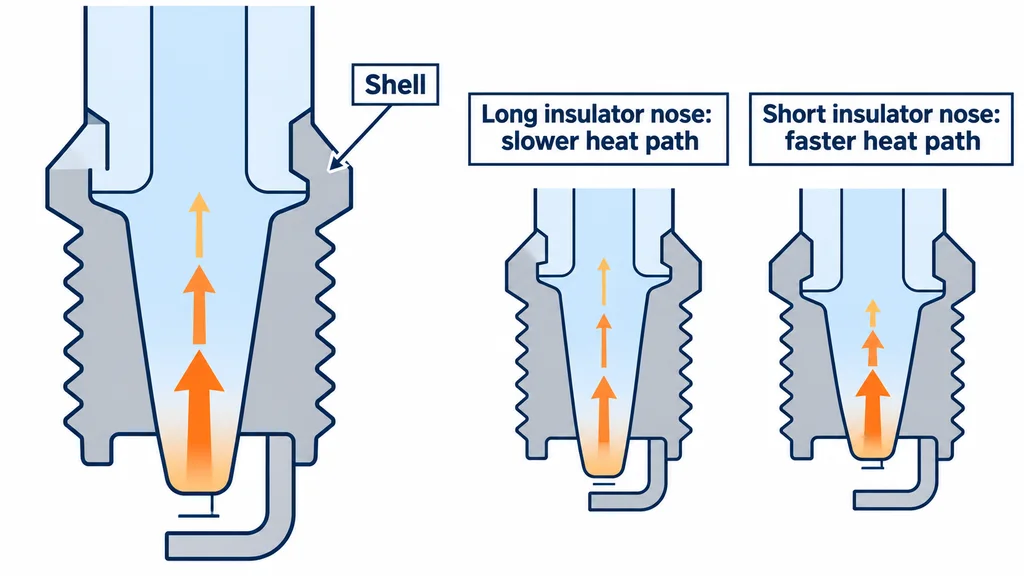 Heat leaves the firing end through the insulator nose and the shell. A longer nose slows that path, so the tip runs hotter at the same load.
The table below says nothing about any brand's numbering, only about what a position on a scale means in service.
| Scale position | Firing end temperature tendency | Heat path through the plug | Duty that suits it | Symptom when it is wrong |
|---|---|---|---|---|
| Hotter end of the scale | Climbs quickly at light load | Long insulator nose, slow transfer to the shell | Short trips, cold climate, low speed urban duty, low output stock engines | Pre-ignition, electrode erosion, detonation under load |
| Middle of the scale | Settles inside the self-cleaning window | Balanced nose length and core section | Mixed duty, the ordinary road car | None, this is the design point |
| Colder end of the scale | Stays low under sustained load | Short nose, short path into shell and head | Track use, towing, sustained high speed, high boost, LPG | Carbon fouling, cold start misfire, wet black tip |
Fact: KEHO runs 6 production lines across a 35,000 m² factory area plus a 20,000 m² industrial park, with 40+ R&D engineers supporting fitment and specification work (per company data).
The Direction Problem: NGK and DENSO Count Up, Bosch and Champion Count Down
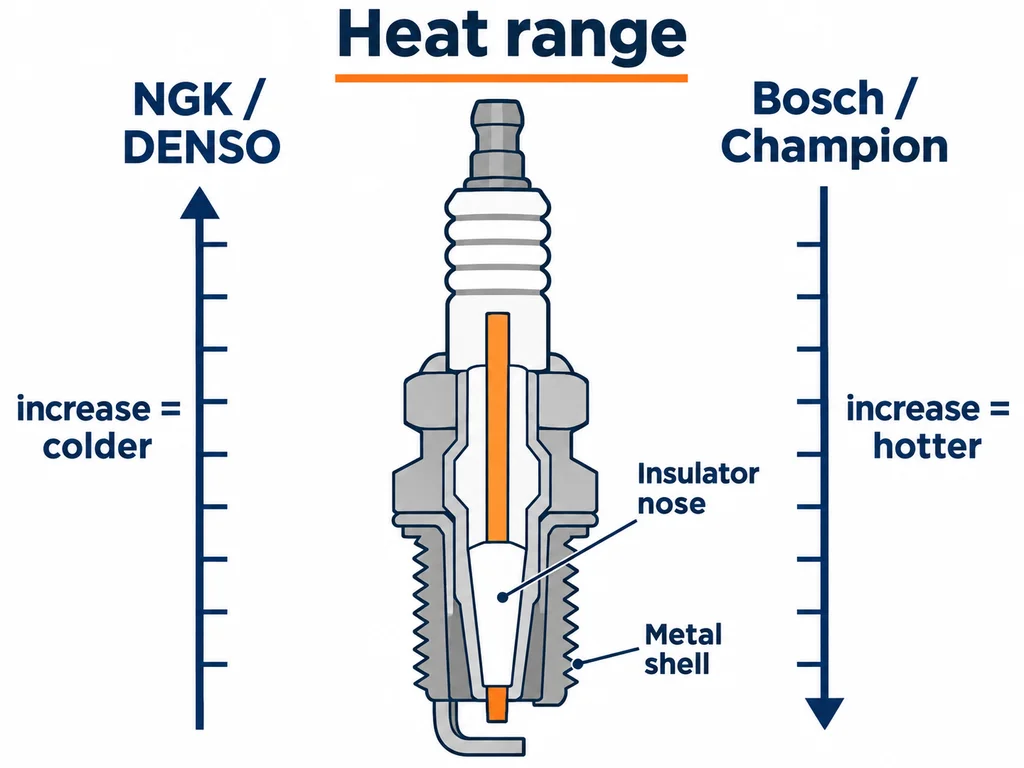
Here is the fact that causes most wrong crosses, and it is about direction, not values. On NGK and DENSO scales the number rises as the plug gets colder. On Bosch and Champion scales the number rises as the plug gets hotter. NGK and DENSO count up toward cold; Bosch and Champion count down toward cold.
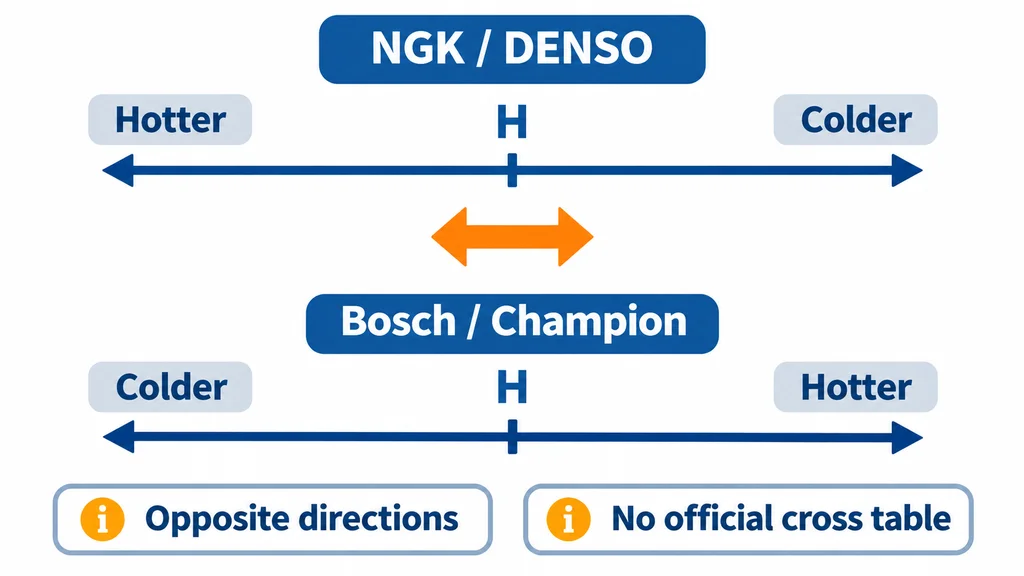 Two directions, no meeting point. The axes show which way each family counts; they deliberately carry no cross values.
The failure is easy to picture. An engineer reads a Champion digit in a Bosch catalogue, keeps it, or moves it the wrong way to compensate, and the plug ships displaced by twice the intended distance from the design point. Nothing in the part number warns anyone, and the fault appears weeks later on a long climb.
Direction is the first layer only. Step size is the second: one step on one scale does not represent the same temperature change as one step on another, and neither scale is linear. The third is code structure, because heat range is one character inside a longer type code and that character sits in a different place in each brand's code. Read the wrong one and you get a number that is real, plausible and unrelated to heat.
For those three reasons no official one to one table exists. The brands publish dimensional and application data, not thermal equivalence, because equivalence is an engine property as much as a plug property. A plug that behaves in a naturally aspirated 1.6 can be marginal in a turbocharged 1.8 with the same thread.
What a distributor can do is narrower and more reliable: fix the direction, keep the offset at zero, and treat any movement as an engineering decision with evidence behind it.
Building the Cross Reference in Four Fields
A defensible cross reference is built in a fixed order, and heat range comes last. If the earlier fields fail, the heat range comparison is irrelevant, because the part will not install correctly or sit at the right depth. The order is thread, seat, reach, hex, then heat range.
Thread is diameter and pitch together. A 14 mm shell at 1.25 mm pitch and a 12 mm shell at the same pitch are different parts, as are two 14 mm shells at different pitches. Thread has no tolerance: either the plug starts by hand into the head or it does not, and forcing it is how heads get stripped.
Seat type follows. A gasket seat plug crushes a washer to seal and set its final depth. A taper seat plug has no washer and seals on a cone machined into the head. A taper plug in a gasket seat hole sits at the wrong depth no matter how carefully reach was measured.
Reach is thread length from the seat face to the end of the shell. It decides how far the firing end projects into the chamber, so it decides both combustion exposure and whether the shell can meet the piston at top dead center. Hex is across flats, a workshop problem rather than a combustion one: a 16 mm hex in a deep narrow well needs a thin wall socket, a 20.6 mm hex needs the larger one.
| Field | What you measure | Failure if wrong | Tolerance for a cross |
|---|---|---|---|
| Thread diameter and pitch | Shell thread, for example M14 x 1.25 | Will not start in the hole, or strips the head | Zero |
| Seat type | Gasket washer or taper cone | Seals at the wrong depth, compression leak | Zero |
| Reach | Thread length from seat face to shell end | Piston contact if long, carbon packed threads if short | Zero |
| Hex | Across flats, commonly 16 mm or 20.6 mm | Correct plug, wrong socket, unserviceable in the field | Zero on the vehicle |
| Heat range | Position on that maker's own scale | Fouling on one side, pre-ignition on the other | Direction known, value not transferable, start at zero |
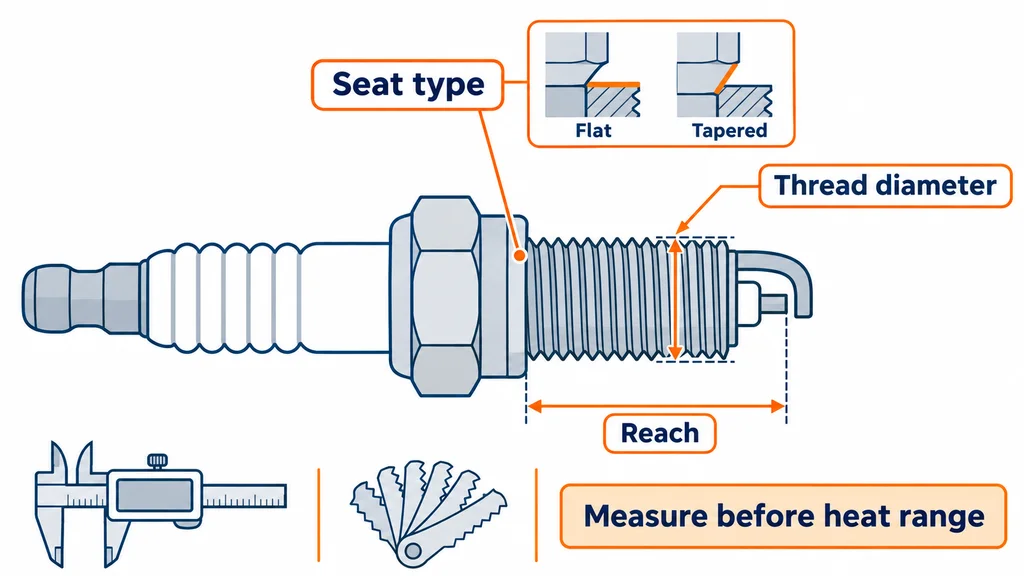 Where to put the caliper: thread diameter and pitch, seat face, and reach measured from the seat to the end of the shell.
Written this way, a cross reference becomes a worksheet rather than an answer: four rows verifiable against the part in hand, and one row that has to be argued. That separation is what makes the result auditable when a customer asks why a particular plug was supplied.
The Three Checks That Prevent a Wrong Cross
The first check is thread and seat together, because they are one mechanical interface. Compare diameter, pitch and seat style against the original part, not against a catalogue photo. Gasket and taper plugs of the same thread both screw in, and only one seals at the designed depth. On aluminium heads the cost is a thread repair; on any head it is a compression leak that reads as a misfire.
The second check is reach, measured on the bench. Too long and the shell or the ground electrode can meet the piston, or the exposed threads carbon up until removal damages the head. Too short and the firing end sits recessed, shielded from the mixture, running cold and fouling. Both look like a heat range problem from the driver's seat, which is why reach is settled first.
The third check needs discipline: offset tolerance. The default is zero steps. A cross that moves one step is a specification change, not a translation, and needs a recorded reason against the vehicle: sustained load, fuel, boost, ambient, or a plug reading. Two steps belongs to an engine builder, not a warehouse. If the only way to make a cross work is two or three steps, the cross has failed and the original specification should be sourced.
Fact: KEHO applies four stage quality control from incoming inspection through process patrol, packing inspection and shipment review, under ISO/TS 16949 certification held since 2012 and SGS third party verification (per company data).
A fourth habit supports all three: record what was compared. A note listing thread, seat, reach, hex, the original heat range field and the offset turns a judgement into a document, and answers a claim in a minute six months later.
These checks also protect the heat range decision. Once thread, seat and reach are confirmed identical, any remaining difference in behaviour is genuinely thermal, and thermal differences are what plug reading is for. Without that step, a fouled plug gets blamed on heat range when the real fault was a recessed firing end.
When a Colder or Hotter Plug Is Legitimate
A heat range change is legitimate when the engine's thermal load has changed and the plug has to follow it. Sustained high speed, towing, track sessions, sustained boost and aggressive advance all raise the heat reaching the firing end, and one step colder than stock is a normal engineering response. LPG is the textbook case: propane and autogas burn differently from petrol, and conversions commonly specify a colder plug with a tighter gap. Government fuel data confirms the wide use of propane in converted fleets, which is why LPG specifications are routine requests in export markets.
The rule that keeps this honest is that the change follows evidence and stays small. One step, one reason, one recorded observation, taken after a defined interval rather than in the first hundred kilometres, because a new plug has not yet settled into equilibrium.
A change is not legitimate when it covers a fault. A fouling plug is reporting mixture, spark energy or duty cycle. A blistering plug is reporting lean running, timing or cooling. One step colder to stop detonation leaves the lean condition in place and removes the component that was complaining about it. One step hotter to burn off soot does the reverse and adds pre-ignition risk on the cylinder that was already hottest.
The same logic covers a plug and coil mismatch. Weak spark energy fouls correctly rated plugs, and a hotter plug appears to fix it for a while. That is why the ignition side is checked first, as set out in the ignition coil buying guide: the coil sets the spark, the plug only spends it.
For distributors this is a sales rule too. Supplying a colder plug on request is service. Supplying one because a chart suggested it is a specification change made without authority, and the return is yours.
Reading a Plug as Evidence
A used plug is a record of the last few thousand combustion cycles and the only thermal data most workshops will ever have. Read it before changing anything.
Start with the insulator tip and the ground electrode, not the shell. A dry matte black tip points to a rich mixture, weak spark energy or a plug running below its self-cleaning window. A wet oil film is not a heat range signal: oil is coming past rings, guides or a turbo seal, and a hotter plug will bake it onto the ceramic. A blistered chalky white insulator with a rounded ground electrode is the dangerous reading, pointing to pre-ignition or detonation from lean running, timing, overheating or a plug too hot for the duty.
Then look at the thread and the seat. Carbon packed into the threads above the seat means the plug sat too deep or was loose. A clean band where the gasket should have crushed means the seat never sealed. Neither is a heat range fault, and both are visible in thirty seconds.
| What you see on the firing end | What it indicates | What to check before touching heat range |
|---|---|---|
| Dry black soot over the tip | Rich mixture, weak spark, or duty colder than the plug was built for | Injector trim, coil output, thermostat, then heat range |
| Wet oil film | Oil past rings, guides or a turbo seal | Compression, leak down, guide clearance |
| Blistered white insulator, melted electrode | Pre-ignition or detonation from lean running, timing or overheating | Fuel pressure, lambda, knock logs, cooling |
| Uniform light tan or grey | Plug is in its working window | Nothing |
| One sided or asymmetric wear | Cylinder specific cooling or spray pattern fault | Coolant flow, injector balance, intake sealing |
Read it at the right moment. A plug pulled after a long idle reports idle; a plug read after a hard pull and immediate shut down reports load, the condition heat range is chosen for. One photograph of the tip plus the duty description is stronger evidence than any conversion chart. Where the complaint is misfire rather than appearance, the misfire diagnostic codes guide maps codes to systems before any plug is replaced.
Fact: KEHO supplies 80+ export countries from a catalogue of 50,000+ SKUs, serves 2,000+ active clients and reports 99.2% on-time delivery (per company data).
How to Run a Cross Reference Without a Magic Table
The process that holds up in a warehouse has five steps and no shortcuts.
First, capture the original specification as a specification, not a brand name: thread, seat, reach, hex, heat range field and feature codes such as projected tip or suppression resistor. A request that arrives as one part number should leave the desk as six recorded fields.
Second, isolate the heat range character using that maker's own documentation, not a guess from position. If the character cannot be identified with confidence, the cross stops and the original part is sourced.
Third, convert direction only. Establish whether the target brand counts up or down toward cold, place the plug on the correct side of the design point, and write zero offset beside it.
Fourth, verify the mechanical half against the physical part: thread with a pitch gauge, reach with a caliper, seat by washer presence, hex with the socket used in service.
Fifth, define the confirmation interval. A cross that has not been read is a hypothesis. Agree when the plugs will be pulled and what will be photographed, so the next order rests on data instead of the chart that started it.
That explains why fitment data matters more than a cross reference column. The question is not what replaces this number, but what this engine takes and what the four fields are. Working from application data with the OEM number as the index keeps the decision attached to a vehicle, the logic behind the spark plug buying guide and how the spark plug range is organised.
Plugs and coils are often replaced together, so one source for both shortens the loop, which is why the ignition coil range sits beside the plug line. Where a specification is unclear, send the four fields and the duty description through contact and let fitment check run first. Cross reference by dimension, convert by direction, decide by evidence.
FAQ
What is a spark plug heat range?
It is the position of a plug on its maker's own scale for how quickly the firing end sheds heat into the cylinder head. It is an index, not a temperature reading, and it only means something inside the family that produced it.
How do I cross reference a spark plug heat range between NGK, DENSO, Bosch and Champion?
Match thread, seat, reach and hex first, isolate the heat range character in each code, then convert direction only. NGK and DENSO count up toward cold, Bosch and Champion count down toward cold. Start with a zero step offset.
Can I fit a hotter plug to stop fouling?
Only after the cause is ruled out. Dry soot usually means a rich mixture, weak spark energy or a duty cycle colder than the plug was built for. A hotter plug masks the symptom and adds pre-ignition risk.
Is a higher heat range number always a colder plug?
No. On NGK and DENSO scales a higher number is colder; on Bosch and Champion scales a higher number is hotter. Assuming one direction across all four brands is the most common way a correct looking cross ends up two steps out.
Do NGK and DENSO heat ranges line up one to one?
No. Each maker defines its own scale with its own test conditions, and one step on one scale does not represent the same temperature change as one step on another. Arithmetic across brands drifts even when the direction is right.
Why is there no official cross reference table for spark plug heat ranges?
Because the published standards cover dimensions, not thermal equivalence, and heat range depends on the engine as much as on the plug. ISO 28741 fixes threads, seats, reaches and terminals but assigns no heat ratings.
Sources
- International Organization for Standardization. ISO 28741:2023, Road vehicles, Spark-plugs and their cylinder head housings, Basic characteristics and dimensions. https://www.iso.org/standard/79008.html
- International Organization for Standardization. ISO 28741:2013, previous edition of the same dimensional standard. https://www.iso.org/standard/56857.html
- U.S. Department of Energy, Alternative Fuels Data Center. Propane as a vehicle fuel. https://afdc.energy.gov/fuels/propane.html
- Wikipedia. Spark plug, construction, insulator tip and heat range. https://en.wikipedia.org/wiki/Spark_plug
- Wikipedia. Ignition system, coil-on-plug and wasted spark arrangements. https://en.wikipedia.org/wiki/Ignition_system