How to Compare Auto Parts Quotations: A Line-by-Line Method for Importers
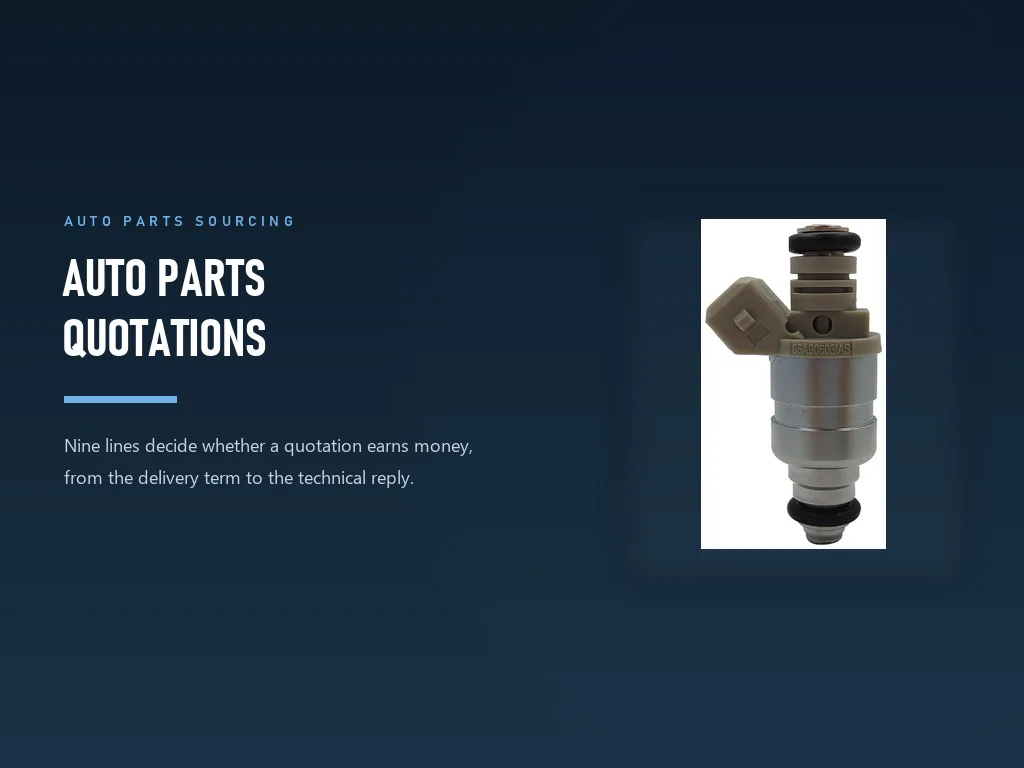
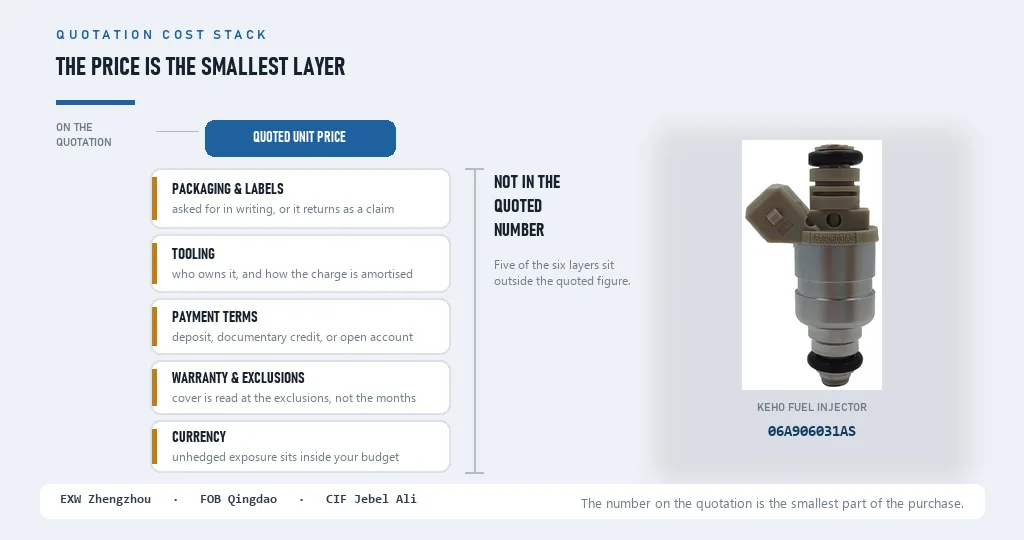 Three quotations for the same fuel injector, three different numbers, and no way to rank them until every layer above the price is on the same basis.
1. A Quotation Is a Cost Stack, Not a Price
Three suppliers quote the same fuel injector. The first offers it EXW Zhengzhou. The second offers it FOB Qingdao. The third offers it CIF Jebel Ali.
The first number is the smallest and is quite likely the most expensive purchase of the three, because EXW stops at the factory gate and leaves every step after that to you. Until the three offers describe the same point of delivery, there is nothing to compare. That is line one of nine.
Fact: KEHO has supplied auto parts to importers in 80+ countries since 1995, holding ISO/TS 16949 certification since 2012 along with CE marking and SGS third-party verification (per company data).
Most quotation advice stops at "negotiate the price". Price is the one line every buyer already knows how to fight over, and it is the line a supplier can move without changing anything that matters. The lines that decide whether a purchase earns money sit under headings that look administrative: packaging, tooling, payment terms, warranty exclusions. None of them changes the quoted number. All of them change the money that leaves your account.
This method assumes you are holding two to five quotations for one requirement and need to rank them. It works for a trial order and for a container program, and it ends with a scorecard you can keep in a spreadsheet.
The stages either side of this one are covered separately. Finding the correct part number is the subject of the OEM matching guide, qualifying who you buy from is the supplier vetting guide, moving the goods is the mixed container shipping guide, and holding the resulting data is the cross reference guide. This article covers the stage in between, where a quotation stops being an email and becomes a purchase decision.
2. Line 1: The Delivery Term, or Why the Cheapest Number Usually Loses
2.1 What the terms decide, and what they leave to your contract
Incoterms are a series of three-letter commercial terms published by the International Chamber of Commerce, defining the responsibilities, costs and risks involved in delivering goods from seller to buyer [1]. They exist because the same word means different things in different jurisdictions, and because a shipment has many points at which responsibility could plausibly sit.
They are also narrower than most buyers assume. The rules do not conclude a contract, do not determine the price, currency or credit terms, do not govern contract law, and do not define where title to the goods transfers [1]. Those four gaps are where disputes live, and a delivery term that looks settled on the quotation can still leave you arguing about who owns a damaged pallet.
The current edition is Incoterms 2020, the ninth set, published on 10 September 2019. It defines eleven rules, divided into seven that work with any mode of transport and four that apply only to sea and inland waterway shipments [1]. The 2020 edition also formally defined delivery, as the point at which the risk of loss or damage to the goods passes from seller to buyer [1]. That definition is the one to hold on to when comparing quotes, because a term is largely a statement about where that point sits.
2.2 Why an EXW offer is a trap in a comparison
EXW, or Ex Works, places the maximum obligation on the buyer and the minimum on the seller [1]. The seller makes the goods available at their premises and does not load them onto the collecting vehicle or clear them for export [1]. The term is common precisely because it is convenient for a first quotation, since it requires no cost estimation beyond the goods themselves [1].
Two consequences follow for the buyer.
The first is arithmetic. Every step between the factory gate and your warehouse has to be added before the EXW number can be compared with anything: loading, inland transport, terminal handling, export clearance, ocean or air freight, insurance, import duty and on-carriage. A buyer who compares the EXW figure against a CIF figure is comparing a third of a journey against all of it.
The second consequence is administrative, and it is the one buyers rarely see coming. Under EXW the buyer is responsible for export documentation. In jurisdictions such as the European Union, customs rules require the declarant to be resident in that jurisdiction, so a buyer based outside it may be unable to clear the goods for export at all, leaving the seller to declare the shipment in their own name [1]. That arrangement also creates a tax exposure for the seller, because in an EXW shipment the buyer has no obligation to provide proof of export, and without that proof the seller can be assessed for sales tax as though the goods had been sold domestically [1].
The practical effect on your comparison is that an EXW price may carry a risk premium built into it, while the same supplier's export-cleared figure can be slightly higher and cost you nothing in administration. Ask which one you are looking at. The supplier vetting guide covers how to test whether a supplier can actually handle export formalities rather than merely asserting that they can.
2.3 The sea-only group, and why containers change the answer
Four of the eleven rules apply only where transport is entirely by water: FAS, FOB, CFR and CIF [1]. They are not suitable for containerised freight, for a structural reason: under these terms the risk transfer point is loading on board the vessel, and if the goods are sealed inside a container it is impossible to verify their condition at that moment [1]. Note too that the risk point under these terms moved from the ship's rail in earlier editions to loading on board [1].
Auto parts shipments are almost always containerised or palletised in groupage, which means FCA, CPT or CIP is the correct family for most of what an importer buys [1]. A supplier offering a container shipment CIF is using a term outside its intended scope, and the risk transfer point may not mean what either party thinks it means.
One more market-specific wrinkle is worth knowing before you normalise. Some jurisdictions calculate duty against a specific term: India against the CIF value of the goods, South Africa against the FOB value [1]. In those markets the delivery term on your quotation quietly changes your duty base, which is a second reason to insist on the term rather than accepting whichever one the supplier printed.
2.4 The comparison table
| Term | Seller pays | Buyer pays | Risk transfers | What to check in a comparison |
|---|---|---|---|---|
| EXW | Goods made available at the named place | Loading, inland transport, export clearance, freight, insurance, duty | At the seller's premises on availability | Add every downstream step before comparing; confirm who can legally declare the export |
| FCA | Goods cleared for export, delivered to a carrier at the named place | Freight onward, insurance, import duty | On handover to the carrier | The appropriate term for containerised shipments |
| FOB | Goods loaded on board the vessel at the named port | Ocean freight, insurance, import duty | When the goods are on board | Sea-only in principle; not designed for containerised freight |
| CIF | Goods on board plus ocean freight and default insurance cover | Import duty and on-carriage | When the goods are on board | The insurance level is a default minimum, not full cover |
| CIP | Carriage plus insurance to the named destination | Import duty and on-carriage | On handover to the first carrier | Higher default insurance cover than CIF |
| DAP | Carriage to the named place, ready for unloading | Import clearance, duty and taxes | At the named destination before unloading | Duty and clearance stay with you |
| DDP | Everything, including import duty and taxes | Unloading | At the named destination | Maximum seller obligation; often priced with a risk premium, or not offered at all |
Two of those rows carry more weight than the rest.
CIF and CIP differ in insurance, and the difference is easy to miss. Under the 2020 rules, CIP requires cover equivalent to Institute Cargo Clauses (A), while CIF retains Clauses (C) as its default, with the parties free to agree a higher level [1]. Where the term is CIP, the seller insures the goods for 110 per cent of the contract value, and the policy has to be in the same currency as the contract so that the buyer and seller can both claim [1]. If you are comparing a CIF quote against a CIP quote, part of the price gap is insurance cover, and it is cover you may need.
DDP places every obligation on the seller and leaves nothing with the buyer until delivery at the named place [1]. It is attractive on paper and risky in practice, because the seller is then responsible for clearing customs in your country, paying duties and taxes there, and holding whatever authorisations that jurisdiction requires. Sellers who do not know your market well can absorb unexpected cost and delay, and the buyer usually pays for that later through price or service. Treat DDP as a term to accept only from a supplier with an established presence in your country.
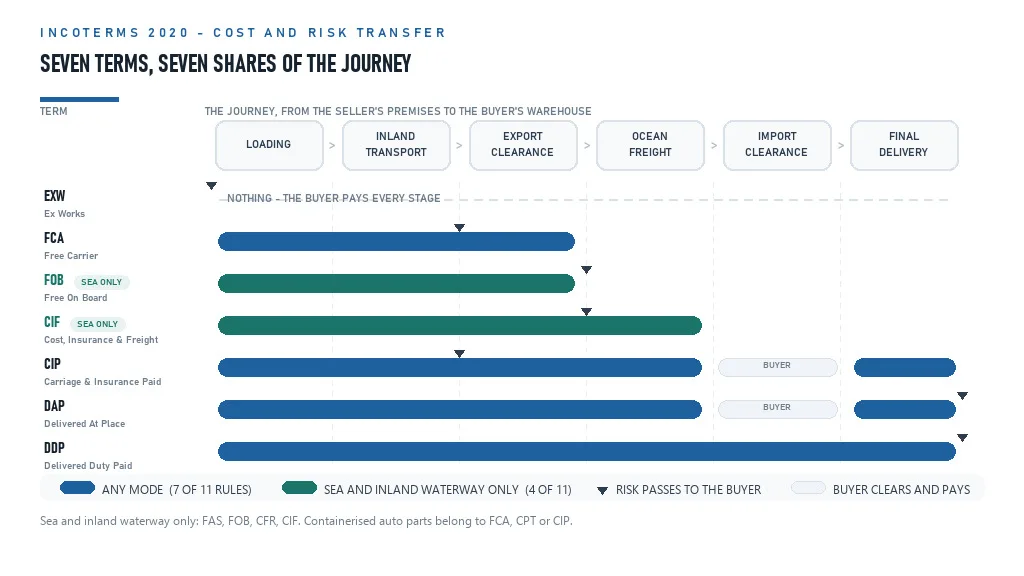 The same shipment, seven points at which cost and risk can change hands. Normalise the terms first, because the term decides which share of this diagram the quoted number covers.
3. Line 2: Normalise the Unit Before You Read the Number
3.1 The billing unit
The same part can be quoted per piece, per set, per kit, per axle or per carton, and the unit changes what the number means. A brake pad set priced per axle and a set priced per wheel are 100 per cent apart on the same goods.
Bring every quotation to the unit you actually sell in. If your customers buy in single units and the supplier quotes by the carton of twenty, your handling cost per sellable unit is a fifth of the carton cost plus your repacking labour, not the carton figure divided by twenty.
3.2 The currency
Incoterms do not set the currency, the price or the credit terms; that is the contract's job [1]. A quote in one currency against a payment in another, or against a selling price in a third, carries an exposure that belongs in the comparison as a cost.
The arithmetic is simple enough to do on a quotation. Take the fraction of your annual spend exposed to the currency pair, apply the worst movement you would tolerate in a year, and treat the result as a cost line. If the number is material, either ask for the quote in your payment currency or accept that you are running an unhedged position inside your purchasing budget.
3.3 What to convert, and to what
| What the quotation says | What you need before comparing |
|---|---|
| Price per piece | Landed cost per sellable unit in your market |
| Price per carton | Landed cost per sellable unit, including your repacking labour |
| Price in a foreign currency | Cost in your payment currency at a stated rate and date |
| Price at one MOQ tier | Cost at your actual order quantity |
| Price EXW or FOB | Cost at the same point of delivery as the other quotes |
Five conversions, and only then is the number readable. Buyers who skip them are not comparing prices. They are comparing quotation formats.
4. Line 3: The MOQ Ladder Is a Ladder, Not a Slope
Every supplier quotes a price break structure, and the structure is a set of steps. The gap between a 2,000-piece price and a 10,000-piece price is available only if you buy 10,000 pieces. Quoting the 10,000-piece tier as your basis is a common arithmetic error in sourcing, because it produces a unit cost you can achieve only by holding inventory you have not yet sold.
Read the ladder at your real order quantity, then at the quantity you would reach by consolidating two or three SKUs into one production run. The second number is often where the value is, and it is why mixed-container consolidation across categories changes the economics rather than just the freight bill. The multi-category procurement guide works through that consolidation logic from the assortment side.
Two costs belong next to the price break when you evaluate a larger tier.
The first is carrying cost: capital tied up in stock, warehouse space, insurance, and the cost of money over the months the stock sits. The second is obsolescence, and in this industry it has a specific shape. Part numbers get superseded, and a pallet of a superseded reference can become unsellable while a newer number sells normally. The cross reference guide covers supersession in detail; the point here is that a deeper stock position in a number with an active supersession risk has a real expected loss attached to it.
Fact: KEHO sets minimum order quantities per product and packaging configuration rather than applying one blanket figure, supports mixed-container consolidation across categories, and takes on OEM/ODM and private label programs (per company data).
Annual cost, not unit price, is the comparable number. Multiply the unit cost at your realistic order quantity by annual volume, add carrying cost and expected obsolescence, and compare totals. A supplier with a higher unit price and a workable order quantity frequently wins that calculation against a supplier with a beautiful top-tier price you cannot reach.
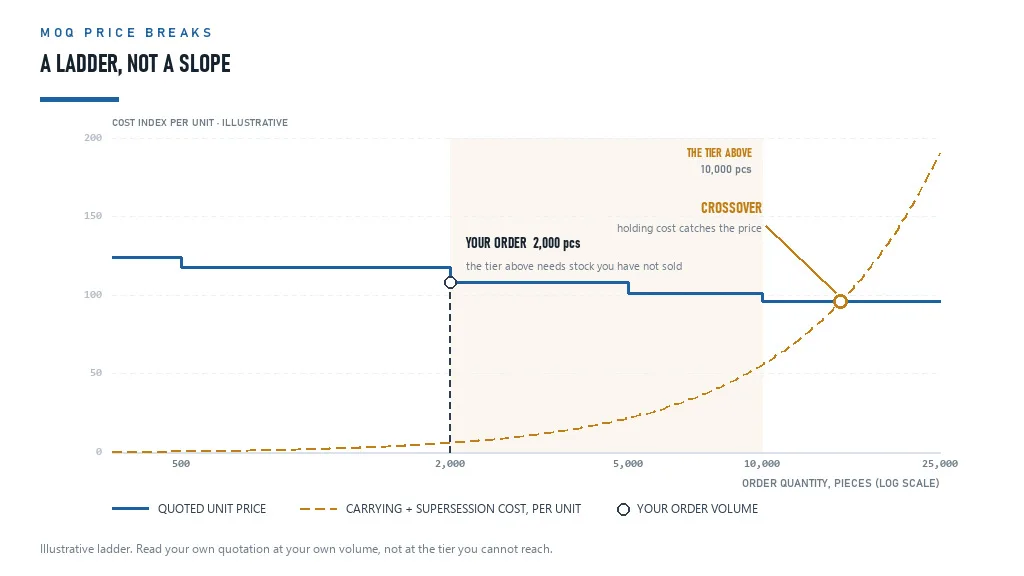 Price breaks are steps, not a slope. The comparison that matters reads the ladder at the quantity you can actually order, then adds carrying cost and supersession risk to the tier above it.
5. Line 4: Packaging, Labelling and Destination Compliance
Packaging is often left out of a quotation, and it tends to come back later as a surprise invoice.
Ask for the quoted packaging standard in writing, in enough detail to compare: carton board grade, compression or drop-test standard, inner protection, carton quantity, palletisation pattern, carton mark format, and whether the label carries the barcode format your market requires. Two suppliers offering "standard export carton" may be describing two different things, and the difference shows up as a claim when a pallet arrives crushed.
Labelling is where compliance costs hide. Retail-ready packaging in some markets has to carry specific language, country of origin marking and barcode formats, and a supplier who has never shipped to your market will price the job as if none of that applies. If the packaging changes after approval, both the cost and the minimum quantity usually change with it, because the print run for the packaging itself has its own MOQ.
The line to put in your comparison is not the packaging cost. It is the cost of the packaging you actually need, plus the cost of one change after approval, because that second figure is what you will pay if the first sample is wrong.
6. Line 5: Tooling, Moulds and Development Charges
Tooling turns a per-unit comparison into a total-cost comparison, and the two rarely point at the same supplier.
Development charges arrive in a few standard shapes: a one-off payment, an amount amortised into the unit price over the first production run, or a charge waived above a volume threshold. All three are comparable once you convert them to a single figure at your realistic volume:
Total cost at volume = (unit price × quantity) + tooling charges − waived amounts
Run that at your first-order volume and at your year-two volume. A supplier who waives tooling at a volume you will reach in year two is more attractive than a supplier with a lower unit price and an amortisation schedule that never ends. A supplier charging tooling upfront and then protecting that investment with a lower unit price is also a legitimate structure, provided the tool is yours or transferable.
Three clauses belong in the comparison, not just the number: who owns the tool, whether it can be transferred to another manufacturer, and what happens to the charge if you never place the second order. Private label and OEM work is where these questions concentrate, and the answer determines whether you are buying parts or buying a relationship you cannot leave.
7. Line 6: Payment Terms and the Cost of Money
Payment structure changes the real cost of a quotation more than most buyers expect, and the comparison is arithmetic rather than negotiation.
7.1 The three structures you will be offered
| Structure | How it works | Seller's risk | Your cost |
|---|---|---|---|
| Deposit and balance by transfer | Part of the value paid at order, the remainder before shipment or on documents | Low | Working capital tied up through production; bank transfer fees |
| Documentary credit | A bank promises to pay the seller on presentation of specified documents | Low, since the seller relies on the bank rather than on you | Bank charges, often a percentage of the credit amount, plus possible collateral and confirmation fees |
| Open account | Goods ship first and you pay on agreed terms | High, carried by the seller | Use of the seller's capital, usually priced into the unit cost |
A letter of credit, also called a documentary credit, is a payment mechanism in which a creditworthy bank provides an economic guarantee to the exporter [2]. Its effect is to introduce the bank as an underwriter of the buyer's payment risk, so the seller relies on the bank's credit standing rather than on yours [2]. The bank pays against documents rather than against the goods, traditionally on presentation of a bill of lading, which also gives the bank security while the goods are still under its control [2].
7.2 What a letter of credit actually costs
Three cost items belong in your comparison, and only one of them appears on a bank tariff sheet.
Banks typically require collateral from the applicant and charge a fee that is often a percentage of the amount covered by the credit [2]. Confirmation, where a second bank adds its undertaking, reduces your seller's risk further and is usually charged at an extra cost [2]. Both of those are visible.
The third is not. The credit operates on documents, and under UCP 600, the ICC rules that govern letters of credit and whose current version has been in effect since 1 July 2007, the standard is that data in a document need not be identical to the credit but must not conflict with it [2]. In practice many banks still apply strict compliance, because it gives all parties a clear test [2]. A minor discrepancy between your documents and the credit terms can therefore delay payment, and the resulting negotiation costs you the goodwill you were trying to buy with the credit in the first place. Note also that under UCP 600 all credits are irrevocable, so the revocable type that appears in older templates is obsolete [2].
7.3 Converting terms into money
The conversion is a straight calculation on your own cost of capital.
Take the value of the order, the number of days your money is committed before the goods become sellable, and your annual cost of capital. A structure that ties up the full order value for ninety days costs you ninety days of financing on that amount, whether or not an invoice ever shows it. Lengthening the terms from thirty to ninety days is not a discount; it is a transfer of that financing cost, and it is worth pricing because it is frequently the largest gap between two quotations that look close on price.
Put the number in the scorecard. A supplier 2 per cent higher on unit price but thirty days shorter on cash commitment can be the cheaper offer, and the arithmetic proves it in one line rather than in an argument.
8. Line 7: Lead Time, Capacity and What Happens When It Slips
Lead time is quoted as a number and delivered as a range, so the comparison has to establish which number you are reading and what the supplier's exposure is when the number is missed.
Ask three questions. Is the quoted lead time from order confirmation or from deposit? Does it cover tooling, sampling and packaging artwork, or only production? And what is the standing capacity behind the promise, meaning how many lines produce this family and how many other customers share them?
Then look at the remedy. A lead-time commitment with a defined remedy for late delivery is a different offer from the same commitment without one, and the difference is inexpensive for a supplier who intends to hit the date. In a market where your customers have their own promises to keep, the cost of a two-week slip is not the freight. It is the sale you lose and the account you have to rebuild.
9. Line 8: Warranty Terms and Exclusions
Warranty is quoted as a duration and judged by its exclusions, which is where the two quotations diverge.
Read the terms as four separate questions. How long does the cover run, and from what date: production, shipment or sale to the end customer? What does it cover, meaning parts only or parts and freight? What voids it, in particular installation by an unqualified workshop or use of the part in a commercial fleet? And who decides whether a claim is valid, which matters more than the length of the cover.
An eighteen-month warranty that excludes labour, freight and any claim without an installation invoice is a shorter offer in practice than a twelve-month warranty that covers the part and its freight with a documented claim process. Put the exclusions in the scorecard as text, because they cannot be reduced to a number and they are the terms you will be reading when a claim goes wrong.
10. Line 9: Technical Support and Response Behaviour
The last line is the one that decides whether the relationship survives its first problem, and it is measurable before you order.
Send each supplier the same technical question as part of the quotation request: an OEM number with a vehicle model, a year and an engine code, and a request to confirm fitment. What you learn from the replies is more useful than anything else in the file. One supplier returns a table with all four fields verified, one returns the number back to you, and one does not reply. The quotation may be identical in all three cases.
Response speed is what makes a supplier usable at scale, because your own customers judge you on the answers you forward. A supplier who commits to a response window and keeps it is worth more than a small price advantage, and KEHO works to a response window of about three hours on platform enquiries, with technical questions generally answered the same business day (per platform data).
Fact: KEHO holds 50,000+ SKUs, dispatches in-stock items within 48 hours, ships standard orders in 15-25 days, and backs parts with a 12-24 month warranty (per company data).
11. The Quotation Scorecard
Everything above collapses into one table, and the table is the deliverable. Fill one column per supplier, then read across.
| Line | What to record | Red flag |
|---|---|---|
| Delivery term | The term plus the named place, in writing | Term stated without a place, or a sea-only term offered for a container |
| Landed unit cost | Unit cost expressed at one point of delivery, in one currency, per sellable unit | A price with no basis attached |
| MOQ and price breaks | The full ladder, plus the tier you can actually reach | Only the top tier quoted |
| Annual cost at your volume | Unit cost at realistic volume plus carrying and obsolescence risk | A cost curve that ignores what you can order |
| Packaging and labelling | The standard in writing, plus the cost of one change after approval | "Standard export carton" with no specification |
| Tooling | Owner, transferability, amortisation, and total cost at year-two volume | An amortisation that never ends |
| Payment terms | Structure, bank charges, collateral, and days of cash committed | A term that never appears in the written quotation |
| Lead time | Start point, scope, capacity behind it, and the remedy if it slips | A date with no remedy attached |
| Warranty | Duration, coverage, exclusions, and who adjudicates | Cover without exclusions or an adjudication process |
| Technical response | The reply to the fitment question you sent | No reply, or the number returned unchanged |
Two habits make the scorecard work.
Score the written document rather than the conversation. A term that was agreed verbally but is absent from the quotation is not a term you can rely on, and the gap between what was said and what was printed is itself a finding worth recording.
Rank the columns twice: once on price, once on total cost. When the two rankings agree, the decision is easy. When they disagree, the difference is the number your negotiation is actually about, and it is a far better starting point than an opening offer.
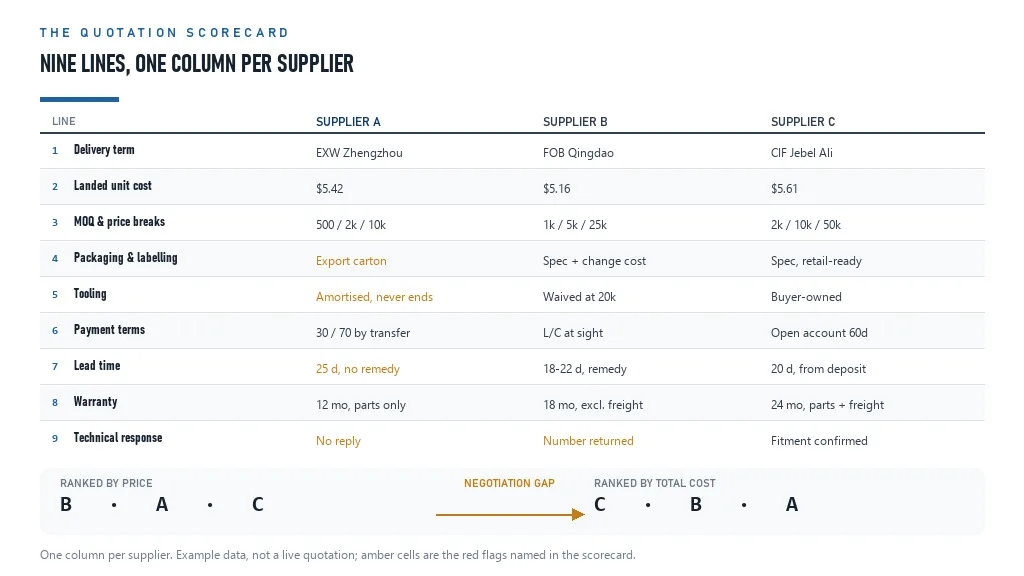 Nine lines, one column per supplier, ranked twice: once on price and once on total cost. The gap between the two rankings is where the negotiation happens.
12. FAQ: Quotation Questions From Buyers
How do I compare auto parts quotations?
Put every quotation on the same basis first, then compare line by line. Convert each offer to one delivery term, one currency and one billing unit, read the MOQ ladder at your real order quantity rather than at the lowest quoted tier, and add the costs that sit outside the unit price such as packaging, labelling, tooling, payment terms and warranty exclusions. A comparison that starts with the unit price will usually rank the quotations wrongly, because the cheapest headline number is normally the one with the most cost sitting outside it.
What is the difference between EXW, FOB and CIF pricing?
The three terms place different stages of the journey on different parties. Under EXW the seller makes the goods available at their premises and the buyer handles loading, inland transport, export clearance, freight, insurance and duty, which is why an EXW price is the lowest number on the page and rarely the cheapest landed cost. Under FOB the seller delivers the goods on board the vessel at the named port. Under CIF the seller adds ocean freight and a default level of insurance cover. To compare them, add the buyer-side costs to each quote until all three describe the same point of delivery.
Why do two suppliers quote different prices for the same part?
Sometimes for real reasons and sometimes for presentation reasons. Real differences come from material grade, manufacturing process, quality control depth, packaging standard and order quantity. Presentation differences come from the delivery term, the currency, the billing unit, the MOQ tier being quoted, and which costs have been left outside the number. Before assuming one supplier is cheaper, normalise both offers to the same term, quantity and unit, then compare the remaining gap. A price difference that survives normalisation is a genuine difference in the offer.
What should a quotation include besides the unit price?
A usable quotation states the delivery term and named place, the currency, the billing unit, the MOQ ladder with each price break, the packaging and labelling standard, any tooling or development charge and how it is amortised, the payment structure, the lead time and its conditions, and the warranty terms including exclusions. Ask for the delivery term and the MOQ ladder in writing even when you expect to buy at the top tier, because those two fields determine how the unit price was constructed.
How do I evaluate payment terms in a quotation?
Convert the terms into money. A deposit-and-balance structure ties up working capital for the production period, while a documentary credit adds bank charges that are often calculated as a percentage of the credit amount and may require collateral. Lengthening terms from 30 to 90 days is not free either: value the extra 60 days at your own cost of capital and subtract it from the price advantage. A higher price on shorter terms can be the cheaper offer once the financing cost is included.
Which delivery term is right for a first trial order?
For a small trial order the priority is to reach a comparable basis rather than to move the most cost onto the supplier. A term that has the seller handle export clearance and delivery to a named carrier removes the administrative risk of you having to clear goods for export in a country where you have no legal presence. If the trial is airfreighted, the sea-only terms are not appropriate. Confirm the term in writing with the named place, since the same three letters with a different named place can mean a different price.
13. Turning Nine Lines Into One Decision
A quotation is a document that answers nine questions, and most buyers only read the first one. The delivery term decides which share of the journey the number covers. The unit and the currency decide what the number describes. The MOQ ladder decides whether you can reach it. Packaging, tooling, payment terms, lead time, warranty and technical response decide what the purchase actually costs and what happens when something goes wrong.
None of that requires a negotiation. It requires a scorecard, and the scorecard does the arguing for you, because a supplier cannot dismiss a line you have written down.
If you want to test this method on live numbers, send us one part family you buy regularly with your target annual volume and destination port. We will return a line-by-line quotation stating the delivery term, the MOQ ladder, the packaging standard, the tooling position, the payment structure, the lead time and the warranty terms in the same format, so it can be dropped straight into the scorecard. The fuel injector and spark plug ranges are reasonable starting points for a trial order, and the full category list sits on the KEHO product catalogue.
Sources
- Wikipedia contributors. "Incoterms." Wikipedia. https://en.wikipedia.org/wiki/Incoterms - Publication by the International Chamber of Commerce and the scope of the rules, including the four areas the terms do not determine: contract formation, price, currency and credit terms, contract law, and transfer of title; the 1936 first edition and 2020 ninth edition published 10 September 2019; the eleven rules split into seven for any mode and four for sea and inland waterway only; the formal definition of delivery as the point of risk transfer; EXW obligations, the buyer's export documentation exposure and the seller's proof-of-export tax exposure; the sea-only group and why it does not suit containerised freight; the shift of the risk point to loading on board; the 110 per cent insurance requirement and currency matching under CIP; the difference between CIF and CIP default insurance clauses; DDP obligations; and the duty valuation practice in India and South Africa.
- Wikipedia contributors. "Letter of credit." Wikipedia. https://en.wikipedia.org/wiki/Letter_of_credit - The mechanism of the documentary credit and the issuing bank's promise to pay against documents; the economic effect of introducing a bank as underwriter of the buyer's payment risk and the seller's reliance on bank credit rather than buyer credit; payment against documents such as the bill of lading, with the goods under the bank's control as security; the role of the ICC Uniform Customs and Practice for Documentary Credits, current version UCP 600 in effect since 1 July 2007; the requirement for collateral and the fee calculated as a percentage of the credit amount; the additional cost of confirmation; the treatment of document data under UCP 600 and the persistence of strict compliance practice among banks; and the position that all credits are irrevocable under UCP 600.