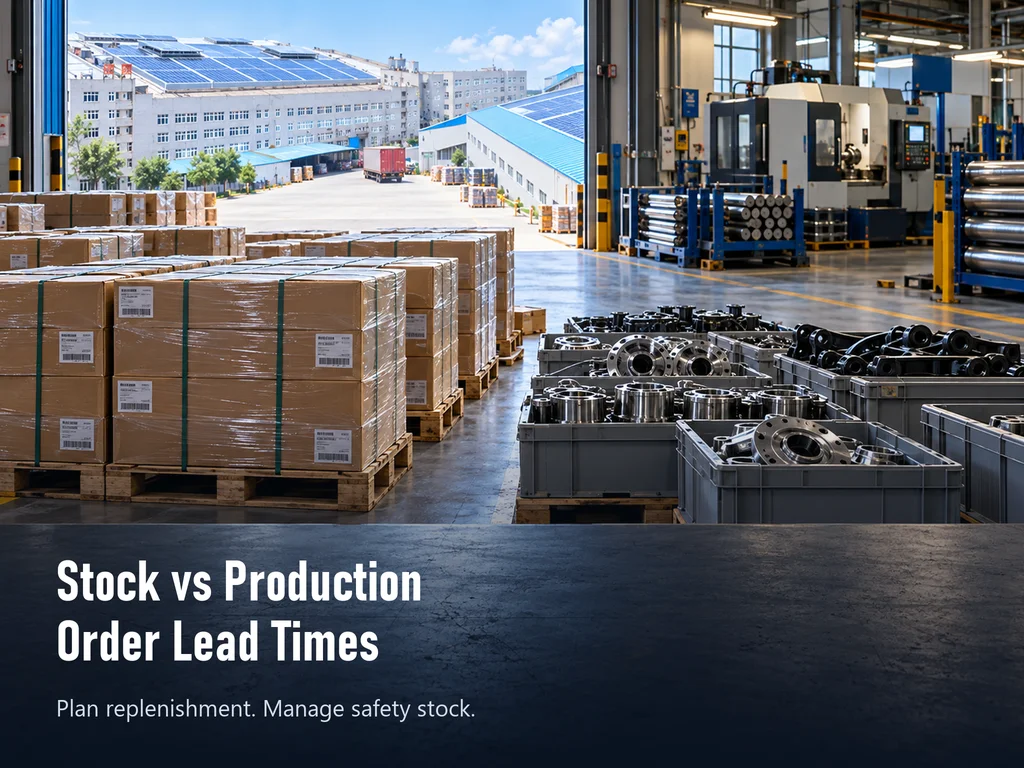
1. Two order types, two different jobs
Treat the two order types as tools with different cost structures, not as a good one and a bad one.
A stock order pulls from parts the factory already has on the shelf. You confirm the SKU, the factory picks and packs it, and it leaves quickly. The published dispatch term for in-stock items is 48 hours (per company data). What you pay for is that speed and the certainty that the part exists today. What you give up is choice: a stock order can only sell you what is in stock, in the quantities that are in stock.
A production order is a manufacturing run built after you confirm. That is where customization lives: OEM or ODM specifications, private-label packaging, logo printing, a specific connector or pin configuration, a carton layout made for your market. Because the setup costs spread across the whole run, the unit price is usually lower at volume. The published shipping term for standard orders is 15 to 25 days (per company data), and that window moves with the content of the order, the season, and vessel schedules.
| Factor | Stock order | Production order |
|---|---|---|
| Source of supply | Parts already held in the factory warehouse | A run built to your specification after confirmation |
| Published dispatch or shipping term | Dispatch within 48 hours for in-stock items (per company data) | Shipping in 15 to 25 days for standard orders (per company data) |
| Best used for | Urgent replenishment, a new SKU trial, filling a gap before a peak | Volume buying, OEM or ODM runs, private-label packaging, custom specifications |
| Unit price | Higher, since you pay for ready availability | Lower at volume, since setup spreads across many units |
| Quantity available | Limited to what is in stock, by SKU | Set by your order and the factory minimum |
| Main risk | The SKU sells out or is discontinued | The window slips with order complexity, season and vessel schedules |
| Planning horizon | Days | Weeks, extended by the shipping calendar |
Both terms in that table are the factory's published figures, not a delivery commitment. Treat them as the factory segment of your plan, then add the transport and clearance stages yourself.
Fact: KEHO has supplied auto parts to importers in 80+ countries since 1995, holding ISO/TS 16949 certification (since 2012), CE marking, and SGS third-party verification (per company data).
2. Choosing between them, SKU by SKU
Most importers run both types at once. The useful question is not which type to use but which type each SKU needs this month.
Reach for a stock order when you are out of stock now or a key account is waiting. Reach for it when you are testing a new SKU before committing volume, when you need a sample set for a customer or for a fitment check, and when working capital is tight and you want the inventory risk small.
Reach for a production order when you are buying volume and unit price matters more than speed, when the part needs customization such as OEM or ODM specifications, private label or market-specific packaging, and when you have lead time and can plan weeks ahead.
The hybrid move keeps shelves full. When a SKU is running dry and a production run is already in progress, a small stock order bridges the gap. The stock order covers the account this month; the production order refills the shelf next quarter.
3. A lead time is a chain, not a number
A common planning error is treating lead time as one number. The factory's shipping term is one stage of seven.
- Confirmation and payment. The clock starts when the deposit clears, not when the enquiry is sent. The payment terms and currency you agreed decide whether that is next day or next week, which is one reason it pays to read payment terms carefully when comparing auto parts quotations.
- Material preparation. The factory orders and receives what the run needs. If the specification or the artwork is not final, this stage stalls before production even starts. Confirming the part number first, as set out in the OEM matching guide, keeps this stage short.
- Production. The manufacturing window itself, the only stage most buyers count.
- Inspection. Incoming material checks, in-process checks and the pre-shipment review are separate gates, and a failed gate costs days, not hours.
- Packaging. Cartons, labels, the packing list, and destination labelling.
- Inland transport. Factory to the loading port, including trucking and the port cut-off deadline.
- Booking and sailing. Confirmed space on a vessel, the documentation cut-off, and the sailing schedule itself.
| Stage | What happens | Who leads | Where it usually slips |
|---|---|---|---|
| Confirmation and payment | Order confirmed, deposit clears, terms fixed | Buyer and finance | Slow payment release or an unclear term |
| Material preparation | Raw parts and components sourced to spec | Factory | Spec or artwork not final |
| Production | Manufacturing run | Factory | Order complexity, capacity queue, season |
| Inspection | Incoming, in-process and pre-shipment gates | Factory quality team | A failed gate and rework |
| Packaging | Cartons, labels, packing list, destination labelling | Factory | Late label confirmation |
| Inland transport | Trucking to port, port cut-off | Factory and forwarder | Cut-off missed, port congestion |
| Booking and sailing | Space booked, documents cut off, vessel sails | Forwarder and carrier | Rolled cargo, blank sailings |
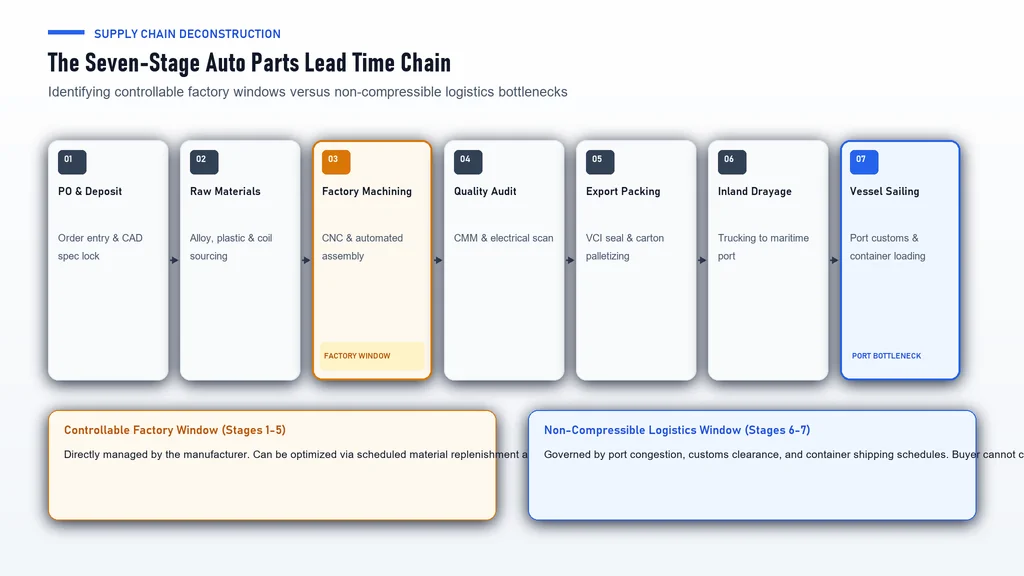 Lead time runs from deposit to sailing, in seven stages. Only production sits inside the factory window; the rest you plan around.
Only stage three is the manufacturing window. That is why adding the published 15 to 25 days to a calendar and expecting goods at the door is optimistic.
Fact: KEHO's published terms describe in-stock items as dispatching within 48 hours and standard orders as shipping in 15 to 25 days, across a catalog of 50,000+ SKUs with a 99.2% on-time delivery rate (per company data).
4. Setting a reorder point that survives the real world
A reorder point is the stock level that triggers your next order. Set it too low and you run out while the order is in transit; set it too high and you tie up cash in slow-moving stock. The method is simple arithmetic once you have two honest inputs.
- Measure sell-through. Record average units sold per day for each SKU.
- Measure the full chain. Use the whole chain from deposit to goods on the shelf, not the production window.
- Choose a safety stock. This is your buffer for a demand spike, a missed sailing, or a holiday shutdown.
- Add them. Reorder point equals lead-time demand plus safety stock, where lead-time demand is daily sales multiplied by the full-chain length in days.
Here is a worked example. Every figure below is a placeholder you replace with your own, so treat it as an illustrative example rather than a quote.
Assumptions used in the example
- The distributor moves one SKU, a crankshaft position sensor, at about 600 units a month, which is about 20 units per trading day over 30 trading days.
- They are ordering a custom-label run, so they plan around a 25-day supplier window, the top of the published 15 to 25 day range, as their factory segment.
- They add an assumed 30 days for booking, sailing, clearance and inland movement to the shelf. The 30 days is their own planning assumption, not a promised transit time and not a KEHO figure.
- Their assumed full-chain lead time is therefore 25 plus 30, or 55 days.
- They choose 20 days of safety stock to cover a demand spike and one missed sailing.
Result
| Input | Assumption | Result |
|---|---|---|
| Average daily sales | 20 units per day | - |
| Assumed full-chain lead time | 55 days | - |
| Lead-time demand | 20 units per day x 55 days | 1,100 units |
| Safety stock | 20 days of cover | 400 units |
| Reorder point | 1,100 plus 400 | 1,500 units |
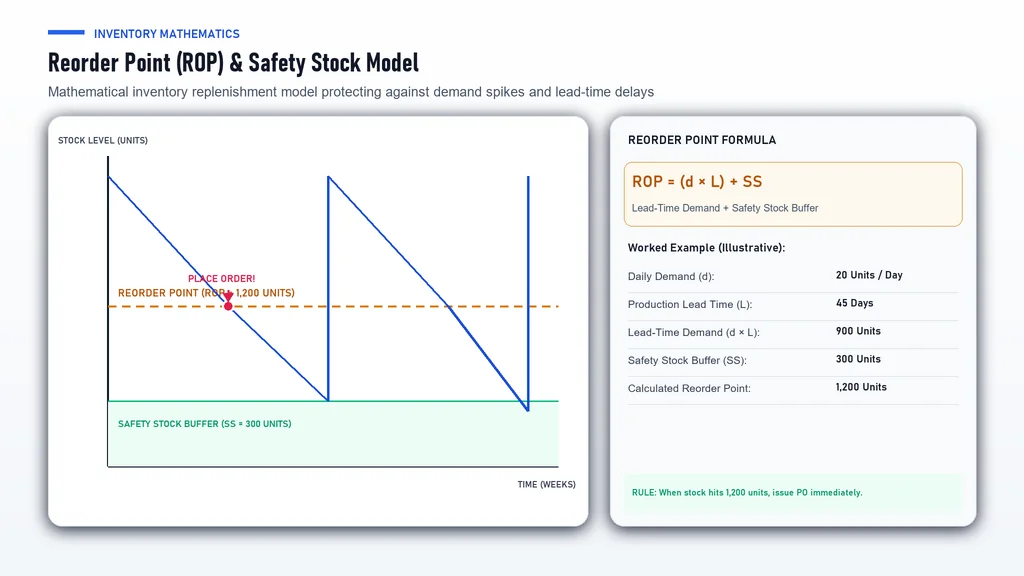 The reorder point is lead-time demand plus safety stock. Order when stock crosses the line, not when a shelf looks empty.
When on-hand stock falls to 1,500 units, the next production order goes out. If the plan uses a 45-day order interval, the order quantity roughly matches 20 units per day x 45 days, or 900 units, and that quantity has to clear the factory minimum for the SKU.
Two things move the answer once the plan is live. A demand spike raises the daily-sales figure and the reorder point with it. A longer chain, from a holiday break, a missed sailing or a slow clearance, pushes the reorder point up again. Recompute the numbers before every peak rather than once a year.
5. Two tables to fill in before you order
Fill in the first table once per SKU decision, and keep the second as a live sheet you revisit every month.
Table A. Stock order vs production order decision table
| Decision point | Question to answer | If yes | Action |
|---|---|---|---|
| Stock position | Is the SKU out of stock or nearly out? | Stock order | Bridge the gap while a run is planned |
| New SKU test | Is this a SKU you have not sold before? | Stock order | Validate fitment and demand before volume |
| Volume | Is the quantity enough to justify a run? | Production order | Get volume pricing and lock the spec |
| Customization | Does the part need an OEM or ODM spec, label or packaging? | Production order | Finalize spec and artwork before the deposit |
| Lead-time tolerance | Can you wait several weeks for this SKU? | No: stock order | Confirm the SKU is in stock first |
| Working capital | Is inventory risk the binding constraint this month? | Stock order | Keep the commitment small and reversible |
Table B. Replenishment and lead-time planning table
| SKU / OEM number | Avg daily sales (units) | Assumed full-chain lead time (days) | Lead-time demand (units) | Safety stock (days) | Reorder point (units) | Order type | Next review |
|---|---|---|---|---|---|---|---|
| Crankshaft position sensor | 20 | 55 | 1,100 | 20 | 1,500 | Production | Before peak |
| (your SKU) |
6. Peak season, holidays and sailing schedules
Three recurring forces stretch a plan, and none of them is within a supplier's control.
The Chinese New Year break is the biggest. Factories slow and then stop around the holiday, and capacity takes time to recover after workers return [3]. Buyers who need first-quarter stock place production orders to finish before the shutdown, not during it. The holiday dates shift each year, so the practical rule is to confirm the year's calendar with your supplier early and plan the run to complete before the break.
Other national holidays, including the early-October Golden Week, create shorter versions of the same effect. A week of lost production in a tight capacity month can push a run back further than the holiday itself suggests, because every order behind it also moves.
Peak ocean season is the third force. Late summer into the fourth quarter, ahead of the northern-hemisphere retail build, is when vessel space is tightest. This is when bookings are rolled to a later vessel and a planned sailing slips by a week or more. Blank sailings, where a carrier cancels a departure to manage capacity, and port congestion at either end add variability on top [2].
The habit that works is to finish the factory segment with a buffer before the sailing you want, and to treat the sailing as a schedule with variability rather than an appointment. When the chain is longer than planned, the reorder point from Section 4 rises with it.
7. Mixed containers and multi-category lead times
Consolidating several categories into one container, one bill of lading and one customs entry lowers freight per unit and simplifies clearance. The cost side of that trade is covered in the low MOQ and mixed-container shipping guide.
The lead-time side is less obvious. A mixed shipment leaves when the slowest line is ready. If the spark plugs can be packed in a week but a private-label steering-wheel run takes three weeks, the container waits for the wheel, and every fast line rides along with the slow one.
There are three ways to manage the coupling.
- Sequence production so every line finishes together. Place the longest-lead item's order first and let the short lines catch up to it.
- Keep the fastest-moving line on a stock order and let the slower custom lines ride the container. The high-turnover SKU keeps its own clock.
- Split the order when one line is critical and the rest can wait. Paying freight twice can cost less than a stock-out.
Choosing which categories belong together in the first place is the subject of the multi-category parts program guide. This section is only about the timing consequence: in a mixed container, the slowest line sets the date.
8. Communication milestones and order tracking
When a lead time goes wrong, the usual cause is a missed checkpoint rather than a schedule that shifted. A production order has natural gates, and each one is a chance to catch a slip while it is still cheap to fix.
Agree this milestone set when you place the order: deposit confirmation; material ready; production start; production complete; inspection result; packaging complete; sailing booked; documents issued. Then ask for evidence at each gate rather than a status word. Confirming the balance payment only after the packaging and pre-shipment gates pass keeps the last inspection meaningful.
Response speed matters at the front of the chain. KEHO answers enquiries within 12 hours in business hours (per company data), with a platform response target of three hours or less (per platform data). Business hours are Monday to Friday 09:00 to 18:00 and Saturday 09:00 to 12:00, China Standard Time.
Use the milestones to feed the planning table, not just to track. If production completes later than planned, your chain is longer, and the next reorder point is higher. A milestone that slips is a signal to raise the safety stock, not only to chase the order.
Fact: KEHO answers enquiries within 12 hours in business hours, runs a four-stage quality process of incoming checks, in-process checks, packaging inspection and pre-shipment review, and supports mixed-container orders across categories (per company data).
9. FAQ: Lead time and order planning questions
What is the difference between a stock order and a production order?
A stock order draws on parts the factory already holds, so it moves fast but is limited to what is in stock. A production order is a manufacturing run built after you confirm, so it takes longer but lets you set the specification, packaging and branding, and usually lowers the unit price at volume. Most importers run both at once, choosing per SKU.
How long does an auto parts production order take?
KEHO's published terms describe standard orders as shipping in 15 to 25 days, and that figure is the factory segment only. It moves with the content of the order, the season and vessel schedules, so plan the transport, inspection and booking stages on top of it rather than treating it as a delivery date.
How fast can in-stock auto parts ship?
KEHO's published terms describe in-stock items as dispatching within 48 hours. That term applies only to parts the factory holds at the time of order, and availability changes daily, so confirm the specific SKU is in stock before you build a plan around it.
How do I calculate a reorder point for auto parts?
Multiply your average daily sales by the full chain length from deposit to goods on the shelf, then add a safety stock for demand spikes and shipping variability. The reorder point is that total. Recompute it before every peak season, because a longer chain raises the number.
How does Chinese New Year affect auto parts lead time?
Factories slow and stop around the Chinese New Year break, and capacity takes time to recover afterward. Buyers who need first-quarter stock place production orders to finish before the shutdown rather than during it. The holiday dates shift each year, so confirm the calendar with your supplier early.
Can I mix categories in one container without delaying the shipment?
You can consolidate several categories into one container, but the shipment leaves when the slowest line is ready. Consolidation lowers freight per unit and couples your fastest SKUs to your slowest, so sequence production so every line finishes together or move the fastest line to a stock order.
10. Turning the plan into your next order
Lead time is a planning problem, not a promise. The two order types exist because buyers face two different situations, and the skill is matching the type to the SKU rather than applying one rule to the whole catalog. Plan the whole chain, not the factory window. Set the reorder point from real sell-through and an honest chain length. Watch the calendar for the holidays and the peak season that stretch it. Then track the milestones so a slip shows up while you can still act on it.
KEHO has supplied auto parts across 50,000+ SKUs for 30 years, with in-stock dispatch and standard order windows as published figures, and a 12 to 24 month warranty (per company data). Send your SKU list and your sell-through figures, and we will help you map the order type and plan the timing. Browse all auto parts or contact the KEHO team to start the next plan.
Sources
- [KEHO]. Company data: published dispatch and shipping terms, catalog size, on-time delivery rate, certifications, response time, quality process and mixed-container capability. kehoauto.com: Company-reported figures marked "(per company data)" in the article body.
- [World Shipping Council]. "Container Shipping." worldshipping.org: Industry reference on container vessel schedules, blank sailings and capacity management that explain why a planned sailing can be rolled.
- [U.S. International Trade Administration]. "China Country Commercial Guide: Holidays." trade.gov: Government guide noting Chinese New Year and the early-October national holiday as periods that disrupt manufacturing and logistics in China.