Sample Approval Before Bulk Order: What Auto Parts Importers Should Validate
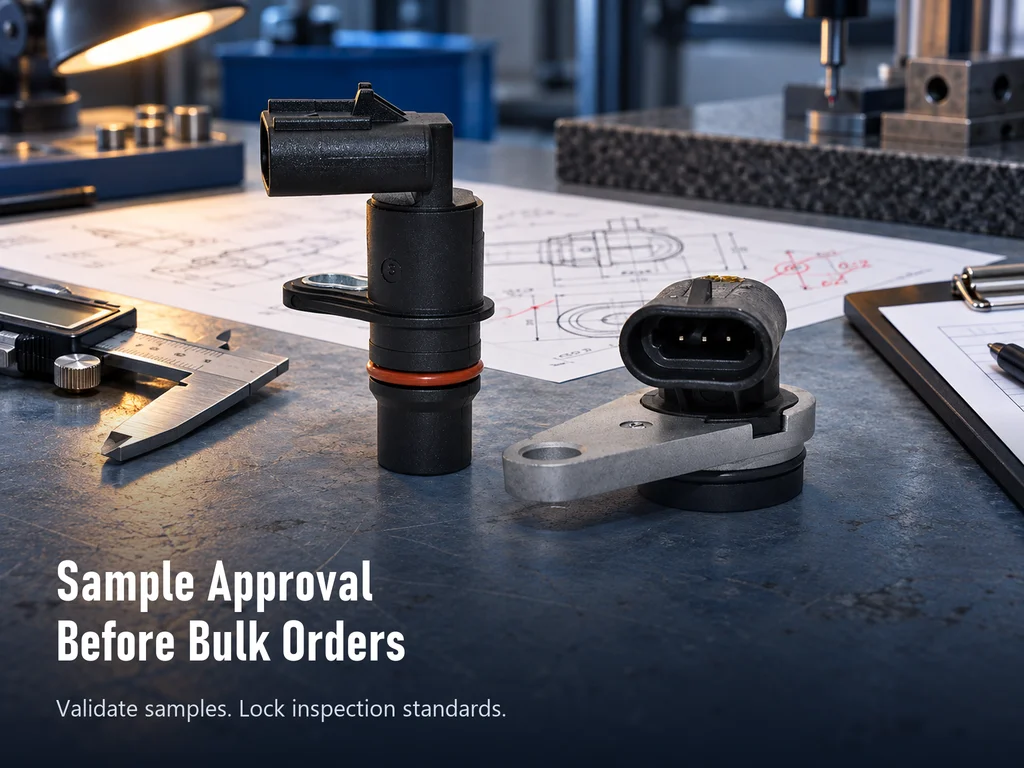
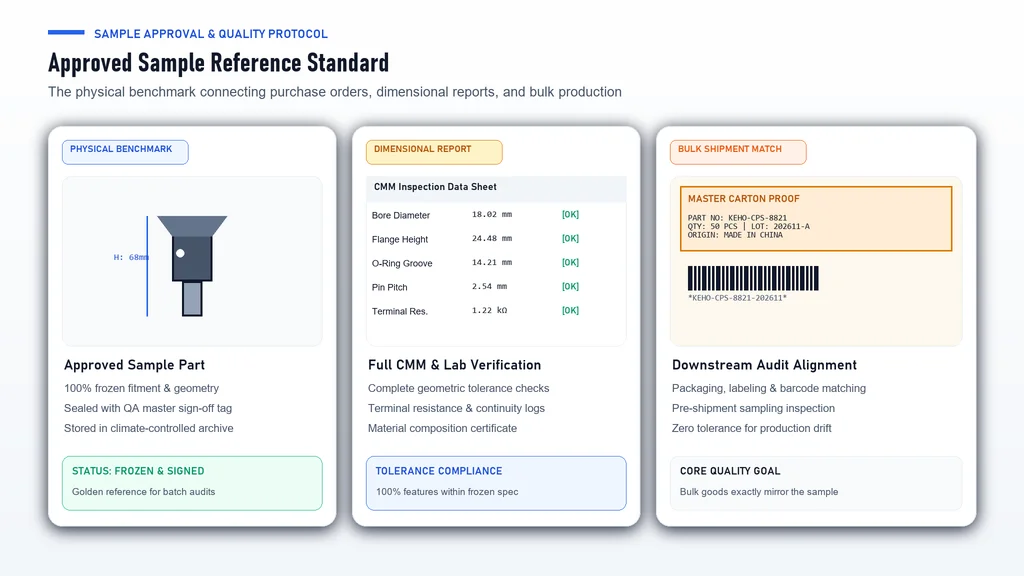 One approved sample, one inspection report, and the carton the bulk order has to match. The sample is the reference everything downstream is measured against.
1. The Sample Is the Last Cheap Correction Point
For an importer or wholesale distributor, sample approval before bulk order is the one stage where a wrong part number, a reversed connector or a mislabelled carton still costs a courier parcel instead of a container. Once a bulk run is released, tooling, print, packaging and labour are committed, and correcting any of them means rework, air freight or dead stock. This article sets out what to validate on the sample, what evidence to demand with it, and how to carry the approved specification into production.
Fact: KEHO has manufactured and exported auto parts from Zhengzhou since 1995, now serving buyers in 80+ countries, with ISO/TS 16949 certification held since 2012, CE marking and SGS third-party verification (per company data).
Most buyers approve a sample by eye. They confirm the part looks right, sits in the bracket, and matches the catalogue photo, then release the order. That habit misses the fields that decide whether the part works in the vehicle, and whether the bulk shipment matches what was approved. A sample is a specification to be frozen, and freezing it takes a form and a set of documents rather than a glance.
2. Why the Sample Stage Is the Only Low-Cost Correction Point
The cost of a change rises steeply along the production chain, and the sample sits near the bottom of that curve.
At the sample stage, a correction means an engineer edits a drawing or a supplier reworks a single unit. At the tooling stage, it means machining or modifying a mould. At the production stage, it means stopping a line, sorting finished goods and often scrapping material. At the shipment stage, it means freight back, duty already paid and a customer waiting. By the time the parts reach your warehouse, a dimensional error that was free to fix earlier has become a commercial problem.
Three things get locked in at the moment the sample is approved:
- The drawing revision the supplier will manufacture to
- The tooling and fixtures used to make it
- The packaging and label artwork that go with it
Each is cheap to change before approval and expensive to change after. That is the argument for treating sample approval as a controlled event with written sign-off rather than a quick visual check. The supplier vetting guide covers how to confirm a supplier can hold a specification at all; this article assumes that check has passed and deals with the specification itself.
3. What a Sample Has to Prove
A sample proves four things: that the part fits the vehicle, that it connects and functions electrically where relevant, that it is made from the material and finish specified, and that it arrives in the packaging your market expects. Each maps to a field you can write down and check.
3.1 OEM number and fitment fields
The starting field is the OEM or reference number, but the number alone is not enough. Fitment fields are the make, model, year and engine or displacement the number is valid for, and one number family can cover several while a single part does not. Confirm the sample against the same vehicle data you sell from before you approve. If you are still building that mapping, the OEM matching guide and the cross reference guide cover how to build it and how supersession changes it.
3.2 Connector and pin definition
For anything with a plug, including injectors, ignition coils, oxygen sensors, position sensors, ABS wheel speed sensors and tire pressure sensors, the connector body and pin assignment decide whether the part works even if it fits. Check the keying, the pin count and the pin function against the vehicle side. A part that plugs in but routes a signal to the wrong pin will fit and fail, so ask for the connector and pin data in writing with the sample.
3.3 Mounting points and critical dimensions
Critical dimensions decide whether the part installs and seals: mounting hole centres, boss heights, overall length, thread pitch and any sealing face. These should be measured and recorded, not judged by eye, and marked as critical on the drawing so both sides inspect the same features. The first article inspection model [2] is useful here precisely because it verifies every dimension on the drawing rather than only the features that look important.
3.4 Material and surface finish
The material grade and surface finish are two of the easiest fields to drift between sample and production, because a lower-grade material or a thinner coating still looks correct in a photo. Record the material specification and the finish, including coating type, colour and gloss or texture, and ask for material certification with the inspection evidence.
3.5 Packaging and label sample
The packaging that arrives with the sample is the packaging the bulk order will use, so approve an actual carton and label, not a written description of one. Check carton grade and quantity, inner protection, the label fields such as part number, quantity, batch or date code and country of origin, and the barcode format your market requires. If your label is private label, approve the printed proof, because print runs have their own minimums and a change after approval resets both cost and lead time.
| Field | What the sample has to prove | Document to attach | Red flag |
|---|---|---|---|
| OEM / reference number | The number matches the vehicle data you sell from | Approved drawing or catalogue entry | Number quoted with no make, model, year or engine |
| Fitment fields | Make, model, year and engine all validate | Fitment list or cross-reference sheet | A single number claimed across several engines |
| Connector and pins | Keying, pin count and pin function match the vehicle side | Connector and pin-out drawing | No pin data, or "same as original" with nothing attached |
| Critical dimensions | Mounting points, sealing faces and key sizes are measured | Dimensional report against the drawing | Dimensions given as a range with no measurement |
| Material and finish | Grade and finish match the specification | Material certificate and finish specification | Finish described only as "black" or "standard" |
| Packaging and label | Carton and label meet your market requirements | Printed proof and label sample | Label described but never shown |
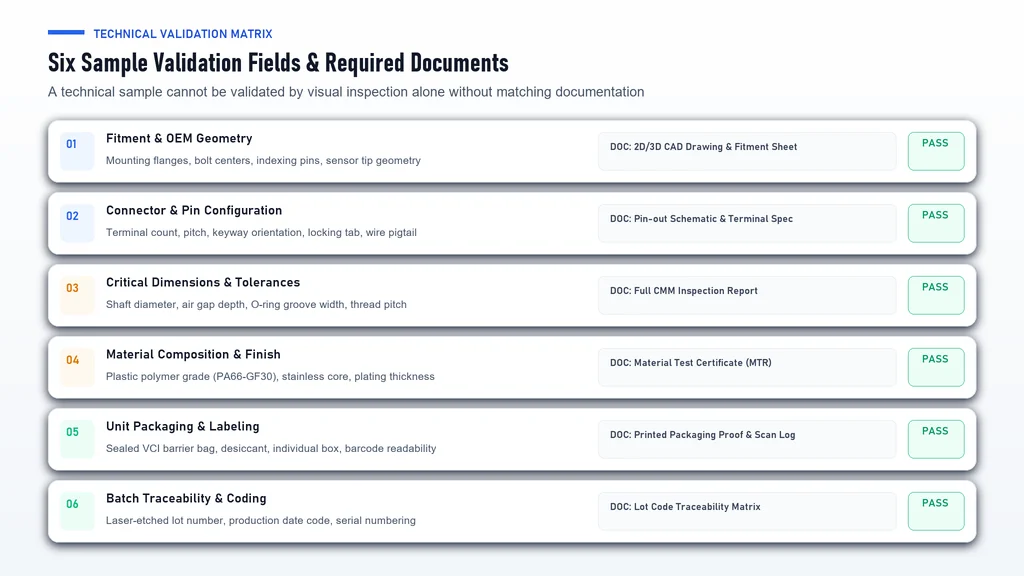 Six fields, six documents. A field without its document is a description, not a specification, and a description cannot be inspected at the bulk stage.
4. The Evidence That Should Travel With the Sample
A physical sample without paperwork is an opinion. The documents make the approval defensible, both with your own customers and in any later claim.
4.1 Third-party inspection reports
A report from an independent body such as SGS or TUV is a layer of assurance separate from a supplier's own inspection. SGS, a Swiss inspection, verification, testing and certification company founded in 1878, verifies the quantity, weight and quality of traded goods and tests product quality against health, safety and regulatory standards [4]. Check three things rather than the logo: what was inspected, the specification the results were measured against, and whether the report covers the batch you are approving. A report that names a different batch does not tie to your order.
A third-party report is evidence, not a passport. Whether your destination market accepts a given report, and what else it requires, is a question for you and your local compliance advisers, not something a supplier can settle for you.
4.2 Dimensional records
Ask for measured dimensions, not just a pass or fail statement. A dimensional record lists each critical dimension, its specification and tolerance, the measured value and the assessment. This follows the same logic as the dimensional results element of a production part approval package, which reports measured results against a ballooned drawing for a minimum number of pieces per product and process [1]. Ask for a small number of pieces rather than one, so the record shows the process is stable instead of showing that a single lucky unit passed.
4.3 Batch traceability
Traceability links the approved sample to the bulk goods. Confirm what batch or date code the sample carries, how the supplier records it, and how that code will appear on the bulk cartons. Without a code you cannot connect a future claim to the run that produced it; with a code, a field problem can be traced to a specific production window.
Illustrative example: an importer approves a position sensor measured at nominal, then receives a bulk shipment where the mounting boss runs long on part of the run. Because the approval form recorded the boss as a critical dimension with a specific tolerance, and the bulk cartons carry a batch code, the importer can identify which cartons came from the affected window instead of quarantining the entire order. The specific numbers here are illustrative; the point is that recorded dimensions plus batch codes make a partial containment possible.
5. Sample Approval and the Trial Order
Approving a sample and placing a small trial order are two different decisions, and buyers often merge them.
The sample proves the design and the specification. A trial order proves the process at volume, the packaging, and the shipping and documentation chain, with a real order value attached. For a new SKU you intend to test, a trial order is the natural next step after sample approval, and it is where flexible minimum order quantities matter. KEHO sets minimum order quantities per product and packaging configuration rather than one blanket figure, which lets a distributor test a new line without committing to a container of stock it has not sold (per company data). The low MOQ and mixed container guide covers combining SKUs into one shipment, and the multi-category program guide covers building the wider assortment.
Two notes on the trial order. First, approving a sample does not by itself commit either side to a bulk price; pricing, delivery and packaging terms are confirmed per project, and the quotation comparison guide sets out how to compare those terms line by line. Second, whether a sample is provided, and whether it is charged, is confirmed per product and project rather than assumed, so raise it early instead of expecting a free unit.
Fact: KEHO confirms fitment across OEM number, model, year and engine or displacement, supports OEM/ODM and private label work, sets minimum order quantities per product and packaging configuration rather than one blanket figure, and runs a four-stage quality control process (per company data).
6. Why a Sample Passes and Production Changes
One of the costliest failures in sourcing is a sample that passes while a bulk order does not match it. It happens for predictable reasons, and each has a control point.
The gaps open in a few places. A different machine or a re-set tool produces different dimensions. A substitute material arrives from a sub-supplier. A run is split across shifts or lines. Packaging is changed to hit a delivery date. A gauge drifts out of calibration. None of these is sabotage; they are ordinary process variation, and they are exactly what a staged control model is designed to catch.
KEHO's four stages are incoming inspection, in-process patrol inspection, packaging inspection and outbound review (per company data). Incoming inspection checks that what enters the line matches the approved material and components. In-process patrol inspection watches critical dimensions while the run is live, so a drift is caught during production rather than after. Packaging inspection checks the carton, label and quantity against the approved sample. Outbound review checks the packed goods against the order before they leave. Each stage compares against the approved sample and drawing, which is why the approval record must name the specific revision.
Two further tools tighten the link between sample and mass production.
The first is a first article inspection on the first production part. Where a sample is often made as a one-off, a first article inspection fully tests and inspects the first part produced by the actual process against the drawing, verifying every parameter rather than only the critical ones and confirming the tooling can hold the specification [2]. The production part approval process exists for the same purpose: to establish confidence that a supplier's processes can consistently produce parts meeting the requirements, and it is required when a new or modified component enters production or the process changes [1]. A supplier that reports a dimensional result from the sample but never re-inspects the first production part has left the biggest gap open. The German initial sample inspection report, or ISIR, plays the same role within that framework [1].
The second is an agreed sampling standard for the visual and functional checks you cannot measure on every unit. This is where an acceptable quality limit, or AQL, belongs. An AQL defines the worst tolerable process average still considered acceptable, and prescribes how many defective components are acceptable in a random sample; defects are usually classified as critical, major or minor, and buyers and sellers agree which limit applies to each class and use it as the reference during pre-shipment inspection [3]. Agreeing that limit in writing before the bulk run turns "we will check the goods" into a test both sides apply the same way.
| Stage | What is compared | Control point | Failure it prevents |
|---|---|---|---|
| First production part | Every drawing dimension on the first part of the real run | First article inspection report | A sample made on a different set-up than production |
| In-process | Critical dimensions while the run is live | Patrol inspection at set intervals | Dimensional drift, tool wear, re-set error |
| Incoming | Material and components entering the line | Incoming inspection and material certificates | Substitute material from a sub-supplier |
| Packaging | Carton, label and quantity against the approved sample | Packaging inspection | Wrong label fields, wrong carton quantity |
| Outbound | Finished packed goods against the order | Outbound review before dispatch | Quantity and shipping document errors |
| Pre-shipment sampling | Visual and functional defects in a random sample | Agreed AQL limits by defect class | A run that passes on measurements but fails on workmanship |
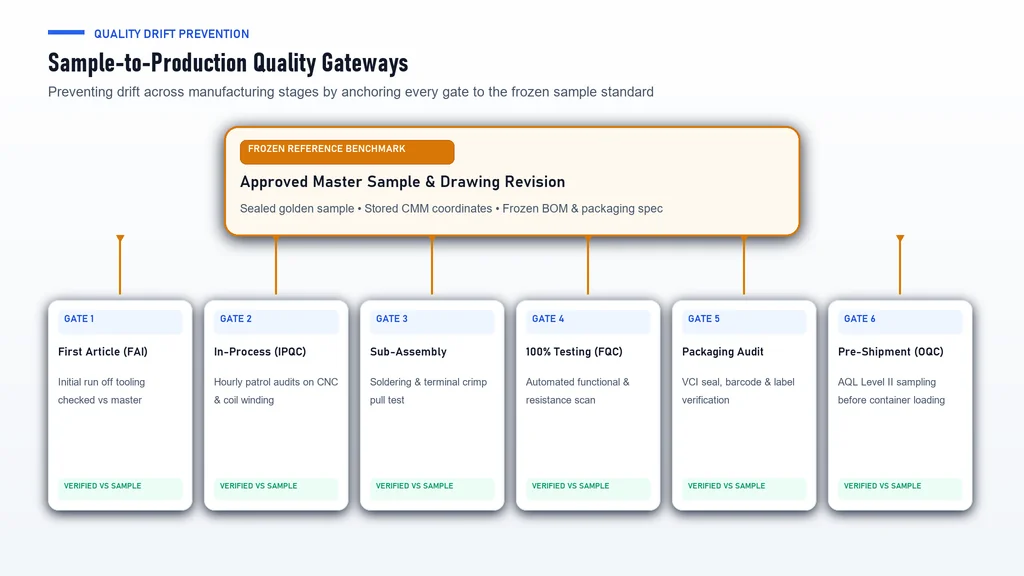 From the first production part to the outbound review: each stage compares the goods against the approved sample and the named drawing revision, which is what stops a passed sample turning into a mismatched bulk run.
Fact: KEHO holds 50,000+ SKUs, dispatches in-stock items within 48 hours, ships standard orders in 15-25 days, and backs parts with a 12-24 month warranty whose exact scope is agreed in writing per order (per company data).
7. Change Management After Approval
An approved sample is only useful if it stays the reference. The moment a drawing, material or process changes without the change reaching your file, the approval is void in practice even though the paper still exists.
Three controls keep it valid. First, a controlled drawing: agree which revision is the approved one, and reference that revision on the approval form and on the order. Second, a written change confirmation: any change to material, dimensions, connector, packaging or label should be confirmed to you in writing before it is made, with the reason and the effective date, as an engineering change notice or its equivalent. Third, a re-approval rule: decide in advance which changes require a new sample and fresh approval, and which can be accepted by written notice. A material substitution or a connector change should trigger a new sample; a carton print correction that does not touch the label fields usually does not.
The principle matches cross-referencing: a part number and a revision only mean the same thing if both sides hold the same record. The cross reference guide covers that discipline from the catalogue side; here it applies to the drawing and the order.
8. The Sample Approval Form
Everything above collapses into one document you fill in at the moment of approval. Fill one form per part and per approved revision, and keep it with the order.
| Field | Entry |
|---|---|
| Part name and category | |
| OEM / reference number | |
| Approved fitment (make / model / year / engine) | |
| Drawing or specification revision | |
| Connector and pin-out verified (yes / no / not applicable) | |
| Critical dimensions and measured result | |
| Material and surface finish | |
| Packaging and label version approved | |
| Batch or date code on the sample | |
| Inspection evidence attached (report / dimensional record / material certificate) | |
| Sampling standard agreed (if applicable) | |
| Changes that require re-approval | |
| Approved by / date |
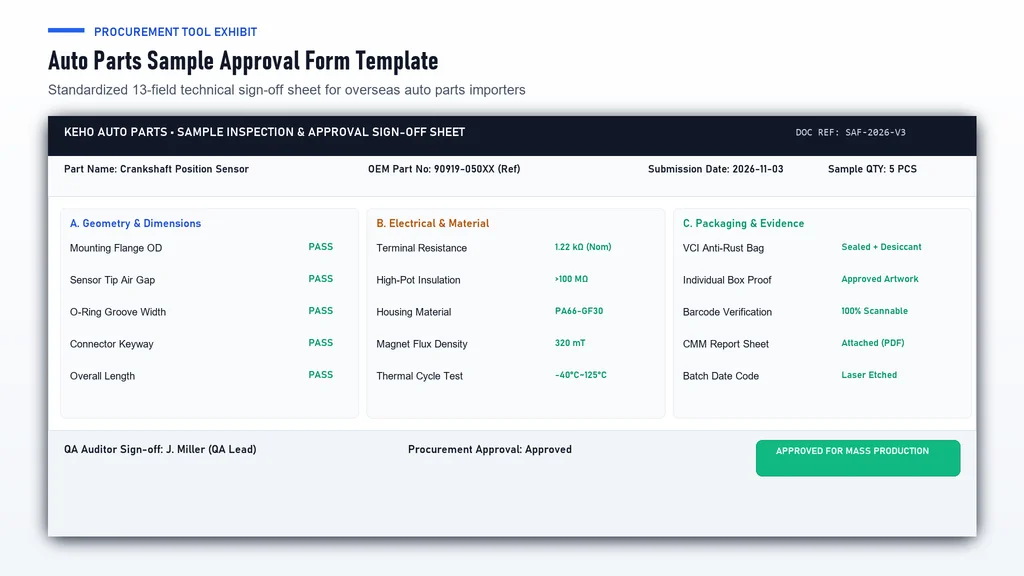 The sample approval form as a single page: fill it per part and per approved revision, attach the evidence rather than summarising it, and keep it with the order.
Two habits make the form work.
Record the revision, not just the part number. The same number at a different revision is a different part, and a bulk order built to the wrong revision is the exact failure the form exists to prevent.
Attach the evidence rather than summarising it. A line that says "dimensions OK" cannot be checked later; a dimensional record can.
9. FAQ: Sample Approval Questions From Buyers
What is sample approval before bulk order?
It is the controlled step where you confirm that a pre-production sample matches the specification you intend to buy, and freeze that specification before a bulk run is released. On an auto part that means confirming the OEM number and fitment fields, the connector and pin definition, the critical dimensions, the material and finish, and the packaging and label, and recording them on a signed approval form with the inspection evidence attached. The approval is what later shipments and any future claim are measured against, so it needs to be a written record rather than a verbal agreement.
Which fields should an importer validate on an auto parts sample?
Six fields cover most of the risk: the OEM or reference number together with the make, model, year and engine that the number is valid for; the connector body and pin assignment for anything electrical; the critical dimensions such as mounting points and sealing faces; the material grade and surface finish; the packaging and label; and the batch or date code that links the sample to the bulk goods. Record each with a value and, where relevant, a document attached, so the bulk order can be checked against the same list.
Should I ask for a third-party inspection report with the sample?
Ask for one where the risk, the destination market or your own customer requires independent evidence, and understand what you are receiving. A report from a firm such as SGS or TUV is a layer of assurance separate from the supplier's own inspection, but its value depends on the scope of what was inspected, the specification the results were measured against, and whether the report covers the specific batch you are buying. Whether your destination market accepts a given report is a compliance question for you and your advisers, not one the supplier can settle on your behalf.
How does a first article inspection differ from sample approval?
Sample approval is a commercial decision about a reference unit: you agree that this part, made to this revision, is the one you want, and you record the specification. A first article inspection is a production validation: the first part produced by the actual process is fully inspected and measured against the drawing, which verifies that the process and tooling can hold the specification rather than only that the design is correct. The two are complementary, because a sample made as a one-off can pass while the production process still drifts, so the first part off the real line should be inspected as well.
Why do bulk orders sometimes not match the approved sample?
Because a sample is often made on a different set-up than the production run, and normal process variation then appears: a re-set tool, a substitute material from a sub-supplier, a run split across shifts, a packaging change made to meet a delivery date, or a gauge that has drifted out of calibration. The controls that close the gap are inspecting the first production part against the drawing, patrolling critical dimensions while the run is live, inspecting packaging and labels against the approved sample, reviewing the packed goods before dispatch, and agreeing a sampling standard for the visual and functional checks in advance.
Can I order a small trial quantity before a full bulk order?
Yes, and for a new SKU it is usually the sensible next step after sample approval, because it tests the process, the packaging and the shipping chain with a real order attached. Suppliers set minimum order quantities differently, and some set them per product and packaging configuration, which is what makes a small trial possible without committing to a full container. Confirm the trial quantity, the packaging and the price per project, and do not assume a sample is free or that a trial price matches the bulk price. Whether a sample is provided, and whether it is charged, is confirmed per product and project.
10. Turning One Approved Sample Into a Repeatable Process
Sample approval before bulk order is a small step with an outsized effect. Done as a visual check, it leaves the specification undefined in exactly the place the bulk order needs it fixed. Done as a controlled event, it produces three things: a written record of what was approved, the evidence that supports it, and the control points that carry it through production. Those three are what let you reorder with confidence and what let a field problem be traced to a specific run.
None of it requires a large team or a formal quality system of your own. A single form per part, a habit of recording revisions rather than part numbers, and a supplier willing to confirm changes in writing are enough to move a purchase from hope to process.
If you want to test this on a live part, send the OEM number and the vehicle details you sell into, and we will confirm the fitment fields, the connector and pin data where relevant, the critical dimensions, the packaging and label, and the inspection evidence we can provide for that item, so the sample arrives with the paperwork the approval form needs. The fuel injector, ignition coil, oxygen sensor and ABS wheel speed sensor ranges are common starting points for a first order, and the full range sits on the KEHO product catalogue. You can reach the team through the KEHO contact page.
Sources
- Wikipedia contributors. "Production part approval process." Wikipedia. https://en.wikipedia.org/wiki/Production_part_approval_process - The definition of PPAP as a standardized quality assurance process used primarily in the automotive supply chain to establish confidence that a supplier's production processes can consistently produce parts meeting customer requirements; the role of the Automotive Industry Action Group (AIAG) and Advanced Product Quality Planning (APQP); the requirement for sample parts and documentary evidence when a new or modified component enters production or the process changes; the dimensional results element and its minimum number of pieces reported per product and process; and the initial sample inspection report (ISIR) used by German vehicle manufacturers.
- Wikipedia contributors. "First article inspection." Wikipedia. https://en.wikipedia.org/wiki/First_article_inspection - The definition of a first article inspection (FAI) as a production validation process verifying that a new or modified production process produces conforming parts meeting the drawing specification; the practice of fully testing and inspecting the first part or a sample from the first batch; inspection of dimensional characteristics with calibrated tools; material testing; its use in the automotive, aerospace and medical industries; and the standard's role in fulfilling the process validation requirement of a quality management system.
- Wikipedia contributors. "Acceptable quality limit." Wikipedia. https://en.wikipedia.org/wiki/Acceptable_quality_limit - The definition of the acceptable quality limit (AQL) as the worst tolerable process average still considered acceptable; its use as an inspection standard prescribing the range of defective components considered acceptable under random sampling; the classification of defects as critical, major or minor; and the practice of buyers and sellers agreeing an AQL standard according to the risk each party assumes, used as a reference during pre-shipment inspection.
- Wikipedia contributors. "SGS S.A." Wikipedia. https://en.wikipedia.org/wiki/SGS_S.A. - SGS as a Swiss multinational headquartered in Baar providing inspection, verification, testing and certification services, founded in 1878; and its core services of inspecting and verifying the quantity, weight and quality of traded goods, testing product quality and performance against health, safety and regulatory standards, and ascertaining conformance with standards set by governments, standardization bodies or its customers.