Crankshaft and Camshaft Position Codes (P0335, P0340, P0016): A Parts Coverage Map for Importers
 A position code names a circuit, not a part. That gap decides whether a distributor wins the account or handles a return.
A workshop messages you with three codes: P0335, then P0340, then P0016, and wants a part number today. The tempting reply is to send two sensors and close the ticket. Send that reply often and your returns climb, because none of those codes confirms a failed part. Each reports a circuit or a relationship, and the part behind it is confirmed before it is ordered.
This guide turns the three codes into a parts decision: what each code reports, why the same code can trace back to different parts, the coverage map you can stock against, the pair-stocking logic behind position sensors and ignition parts, and the verification fields that stop a wrong part from leaving your warehouse. Diagnosis stays with a qualified technician and professional equipment, and your job is to be ready with the right parts once that diagnosis lands.
Fact: KEHO has supplied engine sensors and ignition parts, including crankshaft and camshaft position sensors, to importers in 80+ countries since 1995, holding ISO/TS 16949 certification since 2012 along with CE marking and SGS third-party verification (per company data).
1. What Each Code Actually Names
The three codes sit close together in a fault list, which is why buyers treat them as one problem. Each reports something different, and that difference tells you which parts to have ready.
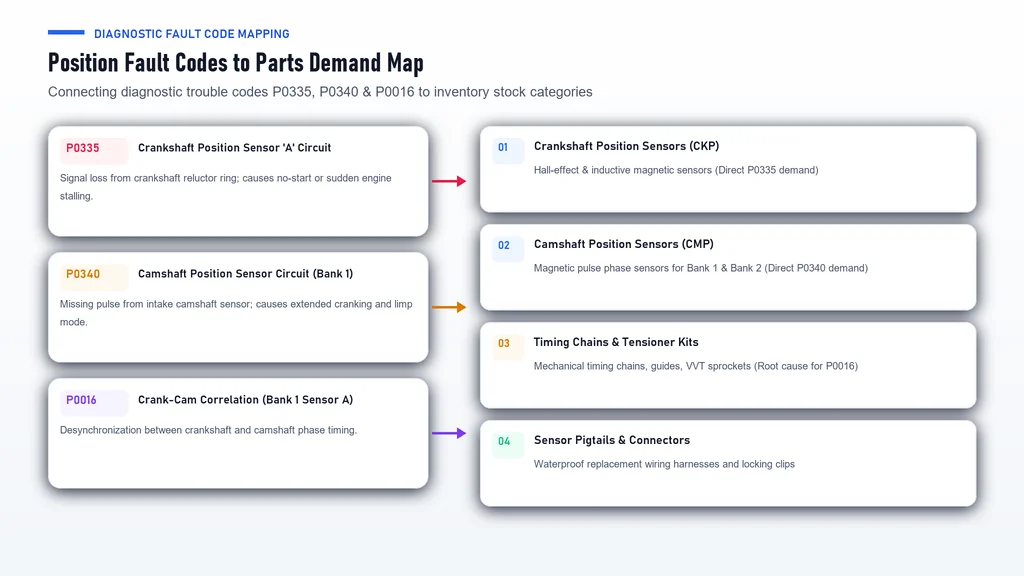
P0335 is the generic code for the crankshaft position sensor A circuit [1]. The module is reporting that the crank signal is missing, intermittent, or outside its expected range. The code describes the signal, and the sensor is one of its possible sources.
P0340 is the generic code for the camshaft position sensor A circuit [1]. It reports the same kind of fault on the camshaft side, where the engine uses the signal to sequence injection and check valve timing.
P0016 is different in kind. It reports a correlation fault: the module compares the crankshaft and camshaft signals and finds they disagree beyond the allowed tolerance [1]. Nothing is necessarily broken in either device. That distinction matters most to a distributor, because P0016 is a timing question before it is a sensor question, and the parts direction is wider than for the other two.
| Code | Standard label | What the module is reporting | Parts direction (not a verdict) |
|---|---|---|---|
| P0335 | Crankshaft position sensor A circuit | The crank signal is missing, intermittent, or out of range | Crankshaft position sensor, its connector, the harness, the signal wheel it reads |
| P0340 | Camshaft position sensor A circuit | The cam signal is missing, intermittent, or out of range | Camshaft position sensor, its connector, the harness, the camshaft trigger |
| P0016 | Crankshaft and camshaft position correlation | The two signals disagree beyond tolerance | Both position sensors and their wiring, then the mechanical timing relationship |
The table is a direction finder, not a diagnosis. Every row lists more than one candidate on purpose, because a code tells a workshop where to look and a technician confirms which candidate is guilty.
That is also why the code is a stable routing signal for a parts desk. The four-character format uses a letter for the system, P for powertrain, plus three digits, and the generic P03xx and P00xx families are shared across manufacturers [2], so a P0335 means the same on a car in your market as anywhere else.
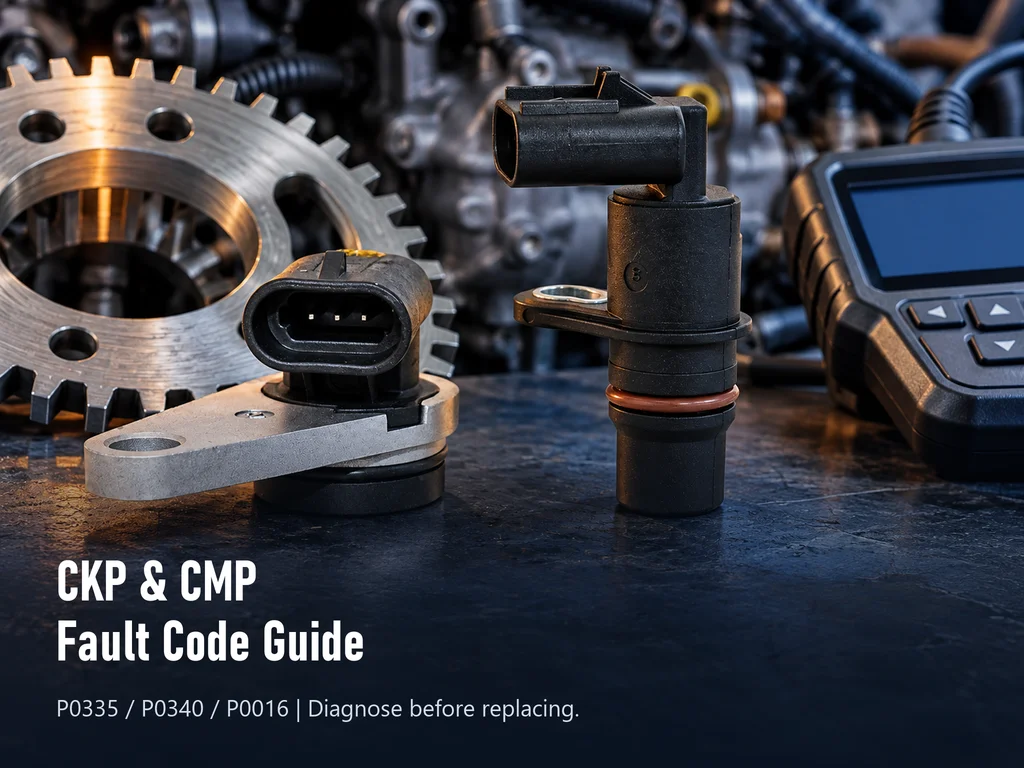
If you are new to the position sensor lines themselves, the crankshaft and camshaft sensor buying guide covers the CKP and CMP split and how to index the catalog by OEM number. This guide assumes that background and stays on the code-to-parts question.
2. Why One Code Can Trace Back to Different Parts
The most expensive assumption in this category is that a position code equals a position sensor. The code names a circuit, and several things sit on that circuit. Quoting a sensor for every P0335 is a guess.
Five places commonly sit behind one of these codes, and a qualified technician works through them with professional equipment. For a distributor, the value is knowing the directions, so your quote covers the realistic outcomes.
Connector and harness. The sensor is only as good as the wiring that carries its signal. A corroded terminal, a chafed wire, or a loose connector can produce exactly the fault a failed sensor would. Connector and pigtail coverage is worth carrying alongside the sensors, because a position sensor sale that ships without the matching connector can become a second shipment on the same repair.
The signal wheel or reluctor. The sensor reads a rotating toothed wheel or a similar trigger on the crank or cam. A damaged, dirty, or wrong trigger produces a bad signal from a healthy sensor. Nothing you sell fixes a damaged trigger, but knowing it exists keeps you from replacing a sensor twice.
Air gap and mounting. A crankshaft position sensor works without touching the wheel it reads, across a small air gap. The gap and the mounting position are part of the specification [3]. A sensor that matches electrically but sits at the wrong gap, or mounts at the wrong angle, reports badly, so mounting geometry belongs on the verification checklist, not just the OEM number.
Timing and mechanical relationship. This is the direction behind P0016. When the crank and cam signals disagree, the cause can be the mechanical relationship between them rather than either sensor. The parts direction here reaches beyond sensors, and a distributor who says so early keeps trust that a hurried sensor quote would spend.
The sensor itself. Only after the rest has been considered does the sensor become the confirmed part. When it is, the two most common device types behave differently. A magnetic (variable reluctance) sensor generates its own signal as the trigger passes and typically uses a two-wire connection, while a Hall effect sensor needs a power feed and returns a cleaner switching signal [4]. The two are not interchangeable on a given application, which matters the moment you start cross-referencing part numbers.
Each code can point at a sensor, and each code can point somewhere a sensor will not help. A distributor who understands the spread of candidates sends the parts a technician actually needed.
3. The Coverage Map: Code to Parts to Stock
The table above sorts the directions. This table sorts the business decision. Read it by code, then decide what belongs on your shelf, what is already in the KEHO catalog, and what to weight first.
| Code | Parts the repair can involve | In the KEHO catalog? | Procurement priority |
|---|---|---|---|
| P0335 | Crankshaft position sensor | Yes, crankshaft position sensors | High. Core SKU, stock in depth by platform |
| P0335 | Sensor connector and pigtail | Not as a standalone line, request with the sensor order | Medium as an attachment, low as a line |
| P0335 | Signal wheel or reluctor | Not in this catalog, verify separately | Out of scope, note the direction |
| P0340 | Camshaft position sensor | Yes, camshaft position sensors | High. Stock in breadth across engine families |
| P0340 | Sensor connector and pigtail | Not as a standalone line, request with the sensor order | Medium as an attachment |
| P0340 | Camshaft trigger | Not in this catalog, verify separately | Out of scope, note the direction |
| P0016 | Crankshaft and camshaft position sensors | Yes, both lines | High. Pair coverage, see section 4 |
| P0016 | Timing components (chain, belt, tensioner, phaser) | Not in this catalog, verify separately | Out of scope, name the limit plainly |
| P0335 / P0340 / P0016 | Ignition coils and spark plugs | Yes, ignition coils and spark plugs | Medium to high. Ride the same invoices, see section 4 |
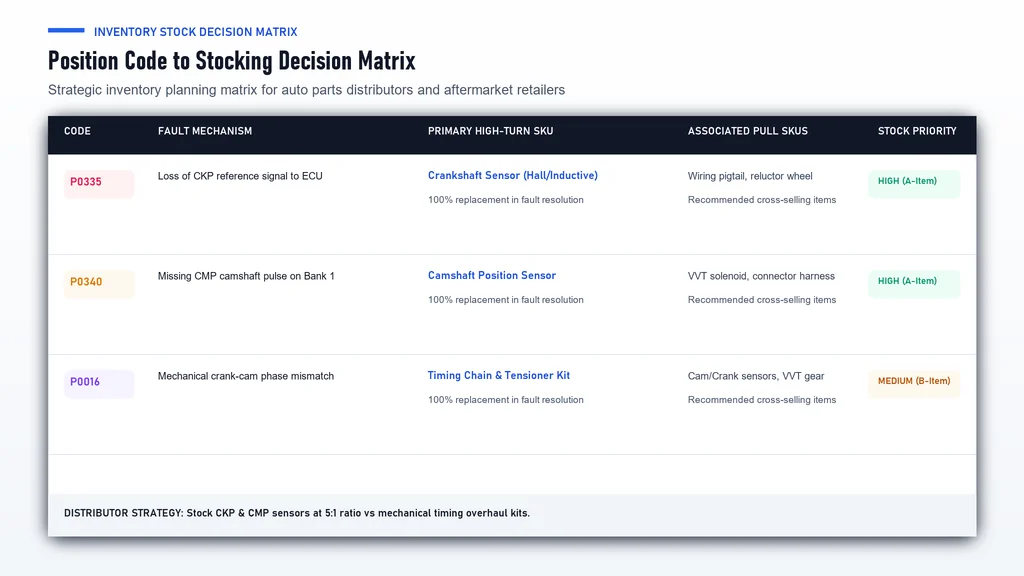 Read the coverage map by code, not by vehicle. It tells a parts desk what to quote and what to leave to another supplier.
Two rows in that table decide most of your risk. The first is the crankshaft position sensor, the highest-turnover SKU on the list. The second is the row that says a code can lead to timing components or a trigger wheel you do not carry. Naming that limit plainly is a commercial strength: it tells the workshop you understand the code, and it stops you from shipping a sensor the technician did not need.
For the mapping to work at the counter, your staff need to read the code, not just the vehicle. A workshop that says "position sensor, 2013, engine unknown" gives your team almost nothing, while one that says "P0335, and the number stamped on the old sensor" gives a part number to verify. Train the intake question accordingly and the coverage map turns into a quote on the first reply.
4. Why Position Sensors and Ignition Parts Are Stocked Together
Position code repairs do not arrive alone, and two patterns explain why.
The first is the crank and cam pair. The two sensors share a failure symptom and a reference, so a workshop chasing P0016 may replace both before it can trust the timing again. In most pairs the camshaft sensor costs less, so it is an easy add when the job is already open. Carry the crankshaft sensor in depth, because it sells on its own, and the camshaft sensor in breadth, because it sells as the companion across many engine platforms. A distributor with only the crankshaft line is missing the companion part on the jobs that follow.
The second is the ignition adjacency. A car that cranks but will not start, or one running roughly after a position code, brings the ignition system into the same job. When a technician works a signal fault on a no-start car, the coil and plug on the affected cylinder are already in the conversation and move on the same invoice. That is why the coverage map pairs the position sensor lines with ignition coils and spark plugs rather than treating them as separate purchases.
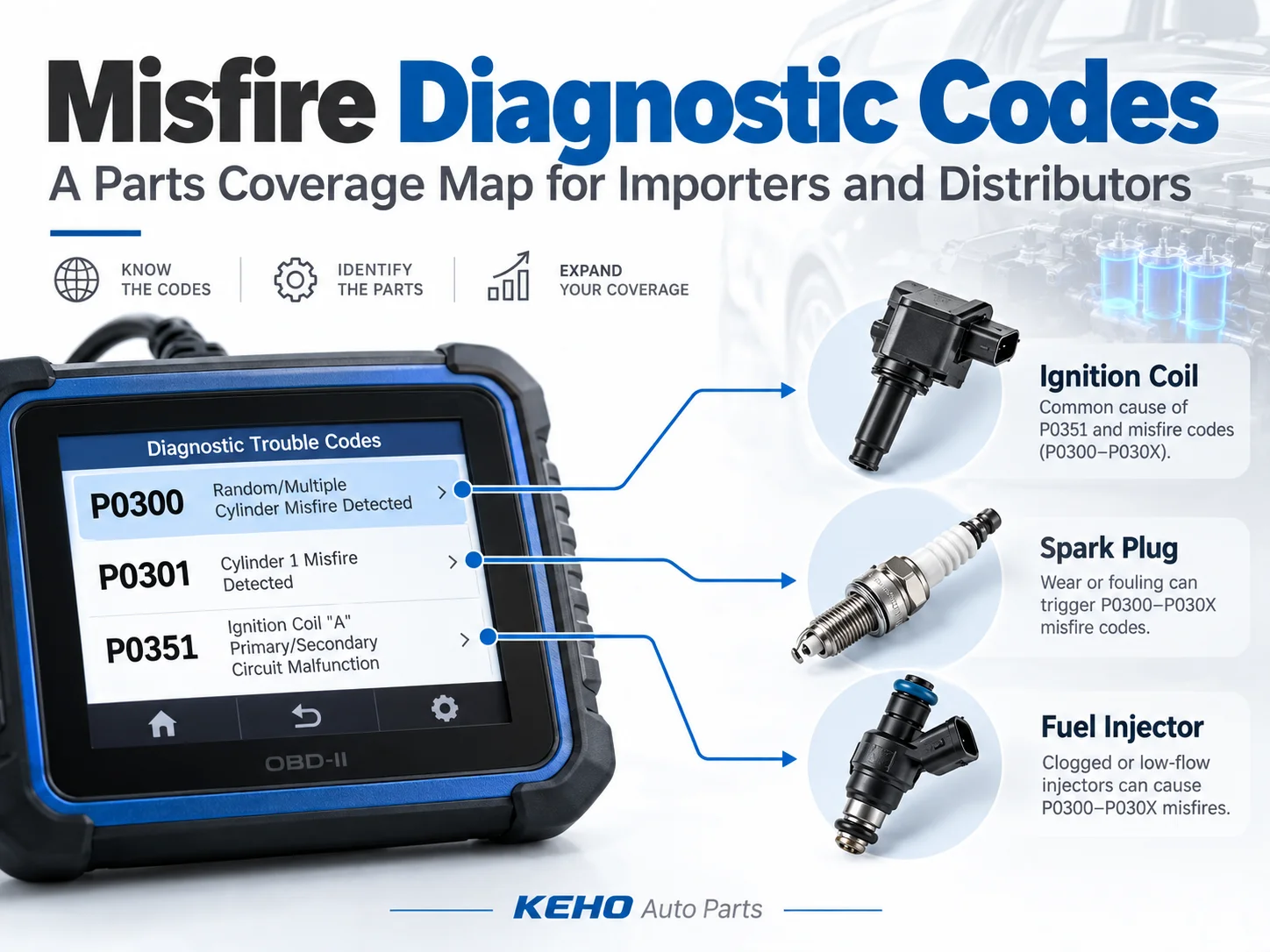
A P0335 or P0340 often arrives with a misfire code beside it, because a degraded position signal disturbs the timing the engine uses to fire. The misfire diagnostic codes coverage map works the other side of that overlap, and reading the two together is how your support stops treating a code list one line at a time.
Fact: KEHO supplies the position sensor, ignition coil, spark plug, and oxygen sensor lines that position code repairs pull from a single catalog of 50,000+ SKUs, with OEM number, vehicle model, year, and engine code cross-checked before shipment (per company data).
Weight the depth of each OEM number to your own repair traffic. Markets with older naturally aspirated fleets move position sensors and ignition parts on steady volume, while fleets on modern turbocharged engines concentrate movement in fewer, more specific part numbers.
5. The Sensor Sourcing Checklist
A position sensor is small and cheap, which is why it is easy to buy badly. A reboxed substitute or a wrong connector holds together in the warehouse and fails at the counter, and the labour that follows lands on your account. The checklist below is what to confirm before a sensor line goes onto a stock order.
| Check item | What to confirm | Where the error usually comes from |
|---|---|---|
| OEM number | The exact original number, then cross-checked against vehicle make, model, year, and engine | Matching on vehicle model alone, ignoring the engine code |
| Cross-reference | Any supersession or cross-reference numbers, confirmed against the OEM figure | Relying on an aftermarket number that was never verified against the original |
| Connector and pins | Housing shape, keying, and pin count identical to the original | "It fits most applications" claims that ignore the connector |
| Sensor technology | Magnetic or Hall effect, matched to the application | Substituting one type for the other where the wiring differs |
| Harness length | Lead length and routing matched to the original | Short leads that strain the connector once installed |
| Mounting and seal | Mounting holes, bracket, and O-ring or seal arrangement matched | A correct signal but a wrong seat or a missing seal |
| Fitment verification | Supplier confirms the four fitment fields before shipment | Supplier ships the number you ordered without verifying it |
| Warranty terms | Coverage, period, and claim terms in writing | Terms described verbally and never put in the order documents |
The OEM number is the anchor, and the method behind it is the same four-dimension check set out in the OEM number matching guide: collect the number, verify it against make, model, year, and engine, then cross-check the batch before it ships. Where two numbers might both apply to a vehicle, the auto parts cross reference guide covers how to resolve the crossover without guessing.
Two rows deserve emphasis. Sensor technology is the row most often skipped and the one that sinks a cross-reference: a magnetic and a Hall effect sensor may share a housing yet differ in wiring and signal, so a number that "looks the same" is not the same. Harness length and seal arrangement cause field comebacks, because a sensor that works on the bench can still leak or fail if its lead or seal does not match the original seat.
The general supplier diligence sits in the Chinese auto parts supplier vetting guide. Applied to position sensors, it adds one request: ask for the connector and pin information in writing with the specification sheet, because a sheet that lists only an OEM number leaves the most common field failure unaddressed.
6. What Sits Outside This Catalog
Being clear about scope protects both sides of an order. The position code repair can legitimately involve parts beyond the sensor lines, and some of them are not in this catalog.
- Mass air flow sensors, throttle position sensors, and camshaft adjusters are not in this catalog and need to be verified separately.
- Timing components such as chains, belts, tensioners, and phasers, which can sit behind a P0016, are not in this catalog and need to be verified separately.
- Signal wheels and reluctor rings are not carried as standalone lines here and need to be sourced separately where a repair calls for them.
This catalog covers eleven categories, and the ones that matter for position code work are the crankshaft position sensors, camshaft position sensors, ignition coils, spark plugs, and oxygen sensors, alongside the other electrical and sensor lines. Where a repair reaches past that list, say what is available, name what is not, and let the workshop source the rest. Telling a workshop "P0016 can involve the timing, which I do not carry, so confirm that first" costs nothing and earns a reputation for being straight with them.
7. FAQ: Position Code Questions Distributors Get Asked
What does P0335 mean?
P0335 is the generic code for the crankshaft position sensor A circuit [1]. The module is reporting that the crank signal is missing, intermittent, or outside its expected range. Several things can set that code, from the sensor itself to its connector, its harness, or the signal wheel it reads, so the part is confirmed by a technician before it is ordered.
What does P0340 mean?
P0340 is the generic code for the camshaft position sensor A circuit [1]. It reports the same kind of fault as P0335 but on the camshaft side, which the engine uses to sequence injection and to verify valve timing. The parts direction points at the camshaft position sensor and its electrical path first, with the camshaft trigger and the timing relationship second.
What does P0016 mean?
P0016 reports a correlation problem between the crankshaft and camshaft signals [1]. The module is comparing the two and finding they disagree beyond the allowed tolerance. That is a timing question before it is a sensor question, which is why the parts direction is wider: both position sensors and their wiring, then the mechanical timing relationship, can sit behind the same code.
Why do P0335, P0340 and P0016 often appear together?
The three codes share a signal path and a reference, so one upstream issue, such as a wiring fault, low supply voltage, or a worn trigger wheel, can set more than one at once. Seeing them together changes the parts conversation: do not quote two sensors on the assumption that both have failed, because one shared cause can sit behind the list.
Which parts should a distributor stock to cover position codes?
Cover the position sensor lines first, in both crankshaft and camshaft form, because those are the parts a workshop pulls for a P0335, P0340, or P0016 repair. Weight them by the platforms your market runs, pair them with ignition coils and spark plugs, which move on the same invoices, and add connectors and pigtails as low-cost attachments that reduce a second shipment.
How do I verify a camshaft or crankshaft position sensor before ordering?
Confirm four fields before you commit: the OEM number, the connector and pin count, the sensor technology (magnetic or Hall effect), and the mounting and seal arrangement. Cross-check the OEM number against make, model, year, and engine, then confirm the connector and signal type against the original, because vehicle model alone is not a reliable fitment key.
Are the crankshaft and camshaft position sensors the same part?
On most vehicles they are different parts with different connectors, mounting points, and often different signal types. A few older engines used a combined sensor, but that is the exception. Stocking one SKU for both positions is a common source of returns, so keep the two lines separate and flag every line by position.
8. Turning Position Codes Into a Stock Plan
Read the code, name the directions, and quote the parts that cover them. A P0335 and a P0340 point at the two position sensor lines, a P0016 reaches into timing territory you can name but may not carry, and all three ride in with ignition parts on the same repair orders. A distributor who builds around that pattern answers faster and ships fewer wrong parts. Start with depth on the crankshaft line, add breadth on the camshaft side, pair both with ignition coils and spark plugs, and verify every line by OEM number, connector, technology, and mounting before it reaches a stock order.
Fact: KEHO ships in-stock items within 48 hours and standard orders in 15-25 days, with parts backed by a 12-24 month warranty per the published terms, with the exact scope set in the order documents (per company data).
If you want a coverage map built against the engine codes your market runs, send us the top position codes your workshops report with the OEM numbers behind them, and we will come back with a stocking plan. Browse the full KEHO product catalog for the position sensor and ignition lines, or review the crankshaft and camshaft sensor guide for the catalog side of the decision.
Sources
- SAE International. "SAE J2012, Diagnostic Trouble Code Definitions." SAE Standards. https://www.intertekinform.com/en-us/standards/sae-j2012-202509-1020881_saig_sae_sae_3732294/ (2025) - Standard definitions for powertrain trouble codes, equivalent to ISO 15031-6; basis for the P0335, P0340, and P0016 definitions here.
- Wikipedia contributors. "On-board diagnostics." Wikipedia. https://en.wikipedia.org/wiki/On-board_diagnostics - OBD-II mandate and the four-character P/B/C/U trouble code format.
- Wikipedia contributors. "Crankshaft position sensor." Wikipedia. https://en.wikipedia.org/wiki/Crankshaft_position_sensor - Crankshaft position sensor operation and non-contact reading of the reluctor wheel or ring.
- Haltech. "Hall Effect or Reluctor?" haltech.com - Comparison of variable reluctance and Hall effect trigger sensors, including reluctor wiring, powered Hall wiring, signal shape, and air gap sensitivity.