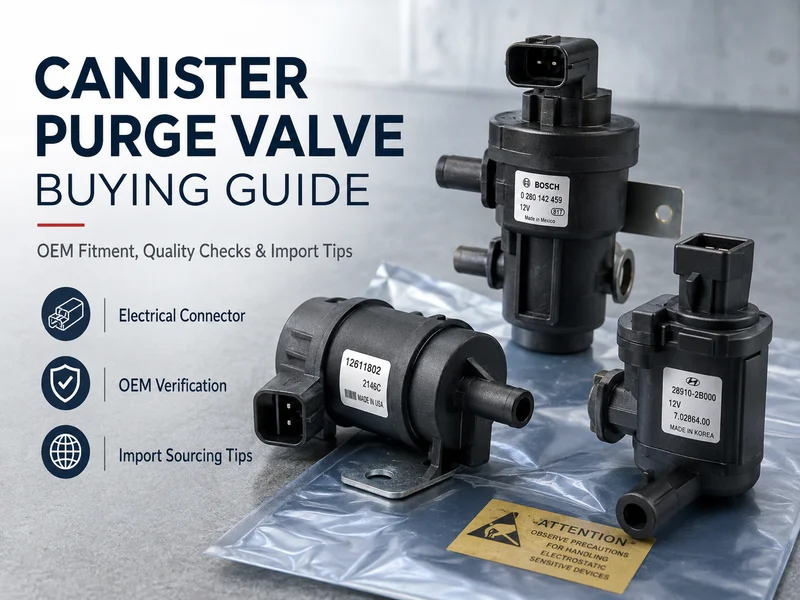
The canister purge valve is a small emissions part with a specific failure signature. It fails open or it fails closed, and the two failures produce opposite symptoms, which means buyers return it for the wrong reason just as often as the right one. This canister purge valve buying guide covers the failure modes and the fitment fields that decide whether your bulk order stays sold.
If you already stock fuel injectors or oxygen sensors, the sourcing discipline is the same. The specifics here are the purge valve.
1. What the Purge Valve Does in the EVAP System
The evaporative emissions system captures fuel vapor from the tank in a charcoal canister instead of venting it to the air [1]. The purge valve is the gate that releases that stored vapor into the intake manifold to be burned, and it only opens when the engine is warm and under part load.
That dual role is the point. It is an emissions part, so it has to satisfy the emissions monitors that set the check engine light. It is also a running-quality part, because when it opens at the wrong time it changes the air-fuel mixture. A distributor who understands both sides can stock and sell the part better than one who treats it as a simple solenoid.
2. Two Failure Modes, Opposite Symptoms
The valve fails in one of two ways, and the symptom points in different directions.
Stuck closed means the stored vapor cannot reach the intake. The canister builds pressure, and the driver notices it at the fuel pump: the nozzle clicks off early because the tank vapor has nowhere to go. The engine usually runs fine, which is why this failure can drag on unnoticed.
Stuck open means vapor flows into the intake constantly. Idle gets rough, a fuel smell appears around the engine bay, and fuel consumption rises because the mixture runs rich. This one gets noticed faster because it affects how the car drives.
| Factor | Stuck closed | Stuck open |
|---|---|---|
| Vapor flow | Blocked | Constant |
| Idle quality | Usually normal | Rough, unstable |
| Fuel smell | Rare | Common |
| Refueling | Nozzle clicks off early | Normal |
| Typical result | Emissions fault, drives fine | Driveability complaint, runs rich |
| Return risk | "No problem found" returns | Genuine defect returns |
For a distributor, the stuck-closed failure is the trickier one to support, because the part gets returned as "no problem found" by installers who did not diagnose it properly. Sell with a fitment and diagnosis note, and the return rate drops.
Fact: KEHO has supplied auto parts to importers in 80+ countries since 1995, holding ISO/TS 16949 certification (since 2012), CE marking, and SGS third-party verification (per company data).
3. The Fitment Fields That Decide the Order
A purge valve is not universal. Three fields have to line up before it will work on the vehicle it was bought for.
OEM number is the first gate. Cross-reference the original valve number the way you would for any other part; our guide on matching auto parts by OEM number walks through the method. KEHO's line covers Chevrolet, Opel, and Vauxhall platforms, with common numbers like 0280142513, 0280142427, and 55566514 (per company data).
Connector shape is the second gate. The same valve body is often fitted with different electrical connectors across platforms, so a visually identical valve can still be the wrong one. Confirm the connector against the vehicle before you commit.
Coil resistance is the third gate and the one buyers skip. The engine computer drives the valve through its coil, and a coil outside the expected resistance range either will not open or will draw too much current. This is a spec, not a preference.
Fact: KEHO's canister purge valves are priced around $ 7.90-9.90 per piece, with common OEM numbers like 0280142513 and 0280142427 covering Chevrolet, Opel, and Vauxhall (per company data).
4. How to Vet a Purge Valve Supplier
Most of what goes wrong with a purge valve order is decided before the container ships. The checks are the same discipline you would apply to any supplier, applied to a part whose failure mode is electrical, not wear.
Certifications. ISO/TS 16949 (now IATF 16949) is the automotive-specific quality standard that matters; CE matters for Europe. Ask for the certificate number and verify it.
Fitment support. A good supplier verifies the OEM number, connector, and coil spec against your vehicle list. A bad one ships whatever you typed. The full checklist is in our guide on vetting a Chinese auto parts supplier.
Batch consistency. Valves in the same order should share the same coil winding, connector, and housing supplier. Mixed batches create a support problem where part of your SKU behaves differently from the rest.
5. MOQ, Mixed Containers, and the Real Cost
Purge valves are low-value, high-count parts. Unit cost matters less than total landed cost, and that is shaped by how you ship.
Start small. A new valve line should begin with a trial batch, not a full container, so you can test fitment accuracy and return rates on real vehicles before committing cash to a slow mover. KEHO's purge valve line supports a one-piece minimum (per company data), which makes that trial order cheap to run.
Mix the container. Purge valves rarely fill a container on their own. They ship well alongside other engine and emissions parts, spreading freight across more SKUs and lowering per-unit cost. Our low MOQ shipping guide covers consolidating brake, suspension, steering, and electrical parts into one shipment.
Count the warranty. A cheaper valve with a loose warranty process can cost more than a slightly pricier one that handles claims cleanly. For a part that sells on replace-not-repair logic, the warranty is part of the product.
Fact: KEHO maintains 50,000+ SKUs across six production lines with 500+ workers and a 99.2% on-time delivery rate, backing parts with a 12-24 month warranty (per company data).
6. FAQ: Purge Valve Questions From Real Buyers
What are the symptoms of a bad canister purge valve?
The common signs are a check engine light with an EVAP fault code, rough or unstable idle, a fuel smell around the engine bay, hard starting after refueling, and a fuel nozzle that clicks off early when filling the tank. The exact symptom depends on whether the valve failed open or closed. A scan tool reading the EVAP codes is the fastest way to confirm the valve rather than guessing.
What does the canister purge valve do in the EVAP system?
The EVAP system captures fuel vapor from the tank in a charcoal canister instead of venting it to the air. The purge valve is the gate that releases that stored vapor into the intake manifold to be burned when the engine is warm and under part load. The engine computer opens and closes the valve on a duty cycle, so it is an emissions part and a running-quality part at the same time.
What is the difference between a stuck-open and a stuck-closed purge valve?
A stuck-closed valve blocks the stored vapor from reaching the intake. The canister builds pressure, and refueling becomes difficult because the tank vapor has nowhere to go, so the nozzle clicks off early. A stuck-open valve lets vapor flow into the intake constantly, which leans on idle quality, causes a fuel smell, and can raise fuel consumption. Both set an EVAP code, but the driveability symptoms point in opposite directions.
How do I find the right canister purge valve by OEM number?
Cross-reference the vehicle's OEM valve number, or the make, model, year, and engine, against the supplier's catalog. Then confirm the electrical connector shape and the coil resistance range, because the same valve body can be fitted with different connectors across platforms. Fitment is not a single field; it is the OEM number plus the connector and electrical spec all lining up.
Can a canister purge valve be cleaned, or must it be replaced?
In most cases it is a sealed solenoid and is replaced, not serviced. Some valves can be temporarily freed by cleaning, but a valve that has stuck once usually sticks again, and the cost of a return or a comeback outweighs the part price. For a distributor this means the part moves on a replace-not-repair logic, which keeps demand steady.
What should I check in a canister purge valve supplier before a bulk order?
Check certifications first, ISO/TS 16949 (now IATF 16949) and CE for Europe. Then fitment support, meaning the supplier verifies the OEM number, connector, and coil spec against your vehicle list. Then warranty terms and how claims are handled, MOQ flexibility to test a new SKU with a small batch, and response time on technical questions. A supplier that cannot confirm a valve's connector same day is not ready for your program.
7. Conclusion: Match the Connector, Not Just the Number
A purge valve program lives or dies on three fields: OEM number, connector, and coil spec. Get those right and the part sells on steady replace-not-repair demand. Get one wrong and you buy a false-defect return.
KEHO has supplied engine and emissions parts to importers for 30 years (per company data), and the same fitment discipline applies across the canister purge valve line. Send your vehicle list and OEM numbers, and we will confirm connector and coil spec before you commit to the first batch.
Sources
- [Wikipedia]. "Vehicle emissions control." en.wikipedia.org: The charcoal canister collects and contains fuel vapors, routing them to the air intake to be burned once the engine is started and warmed up.
- [KEHO]. Company data: certifications, quality control process, warranty, delivery rate, and purge valve line pricing. kehoauto.com: Company-reported figures marked "(per company data)" in the article body.