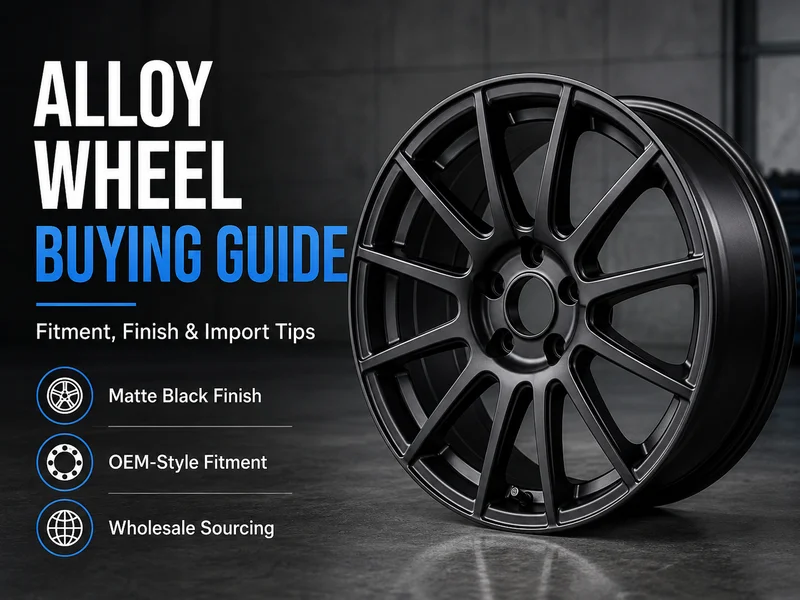
An alloy wheel is where style meets hard fitment. The finish is the easy sell. The hard part is that every wheel has to match the diameter, width, offset, bolt pattern, and hub bore of a specific vehicle, and a single mismatch means the wheel does not fit. This alloy wheel buying guide covers the fields that decide whether your bulk order stays sold.
If you are sourcing for wholesalers and tuning shops, the buyer is not picking one wheel. They are stocking a size and finish range, which means the fitment has to be right across every line.
1. Cast Aluminum: The Volume Logic
The aftermarket wheel market splits into two construction methods, and they serve different buyers.
Cast wheels are made by pouring molten aluminum into a mold. They cost less to produce, which makes them the standard for volume aftermarket fitment. The trade-off is weight: at the same strength, a cast wheel is heavier than a forged one.
Forged wheels are pressed from a solid aluminum billet under high pressure. They are lighter and stronger, but they cost several times more, which puts them in the specialist performance line.
For a distributor, cast wheels are the volume business. KEHO's line is cast aluminum, covering the everyday sedan and 4x4 markets where the unit price, not the gram count, drives the decision.
Fact: KEHO has supplied auto parts to importers in 80+ countries since 1995, holding ISO/TS 16949 certification (since 2012), CE marking, and SGS third-party verification (per company data).
2. The Five Fields That Decide Fitment
A wheel is not universal. Five fields have to line up before it will bolt on and run.
Diameter and width set the tire and the stance. Diameter is the 18-inch or 20-inch number; width is the J-value, like 8J. A wider wheel takes a wider tire and pushes the stance out.
ET offset sets how far the wheel sits in or out of the arch. It is the distance from the mounting face to the wheel's center line, measured in millimeters. Too high and the wheel rubs the suspension; too low and it sticks out past the fender.
PCD is the bolt pattern, the diameter of the circle through the bolt-hole centers. A 5x114.3 wheel has five bolts on a 114.3 mm circle. This is a hard field: the wrong PCD will not bolt on at all.
Center bore is the hub hole. It centers the wheel on the hub, and it has to match or use a correct hub ring. The OEM number and chassis code are the reliable keys, the way you would match any other part; our guide on matching auto parts by OEM number walks through the method.
3. Finish: Gloss, Matte, and Satin Black
The finish is the visual selling point, and each one fits a different build.
Gloss black is shiny and reflective. It hides brake dust well but shows scratches and swirl marks faster.
Matte black is flat and non-reflective. It hides dirt best and is the dominant look for off-road and 4x4 builds.
Satin black sits between the two, a soft sheen that reads more premium than matte without the glare of gloss.
For a distributor, matte and satin black are the safer volume choices in the current market, with gloss kept for customers who ask for it.
4. Size and Use: Match the Wheel to the Vehicle
| Factor | 18-inch daily sedan | 20-inch 4x4 wide | Wide-body stability |
|---|---|---|---|
| Diameter | 18 inch | 20 inch | Wide stance |
| Typical vehicle | Sport sedans, daily drivers | 4x4 SUVs, off-road builds | Wide-body and stance builds |
| Width / offset | 18 mm ET | 8J wide, matte black | Enhanced stability |
| Finish | Black | Matte black | Satin black |
Stocking 18-inch and 20-inch together lets a distributor cover the commuter market and the off-road market with the same supplier, which is how the SKU mix should be built.
Fact: KEHO's cast aluminum wheels run 18 to 20 inches in gloss, matte, and satin black, priced from $ 50 to $ 85 per piece with a four-piece minimum (per company data).
5. Supplier Check, MOQ, and Warranty
Most of what goes wrong with a wheel order is decided before the container ships.
Certifications. ISO/TS 16949 (now IATF 16949) is the automotive-specific quality standard that matters; CE matters for Europe. Ask for the certificate number and verify it. The full supplier-vetting checklist is in our guide on vetting a Chinese auto parts supplier.
Fitment support. A good supplier confirms diameter, width, ET, PCD, and center bore against your vehicle list. A bad one ships whatever you typed.
Finish consistency. Wheels in the same batch should match in color and coating, because a customer who orders four wheels in matte black will return the set if one is a different shade.
Start small, then scale. A new design should begin with a trial batch. KEHO's wheel line supports a four-piece minimum (per company data), which keeps the trial cheap. Wheels ship well alongside other parts, and our low MOQ shipping guide covers consolidating mixed categories into one container.
Fact: KEHO maintains 50,000+ SKUs across six production lines with 500+ workers and a 99.2% on-time delivery rate, backing parts with a 12-24 month warranty (per company data).
6. FAQ: Alloy Wheel Questions From Real Buyers
What is the difference between cast and forged alloy wheels?
Cast wheels are made by pouring molten aluminum into a mold. They cost less to produce and are the standard for volume aftermarket fitment, but they are heavier than forged wheels at the same strength. Forged wheels are pressed from a solid aluminum billet under high pressure, which makes them lighter and stronger, but they cost several times more. For a distributor, cast wheels are the volume line and forged wheels are a specialist line.
How do I determine the right wheel size and offset for a vehicle?
The key fields are diameter, width, ET offset, PCD, and center bore. Diameter and width set the tire and the stance. ET offset sets how far the wheel sits in or out of the arch. PCD is the bolt pattern, and center bore is the hub hole. All five have to match the vehicle, because a wheel with the wrong offset or PCD will not fit or will rub.
What is PCD and why does it matter?
PCD is the pitch circle diameter, the diameter of the circle that passes through the center of the bolt holes. A 5x114.3 wheel has five bolts on a 114.3 mm circle. It is a hard fitment field: a wheel with the wrong PCD will not bolt on at all. Always confirm PCD and center bore together, because both are hub-side fitment and both have to line up.
What is the difference between gloss black, matte black, and satin black?
Gloss black has a shiny, reflective finish and hides brake dust well but shows scratches. Matte black is flat and non-reflective, hides dirt best, and is the dominant look for off-road and 4x4 builds. Satin black sits between the two, a soft sheen that reads more premium than matte without the glare of gloss. For a distributor, matte and satin black are the safer volume choices in the current market.
How do I choose between 18-inch and 20-inch wheels?
It depends on the vehicle and the end market. 18-inch suits daily-driver sedans and balances ride comfort with looks. 20-inch reads aggressive and suits SUVs and 4x4 builds, usually with a wider J-value. Stocking both lets a distributor cover the commuter market and the off-road market with the same supplier, which is how the SKU mix should be built.
What should I check in an alloy wheel supplier before a bulk order?
Check certifications first, ISO/TS 16949 (now IATF 16949) and CE for Europe. Then fitment support, meaning the supplier confirms diameter, width, ET, PCD, and center bore against your vehicle list. Then finish consistency and warranty terms, MOQ flexibility to test a new design with a small batch, and response time on technical questions. A supplier that cannot confirm a wheel's PCD same day is not ready for your program.
7. Conclusion: Five Fields, One Fit
A wheel program lives or dies on five fields: diameter, width, ET, PCD, and center bore. Get those right and the finish sells itself. Get one wrong and the wheel never bolts on.
KEHO has supplied wheels and running gear to importers for 30 years (per company data), and the same fitment discipline applies across the alloy wheel range. Send your vehicle list and we will confirm the five fields before you commit to the first batch.
Sources
- [KEHO]. Company data: certifications, quality control process, warranty, delivery rate, and wheel line pricing. kehoauto.com: Company-reported figures marked "(per company data)" in the article body.