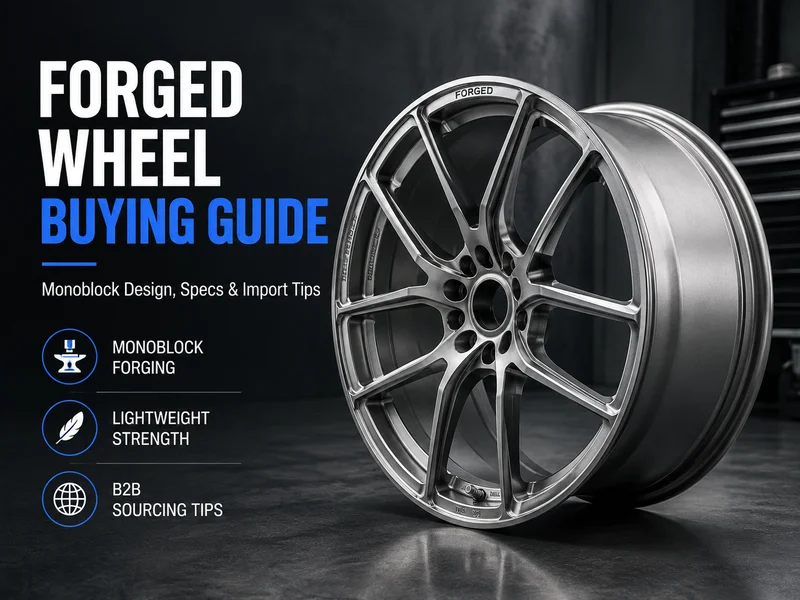
Forged wheels are the opposite of most auto parts. Most parts are cheap, fast-moving, and forgiving when the spec is slightly off. A forged wheel is expensive, slow-moving, and unforgiving: the wrong offset or bolt pattern means a wheel that cannot be mounted, and the freight to send it back costs more than the margin on the order.
This guide is for importers and distributors building a forged wheel program. It covers the three construction types, the style and finish decisions, the fitment fields, and the supplier checks. If you already sell cast wheels, our alloy wheel buying guide covers that side of the category; this one picks up where casting ends.
1. Why Forged Is a Different Category
The difference between cast and forged starts with how the metal is shaped. A cast wheel is poured molten into a mold and cooled. A forged wheel is pressed from a solid aluminum blank under extreme pressure, which compresses the metal's grain into a denser structure [1].
That single difference cascades into everything that matters to a buyer. A forged wheel is lighter and stronger at the same size, which matters on performance and luxury vehicles where unsprung weight affects handling. It costs more, which means the buyer is more careful, the order is smaller, and the return is more painful. You do not stock forged wheels the way you stock brake pads; you stock them the way you stock steering wheels, by application and by confirmed order.
Fact: KEHO has supplied auto parts to importers in 80+ countries since 1995, holding ISO/TS 16949 certification (since 2012), CE marking, and SGS third-party verification (per company data).
2. Monoblock vs Two-Piece vs Three-Piece
The first buying decision is construction. It sets the weight, the strength, the price, and what happens when a wheel is damaged.
| Factor | Monoblock | Two-Piece | Three-Piece |
|---|---|---|---|
| Structure | One piece of aluminum | Barrel + face | Multiple bolted components |
| Weight | Lightest | Middle | Heavier |
| Strength | Highest | High | Medium-high |
| Customization | Low | Medium | Highest |
| Repairability | Low, replace whole wheel | Medium, swap barrel | High, swap parts |
| Fasteners | None | Few | Many, need checking |
| Price | Highest | Middle | Middle-high |
Monoblock is the flagship: lightest and strongest, but a bend means replacing the whole wheel. Three-piece is the tuner's choice, because you can swap barrels and faces to change width and offset, at the cost of more fasteners that need torque checking. Two-piece sits between them. The distributor's job is not to pick a favorite but to match the construction to what the customer's market will pay for and how they use the vehicle.
3. Style and Finish: What the Market Actually Buys
Construction is engineering. Style is where the order happens. The forged wheel catalog breaks into a few patterns that repeat across brands:
- Five-spoke and multi-spoke are the volume styles, easy to clean and broadly accepted.
- Mesh reads sportier and sells into performance segments.
- Deep-dish concave curves the spokes inward for an aggressive stance; it is a styling term, so it must be read together with width and offset, never alone.
- Step-lip and polished lip put a machined edge on the barrel and appeal to the show-car and luxury buyer.
Finish is a regional decision more than a technical one. Matte black and satin black move well in SUV and off-road markets; liquid silver and polished chrome suit luxury sedans; diamond cut and carbon fiber trim go to the performance and tuning segment. Stock a finish mix that mirrors the vehicle segments you already sell into, rather than guessing from a catalog photo.
Fact: KEHO's wheel line spans monoblock, two-piece, and three-piece forged construction across Coupe, Sedan, and SUV platforms, including BMW X5/X7 applications (per company data).
4. The Fitment Fields That Decide Whether a Wheel Mounts
A forged wheel can be perfect in every way and still be useless if the fitment is wrong. Four fields decide it, and they are the same discipline we describe in our guide on matching auto parts by OEM number:
- Diameter and width, stated in inches, set the wheel and tire package.
- Offset (ET), in millimeters, sets where the wheel sits relative to the hub.
- Bolt pattern (PCD), the circle through the lug holes, must match exactly.
- Center bore must match or be adapted with hub rings.
A wheel with the right diameter but the wrong PCD will not mount. A wheel with the wrong offset may mount and then rub the fender or the suspension. For a high-ticket part, fitment confirmation before shipment is not a courtesy; it is the only thing standing between a sale and a freight bill.
5. Sourcing Forged Wheels Without Bleeding on Freight
Wheels are heavy, which makes freight and packaging decisions you cannot ignore. Three rules keep a wheel program from becoming a logistics problem.
Verify the forging is real. A wheel sold as forged but actually cast is the oldest trap in the category. Ask for the material spec and the forging process, not just the marketing photo. A supplier that documents the process is separating itself from one that is copying a listing.
Check MOQ and packaging. Wheels ship in sets and need padding that survives a container. Confirm the MOQ and the packaging spec before quoting a landed price. Our low MOQ shipping guide covers consolidated freight for mixed programs.
Vet once, then reuse the checklist. Certifications, a documented test process, and a written warranty are the same gates for a forged wheel as for any other part. We wrote the full list in our guide on vetting a Chinese auto parts supplier.
Fact: KEHO maintains 50,000+ SKUs across six production lines with 500+ workers and a 99.2% on-time delivery rate, backing parts with a 12-24 month warranty (per company data).
6. FAQ: Forged Wheel Questions From Real Buyers
What is the difference between forged and cast wheels?
A cast wheel is made by pouring molten aluminum into a mold, which is fast and cheap but leaves the metal with a looser grain structure. A forged wheel is pressed from a solid aluminum blank under high pressure, which compresses the grain into a denser, stronger shape. Forged wheels are lighter and stronger at the same size, which is why they carry a premium and why performance buyers ask for them by name.
How do I choose between monoblock, two-piece, and three-piece forged wheels?
Monoblock is forged from a single piece of aluminum, so it is the lightest and strongest but cannot be repaired in sections. Two-piece joins a barrel to a face, which lets you swap the barrel and costs less. Three-piece joins multiple components and offers the most customization, but it has more fasteners to check. The choice is a trade-off between weight, repairability, and customization.
What does deep-dish concave mean on a forged wheel?
Deep-dish concave describes a wheel whose spokes curve inward toward the hub, creating a deep, aggressive stance. The depth depends on the wheel width and offset. It is a styling term, not a fitment spec, so it has to be read together with the diameter, width, ET, and PCD rather than on its own.
How do I choose a forged wheel finish like matte black, satin black, or carbon fiber?
Finish is a regional and segment decision more than a technical one. Matte black and satin black sell well into SUV and off-road markets, liquid silver and polished chrome into luxury sedans, and carbon fiber trim into the performance and tuning segment. Stock a finish mix that mirrors the vehicle segments you already sell into.
How do I confirm a forged wheel fits a customer's vehicle?
Confirm the four fitment fields before ordering: diameter, width, offset (ET), and bolt pattern (PCD), plus the center bore. A wheel that is visually right but has the wrong offset or PCD will not mount. Cross-reference the OEM wheel's specs the same way you would match any other part.
What should I check in a forged wheel supplier?
Four things. First, the forging process and material spec, since a cheap wheel that claims forged but is actually cast is a common trap. Second, whether load rating and structural testing are documented. Third, MOQ and packaging, because wheels are heavy and freight-sensitive. Fourth, a written warranty and a clear process for cosmetic damage in transit.
7. Conclusion: Buy the Construction, Then the Style
A forged wheel program lives or dies on two things: whether you read the construction correctly and whether you confirm the fitment before the wheel ships. Get those right and a wheel is a high-margin line that buyers come back for. Get either wrong and the freight alone eats the profit.
KEHO has supplied wheels and chassis parts to importers for 30 years (per company data), with a forged wheel range covering monoblock, two-piece, and three-piece construction. Send your target vehicle list and fitment specs, and we will confirm construction, finish, and fitment before you commit to the first set.
Sources
- [Wikipedia]. "Alloy wheel." en.wikipedia.org: Forged wheels are lighter, stronger, and more expensive than cast wheels; forged construction includes one-piece and modular (two- or three-piece) designs.
- [KEHO]. Company data: certifications, quality control process, warranty, delivery rate, and forged wheel construction coverage. kehoauto.com: Company-reported figures marked "(per company data)" in the article body.