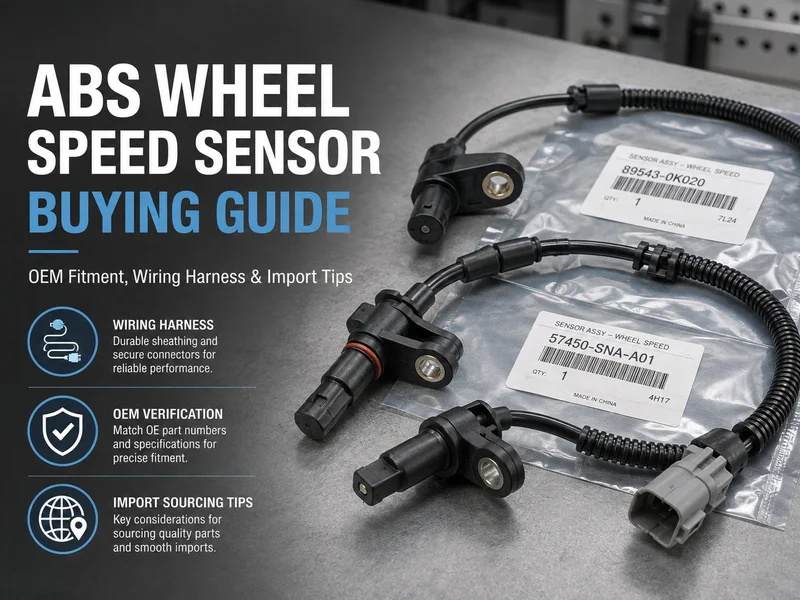
The ABS wheel speed sensor carries a quiet return risk. It is a low-value electrical part, but it feeds several systems at once, and a single fitment mistake turns a working sensor into a "defective" return. This ABS wheel speed sensor buying guide walks through the two things that drive most of those returns: the sensor type, and the fitment fields you verify before you pay.
If you already stock oxygen sensors or other engine sensors, the sourcing discipline is the same. The specifics here are the wheel speed sensor.
1. Active vs Passive: Know Which One You Are Selling
Wheel speed sensors come in two architectures, and the vehicle, not the price, decides which one fits.
Passive sensors are inductive. A coil and magnet sit inside the housing, and as the teeth of a tone ring pass by, the changing magnetic field generates an analog sine-wave signal [1]. They need no external power, which is their main virtue. The catch is that the signal weakens as the wheel slows, so a passive sensor cannot read near-zero speed.
Active sensors are powered by the ABS module and use a Hall effect or magnetoresistive element [1]. They output a digital square wave that holds its amplitude at any speed, reads down to near-zero, and on many designs also reports rotation direction. Modern platforms lean heavily on active sensors; passive sensors still serve older vehicles.
| Factor | Passive (inductive) | Active (Hall / magnetoresistive) |
|---|---|---|
| Power | None, self-generating | Supplied by ABS module |
| Signal | Analog sine wave | Digital square wave |
| Low-speed reading | Fades, cannot read near-zero | Reads down to near-zero |
| Direction detection | No | Yes on many designs |
| Wiring | 2-wire | 2- or 3-wire |
| Typical application | Older platforms | Modern vehicles |
For an importer, the practical rule is simple: stock what the target vehicle calls for, and never substitute one type for the other. A passive sensor cannot be made to work where an active one is required, and the return comes out of your margin.
Fact: KEHO has supplied auto parts to importers in 80+ countries since 1995, holding ISO/TS 16949 certification (since 2012), CE marking, and SGS third-party verification (per company data).
2. The Four Fields That Decide Fitment
A wheel speed sensor is not universal. Four fields have to line up before it will work on the vehicle it was bought for.
Sensor type is the first gate, and we covered it above. The vehicle's ABS architecture decides active or passive.
OEM number is the second gate. Cross-reference the original sensor part number the way you would for any other part; our guide on matching auto parts by OEM number walks through the method. A reliable supplier confirms compatibility across make, model, year, and engine rather than handing you a catalog and wishing you luck.
Wiring and connector is the third gate. Harness length and connector shape differ between platforms, and an otherwise correct sensor with the wrong plug will not reach or will not seat. Confirm the connector against the vehicle before you commit.
Mounting position is the fourth gate and the one buyers forget. Front and rear can differ, and on some models left and right are not interchangeable. The tone ring the sensor reads must also match, because a sensor paired with the wrong reluctor ring reads garbage.
Wheel speed sensors sit in the same electrical and sensors category as the crankshaft and camshaft sensors you likely already stock, so they can ride the same supplier relationship and the same container.
3. One Sensor, Several Systems: Why Demand Stays Steady
The part is called an ABS sensor, but it is really the vehicle's wheel-speed reference, and several systems tap the same signal.
Electronic stability control uses it to detect wheel slip. Traction control uses it the same way. Indirect tire pressure monitoring infers a flat tire from one wheel turning faster than the others [2], which is the same mechanism we described in the tire pressure sensor line. Hill-start assist and, on some vehicles, the speedometer and odometer also read from it.
That is the commercial point for a distributor. A bad wheel speed sensor rarely shows up as one warning light; it usually lights ABS and ESC together, and sometimes the speedometer drops too [3]. The failure is visible and the repair is urgent, which keeps replacement demand steady and price-sensitive in exactly the way a high-count electrical part should be.
Fact: KEHO maintains 50,000+ SKUs across six production lines with 500+ workers and a 99.2% on-time delivery rate, backing parts with a 12-24 month warranty (per company data).
4. How to Vet a Wheel Speed Sensor Supplier
Most of what goes wrong with a wheel speed sensor order is decided before the container ships. The checks are the same discipline you would apply to any supplier, applied to a part whose failure mode is fitment, not wear.
Certifications. ISO/TS 16949 (now IATF 16949) is the automotive-specific quality standard that matters; CE matters for Europe. Ask for the certificate number and verify it instead of accepting a PDF.
Fitment support. A good supplier verifies sensor type, connector, and position against your vehicle list. A bad one ships whatever you typed. This single difference predicts most of your return rate. The full checklist is in our guide on vetting a Chinese auto parts supplier.
Batch consistency. Sensors in the same order should share the same chip set, connector, and harness supplier. Mixed batches create a support problem where part of your SKU behaves differently from the rest.
5. MOQ, Mixed Containers, and the Real Cost
Wheel speed sensors are low-value, high-count parts. Unit cost matters less than total landed cost, and that is shaped by how you ship.
Start small. A new sensor line should begin with a trial batch, not a full container, so you can test fitment accuracy and return rates on real vehicles before committing cash to a slow mover. Most legitimate suppliers support a low minimum on a new line for exactly this reason.
Mix the container. These sensors rarely fill a container on their own. They ship well alongside other electrical and sensor parts, spreading freight across more SKUs and lowering per-unit cost. Our low MOQ shipping guide covers consolidating brake, suspension, steering, and electrical parts into one shipment.
Count the warranty. A cheaper sensor with a loose warranty process can cost more than a slightly pricier one that handles claims cleanly. For a part that sells on repeat replacement, the warranty is part of the product.
Fact: KEHO runs a four-stage quality control process covering incoming inspection, in-process checks, packaging verification, and final shipment review, with in-stock items dispatched within 48 hours (per company data).
6. FAQ: Wheel Speed Sensor Questions From Real Buyers
What is the difference between active and passive wheel speed sensors?
A passive sensor is inductive. It has a coil and magnet and generates its own analog sine-wave signal as the tone ring teeth pass by, so it needs no power, but the signal fades at low speed. An active sensor is powered by the ABS module and uses a Hall effect or magnetoresistive element to output a digital square wave that stays readable down to near-zero speed and can also report wheel direction. Modern vehicles lean on active sensors; passive sensors still cover older platforms.
How do I know if an ABS wheel speed sensor is bad?
The common signs are an ABS warning light, an ESC or traction control light, a speedometer that drops or reads erratically, and stored diagnostic codes pointing at a specific wheel. Because the sensor also feeds several other systems, one failing sensor often lights more than one warning at once. A scan tool reading the live wheel speed per corner is the fastest way to isolate the faulty one.
Are an ABS sensor and a wheel speed sensor the same thing?
Yes, in most parts catalogs they are the same component. The wheel speed sensor is what feeds the anti-lock braking system, so the trade calls it the ABS sensor. It is the same part, mounted at the wheel hub or axle and reading the tone ring. The only thing to remember is that the sensor also feeds other systems like ESC and indirect TPMS, so the replacement has to match the vehicle, not just the brake system.
What other systems use the wheel speed sensor?
Beyond ABS, the same signal feeds electronic stability control, traction control, indirect tire pressure monitoring, hill-start assist, and on some vehicles the speedometer and odometer. That is why a bad sensor shows up in more than one warning light. For an importer it also means the sensor is not a niche brake-only part; it is a wear-adjacent electrical part with steady replacement demand across the whole vehicle.
How do I find the right wheel speed sensor by OEM number?
Cross-reference the vehicle's OEM sensor number, or the make, model, year, and engine, against the supplier's catalog. Then confirm three more fields: active or passive type, wiring harness length and connector shape, and mounting position, since front and rear or left and right can differ on the same model. Fitment is four fields that all have to line up before the sensor will work.
What should I check in a wheel speed sensor supplier before a bulk order?
Check certifications first, ISO/TS 16949 (now IATF 16949) and CE for Europe. Then fitment support, meaning the supplier verifies sensor type, connector, and position against your vehicle list instead of just shipping what you typed. Then warranty terms and how claims are handled, MOQ flexibility to test a new SKU with a small batch, and response time on technical questions. A supplier that cannot answer an active-versus-passive question same day is not ready for your program.
7. Conclusion: Fitment First, Price Second
A wheel speed sensor program lives or dies on four fields: type, OEM number, connector, and position. Get those right and the part sells itself on steady replacement demand. Get one wrong and you buy the return.
KEHO has supplied sensors and electrical parts to importers for 30 years (per company data), and the same four-field fitment check applies across the ABS wheel speed sensor line. Send your vehicle list and OEM numbers, and we will confirm type, connector, and position before you commit to the first batch.
Sources
- [Wikipedia]. "Wheel speed sensor." en.wikipedia.org: Active vs passive wheel speed sensor construction and operation, tone ring design, and use in anti-lock braking systems.
- [Bridgestone Tires]. "What is TPMS & How Does it Work?" tires.bridgestone.com: Indirect TPMS uses ABS wheel speed sensors to detect under-inflation.
- [Hella]. "Wheel speed sensors in motor vehicles: Function, Diagnosis, and Troubleshooting." hella.com: Sensor failure symptoms and diagnostic procedure.
- [KEHO]. Company data: certifications, quality control process, warranty, delivery rate. kehoauto.com: Company-reported figures marked "(per company data)" in the article body.