and packing list that disagree on quantity or part number, a country of origin missing from a document, a vague description such as spare parts, inconsistent batch numbers, or a label that does not match the invoice will all trigger a hold. Untreated or unmarked wood packaging is another common cause. A single consistent set of fields across marks and documents prevents most of them." fact_blocks:
- "KEHO applies a four-stage quality control process that includes a packaging check before the outbound review, and has supplied auto parts to importers in 80+ countries since 1995 (per company data)."
- "KEHO supports OEM/ODM and private label programs covering logo printing and custom packaging, and sets MOQ by product and packaging rather than applying one blanket minimum (per company data)."
- "KEHO supports mixed-container consolidation and provides export documentation including certificates of origin, with standard orders shipping in 15-25 days and in-stock items dispatched within 48 hours across a 50,000+ SKU catalog (per company data)."
Auto Parts Export Packaging, Labeling and Documentation: A Checklist for Importers
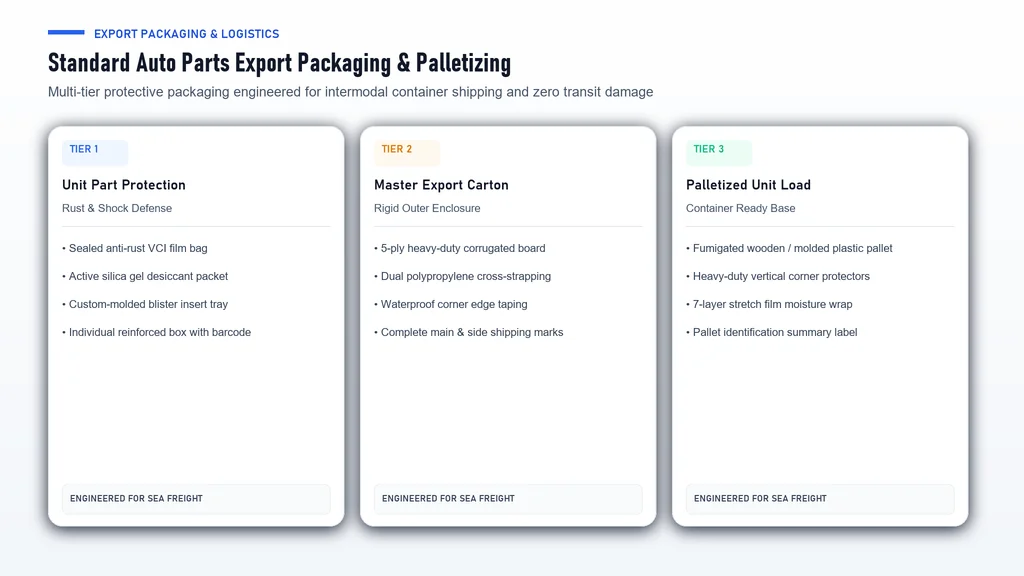 Packaging, labels and documents travel with the parts. Get them right and the shipment clears in days. Get them wrong and the same parts stall at the port.
For an importer, packaging and labeling are not cosmetic. They decide two numbers that land directly on your result: how much of the shipment arrives damaged, and how many days it takes to clear customs. Parts that are protected, marked and documented correctly move through the port in days. The same parts in a thin carton, with an incomplete label and an invoice that does not match the packing list, can sit in a bonded warehouse for weeks, or ship back at your cost.
This guide is a working checklist for importers, distributors and service-chain buyers sourcing auto parts from China. It covers unit packaging, outer cartons and pallets, shipping marks, destination labeling, the export document set and batch traceability, and ends with two blank forms. Two items stay with you rather than the supplier: HS code classification and destination-market labeling law, both confirmed with your customs broker and compliance adviser.
1. Why packaging and labeling move two numbers
Most importers treat packaging as an afterthought and blame the forwarder when a pallet arrives crushed. The damage usually starts earlier, in how the part was packed for a long sea leg with vibration, humidity and stacking pressure. Packaging controls the damage rate; labeling and documents control the clearance rate.
The physical path. A sea container is a hostile place for precision parts. Vibration loosens parts inside a carton, humidity corrodes unprotected metal, and stacking pressure crushes anything that relies on its own shape. Sensor pins bend, spark plug insulators crack, injector nozzles pick up contamination. Each is a claim waiting to happen, and none is a parts problem.
The administrative path. A perfectly packed container still stops if the paperwork does not match. A carton marked with a part number the invoice omits, a country of origin missing from the invoice, or a packing list that disagrees with the bill of lading will trigger a hold. Customs reads the marks and documents and checks whether they line up.
Agree the packaging and labeling specification at the quotation stage, not after the order. Our guide on how to compare auto parts quotations explains why packaging, labeling and destination compliance belong in the quote comparison.
Fact: KEHO applies a four-stage quality control process that includes a packaging check before the outbound review, and has supplied auto parts to importers in 80+ countries since 1995 (per company data).
2. Unit packaging: protect the part, then decide the brand
Unit packaging does two jobs that are easy to mix up: protecting the part in transit, and presenting a brand. Take them in that order.
Protection first. Match the protection to the part's weakest point.
- Corrosion: bare metal needs a rust preventive, such as VCI film, a light oil coating or a desiccant pack inside a sealed bag.
- Moisture: electrical parts and sensors travel best in sealed barrier bags, often with a desiccant, so condensation does not build up through temperature swings.
- Vibration and shock: molded trays, foam inserts or blister packs hold the part still; loose parts in a large carton damage each other.
- Point protection: capping injector ports, protecting sensor connectors and pins, and shielding spark plug insulators addresses the points that fail first.
Then the brand decision. A part can ship in one of three modes, and the choice affects cost, lead time and paperwork.
- Neutral packaging: plain cartons with no brand or logo, common for aftermarket lines sold through more than one channel.
- Seller-branded packaging: the carton carries the supplier's brand.
- Private label: the carton and labels carry your own brand and artwork, which needs artwork files, an approval step and a print run, so it adds lead time and usually a minimum quantity.
If you run a private label program, lock the artwork and the approved sample before the bulk run, and state in writing which mode you want, because "branded" means different things to different suppliers.
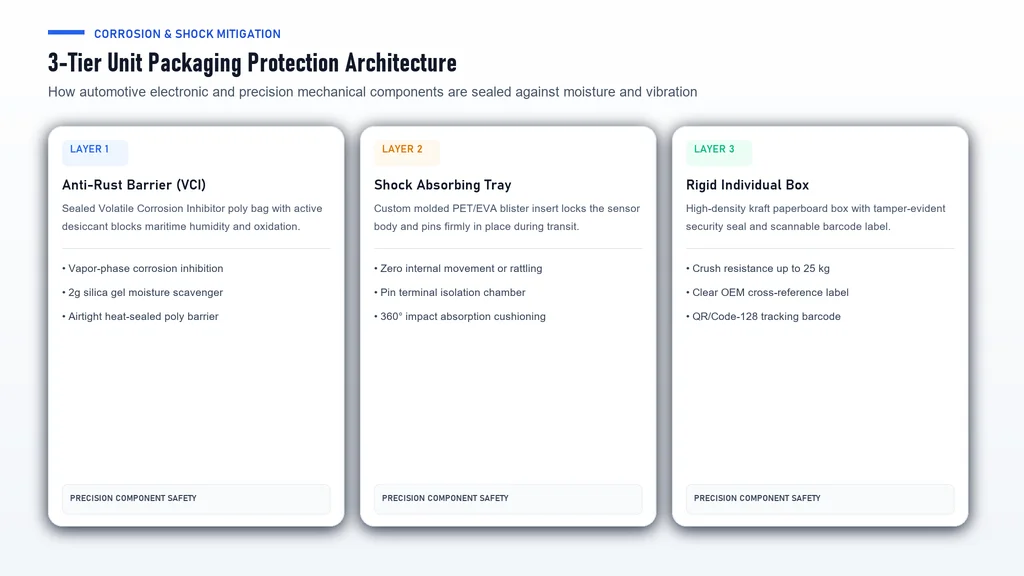 Match the protection to the part's weakest point. Rust, moisture, vibration and point damage each need a different layer.
| Packaging level | Protection goal | What to specify |
|---|---|---|
| Unit / inner pack | Protect the part surface, connector or insulator | Rust preventive, barrier bag, desiccant, molded tray or blister, port caps |
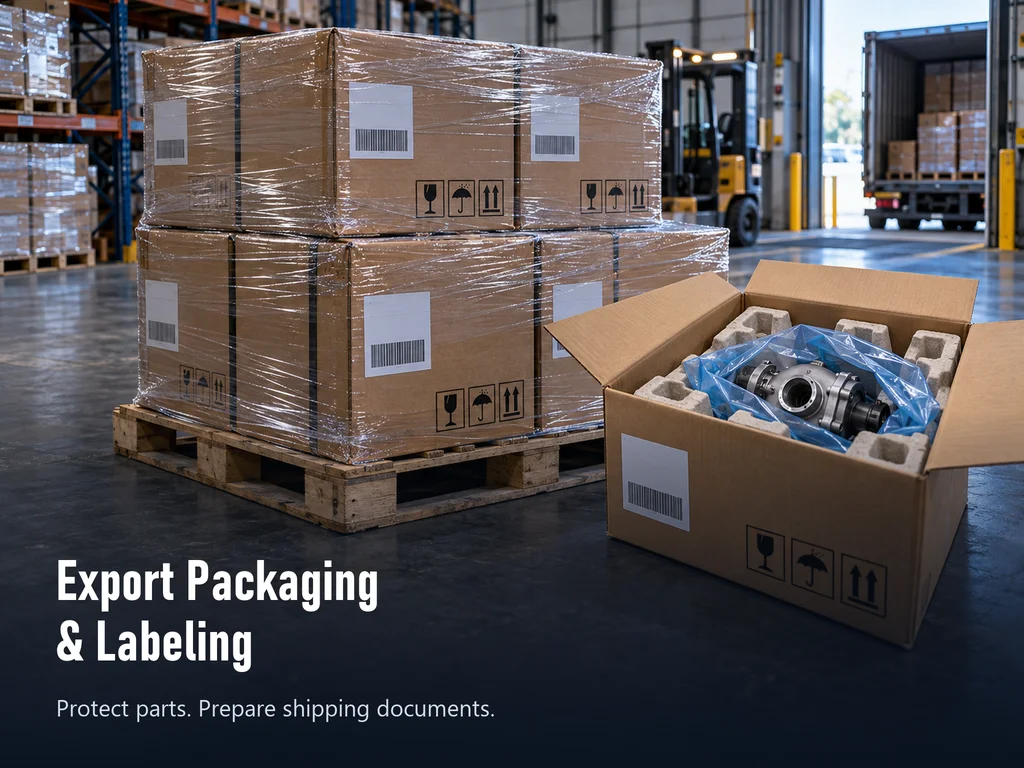
| Carton | Hold the parts still and carry the stacking load | Board grade, insert or divider, maximum stacking height, maximum weight per carton |
| Pallet or load | Keep the load stable in the container | Pallet type, cartons per pallet, wrapping, whether cartons are floor loaded |
Fact: KEHO supports OEM/ODM and private label programs covering logo printing and custom packaging, and sets MOQ by product and packaging rather than applying one blanket minimum (per company data).
3. Outer cartons, pallets and shipping marks
Once the unit is safe, the outer packaging carries the load and the information.
Carton specification and stacking. Agree the board grade, the maximum stacking height, and whether cartons are palletized or floor loaded. Heavy components such as wheels and steering wheels need a stronger carton and, in most cases, a pallet rather than loose cartons. Ask for a sample carton and, for a new or heavy line, a compression or drop test before the bulk run.
Per-carton weight and manual handling. Decide a maximum weight per carton with your supplier and your receiving warehouse. A carton too heavy for one person to lift safely tends to be dropped. If a part is too heavy to keep the carton within your handling limit, plan the palletization around that weight.
Shipping marks. The marks on the outer carton are the shipment's identity. Keep them complete, and make the marks on every carton match the documents exactly.
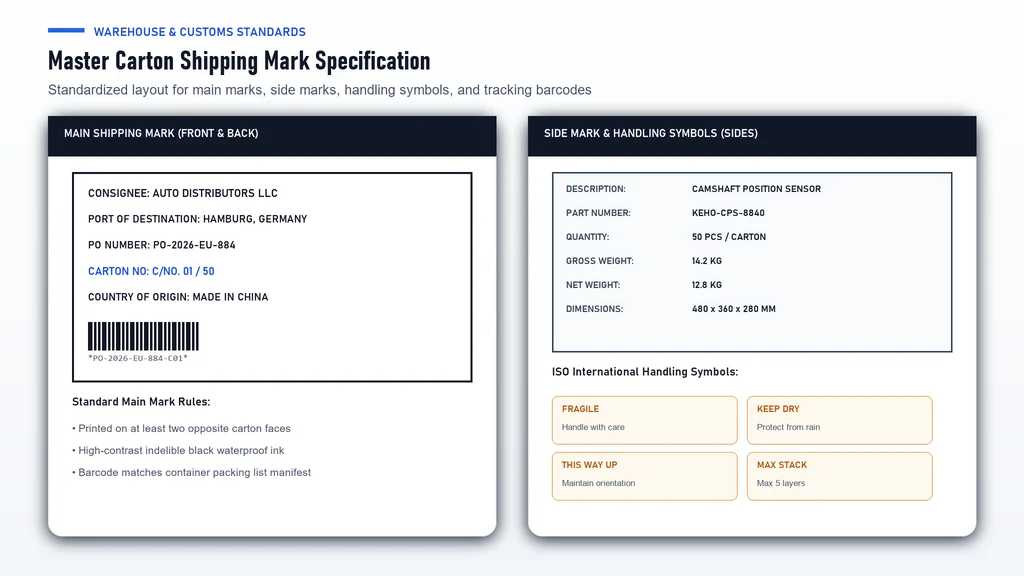 Every carton label should carry the same core fields. When the marks and the documents disagree, the shipment stops.
| Field | Why it matters | Confirm with |
|---|---|---|
| Consignee and destination port | Routes the shipment and links it to the B/L | Freight forwarder |
| Carton number, for example 3 of 20 | Lets the warehouse reconcile a partial or short shipment | Supplier and forwarder |
| Part or item number | Ties the carton to the invoice line | Supplier |
| Description | Identifies the goods for customs without opening the carton | Supplier and broker |
| Quantity per carton | Must match the packing list | Supplier |
| Batch or lot number | Enables traceability back to the production run | Supplier |
| Country of origin | Required for duty and origin rules | Supplier and broker |
| Gross and net weight, dimensions | Feeds freight and the packing list | Supplier and forwarder |
| Handling symbols | Shows fragile, this way up, keep dry | Supplier |
Label must-have fields. Every carton label should carry the item description, the part number, the quantity, the batch or lot number and the country of origin. Those five fields let customs, your forwarder and your warehouse identify the carton without opening it, and they most often cause a hold when missing or inconsistent.
4. Destination market labeling: confirm locally, do not assume
This is where importers most often get into trouble, because the rules belong to your market, not the factory.
Destination labels can require a specific language, specific compliance marks, recycling or packaging-material symbols, and country-of-origin marking rules. Whether these apply to your product, and in what form, depends on the product, the market and the regulations in force. The supplier cannot decide this for you, and no supplier should claim a product already satisfies a given country's labeling law. Verify the requirement with your own compliance adviser, then write the confirmed wording and marks into the purchase order.
Questions worth confirming before the order:
- What language must the label be in?
- Are there mandatory compliance or safety marks for this product category?
- Are recycling, packaging-material or producer-responsibility marks required?
- Does the product need a country-of-origin mark, and in what wording?
- Must the importer's or responsible party's name and address appear on the label?
- Are there rules on how wood packaging must be treated and marked?
Record the answers, attach them to the order, and check the pre-production sample label against them. Here the safe move is to confirm, not to assume.
5. The export documentation set
The documents are the shipment's legal identity. A clean set lets the container flow; one mismatched field can hold it.
| Document | Purpose | Common error |
|---|---|---|
| Commercial invoice | States the goods, value and parties for duty | Description too vague, or country of origin missing |
| Packing list | Details how the goods are packed, carton by carton | Quantity or carton count that disagrees with the invoice |
| Bill of lading or airway bill | Contract of carriage and title document | Consignee, marks or weight that differ from the packing list |
| Certificate of origin | Supports origin rules and duty treatment | Origin wording that conflicts with the carton marks |
| Inspection or test report | Confirms the agreed specification was checked | Report that does not reference the part or lot number |
| Other documents as required | Insurance, wood packaging treatment and the like | Added late, after the booking is fixed |
What not to leave to guesswork. The HS code on the customs entry is a classification of the goods, confirmed by the buyer and seller together with a customs broker or the destination customs authority, based on the actual goods [2]. It is not a label the factory invents. Give your supplier an accurate description of the part, its material and its function, so the classification you agree with your broker reflects the real product, then keep that description on the invoice and the packing list.
Depending on the product and the market, the set can extend to a certificate of insurance, proof that wood packaging has been treated and marked, or a specific product certificate. Confirm the full list with your broker before the booking; adding a document after the container is on the water costs far more than listing it at the order stage.
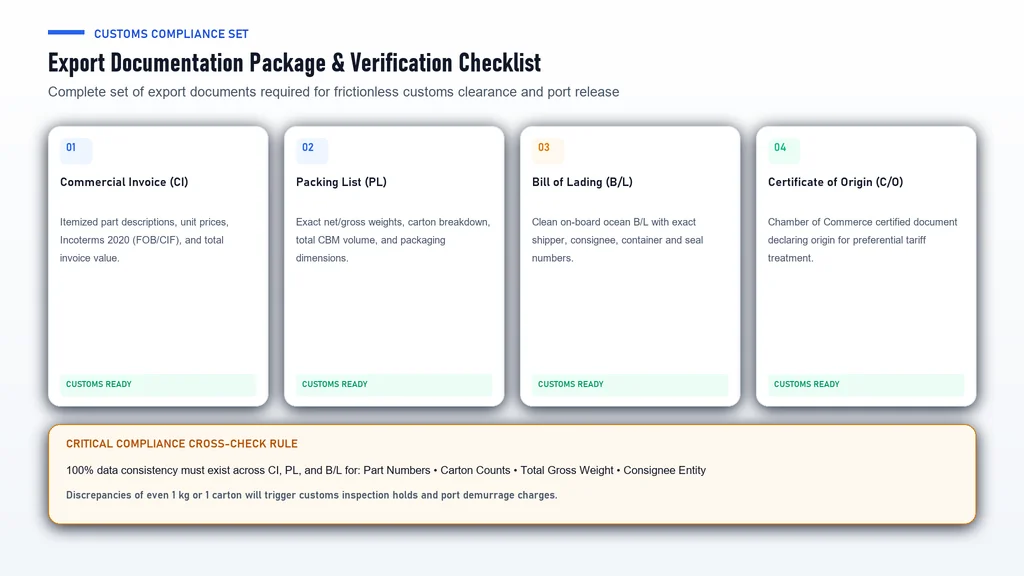 The documents, the carton marks and the label all describe the same goods. The job is to make them say the same thing.
6. Batch traceability and consistency in a mixed container
A batch or lot number is the thread that ties a specific part back to its production and inspection record. Without it, a warranty claim or quality issue is hard to resolve, because neither you nor the supplier can tell which run the part came from. The number does not need to be complex, but it must be consistent: the same lot format must appear on the part label, the carton label, the packing list and the inspection record. That consistency turns a number into traceability.
Traceability gets harder when you consolidate. If you buy across several categories and combine them into one container, every line must follow one labeling convention, or the load becomes impossible to reconcile at the destination. low MOQ and mixed container shipping and a multi-category parts program work only when the marks, carton numbering and lot format are standardized across every supplier in the load. Agree one convention up front, write it into each order, and check the first carton of every line against it.
Fact: KEHO supports mixed-container consolidation and provides export documentation including certificates of origin, so multi-category orders can travel under one consistent set of marks and papers (per company data).
7. The errors that delay or return shipments
Not all mistakes are equal. These are the ones that most often cause a hold or a return, and each is avoidable with a checklist.
- Invoice and packing list disagree on quantity or part number. The most common cause of a hold. Build both from the same source data.
- Country of origin missing or inconsistent across documents and carton marks. Origin has to say the same thing everywhere.
- Description too vague. "Auto parts" or "spare parts" invites questions; a clear item description helps classification.
- Part numbers absent or wrong on the carton, so it cannot be matched to an invoice line.
- Batch numbers inconsistent between the carton, the packing list and the inspection record, which breaks traceability.
- Ordered label not applied. Brand, artwork or language that does not match the invoice is treated as a mismatch.
- Untreated or unmarked wood packaging. Wood pallets and crates usually need to be treated and marked under plant-health rules [1].
- Weight or carton count mismatch between the packing list and the bill of lading.
- Destination labeling that does not match what you confirmed, failing at the border.
Behind all nine is the same pattern: one field that appears in more than one place and does not match. Use a single field list everywhere and most of them disappear.
8. Two forms to fill before every order
These are the two sheets that keep a shipment coherent. Fill them once per order, share them with the supplier, and check the pre-shipment sample and the draft documents against them.
9. FAQ
What are the packaging requirements for exporting auto parts?
Packaging has no single legal standard, so the requirements are whatever you and the supplier agree and record. In practice that means protecting the part from corrosion, moisture, vibration and crushing, adding a carton strong enough to carry the load, and putting clear, consistent marks on every carton. Decide all of it at the quotation stage.
What is the difference between neutral packaging and private label packaging?
Neutral packaging is plain cartons with no brand or logo, common for aftermarket lines sold through several channels. Private label puts your own brand and artwork on the packaging and labels, so it needs artwork files, an approved sample and usually a minimum quantity and extra lead time. Seller-branded packaging carries the supplier's brand. Choose one mode in writing.
What must appear on an auto parts shipping label?
At minimum, every carton label should carry the item description, the part number, the quantity, the batch or lot number and the country of origin. Those five fields let customs, your forwarder and your warehouse identify the carton without opening it, and they must match the packing list and commercial invoice exactly.
What documents are needed to export auto parts from China?
A typical set includes a commercial invoice, a packing list, a bill of lading or airway bill, a certificate of origin and, where agreed, an inspection or test report. You may also need insurance or proof that wood packaging has been treated and marked. Confirm the exact list with your broker before the order.
Who is responsible for HS code classification?
Classification is confirmed by the buyer and seller together with a customs broker or the destination customs authority, based on the actual goods, not chosen by the factory alone. The importer's job is to describe the part, its material and its function accurately, so the code agreed with the broker reflects the real product.
How do I keep batch traceability across a mixed container?
Agree one batch or lot format and one carton-numbering convention before the order, and use it across every category in the load. The same lot number must appear on the part label, the carton label, the packing list and the inspection record, so a line can be traced back to its production run.
What causes customs delays on auto parts shipments?
Most delays trace to information that does not match: an invoice and packing list that disagree, a missing country of origin, a vague description such as spare parts, inconsistent batch numbers, or a label that does not match the invoice. Untreated or unmarked wood packaging is another common cause.
10. Conclusion: package the information, not just the parts
Auto parts export packaging is a two-part discipline. First, physical: protect every part from rust, moisture, vibration and crushing so it arrives in sellable condition. Second, informational: make the marks, labels and documents describe the same goods in the same words, so the shipment clears on its own merits.
The work is front-loaded. Decide the packaging mode, the carton and the marks at the quotation stage. Confirm destination labeling and HS classification with your own adviser and broker. Agree one batch format, then use it everywhere. Check the sample label and the draft documents before the container is sealed. None of that needs new equipment, only a checklist applied before every order.
KEHO built its export process around that sequence: a four-stage quality control process with a packaging check before the outbound review, OEM/ODM and private label support, flexible MOQ by product and packaging, and mixed-container consolidation with the certificates of origin and export documents you need for clearance. If you are preparing a first order or moving a new line into a market with its own labeling expectations, send your part list and our team will confirm the packaging, labeling and document set with you. You can also contact the KEHO team with your destination market.
Sources
- [International Plant Protection Convention (IPPC)]. "ISPM 15: Regulation of wood packaging material in international trade." ippc.int: The international standard requiring wood packaging material to be treated and marked before use in trade; cited here only for the general requirement to treat and mark wood packaging.
- [World Customs Organization (WCO)]. "What is the Harmonized System (HS)?" wcoomd.org: The nomenclature used for classifying traded goods; cited here for the principle that classification follows the actual goods and is applied by customs authorities.
- [KEHO]. Company data: four-stage quality control with a packaging check, OEM/ODM and private label support, MOQ by product and packaging, mixed-container consolidation, certificates of origin, delivery times and catalog size. kehoauto.com: Company-reported figures marked "(per company data)" in the article body.