Incoterms for Auto Parts: FOB, CIF and DDP Risk Transfer
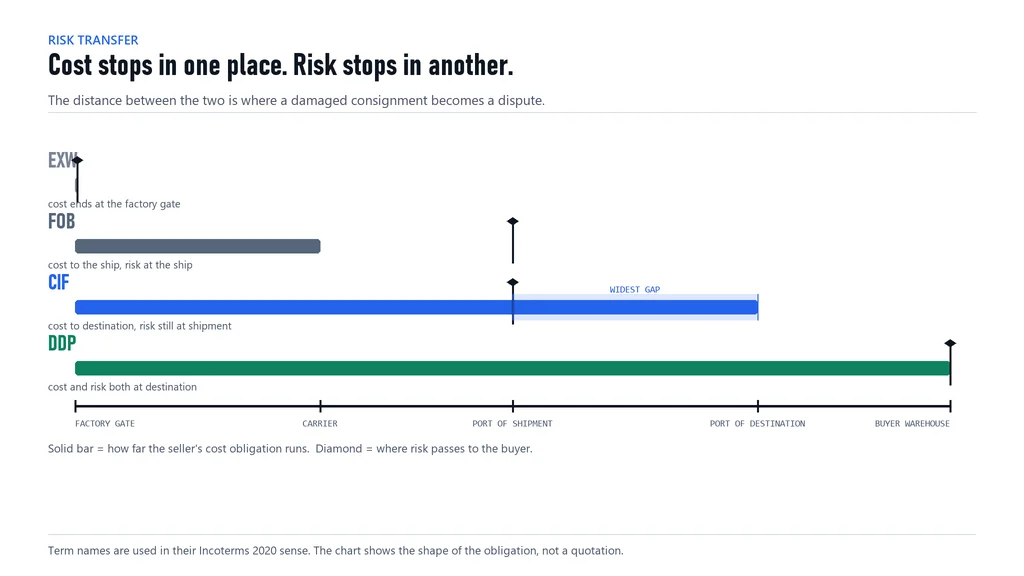 Four terms, four points where the goods stop being the seller's problem. The gap between the cost line and the risk line is where import disputes start.
A supplier quotes two prices for the same carton of oxygen sensors: FOB Ningbo and DDP Chicago. The gap is not only freight. It is a different answer to three questions: who pays for what, when the goods stop being the seller's problem, and who answers for the paperwork at each border.
Most importers read the three letters as a price convention. They are a risk allocation, and that allocation decides whether a torn carton becomes your loss, the seller's loss, or a claim that gets paid. What follows is mechanics, not preference: which term fits depends on who can insure, who can clear, and who carries the credit.
1. What Incoterms Actually Split: Cost, Risk and Responsibility
The rules are published by the International Chamber of Commerce, in use since 1936, current edition 2020. There are eleven, and each is an allocation across three separate cut points.
Cost. Which legs the seller pays for: origin handling, export clearance, main carriage, insurance, destination charges, import clearance, duty and tax, final delivery. Quotes are comparable only when this list is identical on both sides.
Risk. The physical moment when loss or damage stops being the seller's problem. A moment in time and place, not a sum of money.
Responsibility. Who contracts carriage, who lodges the export declaration, who clears on import, who insures, who notifies whom.
The first misreading is assuming that whoever pays for a leg carries the risk along it. CIF breaks that: the seller pays freight and insurance to the destination port, yet risk passed on board at the port of shipment. It is paying for a journey it is no longer responsible for. DDP distorts the same relationship the other way, pulling cost and risk both to destination.
The second is expecting too much. Incoterms is a delivery rule set. It does not set title, payment, product liability or warranty, and a DDP clause does not make the seller the owner until the invoice is paid.
The third is treating three letters as a complete term. Every rule needs a named place, and the named place is where the risk line is drawn. "FOB China" tells you nothing you can enforce.
Fact: KEHO has exported to 80+ countries over 30 years, and under FOB and CIF quotations the export declaration and the shipping document set are handled on the seller side (per company data).
2. The Four Terms Auto Parts Importers Actually Meet
EXW: the seller's gate
Under Ex Works the seller makes the goods available at a named place, usually its factory, and does not load them onto any collecting vehicle. Risk passes there, while the cartons are still on the seller's floor.
The detail importers miss is the paperwork. EXW is the one rule that puts export clearance on the buyer, so a foreign buyer needs a Chinese export agent, a declaration in the right name, and the foreign exchange and tax handling that goes with it. None of that disappears because the price excluded it: it moves to your side, at a worse rate than a supplier that ships every week would pay.
The risk also sits with you while the goods are still in someone else's yard. A pallet damaged by a forklift during loading is your loss, with no transport document to claim against.
FOB: on board
Under Free On Board the seller clears the goods for export and delivers them on board the vessel nominated by the buyer at the named port of shipment. Risk passes at the on-board moment, and the seller bears the cost of loading.
The buyer's side starts immediately after: ocean freight, cargo insurance if it wants any, destination charges, import clearance, duty and inland delivery. Because the buyer nominates the carrier, it controls the booking and holds the bill of lading.
FOB is a sea and inland waterway rule only. With containerized cargo the container reaches the terminal days before the vessel is loaded, so the on-board moment is awkward to evidence, which is why the ICC revised FCA in 2020 to allow an agreed on-board bill of lading.
CIF: cost and freight to the port, risk at origin
Cost Insurance and Freight has the same delivery and risk points as FOB. What changes is the cost boundary: the seller must contract carriage to the named destination port and obtain cargo insurance for the buyer's benefit.
That obligation is where expectations inflate. Under the 2020 rules the default cover is the minimum, corresponding to Institute Cargo Clauses (C) unless the parties agree to more, which the ICC contrasts with the higher level CIP now requires. "The price includes insurance" can be true and still leave realistic losses outside the policy.
CIF also stops at the port. Discharge, terminal handling, storage, demurrage and import clearance sit on the buyer's side.
DDP: delivered, duty paid
Under Delivered Duty Paid the seller delivers at a named place in the country of import, cleared for import, duties and taxes paid, ready for unloading. Risk passes at destination.
That is the widest obligation in the set: two customs clearances, duty and tax, final delivery, and the position of importer of record. That last item is not a label: the importer of record is legally liable to customs for the declaration, for payment, and for compliance with the import rules, whichever company benefits from the sale.
Fact: KEHO carries 50,000+ SKUs for 2,000+ active clients with $ 50M+ annual output, dispatches in-stock items in 48 hours and reports 99.2% on-time delivery (per company data).
3. Why Auto Parts Are Unusually Sensitive to the Term
A container of furniture and a container of ignition parts fail differently, and the difference changes which term is workable.
Value density and countability. A carton holds two hundred spark plugs. The typical failure is not a lost container but a shortage of twelve pieces and a crushed inner box. That is a count and condition dispute, and it turns on who counted, when, and against which document. If the risk line sat at the origin port, your count at destination is the only one that matters.
Fragility that hides. Ceramic insulators crack, sensor tips deform, connector pins bend, housings take a set. Damage invisible at the carton level can appear at installation, when the risk line is far behind you.
Electronics with latent failure modes. Oxygen sensors, ABS wheel speed sensors and pressure sensors can survive a drop and fail weeks later in service. That is a contractual argument with your supplier, not a transport insurance claim, because nothing in the transit looks abnormal on a survey report.
The consequence is that the term decides who you claim against, and the two paths are not interchangeable. Before the risk point the loss is the seller's, and your remedy is a replacement or a credit note. After it, your remedy is your own cargo insurer and, secondarily, the carrier, within that regime's limits and notice periods. Under EXW and FOB a buyer with no cargo insurance has an uninsured loss. Under DDP the seller's insurance protects the seller, and your remedy is a contract claim against its willingness to pay.
4. CIF: Three Traps That Appear After the Vessel Sails
CIF is the most widely quoted term in small-parts trade, and the widest gap between assumption and rule.
Trap one: the insurance is minimum cover, for someone else's benefit. The seller must obtain cover for the buyer's benefit, but at the default level: a certificate responding to a sinking, a stranding or a fire, and possibly not to theft, non-delivery, or water damage from a leaking container. A carton that never arrives is a non-delivery event, precisely what the minimum wording tends to exclude. Check the clauses referenced, the insured percentage, who is named as assured, and where claims are payable. A certificate issued in the seller's name and never endorsed to you cannot be claimed on.
Trap two: destination charges the price does not include. Freight prepaid to the port is not "all charges paid". Discharge, terminal handling, storage, demurrage, examination fees and the destination agent's charges normally fall on the buyer, and unloading costs at destination are allocated to the buyer unless already inside the freight contract. That is why a CIF quote and a DDP quote for the same oxygen sensors can look close and settle far apart.
Trap three: risk is already gone, and some losses are not insurable events. Because risk passed at the port of shipment, ocean damage is an insurance matter, handled with notice to the carrier inside the contractual window, a survey before the cargo is devanned, and a delivery receipt that records the damage instead of clearing it. Delay, a price drop in transit and latent defects are not transit events at all, so no cargo policy pays and no term shifts them.
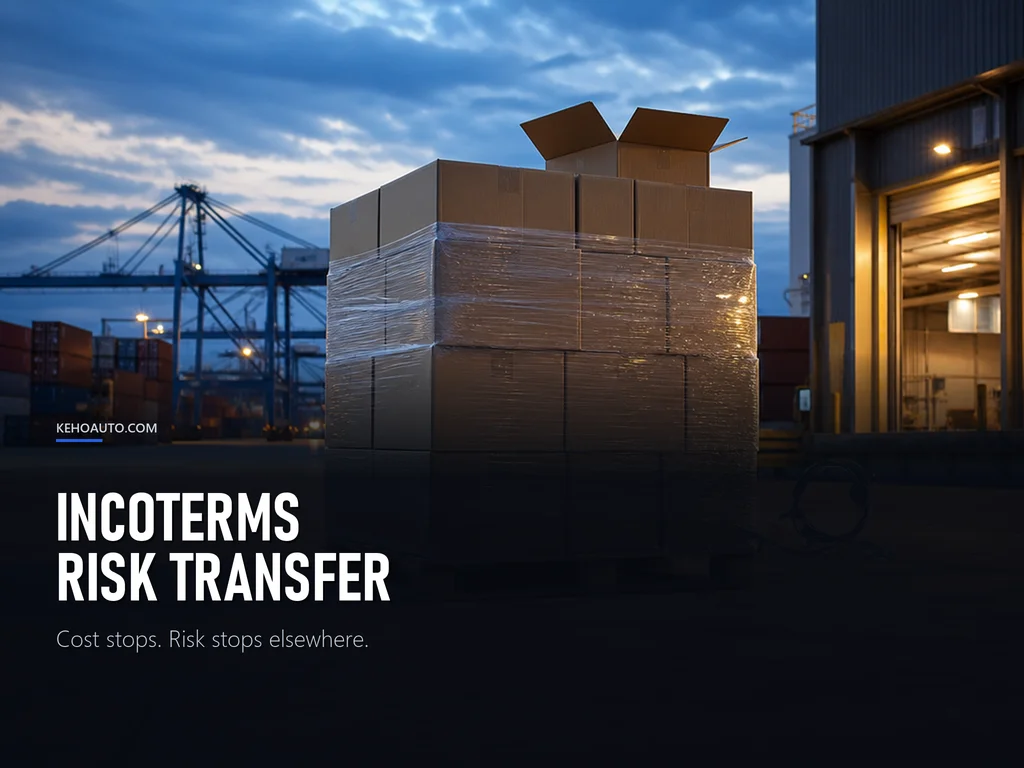
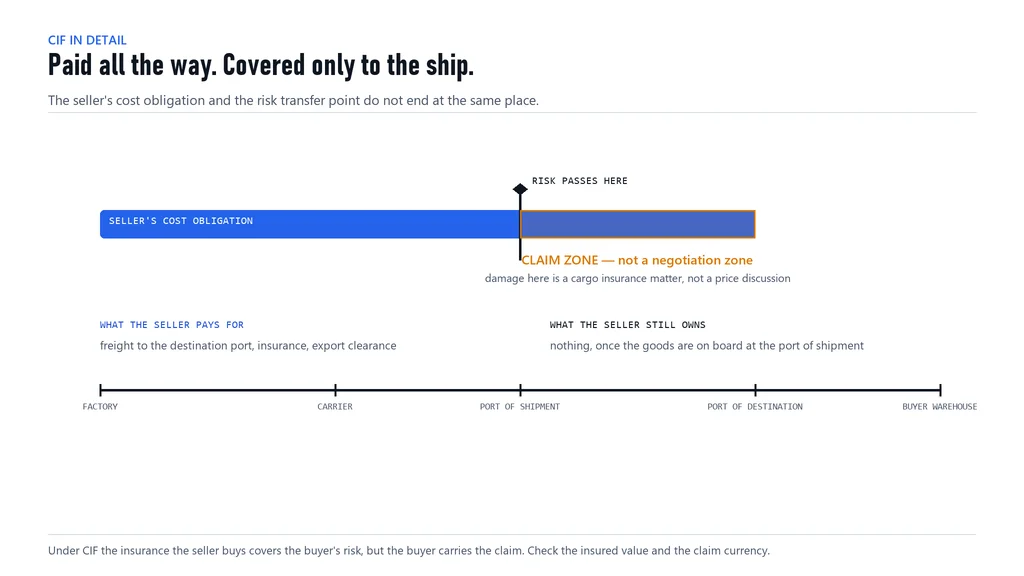 Under CIF the cost line runs to the destination port while the risk line stops at the port of shipment. Everything between the two lines is a claim.
5. DDP: The Attraction, and What It Costs
DDP sells itself. One number, delivered to your door, customs handled, duty included, no broker relationship to build. For a first order, or a buyer without an import licence, it looks like the lowest-friction option available.
The friction does not vanish. It moves to the seller, and where the seller cannot carry it, it comes back.
Importer of record status. Clearing goods as importer of record requires, in many jurisdictions, a local establishment, a tax registration and sometimes a customs bond. Where a foreign seller cannot hold that status, the workaround is often to clear in the buyer's name using the buyer's tax identity, which moves liability in ways neither party intended.
Compliance responsibility. The importer of record answers for the accuracy of the declaration and for the goods meeting applicable import rules, including labelling and technical requirements.
Duty and tax float. The seller pays duty before collecting from the buyer, on a value it declared, at a rate that can change between quotation and arrival. That exposure is priced into the DDP number, which is why DDP is not simply CIF plus freight plus duty.
Destination failures. Examinations, storage, demurrage, detention and a buyer who refuses the goods all land on the seller. A refusal leaves the seller with a re-export problem from a country where it may not be established.
What the buyer gives up is visibility and control. Duty is buried in the unit price, the declared value is invisible, and in many jurisdictions you cannot reclaim import VAT because you are not the importer of record.
That is not an argument against DDP, but a reason to confirm with a local broker that the structure is lawful in your market before you sign.
Fact: KEHO operates two overseas hubs, Dubai and Los Angeles, and holds ISO/TS 16949 certification obtained in 2012; whether a DDP structure is workable still depends on importer of record status in the destination country and has to be confirmed case by case (per company data).
6. How the Term Couples to Payment and Inspection
The delivery term is not a standalone clause. It decides which documents prove that the seller performed, and payment instruments are built on documents.
Under FOB the on-board bill of lading is the proof of delivery. Under CIF the set grows by an insurance certificate, and a payment conditioned on a full set of documents should list it explicitly. Under DDP, proof of performance is delivery at the named place in the importing country, which can be weeks after the vessel sails, so payment on delivery means the seller finances the ocean leg, the clearance and the duty, and prices that credit in.
Term and document mismatches are a common cause of rejected presentations. A bill of lading marked freight collect contradicts a CIF price. A CIF price with no insurance certificate is a discrepancy waiting to be raised.
The inspection node has to sit on the correct side of the risk line, because an inspection only gives you control while the seller still bears the risk. Under FOB and CIF the last such moment is before loading, which makes a documented pre-shipment inspection at the plant, with a signed report and photographs, the only leverage you have. After that, your leverage is the contract, not the goods. Under DDP you can inspect at destination and still hold the seller. A small trial quantity, as described in the guide to low-MOQ trial orders, is a separate lever worth sequencing before the term is fixed.
7. Contract Checklist: What Has to Follow the Three Letters
A term without the following items is a draft, not an agreement.
- The rule, version and named place. Write "Incoterms 2020" and the exact place: port and terminal for FOB and CIF, full delivery address and unloading point for DDP. An imprecise place makes the allocation unenforceable.
- Which document prevails. State that the rules govern and that trade usage or a previous course of dealing does not override them.
- The seams in the cost allocation. Name who pays origin handling, destination terminal handling, discharge, demurrage and detention, examination and storage.
- The insurance clause. Reference the clauses used, the insured percentage, the currency, the assured, where claims are payable, and whether the certificate is assignable.
- The document list by term. Commercial invoice, packing list, transport document, certificate of origin, insurance certificate where required, inspection report, each line naming who issues it. The mechanics are covered in the guide to export documentation.
- Importer of record and customs responsibility. Especially under DDP: who holds the registration, who answers for the declaration, and what happens if the structure is rejected at the border.
- Notice and claim windows. Who notifies whom, within how many days, and when an inspection must be completed for a claim to survive.
For a range that ships in mixed cartons, the test of item five is whether the spark plug range can be described line by line on the invoice and packing list without ambiguity.
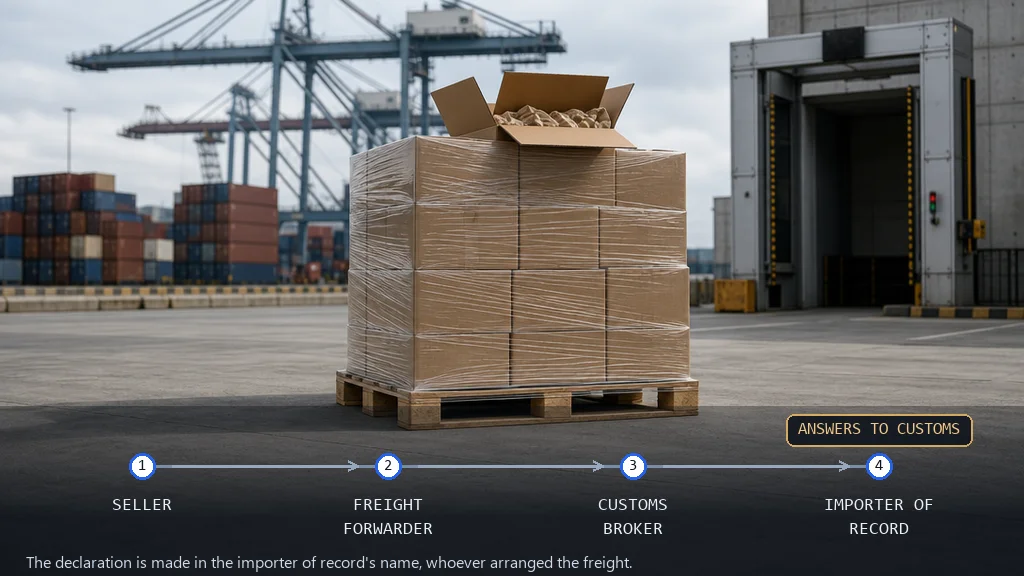 Under DDP the seller stands in the importer of record position, and answers to customs long after the container is empty.
8. Term Comparison Table
Read the table as a map of allocations, not a ranking; each row is workable when the party holding the obligation can perform it.
| Term | Export clearance | Main carriage | Insurance | Import clearance | Risk transfers |
|---|---|---|---|---|---|
| EXW | Buyer | Buyer | Buyer's choice | Buyer | When goods are placed at the buyer's disposal at the named place, not loaded |
| FCA | Seller | Buyer | Buyer's choice | Buyer | When goods are handed to the buyer's nominated carrier at the named place |
| FOB | Seller | Buyer | Buyer's choice | Buyer | When goods are on board the vessel at the named port of shipment |
| CIF | Seller | Seller, to the named destination port | Seller, minimum cover for the buyer's benefit | Buyer | When goods are on board the vessel at the port of shipment |
| DDP | Seller | Seller | Seller's choice, protecting the seller | Seller | At the named place in the importing country, ready for unloading |
9. FAQ
How does FOB differ from FCA?
FCA delivery happens when the seller hands the goods to the buyer's nominated carrier at a named place, which can be a terminal, a forwarder's warehouse or the seller's own premises. FOB delivery happens when the goods are on board the vessel at the named port of shipment, so it applies only to sea and inland waterway carriage. Incoterms 2020 added an option under FCA for an on-board bill of lading, which narrows part of that gap.
Is CIF insurance enough to cover my loss?
It depends on the loss and on the contract. CIF requires cover for the buyer's benefit at the minimum level, which is Institute Cargo Clauses (C) unless the parties agree otherwise. That level responds to major casualties and is narrower than all-risks cover, so theft, non-delivery and fresh water damage can sit outside it.
Which party is responsible when a DDP shipment goes wrong?
Break the failure into types. Damage after the risk point, which under DDP is at the named place in the importing country, is the seller's. A customs penalty for an inaccurate declaration sits with the importer of record, normally the seller under DDP. If the seller cleared the goods using the buyer's tax identity, the exposure can reach the buyer too.
When does risk transfer under EXW?
At the moment the goods are placed at the buyer's disposal at the named place, not loaded onto any vehicle. If the collecting truck is late and the cartons stay on the dock overnight, the risk has already passed.
Can I use FOB for a container of sensors?
FOB can be written for containerized cargo, but its delivery point is on board, which comes after the container has been handed to the terminal. That leaves a window where control of the goods and evidence of their condition are both hard to establish. Many contracts use FCA for containers for that reason.
What happens if goods are damaged after risk has passed to me?
Your claim runs to your own cargo insurer and, where the damage happened in the carrier's custody, to the carrier, within that regime's limits and notice periods. Preserve the evidence: survey before devanning, photographs, and a delivery receipt that records the damage rather than clearing it.
Does the Incoterm decide who owns the goods?
No. The rules allocate cost, risk and formalities. Title, payment, security over the goods and product liability are set by the sale contract and the governing law.
10. Conclusion: Fix the Risk Line Before the Price
The term is the cheapest clause in a purchase contract to negotiate and the most expensive one to get wrong. Three letters decide whether a damaged carton is a seller problem, an insurance claim or a write-off, and they decide it before anyone knows the goods will be damaged.
Separate cost from risk. Name the place. Match the insurance to the loss you can actually suffer. Put the inspection on the seller's side of the risk line. Where the term assigns an obligation to a party that cannot perform it, such as an import clearance the seller has no standing to complete, treat that as a structural problem rather than a pricing detail.
On FOB and CIF shipments the seller side carries the export declaration, the loading operation and the document set, which is how the oxygen sensor range is quoted. To fix the term, the named place and the document list for a specific order, send your shipping terms. Where a clause's legal effect is in question, the Incoterms 2020 text and your contract govern.
Sources
- [International Chamber of Commerce]. "Incoterms 2020." iccwbo.org (2020 edition): Official rules, the eleven terms, the CIF and CIP insurance distinction, and the FCA on-board bill of lading provision in articles A6/B6.
- [World Customs Organization]. "The Revised Kyoto Convention." wcoomd.org: Convention on simplification and harmonisation of customs procedures, covering declaration standards and supporting documents.
- [U.S. Customs and Border Protection]. "Basic Importing and Exporting." cbp.gov: Importer responsibilities, entry process, duties and fees for goods entering the United States.
- [European Commission, DG Taxation and Customs Union]. "Taxation and Customs Union." taxation-customs.ec.europa.eu: EU customs procedures and import formalities for goods entering the Union.