Auto Parts Warranty, Claims and Returns: Terms Importers Should Agree Up Front
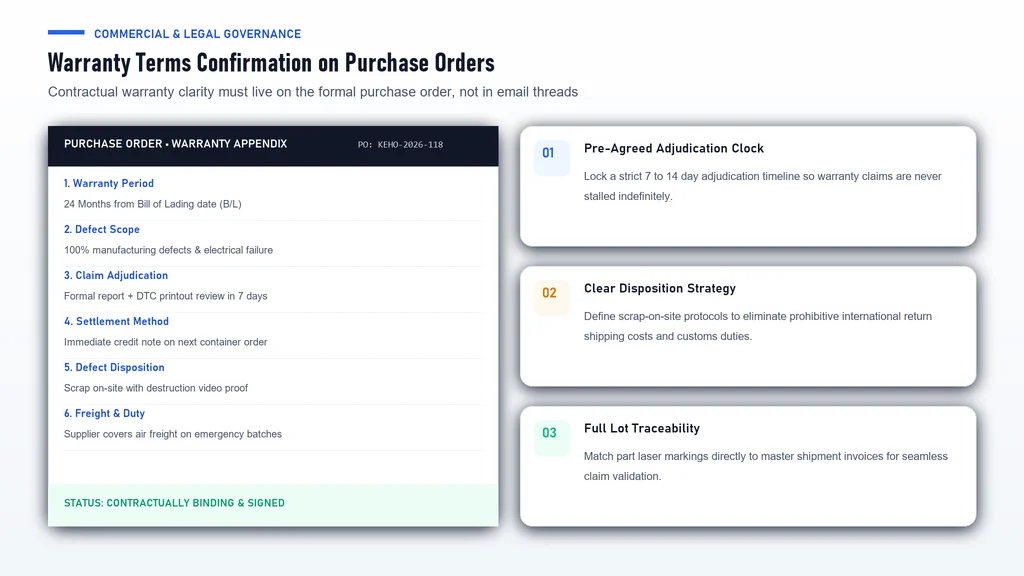 A warranty is a set of terms, not a sentence in an email. The order is the last document both sides sign before the goods and the money move.
Start with the order, not with the argument
When two suppliers quote the same part at the same price, the warranty line often separates them. It is also the line most importers leave until the goods are on the water, which is the worst moment to negotiate it.
A warranty that is not written into the order is not an asset. It is a hope. This guide is for purchasing and quality managers at importers and distributors who need to turn "we offer a warranty" into terms they can file a claim against: what is covered and from when, what is excluded, who decides whether a part failed, how fast the supplier responds, how a claim is settled, who pays freight and duty, and how a batch is traced. Two worksheets at the end are ready to attach to the order.
1. Why the warranty has to be agreed before the order
Once a container has shipped, the supplier has been paid or is about to be, and the negotiating room is gone. A warranty raised after arrival is at best a small discount and at worst an argument about whether the goods were ever the problem.
Warranty terms also carry a cost inside the unit price. A longer period with fewer exclusions is more expensive for the supplier to stand behind, so part of what you compare across quotations is the warranty itself. The quotation comparison method treats it as its own line for this reason.
The order is also the only document both sides sign before money and goods move, and verbal assurances in a chat thread rarely survive the first claim.
Fact: KEHO has supplied auto parts to importers in 80+ countries since 1995, holds ISO/TS 16949 certification achieved in 2012 along with CE marking and SGS third-party verification, and publishes a 12-24 month warranty that is confirmed per category and per project in writing (per company data).
2. The terms to write into every order
A usable warranty clause answers seven questions, and most supplier documents answer one or two. Treat all seven as a checklist, because the ones left out decide the claim.
2.1 The warranty period, and the date it starts
A published range such as 12-24 months is a band, not a promise for your parts. Write the exact figure for the category and project into the order, because the band exists so the supplier can set a different answer for a wear item than for a sensor.
The start date is the trap buyers miss. Cover can run from production, from shipment, or from the date you sell to your customer. A part that ships three months after production and sits three months in your warehouse has spent four months before a workshop installs it, so pick a start date and print it.
2.2 What is covered, and what is not
Cover runs from parts only to parts and labour. For a distributor the parts value is the whole story; for a service chain the labour is where the money is, because a failed part costs a bay twice.
Exclusions matter just as much and are rarely written down: misuse, accident damage, installation by an unqualified workshop, use in a commercial fleet, re-use of wear components such as seals or bolts, and transit damage not notified within a stated number of days. Each is a reason a claim can be turned down, so negotiate out any exclusion that does not fit your market.
2.3 The basis for deciding whether a part failed
Someone has to decide whether a returned part is defective, and if that someone is only the supplier's own inspector, one party is refereeing a dispute it is also a party to. Agree the method in advance: a photo and video record, a physical return for inspection, comparison against a retained reference sample, or testing at a named third-party laboratory. Write down what counts as acceptance, and what happens when the supplier does not respond in time, so silence cannot outlast a claim.
2.4 How fast the supplier must respond and resolve
A warranty period says how long cover runs, not how long the supplier may take to answer, and only one of those clocks is usually published. Set a clock for acknowledgement, for decision, and for dispatch of a replacement, and define each start point as carefully as the warranty start date: "within 48 hours" means nothing until both sides agree whether it runs from the day the claim is sent or the day the evidence pack is complete.
Fact: KEHO publishes a claims handling time of 48 hours, dispatches in-stock items within 48 hours, and ships standard orders in 15-25 days (per company data).
2.5 Replacement, credit note, or refund
A claim has to end in one of three outcomes, and the order should name the default: a replacement shipment, a credit against a future order, or a refund. Each path costs you differently. A replacement carries a second freight bill, a credit note keeps the money with the supplier and ties your next order to them, and a refund returns cash and nothing else. On a delivered and paid order a cash refund is the least likely outcome, so decide the default for a repeat failure and for a single unit, and write both down.
2.6 Who pays the freight and the duty
Many disputes that look like arguments about quality are really arguments about who pays to move a part twice. The defective unit may travel back, the replacement travels out, and both movements cross a border. Put three lines in the order: who pays the freight on a replacement, who pays to return the defective unit if it is returned at all, and who pays import duty if the replacement is taxed as a fresh import. That last line is easy to forget, because in many markets a replacement can attract duty even though it replaces goods already taxed once. Freight on small and mixed shipments is covered in the mixed container shipping guide.
2.7 Batch and traceability
A claim can only be proven against a production run, and a run can only be named by its batch. If the part, carton and label carry no batch code, neither you nor the supplier can tie a failed unit to a run, and the claim becomes a conversation about trust. Agree the marking in advance: which characters identify the batch, where they sit on the part, the inner packaging and the outer carton, and what record the supplier keeps. Traceability also protects the supplier from claims on parts it never made, which is why suppliers usually agree to it.
2.8 The seven terms at a glance
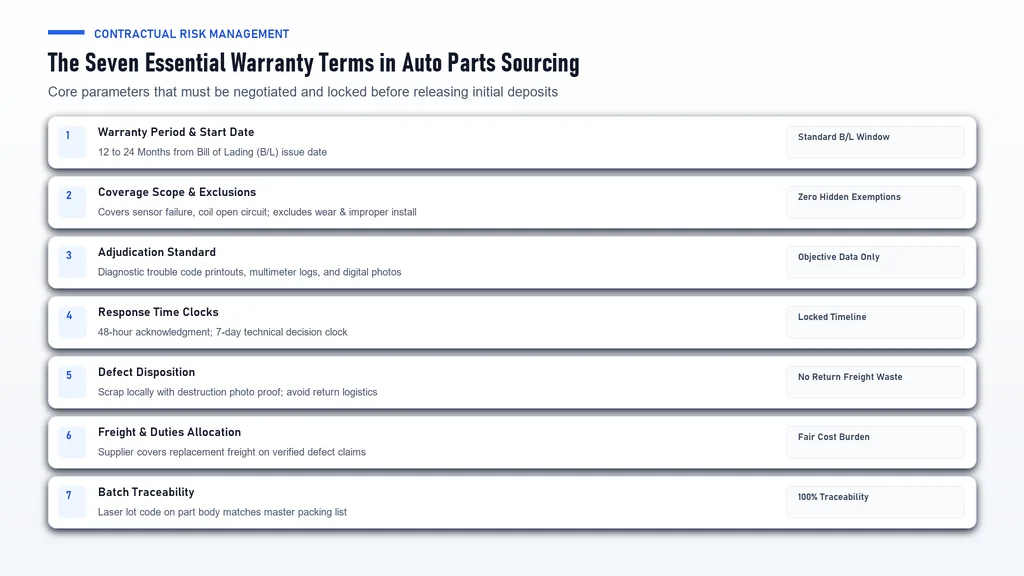 The seven terms in one view: period and start date, coverage and exclusions, adjudication basis, response clocks, disposition, freight and duty, and traceability. The rows left blank at order stage are the rows that get argued over at claim stage.
Treat those seven as one checklist: period and start date, coverage and exclusions, adjudication basis, response clocks, disposition, freight and duty, and traceability. A buyer who fills a single column per supplier can read the offers across the page and see which one is offering a claimable warranty.
3. The claim timeline, in five stages
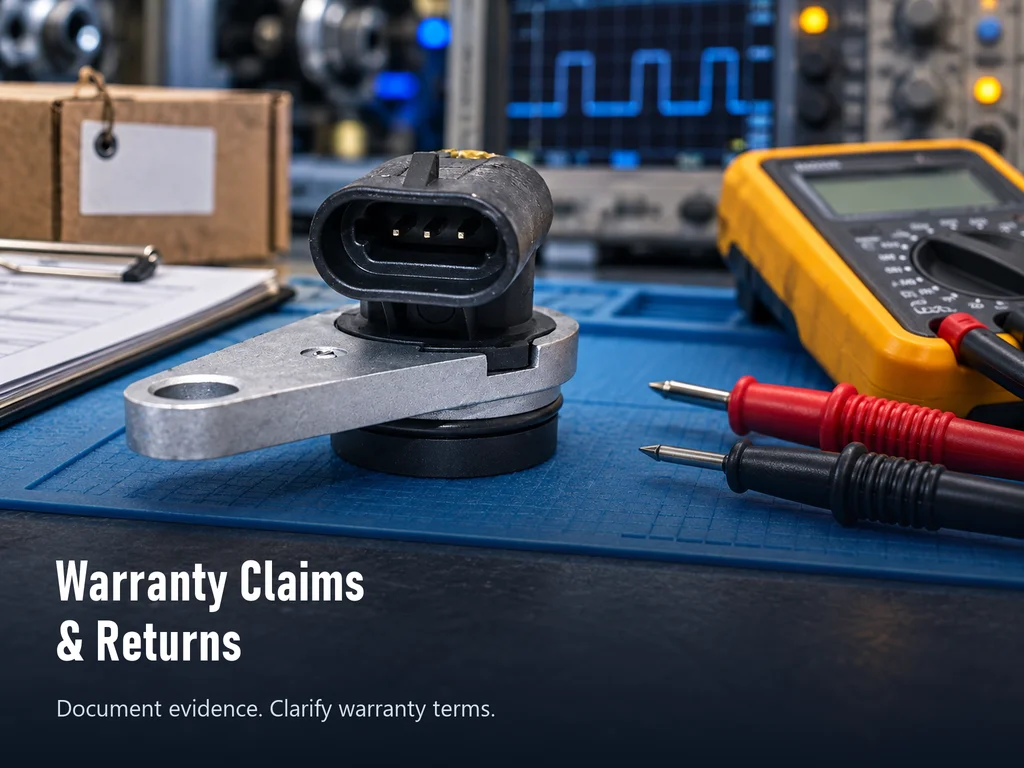
A field failure is usually decided in the first few hours, before anyone fills in a form. Discovery: log the date, vehicle, symptom and order reference, and leave the part in place. On-site evidence: photograph before you touch, capturing the part in place, then the packaging, then the batch code and label. Once a part is dismantled, fitted to another vehicle or cleaned, the evidence chain weakens.
Submission: send one complete claim pack, not a stream of messages, carrying the batch code, the installation record, the photos, any measurement or diagnostic report and the order reference. Adjudication: the supplier decides against the agreed basis, or against its own preference if no basis was agreed. Disposition: the accepted claim is settled by replacement, credit or refund, with freight and duty applied and the settlement recorded against the batch.
4. The evidence that actually decides a claim
Claims are rarely won on argument or lost on merit. They are won and lost on documentation.
| Evidence | What it proves | Common mistake |
|---|---|---|
| Pre-installation photos | The condition of the part as received, and the batch on the packaging | Photographing only the installed part, long after delivery |
| Post-installation photos and date | That the part was installed, and when | No date, so the claim window cannot be checked |
| Measurement records | That the part performed outside its stated parameters | An uncalibrated tool, or no record kept |
| Batch or serial number | Which production run the unit came from | Removing the label before the claim is filed |
| Packaging and label photos | The identity of the goods as shipped | Discarding the carton at the workshop |
| Fault codes and diagnostic reports | The stored fault and the test result behind the complaint | Relying on a verbal description of the fault |
The measurements, fault codes and reports belong to a qualified technician with calibrated equipment, and the photos that matter most are taken before the part is disturbed.
Fact: KEHO runs a four-stage quality control process of incoming inspection, in-process patrol, packaging inspection and final shipment review, and supports mixed-container consolidation across its part categories (per company data).
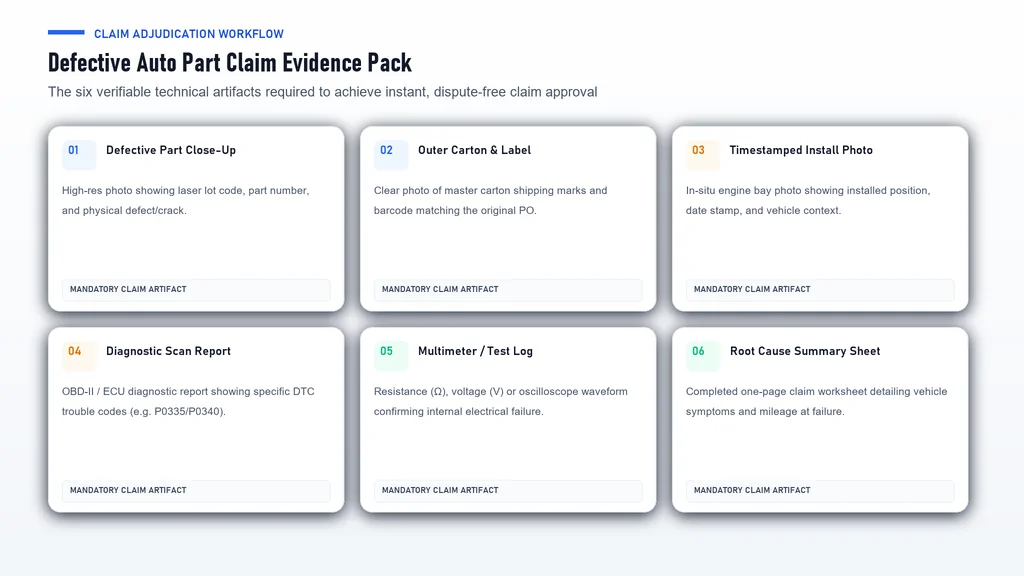 A claim pack is only as strong as its weakest item. The batch code and the dated installation photo usually decide it.
5. Why claims get refused or delayed
The reasons a claim stalls are predictable, and almost all can be removed before the order is placed. A rejection is rarely a flat no on quality. It is a missing document, an expired clock, or an exclusion nobody read.
| Why a claim stalls | How to prevent it at the contract stage |
|---|---|
| The part was dismantled before it was documented | Write a freeze rule into the process: photograph before touching, and tell your workshops |
| No batch code on the part or packaging | Require batch marking as a term of the order, with the location stated |
| No installation record or date | Require installers to keep a dated job sheet and a photo |
| The claim arrived after the period ran out | Fix the start date in writing, and track when each batch's cover ends |
| An exclusion was invoked, such as unqualified installation | Read the exclusions before the order, and remove any that do not fit your market |
| The defect was described only in words | Standardise a claim pack so every claim arrives complete |
| A disagreement about who pays freight | Agree the freight and duty lines at order stage, not at claim stage |
| The claim went to the forwarder or the platform, not the seller | Put the claim contact and channel in the order |
Every row is cheaper to fix before production than after a failure. This is also where supplier selection meets claim quality: a supplier who cannot describe its own traceability, or will not name a response window, is one whose claims will be hard to enforce. The supplier vetting guide covers how to test those answers before you commit.
6. What third-party inspection does, and does not do
A pre-shipment inspection by a firm such as SGS or TUV is a snapshot of the goods at a moment in time, usually before loading. It confirms what is in the container, in what quantity and in what condition on the day the inspector looked, a strong check against a wrong, short or visibly damaged shipment.
It is not a warranty. A clean report says nothing about how the parts perform over the following year, because the failure had not happened when the inspection was done. Third-party testing has a narrower role inside a dispute: a laboratory result on a returned part can break a tie between the buyer's claim and the supplier's denial, if the part was stored to preserve the evidence.
Two boundaries matter here. A certification such as CE or ISO/TS 16949 confirms that a process is controlled, not that every unit performs within specification. And market access, labelling and consumer protection duties sit with the importer, to be confirmed with local counsel.
7. Two worksheets to attach to the order
The terms above only work if they are written down and reused. Copy both tables into your order template once and attach the sheet to every order.
Worksheet 1: Warranty and claim terms confirmation sheet
| Term | Agreed value for this order | Notes |
|---|---|---|
| Warranty period (months) | Per category and project, not a range | |
| Warranty period start date | Production, shipment or sale to customer | |
| Coverage | Parts only, or parts and labour | |
| Exclusions | List each one explicitly | |
| Adjudication basis | Method, and who decides | |
| Acknowledgement / decision window | With a defined start point | |
| Replacement dispatch window | After a claim is accepted | |
| Default disposition | Replacement, credit or refund | |
| Return / replacement freight payer | Who pays each leg | |
| Duty on replacement units | Who bears it, and how it is declared | |
| Batch code location | Part, inner pack, outer carton | |
| Traceability record kept | What the supplier retains, and for how long | |
| Claim contact and channel | A named contact, not a general inbox |
Worksheet 2: Claim documentation checklist
| Evidence item | Required | Collected | Notes |
|---|---|---|---|
| Order and invoice reference | Yes | Ties the claim to the purchase | |
| Batch or lot code | Yes | On the part and the packaging | |
| Pre-installation photos | Yes | Part in its packaging, label visible | |
| Post-installation photos with date | Yes | Proves installation and timing | |
| Installation record | Yes | Who installed it, and when | |
| Measurement records | If applicable | Calibrated tool, recorded values | |
| Fault codes and diagnostic report | If applicable | Qualified technician, stored report | |
| Packaging and label photos | Yes | Carton and part label | |
| Vehicle details and failure description | Yes | Dated and factual, no conclusions |
Fill both sheets at order stage. A warranty becomes a working tool the moment the terms are specific, and stays a marketing sentence as long as they are not.
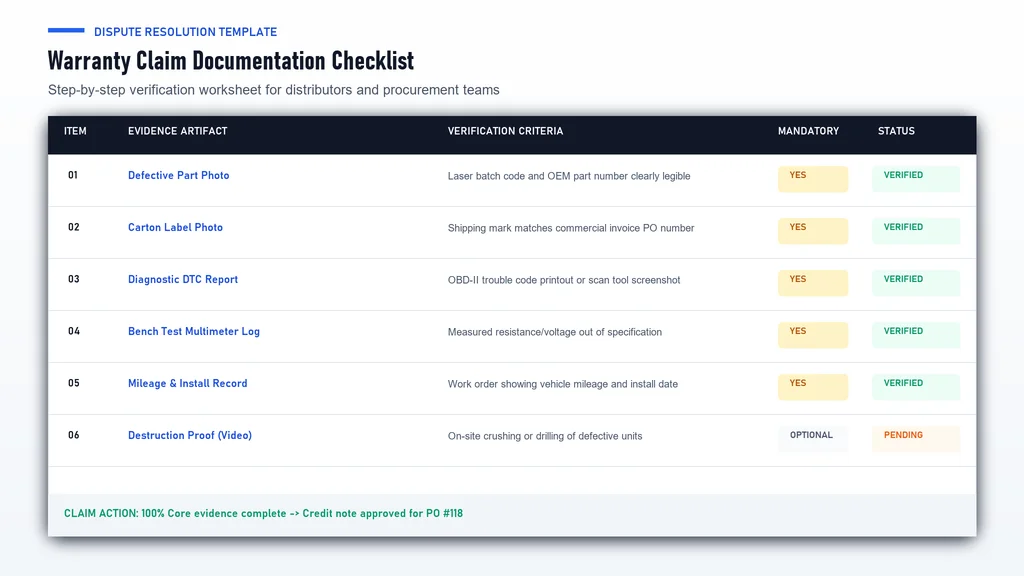 Worksheet 2, filled in per claim. A complete pack separates a claim that is answered from one that is parked.
8. FAQ
What should auto parts warranty terms include?
At minimum: the period and its start date, the coverage and every exclusion, the method for deciding whether a part failed, the response and resolution clocks with defined start points, the default disposition, who pays return and replacement freight and any duty, and the batch code that makes a claim traceable. The terms left out are the terms argued over when a claim is filed, so settle them before production.
When does the auto parts warranty period start?
It depends on what the order says, and the order should say. The period can run from the production date, the shipment date, or the date the part is sold to the end customer. Those dates can sit weeks apart, so the same number of months gives different real cover. Fix the start date in writing, because an open question here shortens your cover without anyone changing the number.
What is the warranty claim process for defective auto parts?
Five stages. Log the failure with the date, vehicle and order reference, and leave the part in place. Collect on-site evidence before the part is disturbed. Submit a single complete claim pack. The supplier adjudicates against the basis agreed in the order. The accepted claim is settled by replacement, credit or refund, with freight and duty applied. Evidence and submission are the stages that most often go wrong.
How do I return defective auto parts to a supplier?
Often you do not. Many claims are settled without the defective unit travelling back, because the return freight and duty can cost more than the part. When a return is required, agree in advance who pays the freight, how the value is declared, and what happens if the unit is damaged in transit. If the supplier needs the physical part, treat the return as part of the claim pack.
Who pays freight and duty on a warranty replacement?
That is a contract term, not a default. Write three lines at order stage: who pays the replacement freight, who pays to return the defective unit if it is returned, and who bears import duty if the replacement is taxed as a fresh import. A replacement can attract duty even though it replaces goods already taxed, so an unclear line turns a settled claim into a second dispute.
Does a third-party inspection report replace a warranty?
No. An inspection is a snapshot of the goods at a moment in time, usually before loading, and it confirms what was in the container on the day the inspector looked. It cannot cover how the parts perform afterwards, because the failure has not happened yet. Third-party testing is more useful inside a dispute, where a lab result on a returned part can break a tie if the part was stored to preserve the evidence.
9. Turning the terms into an order you can claim against
An auto parts warranty is not a promise you test only when something fails. It is a set of terms that decide, before production starts, what is covered, for how long, from which date, decided by whom, settled how, paid by whom and traced through which batch.
None of that guarantees a claim will succeed, and no supplier can promise that every claim is accepted. What it does is remove the reasons a valid claim might be refused: a missing batch code, an undocumented installation, an unread exclusion, a clock nobody defined.
Send one part family you buy regularly with your target volume and destination, and we will return a quotation stating the warranty period, start date, exclusions, claim clocks, disposition and freight position in the same format, ready for Worksheet 1. The full category list is on the KEHO product catalogue, and the team is reachable through contact the KEHO team.
Sources
- Wikipedia contributors. "Warranty." Wikipedia. https://en.wikipedia.org/wiki/Warranty - The distinction between express and implied warranties, and the typical exclusions attached to a product warranty.
- SGS. "Pre-Shipment Inspection." https://www.sgs.com/en-ca/services/pre-shipment-inspection - Pre-shipment inspection as independent verification of the quality, quantity, marking, packing and loading of a shipment before it leaves the country of export.
- Wikipedia contributors. "ISO/TS 16949." Wikipedia. https://en.wikipedia.org/wiki/ISO/TS_16949 - The automotive quality management system standard and the principle that certifying a management system is not a statement of individual product performance.