A tire pressure sensor is a small part that carries a large amount of your return risk. Buy one wrong sensor and a single customer is unhappy. Buy a container of sensors that are programmed for the wrong frequency, and the whole SKU comes back at your cost.
This TPMS sensor buying guide is written for importers, wholesalers, and service chain buyers who order in bulk. It covers the two decisions that drive most mistakes: the sensor type, and the fitment fields you have to verify before you pay. If you already source oxygen sensors or other engine sensors, the discipline is the same; the specifics here are TPMS.
1. Direct vs Indirect TPMS: The First Decision in Every Order
TPMS comes in two architectures, and the difference determines what you are actually selling.
Direct TPMS puts a physical sensor inside each wheel, usually attached to the valve stem. The sensor measures pressure and temperature in real time and transmits the reading by radio frequency to a receiver in the vehicle [1]. The driver sees actual numbers, and the system points to the exact tire that is low.
Indirect TPMS has no sensor in the wheel at all. It reuses the ABS wheel speed sensors to detect that one tire is rotating at a different speed than the others, which almost always means that tire is under-inflated [1][2]. It is cheaper for the automaker, but it only warns that something is off. It cannot tell you the pressure, and it needs re-calibration after a tire rotation or a pressure change.
| Factor | Direct TPMS | Indirect TPMS |
|---|---|---|
| Sensor in wheel | Yes, physical pressure sensor | No, reuses ABS wheel speed sensors |
| Reads actual pressure | Yes, in kPa or psi | No, infers from wheel speed |
| Identifies exact tire | Yes | No, warns generally |
| Measures temperature | Yes | No |
| Re-calibration after rotation | Not usually needed | Required |
| Replacement market | Large, steady, sensor-driven | Small, no sensor to replace |
For an importer, direct TPMS is the business. Indirect systems do not create a replacement sensor market because there is no sensor to replace. And because Europe, the U.S., and China now mandate TPMS on new vehicles [2], every direct-TPMS vehicle on the road is a future replacement order, with the battery inside the sensor guaranteeing that order comes within a decade.
Fact: KEHO has supplied auto parts to importers in 80+ countries since 1995, holding ISO/TS 16949 certification (since 2012), CE marking, and SGS third-party verification (per company data).
2. The Specs That Decide Fitment: Frequency, OEM Number, Valve Type
A TPMS sensor is not universal. Four fields have to line up before the sensor will work on the vehicle it was bought for.
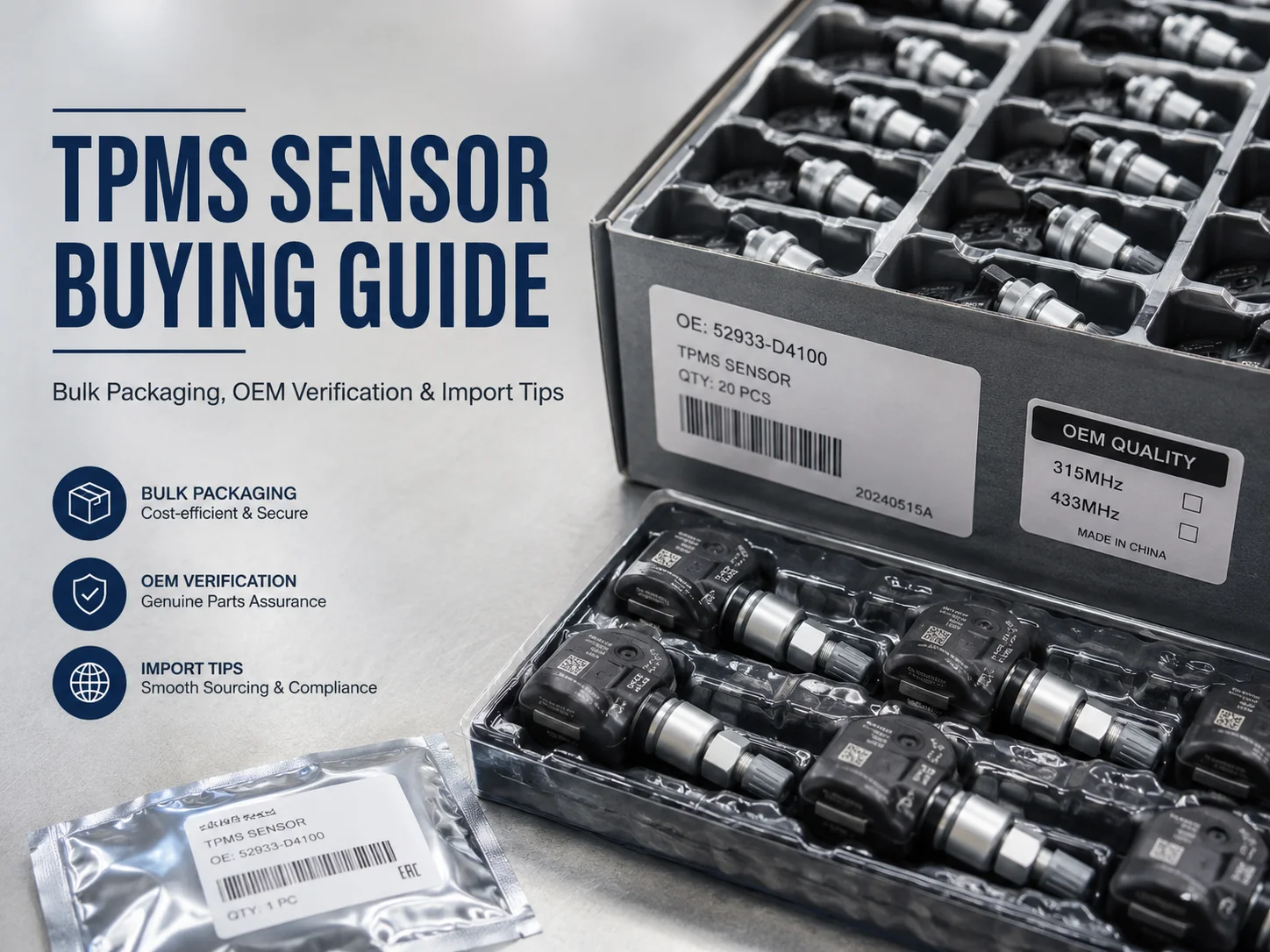
Radio frequency is the first hard gate. Sensors transmit on a regional radio band, commonly 315 MHz in North America and 433 MHz in Europe and much of Asia [3]. A 315 MHz sensor will not talk to a 433 MHz vehicle, so this is a binary check, not a preference. Split your SKU list by destination market and confirm the frequency on every line.
OEM number is the second gate. The cleanest way to match a sensor is to cross-reference the vehicle's original sensor part number, the way you would for any other part. If you are new to that method, our guide on matching auto parts by OEM number walks through the full process. A reliable supplier will confirm compatibility across vehicle make, model, year, and engine, not just hand you a catalog.
Valve type is the third gate. Sensors come with a rubber snap-in stem or a metal clamp-in stem. Metal stems survive harsher environments and higher speeds; rubber stems are cheaper and fine for most passenger cars. The replacement must match the original, or the installer will fight the wheel.
Relearn procedure is the fourth gate, and the one that gets missed most often. We cover it in the next section, because it is where your return rate is decided.
TPMS sensors sit in the same electrical and sensors category as the rest of the engine sensors you likely already stock, which means they can ride the same supplier relationship and the same container.
3. Programming and Relearn: Why It Controls Your Return Rate
The sensor is not plug-and-play. After installation, the vehicle has to learn the new sensor's ID, and the procedure varies by vehicle.
- Automatic relearn: the vehicle picks up the new sensors by driving for a set distance. Easiest for the installer, but not universal.
- Stationary relearn: a TPMS activation tool triggers each sensor with a low-frequency signal while the vehicle is in a specific mode.
- OBD relearn: the new sensor IDs are written into the vehicle computer through the diagnostic port.
Here is the risk for a distributor. If you ship a sensor that the installer cannot program with a standard tool, the part comes back labeled "defective" even when it is not. The sensor works; the fitment was wrong. Return rates on TPMS are rarely about build quality and more often about programming friction.
Before you stock a sensor line, ask your supplier one question: which relearn methods does this sensor support, and can its IDs be written with the tool my customers already own. A supplier that cannot answer that in writing is guessing.
Fact: KEHO maintains 50,000+ SKUs across six production lines with 500+ workers and a 99.2% on-time delivery rate, backing parts with a 12-24 month warranty (per company data).
4. How to Vet a TPMS Sensor Supplier
Most of what goes wrong with a TPMS order is decided before the container ships. The checks are the same discipline you would apply to any supplier, applied to a part where the failure mode is programming, not mechanical wear.
Certifications. For auto parts, ISO/TS 16949 (now IATF 16949) is the automotive-specific quality standard that matters. CE marking matters for the European market. Ask for the certificate number and verify it, rather than accepting a PDF.
Fitment support. A good sensor supplier verifies frequency, valve type, and relearn procedure against your vehicle list. A bad one ships whatever you typed. This single difference predicts most of your return rate.
Warranty. TPMS batteries deplete over time, so ask how the supplier handles a sensor that fails within the warranty window and how claims are processed. The full supplier-vetting checklist applies here; we wrote it out step by step in our guide on vetting a Chinese auto parts supplier.
Batch consistency. Sensors in the same order should come from the same chip set and the same valve supplier. Mixed batches create a support nightmare where half your SKU behaves differently from the other half.
5. MOQ, Mixed Containers, and the Real Cost of a TPMS Program
TPMS sensors are low-value, high-count parts. The unit cost matters less than the total landed cost, and the total landed cost is shaped by how you ship.
Start small, then scale. A new sensor line should begin with a trial batch, not a full container. This lets you test fitment accuracy and return rates on real vehicles before you commit cash to a slow-moving SKU. Most legitimate suppliers support a low minimum on a new line for exactly this reason.
Mix the container. TPMS sensors rarely fill a container on their own. They ship well alongside other electrical and sensor parts, which spreads freight across more SKUs and lowers your per-unit cost. If you have not planned mixed-container orders before, our low MOQ shipping guide covers the mechanics of consolidating brake, suspension, steering, and electrical parts into one shipment.
Count the warranty in the price. A cheaper sensor with a loose warranty process can cost more than a slightly pricier one that handles claims cleanly. For a part that sells on repeat replacement, the warranty is part of the product.
Fact: KEHO runs a four-stage quality control process covering incoming inspection, in-process checks, packaging verification, and final shipment review, with in-stock items dispatched within 48 hours (per company data).
6. FAQ: TPMS Sensor Questions From Real Buyers
What is the difference between direct and indirect TPMS?
Direct TPMS uses a physical pressure sensor inside each wheel that measures pressure and temperature in real time and transmits the reading by radio frequency. Indirect TPMS has no sensor in the wheel; it uses the ABS wheel speed sensors to detect a tire rotating at a different speed, which usually means low pressure. Direct systems read actual pressure and identify the exact tire. Indirect systems are cheaper but only warn that one tire is off, and they need re-calibration after a rotation. For importers, direct sensors are the larger and steadier replacement market.
How do I program or relearn a TPMS sensor after replacement?
It depends on the vehicle's relearn procedure. Some vehicles relearn automatically by driving. Others need a stationary relearn using a TPMS activation tool that triggers each sensor. Many require an OBD relearn, where the new sensor IDs are written into the vehicle computer through the diagnostic port. Before you stock a sensor, confirm which relearn method the target vehicle uses and whether the sensor IDs can be programmed with a standard tool. A sensor that cannot be programmed to the vehicle it was sold for is a return waiting to happen.
How long do TPMS sensors last?
The sensor is sealed around a non-replaceable lithium battery. Typical service life is 5 to 10 years, or roughly 100,000 to 150,000 km, because the battery depletes whether or not the vehicle is driven [1]. The rubber valve stem usually ages faster than the electronics, which is why service kits are sold separately. For a distributor, this means the market repeats: a vehicle will need a second set of sensors in its lifetime, and fleet operators replace on a schedule rather than on failure.
How do I find the right TPMS sensor by OEM number?
Cross-reference the vehicle's OEM sensor number, or the vehicle make, model, year, and engine, against the supplier's catalog. The sensor must also match the correct radio frequency (315 MHz or 433 MHz) for the destination market, the correct valve type, and the correct relearn procedure. Fitment is not a single field; it is four fields that all have to line up. Verify all four before you commit to a bulk order, the same way you would verify any other sensor by OEM number.
What frequency do TPMS sensors use, 315 MHz or 433 MHz?
Both are in use, and the difference is regional. North America mostly uses 315 MHz, while Europe and much of Asia use 433 MHz. A sensor built for one frequency will not communicate with a vehicle expecting the other, so the frequency is a hard fitment field, not a preference. When you order for a mixed export market, split the SKU list by region and confirm the frequency on every line rather than assuming one frequency covers everything.
Can I mix TPMS sensors from different suppliers in one order?
Technically yes, but it costs you in consistency. Different suppliers may use different chip sets, valve materials, and programming tolerances, which complicates warehousing, technical support, and return handling. Sourcing one sensor line from one supplier keeps the SKU, the programming procedure, and the warranty process uniform. If you must mix, keep the split at the vehicle-platform level and document which supplier owns which SKU range.
What should I check in a TPMS sensor supplier before a bulk order?
Check five things. First, certifications: ISO/TS 16949 (now IATF 16949) and CE for Europe. Second, fitment support: will the supplier verify frequency, valve type, and relearn procedure against your vehicle list. Third, warranty: what is the real coverage and how are claims handled. Fourth, MOQ flexibility: can you test a new SKU with a small batch before a container. Fifth, response time on technical questions. A sensor supplier that cannot answer a frequency question same day is not ready for your program.
7. Conclusion: Build the Sensor Program Around Fitment, Not Price
A TPMS sensor program lives or dies on four fields: frequency, OEM number, valve type, and relearn procedure. Get those right and the part sells itself on a repeating replacement cycle. Get one wrong and you buy the return.
KEHO has supplied sensors and electrical parts to importers for 30 years (per company data), and the same four-field fitment check applies across the tire pressure sensor line. Send your vehicle list and OEM numbers, and we will confirm frequency, valve type, and programming support before you commit to the first batch.
Sources
- Total gaps: 3 | Resolved: 3 | Unresolved: 0
- Authority breakdown: Industry 2 | Reference 1 | Company data 1
- [Bridgestone Tires]. "What is TPMS & How Does it Work?" tires.bridgestone.com: Direct vs indirect TPMS definitions, direct sensor battery life of 5-10 years, and how direct sensors read pressure and temperature.
- [Infineon Technologies]. "Tire pressure sensors (TPMS)." infineon.com: Legislation in Europe, the U.S., and China mandating TPMS on new vehicles, and the direct vs indirect TPMS technical comparison.
- [Wikipedia]. "Tire-pressure monitoring system." en.wikipedia.org: TPMS technology background including regional radio-frequency transmission and the TREAD Act (2000) and EU mandatory TPMS (2014).
- [KEHO]. Company data: certifications, quality control process, warranty, delivery rate. kehoauto.com: Company-reported figures marked "(per company data)" in the article body.