A customer emails a distributor with the same sentence every week: "my customer has an EVAP code, what part do they need?" Most distributors guess. A few keep a code-to-part map and answer in one line. The difference between the two is return rate, because an EVAP system has several parts that fail in similar-looking ways, and shipping the wrong one means the light comes back on after the repair.
This guide gives you that map. It is the diagnostic companion to our canister purge valve buying guide, written for importers and distributors who sell EVAP and emissions parts in bulk.
1. The EVAP System in Thirty Seconds
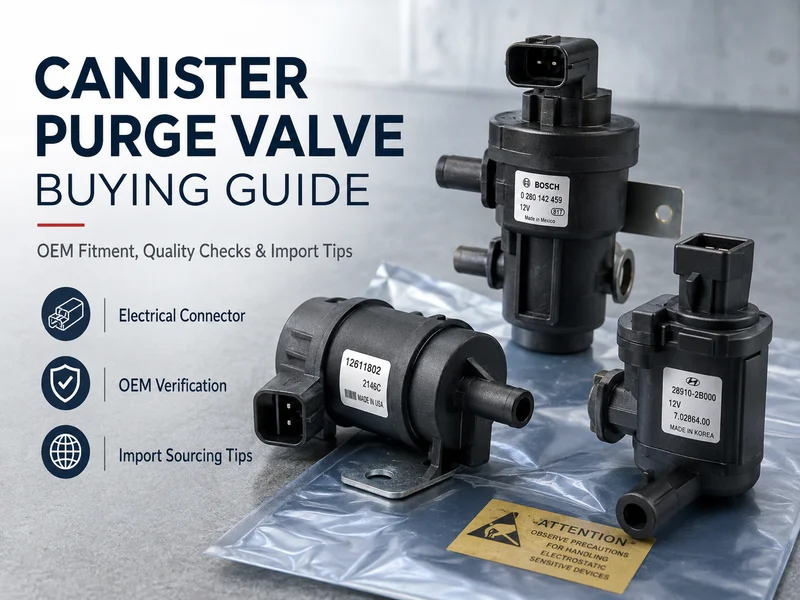
The evaporative emission control system exists to stop fuel vapor from venting into the air. The tank produces vapor constantly, and that vapor is captured in a charcoal canister instead of being released. When the engine is warm and under part load, the purge valve opens and lets the stored vapor get pulled into the intake manifold to be burned [1].
Three parts matter for diagnosis, and they fail in different ways:
- The fuel cap and seals leak slowly, usually from age or being left loose.
- The canister and hoses crack or disconnect, which leaks faster.
- The purge valve either sticks open or sticks closed, which changes the way the engine runs rather than just leaking vapor.
The fault code is the system telling you which of these three it suspects. Reading it is the whole skill.
2. The Fault Code Map: From Code to Part
| Fault code | Meaning | Most likely cause | Order line |
|---|---|---|---|
| P0441 | Incorrect purge flow | Purge valve stuck closed or clogged | Canister purge valve |
| P0442 | Small leak | Fuel cap, aged O-ring, hairline hose crack | Cap / seals first |
| P0443-P0445 | Purge valve circuit | Coil open, short, or wiring fault | Canister purge valve |
| P0455 | Large leak | Disconnected hose, cracked canister, valve stuck open | Hoses / canister |
| P0456 | Very small leak | Fill neck seal, vent valve, evaporating O-ring | Seals / vent valve |
| P0457 | Leak detected | Loose or missing fuel cap | Fuel cap |
Two rows point at the purge valve, which is why the valve is the highest-turn EVAP part in most catalogs. If you stock it and can answer the code question fast, you win the order before a competitor finishes looking it up. Our canister purge valve buying guide covers the valve's fitment fields in detail.
3. Small Leak vs Large Leak: Why the Threshold Changes the Part
The cut-off between a small leak and a large leak is roughly 0.040 inch. It sounds arbitrary, but it maps directly to the kind of fault.
A small leak (P0442) is usually a fuel cap that was not tightened, an O-ring that has hardened, or a hose with a hairline crack. These are cheap, high-frequency parts. A large leak (P0455) is usually something that came apart: a hose off its fitting, a cracked canister, or a purge valve stuck open pulling vapor straight through.
The sales consequence is direct. A P0442 order is a cap and a set of seals, low margin but high repeat. A P0455 order is hoses or a canister, fewer units but higher value. And a purge valve stuck open will often present as a P0455 with a rough idle, which is why the symptom matters as much as the code: a valve stuck open is a leak that the code alone can mislabel.
Fact: KEHO has supplied engine and emissions parts to importers in 80+ countries since 1995, holding ISO/TS 16949 certification (since 2012), CE marking, and SGS third-party verification (per company data).
4. The Smoke Test: How a Customer Confirms the Code
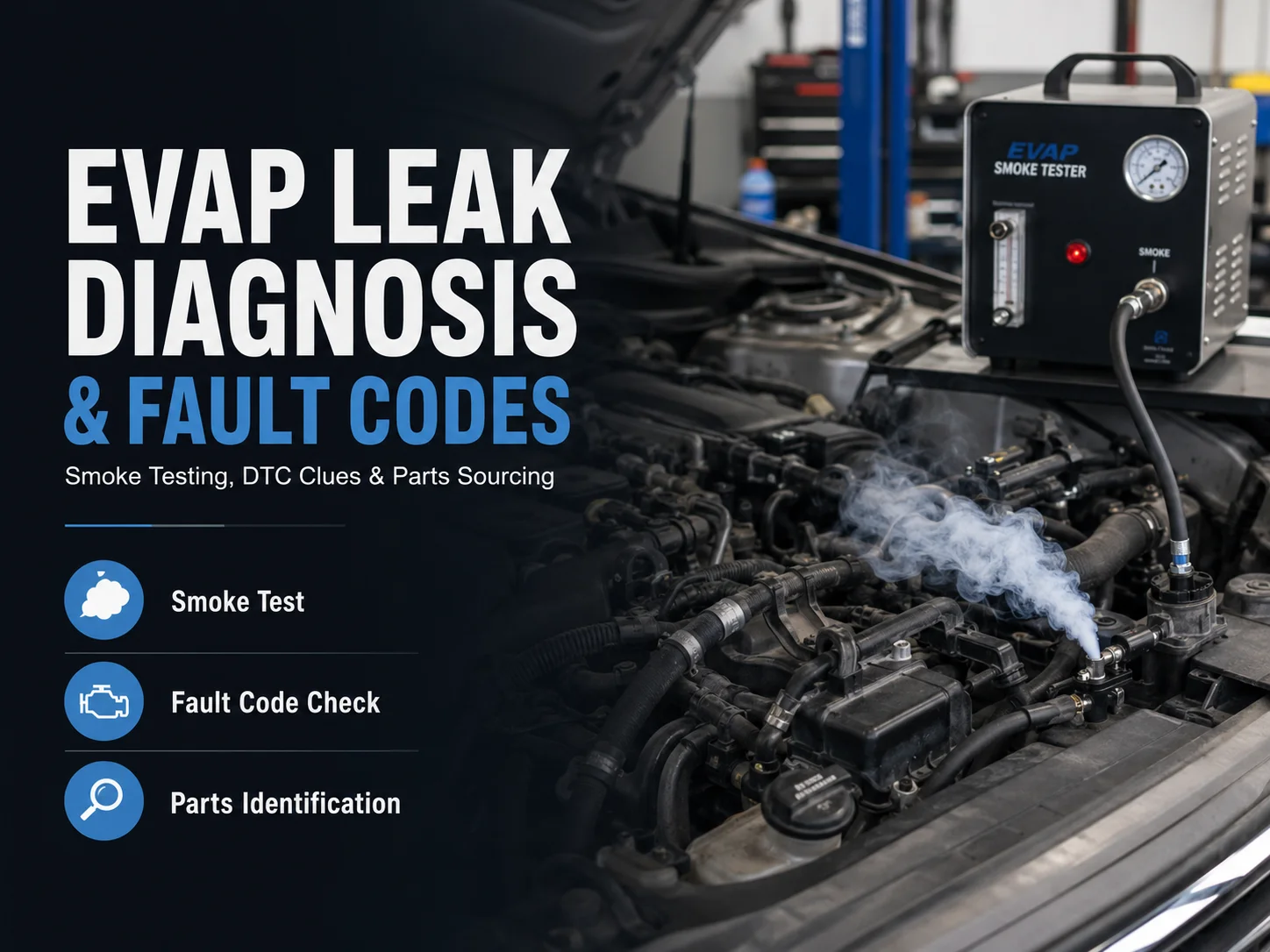
A fault code points at a system. A smoke test points at a part. The technician seals the EVAP system, pushes low-pressure smoke into it, and watches where the smoke escapes. A genuine leak shows itself in minutes; a valve or sensor problem shows nothing, which sends the diagnosis back to the electrical side.
For a distributor, the smoke test matters because it is the step that separates a real parts order from a guess. When a customer calls with a code and you ask "has it been smoke tested," you are filtering out the orders that would otherwise come back. It costs the workshop a few minutes and saves everyone the freight on a wrong part.
5. From Code to Order: The Discipline That Prevents Returns
Turning a code into a part is only half the job. The other half is making sure the part fits before it ships. That is the same four-field method we describe in our guide on matching auto parts by OEM number: confirm the OEM number, then cross-reference make, model, year, and engine.
An EVAP part has one more wrinkle. A purge valve can click when powered and still leak when closed, because the seal has failed. A supplier that tests both electrical function and seal integrity is catching a defect that a bench click test misses. That is the difference between a valve that works and a valve that comes back.
Fact: KEHO's canister purge valves are priced around $ 7.90-9.90 per piece, with common OEM numbers like 0280142513 and 0280142427 covering Chevrolet, Opel, and Vauxhall (per company data).
6. Sourcing EVAP Parts Without Building a Headache
EVAP parts are small, cheap per unit, and easy to over-order. Three rules keep the line clean.
Keep MOQs flexible. A new OEM number should start as a trial batch, not a container. KEHO's purge valve line supports a one-piece minimum (per company data), so you can validate fitment on a real vehicle before committing volume.
Mix the container. EVAP valves, caps, and seals rarely fill a container alone. They ride well alongside other engine and emissions parts, spreading freight across more SKUs. Our low MOQ shipping guide covers the mechanics.
Vet the supplier once, then reuse the checklist. Certifications, a documented test process, and a written warranty are the same gates for an EVAP valve as for any other part. We wrote the full list in our guide on vetting a Chinese auto parts supplier.
Fact: KEHO maintains 50,000+ SKUs across six production lines with 500+ workers and a 99.2% on-time delivery rate, backing parts with a 12-24 month warranty (per company data).
7. FAQ: EVAP Diagnosis Questions From Real Buyers
What are the most common EVAP fault codes and what do they mean?
The codes a distributor sees most often are P0441 (incorrect purge flow), P0442 (small leak), P0455 (large leak), P0456 (very small leak), and P0457 (loose or missing fuel cap). P0443, P0444, and P0445 point at the purge valve electrical circuit. Each code narrows the problem to a specific part of the system, which is what lets you turn a vague customer complaint into an exact order line.
How do I tell if the canister purge valve or another EVAP part is faulty?
Start with the code. P0441 or a P0443/P0444/P0445 circuit code points at the purge valve. A P0442, P0455, or P0456 leak code usually points at the fuel cap, hoses, or the canister itself, not the valve. The purge valve fails in two ways: stuck open, which causes rough idle and a rich mixture, or stuck closed, which makes the tank hard to fill and can throw a P0441. If the symptom matches the valve and the code agrees, the valve is your order line.
What is an EVAP smoke test and how does it work?
A smoke test pushes low-pressure smoke into the sealed EVAP system and watches where it escapes. The technician sees the leak point as a wisp of smoke. It is the standard way to confirm a leak the fault code only hints at, and it separates a genuine leak from a sensor or valve problem in minutes.
What is the difference between a small leak (P0442) and a large leak (P0455)?
The threshold is roughly 0.040 inch. A P0442 small leak is below that; a P0455 large leak is above it. The difference matters because a small leak is usually a fuel cap, an aged O-ring, or a hairline hose crack, while a large leak is usually a disconnected hose, a cracked canister, or a purge valve stuck open. The part you sell changes with the size of the leak.
How do I help a customer match an EVAP fault code to the right replacement part?
Keep a code-to-part map. P0441 or P0443-P0445 to the purge valve, P0442 or P0456 to caps and seals first, P0455 to hoses and the canister. Then confirm the OEM number before ordering, the same way you would for any other part. A supplier that cross-references the OEM number and confirms fitment before shipment removes the last chance of a wrong part.
What should I check in an EVAP parts supplier?
Four things. First, OEM number coverage and cross-referencing against vehicle make, model, year, and engine. Second, whether the purge valves are tested for both electrical function and seal integrity, since a valve that clicks but leaks is still a return. Third, MOQ flexibility so you can test a new OEM number with a small batch. Fourth, a written warranty and a clear defect-handling process.
8. Conclusion: Read the Code, Sell the Part, Skip the Return
EVAP diagnosis looks technical, but the distributor's version of it is a single lookup table. The code says which part of the system is suspect; the symptom says whether the valve is stuck open or stuck closed; the smoke test confirms the leak; and the OEM number locks the part.
KEHO has supplied engine and emissions parts to importers for 30 years (per company data), and the canister purge valve is the highest-turn part in the category. Send your customer's fault codes and OEM numbers, and we will map them to the right part before you commit to the batch.
Sources
- [Wikipedia]. "Vehicle emissions control." en.wikipedia.org: The charcoal canister collects and contains fuel vapors, routing them to the air intake to be burned once the engine is started and warmed up.
- [KEHO]. Company data: certifications, quality control process, warranty, delivery rate, and purge valve line pricing. kehoauto.com: Company-reported figures marked "(per company data)" in the article body.