A steering wheel sits at the intersection of three things the importer usually does not want to deal with: fitment precision, airbag safety, and customer expectation. Get the fitment wrong and the wheel does not mount. Get the airbag wrong and the wheel mounts but the safety system does not. This guide walks through the fields that decide both, written for distributors who sell carbon fiber and performance steering wheels and support the shops that install them.
1. The Five Fitment Fields That Decide Whether a Wheel Mounts
Before any order ships, five fields separate a wheel that installs cleanly from one that comes back. They follow the same discipline we describe in our guide on matching auto parts by OEM number.
| Fitment field | What to check | Common mistake |
|---|---|---|
| Model and chassis code | Exact year and chassis (e.g. BMW F30, Toyota FJ) | Matching by model name only |
| Airbag module | Compatible with the original airbag | Ignoring airbag compatibility |
| Multifunction buttons | Button layout and wiring | Buttons lose function after swap |
| Spline | Tooth count and diameter | Wheel cannot seat on the column |
| Connector | Airbag and button plug type | Wiring does not mate |
The chassis code is the non-negotiable one. A "BMW 3 Series" is not a fitment spec; a BMW F30 is. Two cars that share a name across a mid-cycle refresh can have different steering column splines and different airbag modules, and a wheel bought for the wrong one will not mount. This is the single most common steering wheel return in the aftermarket.
Fact: KEHO has supplied auto parts to importers in 80+ countries since 1995, holding ISO/TS 16949 certification (since 2012), CE marking, and SGS third-party verification (per company data).
2. The Airbag Is the Line You Do Not Cross
Of the five fields, the airbag is the one that turns a parts problem into a safety problem. A correctly designed aftermarket wheel is a direct replacement that reuses the original airbag module, multifunction buttons, and wiring. The wheel changes the rim, the material, and the shape; it does not touch the safety system [1].
That distinction matters because a wheel that requires deleting or bypassing the airbag changes what the vehicle does in a crash. For a distributor, that is not a stylistic preference; it is a liability question, and it can fail inspection in most markets. When a shop asks whether a wheel "keeps the airbag," the answer has to be yes, backed by the fitment documentation, not a guess.
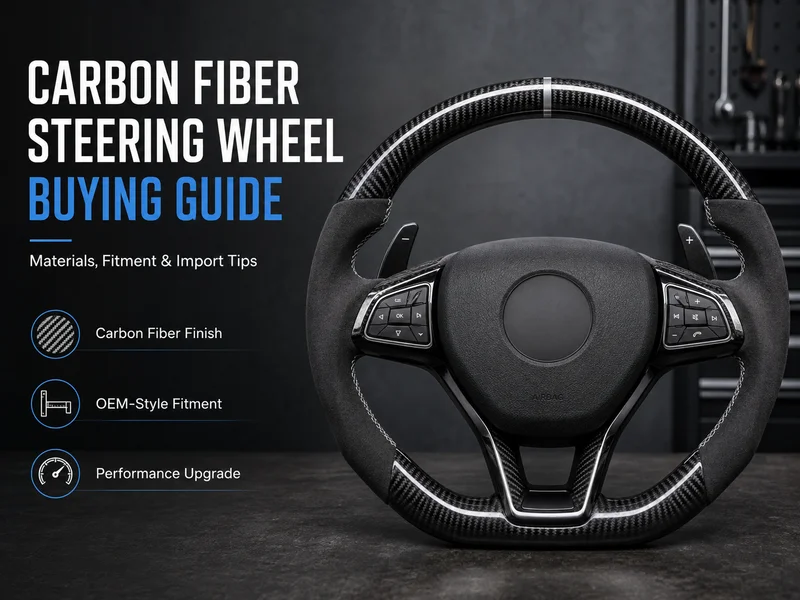
Fact: KEHO's steering wheel line covers Toyota and BMW platforms in carbon fiber, Nappa leather, and flat-bottom styles, priced from $ 89 to $ 389 per piece (per company data).
3. The Install Sequence: Where the Return Risk Actually Lives
Most steering wheel returns do not come from a bad wheel. They come from an install that was rushed. The sequence is short, but two steps are unforgiving.
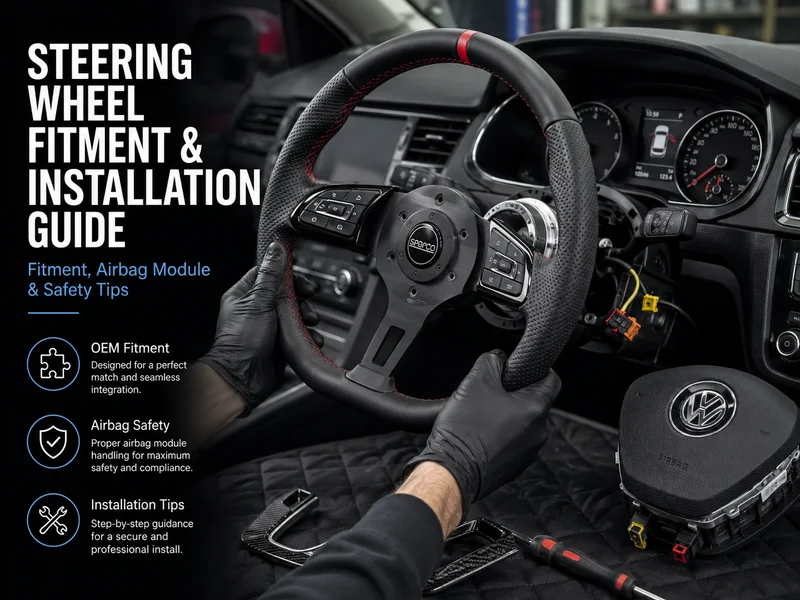
The standard order is: disconnect the battery and wait for the airbag system to discharge, remove the airbag module, unbolt the original wheel, fit the new wheel onto the spline, torque it to spec, then reconnect the airbag and buttons. A competent shop finishes in under an hour.
The two steps that cannot be rushed are the battery disconnect and the spline alignment. The airbag circuit holds a charge, and working on the module before it discharges risks an accidental deployment. Forcing a wheel onto a misaligned spline damages the teeth and can ruin both the wheel and the column. A distributor that gives the shop a one-page install note alongside the wheel removes most of the friction that otherwise becomes a return.
4. Sourcing Steering Wheels Without Buying Returns
The steering wheel category is fitment-heavy, which means the supplier you pick is doing part of your support work. Three rules keep it manageable.
Demand chassis-specific documentation. A supplier that lists a wheel by model name instead of chassis code is asking you to absorb its fitment mistakes. Ask for the chassis code and the airbag compatibility note before you quote.
Check MOQ and packaging. Steering wheels are bulky and cosmetic, so packaging that protects the leather or carbon finish matters as much as the wheel itself. Confirm MOQ and packaging spec up front. Our low MOQ shipping guide covers mixed-program freight.
Vet once, reuse the checklist. Certifications, a written warranty, and a clear returns process are the same gates as any other part. We wrote the full list in our guide on vetting a Chinese auto parts supplier.
Fact: KEHO maintains 50,000+ SKUs across six production lines with 500+ workers and a 99.2% on-time delivery rate, backing parts with a 12-24 month warranty (per company data).
5. FAQ: Steering Wheel Fitment Questions From Real Buyers
Will an aftermarket steering wheel affect the airbag?
An aftermarket wheel must be compatible with the original airbag module to keep the safety system working. Reputable wheels are designed as direct replacements that reuse the original airbag, multifunction buttons, and wiring. A wheel that requires deleting or bypassing the airbag is a safety decision you should not make lightly, and it may fail inspection in most markets.
How do I confirm a steering wheel fits a customer's vehicle?
Check five fields before ordering: exact model and chassis code, airbag module compatibility, multifunction button layout and wiring, spline count and diameter, and the connector type. A wheel that matches the model name but not the chassis code or spline will not mount.
What tools and steps does a steering wheel install involve?
The standard sequence is: disconnect the battery and wait for the airbag system to discharge, remove the airbag module, unbolt the original wheel from the column, fit the new wheel onto the spline, torque it to spec, and reconnect the airbag and buttons. Most shops finish in under an hour, but the airbag steps must not be rushed.
Can the multifunction buttons like cruise and volume be retained?
Yes, on wheels designed as direct replacements. The buttons and their wiring transfer from the original wheel, so cruise control, volume, phone, and other functions keep working. The key is matching the button layout and connector, which is why the fitment check matters.
What happens if the spline does not match?
A mismatched spline means the wheel cannot be fitted to the column, and there is no safe workaround. The wheel has to be exchanged for the correct chassis-specific version. This is why spline count and diameter belong in the fitment check before the order ships.
What should I check in a steering wheel supplier?
Four things: whether the wheel is a direct replacement that reuses the original airbag and buttons, whether the chassis-specific fitment is documented, whether the finish and materials match what was quoted, and whether there is a written warranty and a clear process for fitment-related returns.
6. Conclusion: Fitment Is the Product
In the steering wheel category, the part is only half the sale. The other half is the fitment and install confidence that lets the shop put the wheel on without hesitation. A distributor that treats fitment as part of the product, not an afterthought, turns a high-return category into a repeat-purchase one.
KEHO has supplied steering wheels to importers for 30 years (per company data), with a steering wheel line covering Toyota and BMW platforms in carbon fiber, Nappa leather, and flat-bottom styles. Send your target vehicle list and chassis codes, and we will confirm airbag compatibility, spline, and button fitment before the order ships.
Sources
- [NHTSA]. "Air Bags." nhtsa.gov: Air bags are supplemental protection designed to work with seat belts, not replace them; frontal air bags have been standard equipment in passenger vehicles since the late 1990s.
- [KEHO]. Company data: certifications, quality control process, warranty, delivery rate, and steering wheel line coverage and pricing. kehoauto.com: Company-reported figures marked "(per company data)" in the article body.