Auto Parts HS Code Classification: A Practical Guide for Importers
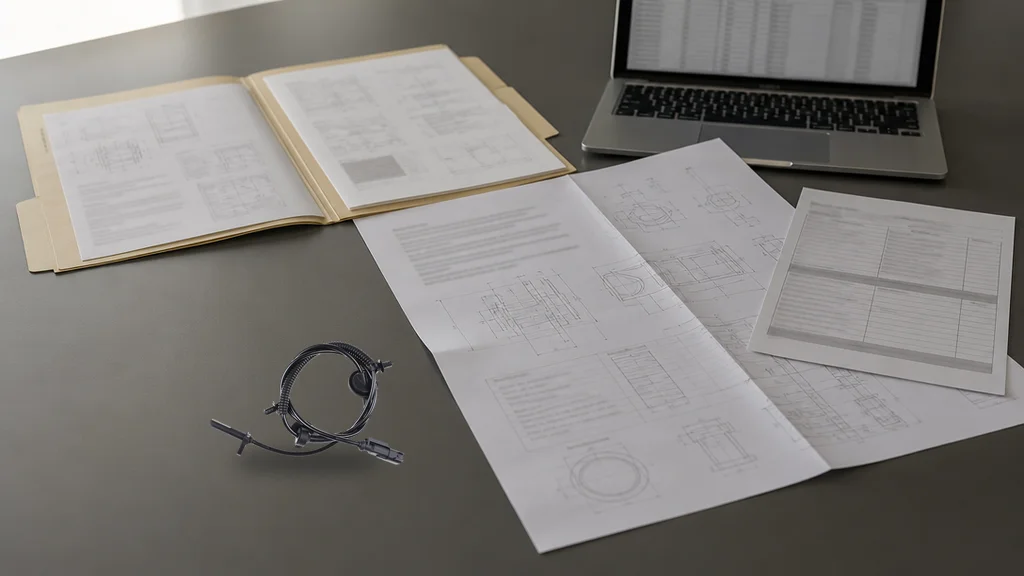 Classification is a documentary exercise before it is a customs one. The file you build decides how the argument goes.
A classification decision looks like a small administrative step. One number on an invoice, inherited from a previous shipment. Then the container arrives, the entry is selected for review, and the number turns out to have been copied rather than reasoned. What follows is a duty assessment on every entry in the review period, interest on the difference, and a delay on goods you have already sold.
This guide is for importers and distributors who already buy auto parts and need a method rather than a lookup table. It covers the four levers that decide where a part lands, the technical file that supports a position, and the mechanisms available when you and customs disagree.
One constraint applies throughout. No code is given in this article, and none should be taken from it. Classification outcomes are determined by the customs authority of the importing country, on the facts of the specific goods, under the nomenclature in force on the date of declaration. What travels across markets is the reasoning and the file, not a number.
Fact: KEHO has manufactured auto parts since 1995, runs six production lines across a 35,000 m² plant and a 20,000 m² industrial park, and exports to importers in 80+ countries (per company data).
1. Why a classification error follows you for years
Misclassifications rarely stay single events. The same position gets repeated on every entry that used that number, so exposure scales with shipment volume rather than with the size of the mistake.
Duty recovery. Customs can reassess entries within a review window that runs for years in most markets. You are not correcting one shipment, you are correcting the population that used the same position, and the assessment runs on the value of the goods.
Interest and penalties. Recovered duty usually carries interest from the original date, so cost grows with delay. Penalty exposure depends on how the error is characterised: a clerical slip, a negligent omission and a deliberate understatement are treated very differently, and the file is what distinguishes them.
Return or destruction. Where goods cannot be released under the declared position and the importer will not amend, the shipment may be returned or destroyed, and freight both ways, storage and lost forward sales land on the importer.
Detention while the argument runs. Goods sit in a bonded area while documents are exchanged, and storage accrues daily. For a distributor running lean stock, a two-week hold is a service failure to its own customers.
| Consequence | What drives the cost | What limits it |
|---|---|---|
| Duty recovery | Value times rate difference, across every entry in the review window | One consistent position, applied knowingly and documented |
| Interest and penalties | Time elapsed, and how the error is characterised | Written reasoning, dated review, voluntary correction |
| Return or destruction | Freight both ways, storage, lost forward sales | Early broker engagement before release |
| Detention | Days held, terminal and storage charges | A complete technical file submitted with the entry |
Cost is driven by repetition and time, and both are controlled by documents created before the first shipment. That is why classification belongs in supplier onboarding, not in the broker's inbox the week the vessel sails.
2. How the harmonized system is actually built
Most classification mistakes come from treating the system as a product catalogue. It is a legal text with a hierarchy, and the hierarchy decides which part of the text wins.
Layers. The nomenclature runs from sections to chapters to headings to subheadings. Sections and chapters group. The heading is the first level that describes goods, and the subheading narrows within it.
The heading is the unit of argument. You are not choosing a code, you are arguing that goods fall within the terms of one heading and are excluded from the alternatives. A defensible file states the candidate headings considered and why each was rejected, not only the one it landed on.
The interpretation rules are ordered. The general rules governing the nomenclature apply in sequence, and later rules operate only when earlier ones do not resolve the question. You cannot argue "it is essentially a sensor" before checking whether a heading specific to that article covers it. Specific descriptions beat general ones.
Chapter and section notes are binding. These notes do more work than most importers realise. They define terms, exclude goods expressly, and sometimes direct a classification regardless of what the heading text appears to say. Reading the notes before the headings is not optional diligence; it is the order the text requires.
Explanatory notes persuade but do not bind. The explanatory material published alongside the nomenclature is the standard reference for how headings are read and carries real weight in an argument, but it is not the legal text. Use it as support, and keep the binding text as the foundation.
Residual headings are a last resort. Catch-all provisions for goods not elsewhere specified attract inexperienced classifiers because the wording sounds broad enough to fit anything. Any specific heading covering the article will defeat them, so landing there signals unfinished analysis.
Revisions are periodic. Goods move between headings, headings split, others retire. A file that records only a number expires when the cycle turns. A file that records the description, the reasoning and the alternatives survives, because the argument can be re-run against the new text. The same documentation discipline keeps a shipment moving at the port, as covered in the export packaging and labeling checklist.
3. The four levers that decide where a part lands
Every auto parts argument reduces to four questions, and experienced brokers move through them in a fixed order, because a later answer cannot override a note that settles an earlier one.
Material. Composition decides a great deal. A part made predominantly of metal, polymer, textile or composite may be drawn toward the chapter dealing with that material, unless a note or a more specific description pulls it back to the article it forms. Within a heading, subheadings are often split by composition, which is why a material declaration by weight or percentage belongs in every file. "Metal" and "plastic" are not answers; grade and share are.
Function. What the part does, mechanically or electrically, is often decisive for components that are not obviously vehicle-specific. A valve that regulates flow, a sensor that converts a physical quantity into a signal, a pump that moves fluid: each function points toward a family of headings. Function is also where the electronic-versus-mechanical distinction gets tested, because a part with a circuit board is not automatically an electronic article.
Vehicle type and intended use. The same article may serve a passenger car, a heavy truck, an agricultural machine or a motorcycle, and those destinations sit in different places in the nomenclature. Intended use must be evidenced, not asserted: fitment data, the system served, the OE application list and the mounting interface do that work.
Whether it is a dedicated part. The most contested lever, and the one most often argued badly. The question is whether the article is identifiable as a part of a vehicle, intended solely or principally for it, rather than a general-purpose article that happens to be fitted to one. Evidence that helps: a part number tied to a vehicle application, mounting geometry with no other use, a connector keyed to a specific harness. Evidence that hurts: the same article sold into industrial or appliance markets, or a datasheet calling it a general-purpose device.
Where the levers conflict, order is set by the text, not by preference. A chapter note that excludes an article ends the argument regardless of function. A heading that names the article defeats a material-based heading. Function typically breaks a tie between two article headings, and dedicated use is what moves a candidate out of a general heading into a vehicle parts heading. Writing the four answers down, in that order, is the whole method.
Two examples show why the answers must be specific. A tire pressure sensor is simultaneously a radio-transmitting device, a wheel-mounted component and a vehicle safety part, and each description points somewhere different. A canister purge valve is a solenoid valve by construction, an emission control component by function and an engine management part by system. Neither can be placed by name alone, and both are placed by evidence.
4. The disputes that repeat across categories
Certain families generate the same argument in every market. Knowing the shape of it shortens file preparation.
Sensors: electronic article or vehicle part. A sensor contains a sensing element, often a circuit, a housing and a connector, so it can be described as an electrical device. The counter-argument is that it is identifiable as part of a specific vehicle system, dedicated to it, and not usable as general instrumentation. What decides it is the file: vehicle application identity, application-specific connector and mounting, and no catalogue use outside vehicles. A sensor presented with a generic datasheet and no application data invites the first reading.
Universal versus dedicated parts. Fasteners, bearings, seals, hose, lamps and wire are made in standard dimensions and sold across industries. A dedicated-part claim on a standard article is weak unless the article is modified for the application or clearly identified as such. The reverse error also occurs: importers claim generality on a part shaped, keyed or programmed for one vehicle family, and lose an argument they should have won.
Assemblies versus separate components. A component imported alone is classified on its own characteristics; the same component inside an assembly may be classified with the assembly, because the assembly is the article presented. The line is whether the parts form an identifiable functional unit or are merely packed together for convenience. Customs reads the invoice, so invoicing an assembly as a list of components changes the classification without changing the goods.
Kits, sets and spares shipments. A repair kit sold as a unit is judged on the kit, which may follow the rule for goods put up in sets for retail sale. The same items shipped loose on a spares order are judged individually. Mixed aftermarket orders therefore need line-level descriptions.
5. What the technical file has to contain
Customs classifies goods, not descriptions, and the file is how the goods get presented when nobody opens the carton.
Specification sheet. Part number, product name, system served, key dimensions, operating parameters, connector type and vehicle applications. The product name must match the invoice line, or the file contradicts the entry.
Drawing or exploded view. A dimensional drawing or exploded assembly resolves assembly-versus-component questions and shows whether a mounting interface is vehicle-specific or generic.
Material declaration. Main materials by weight or percentage, plus surface treatment, written by the manufacturer on letterhead and dated. "High-grade alloy" has no value in a classification argument; a composition table does.
Function and use statement. One page, plain language: what the part does, which system it belongs to, how it is actuated or signalled, and whether it has any non-vehicle application. The dedicated-part argument lives or dies here.
Photographs. Overall view, connector or terminal detail, mounting face, and any marking or part number on the body. Photographs resolve what drawings obscure, particularly on sensors and valves.
Identity anchors. OE number, cross-references and the application list, which tie the part to a vehicle family and are the cheapest evidence of dedicated use available. Our guide on matching auto parts by OEM number explains how to build that mapping so it holds up when a broker checks it.
Fact: KEHO holds ISO/TS 16949, obtained in 2012, alongside CE and SGS third-party verification, and keeps 40+ R&D engineers who prepare the drawings and material declarations importers use in classification files (per company data).
A file built this way takes hours per SKU family the first time and minutes on repeat orders, and the same documents answer questions raised in pre-shipment inspection. Request the set at quotation stage; a supplier who cannot produce a drawing and a material declaration is telling you something about the supplier.
6. Managing inconsistency across SKUs and markets
The expensive failures are rarely one bad decision. They are two defensible decisions that contradict each other, discovered together in an audit.
One SKU, one file, one position. Keep a single record per SKU: description, candidate headings considered, reasoning, supporting documents, review date. Every market draws from that record. Where a market needs a different national line, record why, so the difference reads as a deliberate subdivision rather than an error.
Audit your own history first. Pull two years of entries for your top SKUs by value and check three things: whether one SKU was ever declared under two positions, whether the invoice description matches the technical file, and whether any position was inherited from a supplier without review. Contradictions in your own history are the easiest thing for a reviewer to find and the hardest to explain.
Re-review on a schedule. A new housing material, a new connector, a part that gains a non-vehicle application: each can move the analysis. Put top SKUs on an annual review and the rest on a cycle tied to the nomenclature amendment.
Fact: KEHO ships in-stock items within 48 hours and standard production orders in 15-25 days across a 50,000+ SKU catalog, so a classification file can be built once and reused on repeat orders (per company data).
Consistency is also a sourcing argument. When a program spans several categories, as described in our multi-category parts program guide, one supplier able to produce drawings and material declarations for every line reduces the number of files you must reconcile. The wider range is on our products page.
7. When you and customs disagree: the mechanisms
Disagreement is normal and does not imply wrongdoing. What matters is the order in which you use the mechanisms.
Step one: re-read your own file. Before contesting anything, confirm that the description, the material declaration and the function statement describe the goods as shipped. A surprising share of disputes dissolve here.
Step two: take it to the broker in writing. Ask for the reasoning behind the position, not the position. A broker who can name the heading terms relied on and the alternatives rejected has done the work; one who cannot is guessing, and the answer is better documents rather than a louder argument.
Step three: use a binding instrument where one exists. Many markets offer a formal advance or binding ruling on classification: a written decision, issued before or during import, applying to goods described in the application. The US advance ruling system and the EU binding tariff information system are the best known. A ruling binds only the goods and facts described, so a product change needs a new application.
Step four: formal engagement with the authority. Where no binding instrument is used and an entry is disputed, the route runs through the authority's review or appeal procedure, usually with a deadline that is easy to miss. Keep every exchange in writing, answer the specific point raised rather than restating the whole argument, and preserve the original entry documents.
Step five: correct, do not bury. If review shows the position was wrong, correct it through the market's amendment or voluntary disclosure route. A voluntary correction backed by a documented file is treated differently from one imposed after an audit in almost every jurisdiction.
Across all five steps one rule holds: what you are defending is the reasoning, and the reasoning must predate the dispute.
8. Classification documentation checklist
Use this per SKU family. The right column is the test a reviewer, or your own future self, will apply.
| Document | What it must contain | Test it has to pass |
|---|---|---|
| Specification sheet | Part number, product name, system served, dimensions, connector, applications | Product name matches the invoice line exactly |
| Drawing or exploded view | Dimensions, constituent parts, mounting interface | Shows why the part is not a generic article |
| Material declaration | Main materials by weight or percentage, treatments | Dated, on manufacturer letterhead, specific |
| Function and use statement | What it does, how it is actuated or signalled, non-vehicle uses | Answers the dedicated-part question directly |
| Photographs | Overall, connector, mounting face, body markings | Consistent with the drawing and specification |
| Identity anchors | OE number, cross-references, application list | Traceable to a vehicle family, not invented |
| Packing and presentation | Whether presented as assembly, set or loose components | Matches how the goods are invoiced and packed |
| Classification record | Candidate headings, reasoning, national lines, review date | Dated, signed off, re-reviewed after amendments |
FAQ
What HS code do auto parts use?
There is no single code for auto parts as a category. Each part is classified on its own characteristics: what it is made of, what it does, which kind of vehicle it serves, and whether it is identifiable as a part of that vehicle rather than a general-purpose article. That is why two parts on one order can sit in different chapters. The outcome is confirmed by the customs authority of the importing country.
How are sensors classified, as electronic components or as vehicle parts?
It depends on what the sensor is and how it is presented. A sensor identifiable as part of a vehicle system, dedicated to that use and not interchangeable with general instrumentation, is normally argued as a vehicle part. A sensor presented as a general measuring or signalling device, with no vehicle-specific identity, invites classification as an electrical article.
Can the same part have different codes in different countries?
Yes, routinely. The nomenclature is harmonized only to a common six-digit level; beyond that, each country or customs union adds its own subdivisions, and national notes and rulings differ. Two markets can accept the same technical description and still place the goods in different national lines. A file should therefore record the reasoning, not just a number, so the argument can be re-run in each market.
If a declaration is wrong, can it be corrected?
Usually yes, but the mechanism depends on the market and on whether the entry is still open. Common routes are a voluntary amendment before release, a post-clearance correction, or a formal revision procedure, and many markets treat a voluntary disclosure more leniently than a correction found in an audit. Do not assume a correction erases duty, interest or penalties already assessed.
What documents should I send a customs broker for classification?
The specification sheet with part number and function, an exploded drawing or bill of materials, a material declaration by weight or percentage, a plain statement of what the part does and which system it serves, clear photographs of the part, connector and mounting face, and any OE or cross-reference numbers that identify the vehicle application.
Who is responsible if customs reclassifies my shipment?
The importer of record is responsible for the accuracy of the declaration, even when a broker filed it or a supplier suggested the code. The practical defence is a written file per SKU showing description, reasoning and review date, plus a habit of reviewing it when the nomenclature is amended. A binding ruling, where obtained, covers the goods and facts it describes.
Sources
- World Customs Organization, What is the Harmonized System (HS)? https://www.wcoomd.org/en/topics/nomenclature/overview/what-is-the-harmonized-system.aspx
- U.S. Customs and Border Protection, Rulings and Legal Decisions https://www.cbp.gov/trade/rulings